Trump's AI Gatekeeping: White House Controls
White House Gold Eagle initiative turns voluntary AI access into de facto licensing.
Model Diplomat11 min readNorth America
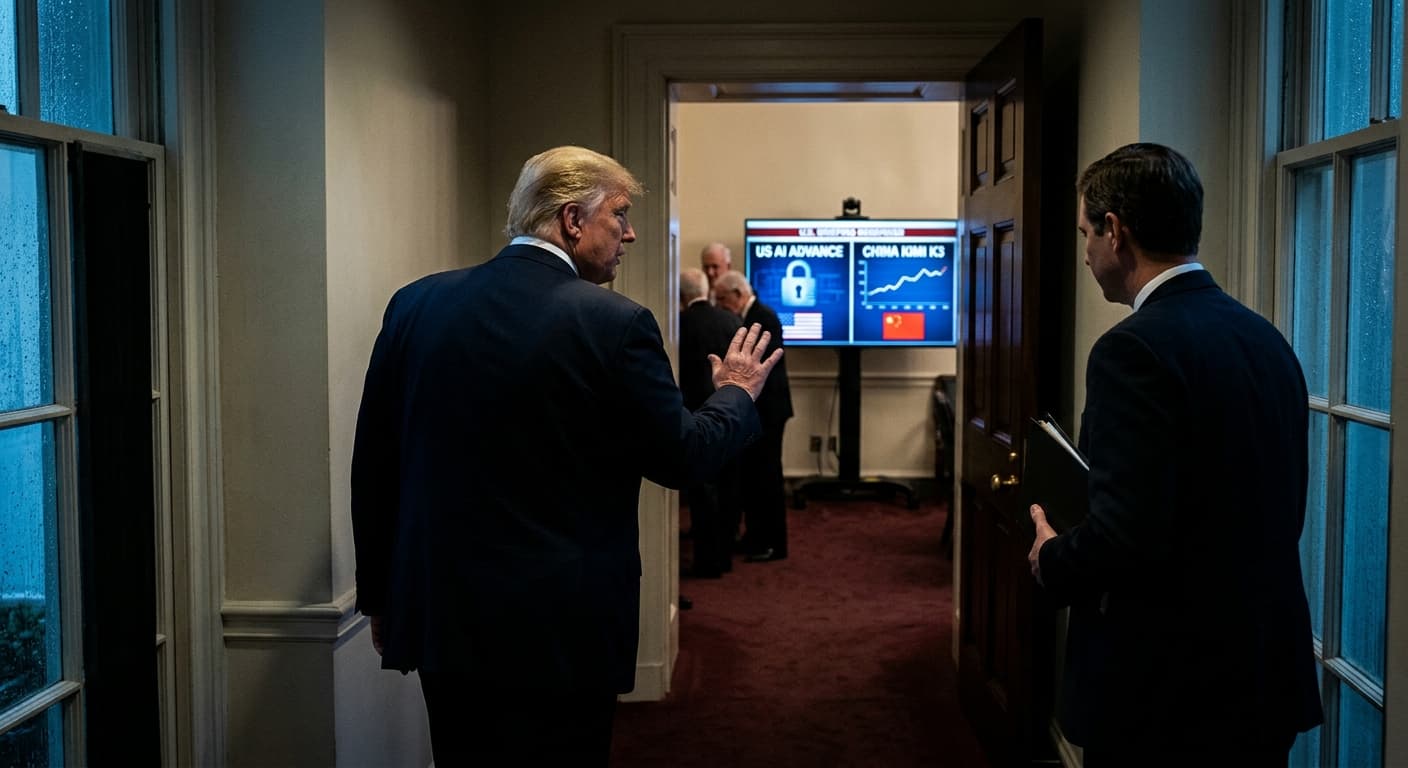
Trump's AI Gatekeeping: The White House Now Decides Who Gets America's Frontier Models
The administration has converted a voluntary, company-run access regime into de facto government licensing of frontier AI, just as China's open-source Kimi K3 closes the performance gap.
The White House launched "Gold Eagle" on July 17, an AI cybersecurity clearinghouse that, according to two people familiar with the matter, puts the administration in charge of greenlighting which companies can access new frontier AI models. Anthropic and OpenAI had until now reserved that role for themselves through private consortia like Project Glasswing and Daybreak. The move completes a six-week transformation: what began as a "voluntary" executive order on June 2 has become a de facto preclearance regime in which the Trump administration dictates the timing, scope, and recipients of America's most powerful AI releases. It arrives the same week China's Moonshot AI unveiled an open-source 2.8-trillion-parameter model that independent evaluators ranked on par with U.S. frontier labs. The administration is exercising a licensing power its own executive order explicitly disclaims, using leverage it lacks clear statutory authority to wield, and the primary beneficiary is China's open-source ecosystem.
From voluntary to mandatory in six weeks
The legal architecture is paper-thin. Executive Order 14409, signed June 2, 2026, states that "nothing in this section shall be construed to authorize the creation of a mandatory governmental licensing, preclearance, or permitting requirement for the development, publication, release, or distribution of new AI models," according to the White House. The order asks developers to "voluntarily" grant the government access to "covered frontier models" for a 30-day cybersecurity review before release to "other trusted partners," and tasks the Treasury, NSA, and CISA with forming an AI cybersecurity clearinghouse within 30 days, per a
Congressional Research Service summary. The 30-day window was itself a concession — the original draft specified 90 days but was cut after industry lobbying,
NPR reported.
In practice, "voluntary" has not meant optional. On June 12, the Commerce Department's Bureau of Industry and Security sent Anthropic a letter imposing export controls on Mythos 5 and Fable 5, requiring a license for any foreign person — including Anthropic's own foreign-national employees — to access the models, CSIS analysis documents. Anthropic, unable to verify citizenship at the user level, pulled the models offline for everyone on June 13. The ban covered allied cyber defenders and non-U.S. AI safety institutes alike, with no carve-outs for NATO partners or Five Eyes. Anthropic had previously granted 200 institutions across 15 countries access to its Mythos Preview under Project Glasswing,
Al Jazeera reported. All were cut off simultaneously.
Three weeks later, Commerce Secretary Howard Lutnick lifted the controls in a June 30 letter after Anthropic agreed to "proactively detect and address security risks," work with the government on standards for upcoming models, and inform the government of "malicious activity," Chatham House notes. OpenAI, meanwhile, said it would release GPT-5.6 Sol, Terra, and Luna to "a small group of trusted partners" first — at the government's explicit request,
CNBC reported on July 17. Dean Ball, a former Trump administration AI adviser, put it plainly: "In a matter of weeks, US federal AI policy has gone from implausibly libertarian to increasingly draconian and opaque," per
The Economist.
The Gold Eagle clearinghouse, announced July 17, operationalizes the order's "trusted partner" provision. According to CNBC's sources, going forward, "these rollouts will require explicit government approval for which partners can be involved" — supplanting Anthropic's Project Glasswing and OpenAI's Daybreak, the company-run consortia that previously decided who got early access. The White House release describes Gold Eagle as a "new operational model for cyber defense" that will "leverage frontier AI capabilities to continue advancing faster than adversaries." It does not mention the access-gating function that sources describe.
The leverage mechanism: compute, contracts, and the Pentagon's double game
The administration's leverage does not rest on the executive order's text. It rests on three pressure points that make "voluntary" cooperation effectively compulsory.
First, procurement power. The Pentagon is seeking nearly $30 billion to build its own AI infrastructure, and the government is simultaneously the largest single buyer of frontier-model access via agencies like the NSA, which was reportedly using Anthropic for offensive cyber operations before the June cutoff, per PIIE. A lab that refuses to stagger releases or gate access risks losing federal contracts, a lesson Anthropic already absorbed in February 2026, when the Department of Defense designated it a "supply-chain risk" after the company declined to waive restrictions on mass surveillance and autonomous weapons,
CFR analysis notes. The Pentagon then kept using Claude anyway, having failed to find a replacement.
Second, export controls. The CSIS legal analysis concluded that Commerce "does not have the authority to reinstate enforcement on specific provisions of the AI diffusion rule" to a single company — yet BIS imposed the controls anyway, citing national security under Section 744.22. The Biden-era AI Diffusion Rule, which first controlled frontier model weights, was scrapped by the Trump administration in May 2025 and is "not currently being enforced," CSIS documents. A senior White House official told Politico that "export controls were a last resort," but the precedent is now set: every frontier lab must price in the possibility that BIS can and will weaponize the export control statute to dictate access.
Third, National Security Presidential Memorandum-11, signed June 5, directs the national security enterprise to "make the most advanced frontier models broadly available to national security professionals" while ensuring that "no commercial entity or adversary possesses the capability to prevent use of, disable or degrade, or materially modify without Federal Government knowledge and approval" any AI system the military depends on, according to the White House. The Pentagon wants unrestricted access for itself and the power to restrict everyone else, a structural tension the administration has not resolved.
"The biggest question now is: What precedent does this set for the industry? Does the U.S. government need to approve every frontier model release? We're already starting to see this with the GPT-5.6 release."
— Tanishq Abraham, former Stability AI research director, to
Al Jazeera
The China gap narrows as Washington tightens
The timing could hardly be worse for the administration's own stated goal of maintaining AI dominance. On July 16, Moonshot AI unveiled Kimi K3, a 2.8-trillion-parameter model that independent evaluators Artificial Analysis and Arena.ai ranked on par with OpenAI's GPT and Anthropic's Claude — and first in web interface engineering, outperforming Anthropic's Fable in blind human-preference tests, BBC News reported. The open-weights model will be freely downloadable starting July 27, making it the world's first open-source model in the three-trillion-parameter class.
David Sacks, founder of Craft Ventures and former White House AI czar, called the Kimi breakthrough "concerning," writing: "This is how you lose the AI race. The rest of the world won't play by our rules if we bog ourselves down," per CNBC.
The strategic problem is structural. The administration's gatekeeping restricts access to closed, U.S.-controlled models — but Kimi K3 is open-weight, meaning it can be downloaded, run, and modified by anyone with sufficient compute, entirely outside U.S. jurisdiction. Academic research on the "open-weight paradox" argues that access restrictions "without governed alternatives may displace risks rather than reduce them," driving proliferation into unsupervised settings while deepening compute asymmetries between the Global South and the frontier, per arXiv. Chinese AI models already have more downloads on Hugging Face, the open-source AI platform, than those from the United States,
CFR notes. The adoption competition is being run on a track Washington cannot control.
CFR estimated in April that the United States held roughly a seven-month lead over China in frontier AI. Kimi K3's performance suggests that lead is now measured in weeks on at least some benchmarks. China's labs have achieved this partly through efficiency innovations — mixture-of-experts architectures, quantization to 4-bit integer formats, and novel sparse attention mechanisms — that squeeze frontier-level performance from less compute, Brookings documents. The administration's chip export controls have not stopped this; they may have accelerated it by incentivizing algorithmic efficiency.
The administration's own AI Action Plan aims to "drive adoption of American AI systems, computing hardware, and standards throughout the world" — a goal Brookings says it is "setting fire to" by denying foreign nationals access to its best models. The "Pax Silica" declaration, which brought together 24 like-minded governments to cooperate on resilient AI supply chains, now looks hollow when those same governments' cyber defenders were cut off from Mythos without notice.
The legal authority question nobody has answered
The deeper problem is that the administration is exercising a licensing power it does not legally possess — and knows it. Executive Order 14409 says so explicitly. The BIS letter to Anthropic reportedly cited Section 744.22 military-intelligence controls and Section 730.13's export scope definition, but the legal fit is awkward: for those provisions to apply, foreign access to an AI model must first be "subject to the EAR," and it is not clear that cloud-based model access qualifies, CSIS argues. The uncertainty itself is now a policy tool: labs cannot challenge the legal basis without risking a longer cutoff.
A recent law review article in the Journal of Technology Law & Policy argues that "overly strict or arbitrary controls may violate WTO obligations" under GATT Article XXI(b), and that "commercial or dual-use AI models and semiconductors do not meet the criteria for security exceptions," per arXiv. The Biden-era AI Diffusion Rule was published as an interim final rule with a 120-day comment period that closed May 15, 2025; the Trump administration let that window pass without a replacement,
Brookings notes. The result is what PIIE calls "an ad hoc de facto regime in which the U.S. government approves individual users and models without any clear criteria," per
PIIE.
The White House official who spoke to CNBC maintained the official line: the government "doesn't provide approvals for AI releases from private companies" and that engagements are "voluntary." But the Anthropic episode — where a company was forced to pull its flagship product offline for three weeks under threat of export-control prosecution — has established a precedent the executive order's own text disclaims.
The historical parallel: crypto export controls, redux
The dynamic mirrors the U.S. encryption export regime of the 1990s, when the State Department classified strong encryption as a munition under ITAR and prosecuted developers for posting PGP source code online. The controls failed because open-source alternatives proliferated outside U.S. jurisdiction, and because the distinction between "domestic" and "export" software collapsed in an internet where code crosses borders by default. The Clinton administration eventually relaxed the controls in 1999 and 2000 after accepting they were unenforceable.
The AI parallel is not exact — model weights are harder to replicate than source code, and compute remains a real bottleneck. But the core dynamic is the same: restricting access to closed, U.S.-controlled capabilities creates a market vacuum that open-source alternatives fill, and the primary beneficiary is the strategic competitor the controls were designed to contain. The Carnegie Endowment's analysis of Europe's governance gap makes the point: "when the practical terms of deployment are set through U.S. procurement power and security doctrine, European governance frameworks require stronger operational safeguards of their own," per Carnegie. Europe's conclusion is not to trust U.S. providers more — it is to hedge.
Named winners and losers
The clearest winners are China's open-source labs. Kimi K3, DeepSeek's V4, and Alibaba's Qwen series are all closed-weight-free, meaning they sidestep U.S. export controls entirely. Shares in Moonshot's domestic competitors Zhipu and MiniMax tumbled 27 percent and 16 percent respectively on the Kimi K3 announcement, BBC News reported — a signal that even China's own market sees consolidation around a shrinking number of frontier-capable labs.
The Pentagon is a short-term winner. It gets preferential access to "covered frontier models" for cyber defense under the June 2 order, and NSPM-11 ensures no commercial entity can "prevent use of, disable or degrade" any AI system the military depends on, per the White House. The NSA reportedly had offensive cyber access to Anthropic's models before the June cutoff, per
PIIE. Gold Eagle institutionalizes that preferential access.
The losers are Anthropic and OpenAI, which have surrendered control over who accesses their own products. Both are on the cusp of IPOs, and the valuation case for a frontier lab whose product can be pulled offline by a Commerce Department letter is materially weaker than for one that controls its own release schedule. European AI safety institutes, cut off during the June controls, are now weighing whether to treat U.S. frontier models as supply-chain vulnerabilities, Carnegie notes. Paris-based Mistral, "the EU's only major homegrown frontier-model competitor," is positioned to benefit from the resulting sovereign-AI push,
Al Jazeera reported.
The biggest loser may be the administration's own strategy. Its AI Action Plan calls for exporting the "full AI technology stack" and leveraging American AI advantages "into an enduring global alliance," Brookings notes. You cannot export what you have embargoed, and you cannot build an enduring alliance by cutting off your allies' cyber defenders without notice.
Diplomat View
The Trump administration has created a frontier AI licensing regime by pressure, not by law. It works because Anthropic and OpenAI cannot risk losing Pentagon contracts or Commerce Department goodwill, and because no lab wants to be the next one to receive a BIS letter. But the regime's coherence depends on the labs' continued willingness to comply, and on the absence of a credible open-source alternative that makes gatekeeping irrelevant.
Kimi K3, downloadable for free on July 27, is that alternative. If it delivers on benchmark promises in real-world deployment, the administration's gatekeeping will have restricted access to U.S. models while driving global adoption toward Chinese ones, the opposite of the intended effect. The encryption export precedent suggests that once an open-source capability reaches the frontier, closed-system controls become unenforceable. The administration's best remaining lever is compute, not model weights; even Kimi K3 requires serious hardware to run.
The forecast hinges on three conditions. First, whether Gold Eagle's "trusted partner" list extends to allied cyber defenders — if it does not, European hedging accelerates and Mistral gains. Second, whether Congress passes a statutory framework for frontier model oversight before the executive order's voluntary fiction collapses under legal challenge. Third, whether Kimi K3's open-source release on July 27 delivers production-grade performance or remains a benchmark optimized demo. If it delivers, the seven-month U.S. lead narrows to weeks, and Washington's gatekeeping becomes a maginot line.
What to watch:
- July 27, 2026: Kimi K3 open-source release. If independent production benchmarks match or exceed Fable 5, the U.S. lead is effectively gone on key capabilities.
- August 1, 2026: Deadline for NSA, CISA, and Treasury to deliver the classified AI benchmarking process that defines "covered frontier models" under EO 14409. The threshold they set determines which future releases trigger government review.
- September 2026: Congressional oversight hearings on BIS authority to impose export controls on AI model access without statutory framework — expected after the August recess, per the CRS report's oversight recommendation.
- Q4 2026: Anthropic and OpenAI IPO windows. Valuation impact of de facto government licensing on frontier lab equity stories.
The bottom line: The Trump administration has built a frontier AI licensing regime by executive pressure rather than statutory authority, and it has done so the week China's Moonshot AI released an open-source model that matches U.S. frontier performance. The administration's gatekeeping restricts access to closed American models while creating a market vacuum that Chinese open-source alternatives are now filling — the exact dynamic that made 1990s encryption export controls unenforceable. If Kimi K3 delivers in production, Washington's leverage over who gets frontier AI will matter only for the models no one needs anymore.
Discover more

India
700 Activists Accuse PM Modi of MCC Breach
Over 700 activists allege PM Modi breached election code with a televised address attacking opposition parties just before state elections.

India
BJP's Misunderstanding of Women's Quota Needs
The BJP's linking of the Women Reservation Bill to delimitation risks delaying women's empowerment in India, misreading the aspirations of female voters.

US Politics
House Ethics Committee Pushes Sexual Miscond.
The House Ethics Committee has shifted responsibility for sexual harassment settlement records to the Office of Congressional Workplace Rights, complicating disclosure efforts.

Economics
Fed's Amex AML order puts correspondent banking on notice
Federal Reserve's Amex AML order requires board-level controls and a 90-day plan; OCC fined the bank $350 million over enterprise-wide deficiencies.