UN: Sahel jihadists outgunning states
UN confirms Sahel jihadists using drones and crypto, displacing 6.8 million
Model Diplomat7 min readWest Africa
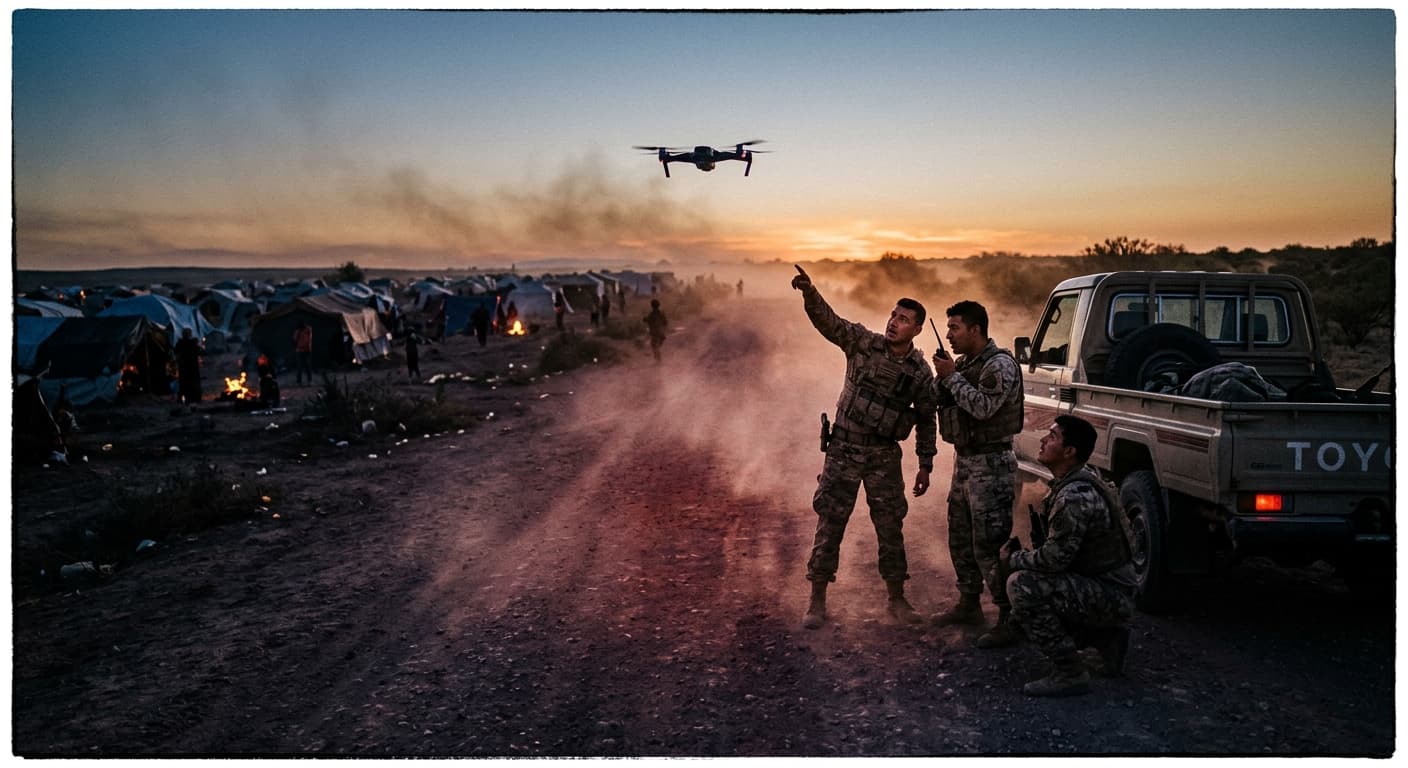
Sahel's jihadists are outgunning the state — and the UN just said so
The UN Security Council's July 14, 2026 briefing confirms terrorist groups across the Sahel now use drones, cryptocurrencies and cross-border coordination to push toward the Gulf of Guinea — displacing 6.8 million and rendering two parallel regional security blocs unable to contain them.
Leonardo Santos Simão, the UN Secretary-General's Special Representative for West Africa and the Sahel, told the Security Council on July 14, 2026 that armed groups in the region are "rapidly targeting coastal states in the Gulf of Guinea" while adapting their tactics with "drones, means of communication and cryptocurrencies" — a technological leap that has outpaced every counter-terrorism architecture currently operating in the region. The briefing, presenting Secretary-General report S/2026/537, confirmed that 6.8 million people have been displaced across West Africa since February, with 1.28 million more turned into refugees or asylum-seekers. The thesis is stark: the Sahel's militant groups are no longer merely escalating attacks — they are building a technologically sophisticated, transnationally coordinated insurgency that two competing regional security blocs, the rump ECOWAS and the Russia-aligned Alliance of Sahel States (AES), are each too fragmented and under-resourced to stop.
A threat that has changed shape
Simão's language marks a shift in how the UN frames the crisis. The threat is no longer described as a surge of attacks but as an evolving operational model. "Their attacks are coordinated across multiple fronts, including across countries," he told the Council. "Their actions intersect with transnational organized crime, and are aimed at consolidating territorial and economic control, erosion of public confidence in state authority." The groups now administer territory, control trade routes, and exploit new technologies rather than simply raiding.
The numbers underwrite the warning. The 2026 Global Terrorism Index found the Sahel accounts for 51 percent of all terrorism-related deaths worldwide and one in five militant attacks globally, with deaths in the region rising nearly tenfold since 2019. Five of the ten countries most affected by terrorism are Sahelian. Burkina Faso has remained the single most terrorism-affected country for two consecutive years.
The tactical modernization is documented. Al-Qaeda-linked JNIM first used a drone in 2023 and has rapidly integrated the capability, according to conflict-tracking data. The Nigeria-based Islamic State West Africa Province (ISWAP) deployed armed drones 10 times between 2024 and 2026, ACLED records show, including a January 2026 strike on Nigerian forces in Borno State. Commercial Chinese-made drones are being repurposed as improvised explosive delivery systems — "low-cost, high-impact" platforms that minimize the need for suicide fighters and make the groups harder to detect, according to Rida Lyammouri of the Morocco-based Policy Center for the New South.
The Mali collapse and the JNIM–FLA alliance
The most consequential development is the tactical alliance between JNIM (Jama'at Nusrat al-Islam wal-Muslimin, the al-Qaeda affiliate led by Iyad Ag Ghali) and the Azawad Liberation Front (FLA), the Tuareg separatist coalition formed in 2024 under Alghabass Ag Intalla. On April 25, 2026, the two launched simultaneous attacks on Bamako's international airport, the Kati military garrison 15 kilometers northwest of the capital, and bases in Kidal, Gao and Mopti — the largest coordinated insurgent-separatist offensive in Mali since 2012. Mali's Defence Minister Sadio Camara was killed. The offensive sent shockwaves through West Africa's capitals.
The JNIM–FLA coordination is the detail that reframes the crisis. "This has not improved overall security," Alex Vines, Africa programme director at the European Council on Foreign Relations, told Al Jazeera. "Armed groups in the country have been coordinating their military action rather than competing with each other." In this context, he added, "foreign military support has limited success." The two groups have squeezed Malian state control into "securitised enclaves and corridors," and since the start of July have battered towns in the north and near Bamako in the south.
Russia's Africa Corps — the successor to the Wagner Group, with an estimated 1,500 to 2,500 personnel in Mali — has not arrested the deterioration. The April attacks forced Africa Corps withdrawals from key territory, according to CSIS analysis, and the renewed July 4–5 assaults on Aguelhok, Anefis, Gao, Sevare and Kenieroba targeted a base used by Russian forces. Mali's junta, led by General Assimi Goïta, seized power in 2020 promising to restore security; six years on, large parts of the north and east remain outside government control and a partial blockade has disrupted supplies into Bamako.
Two blocs, no cooperation
The security architecture that once bound the region has fractured. In January 2025, Mali, Burkina Faso and Niger formally exited the Economic Community of West African States (ECOWAS) to form the Alliance of Sahel States, rejecting the bloc's political conditions and pivoting toward Moscow. ECOWAS, minus its three most conflict-affected members, is now planning a 2,000-soldier regional standby force to mobilize by the end of 2026. The AES is building its own 6,000-strong joint force. The two blocs do not coordinate. "Close collaboration where both sides deploy and fund a single regional force may not happen," warned Comfort Ero-affiliated analyst Murithi Mutiga, cited via Al Jazeera's reporting of Africa expert Ochieng' — but intelligence-sharing through mediator states like Senegal, Ghana and Togo offers a narrow path.
The fracture has a strategic cost the UN is now making explicit. Secretary-General António Guterres told the Council in November 2025 that "this regional crisis demands a regional response" and urged bridging "the communication, co-ordination and trust gaps between ECOWAS and the Alliance of Sahel States." Eight months later, Simão's briefing confirms the gap remains. Burkina Faso's ambassador to the UN told the Council on July 14 that the AES "has faith in the future" and "is open to all dialog," but reaffirmed its independent path.
Meanwhile, the coastal states of Ghana, Togo, Benin and Côte d'Ivoire — historically the region's more stable tier — now host approximately 220,000 refugees fleeing northern conflict. Togo recorded 10 attacks and 52 deaths in 2024, the most since the Global Terrorism Index began tracking. The operationalization of the Combined Maritime Task Force in June 2026 is the coastal states' most concrete collective response, but experts warn it must be paired with governance investment in northern frontier communities to prevent militant exploitation.
The drug–terror convergence
Simão flagged a second-order threat that has received little attention outside specialist circles: the convergence of drug trafficking and terrorism. "Drug production, trafficking and consumption are increasing rapidly, particularly in coastal states where authorities are carrying out numerous seizures," he said. "Youth are the principal victims, but some armed groups are also reportedly using these substances for their fighters." Cartels, he warned, are exerting "growing influence over certain public institutions, contributing to their weakening."
This is the layered threat the military-first response cannot address. The MEI's 2026 analysis of the central Sahel identifies the same dynamic: jihadist groups now intersect with banditry, communal conflict and organized crime, each fueling the other in a "crisis of governance of rural areas" exacerbated by climate pressure and demographic stress. Academic research using ACLED data confirms that political violence in the G5 Sahel countries intensified from 2018 to 2023 and concentrated in the Liptako-Gourma tri-border area — the exact zone from which the southward spread now originates.
Diplomat View
The decisive variable is not military capacity — it is political alignment between ECOWAS and the AES. Both blocs have forces; neither has the other's intelligence or territory. The UN's framing, sharpened under Simão and Guterres, treats that gap as the binding constraint. The forecast is straightforward: without a coordination bridge, the coastal states will absorb the spillover faster than the Combined Maritime Task Force can contain it, and Mali risks becoming what the Journal of Democracy's July 2026 analysis calls "a terrorists' safe haven in West Africa."
The call: the July 19 ECOWAS summit in Freetown is the next decision point. If it produces a standing intelligence-sharing protocol with the AES — even a narrow, counter-terrorism-only channel brokered by Senegal and Togo — the forecast improves. If it produces another sanctions posture or political ultimatum, the southward spread accelerates. Revision condition: a verified JNIM or ISSP attack on a coastal capital (Lomé, Cotonou, Abidjan, Accra) before year-end would confirm the worst-case trajectory and force a reframe from "spillover" to "regional insurgency."
What to watch
- July 19, 2026 — ECOWAS summit in Freetown, Sierra Leone: outcome on regional integration and any AES engagement channel.
- September 2026 — UN General Assembly high-level week: expect a Sahel pledging moment; watch for whether AES states attend or stage a parallel forum.
- Q4 2026 — Deployment milestones for both the ECOWAS 2,000-soldier standby force and the AES 6,000-strong joint force; compare coverage and capability, not rhetoric.
- Ongoing — ACLED and GTI 2027 data cycle: any confirmed armed-drone strike on a Gulf of Guinea coastal capital would be the inflection point.
Sources: UN Security Council press release, July 14, 2026;
UN News;
UN DPPA — Simão briefing;
GBC Ghana Online;
Al Jazeera;
Al Jazeera — drones and AI in the Sahel;
BBC — Sahel terror deaths;
Council on Foreign Relations;
CSIS analysis;
UN Secretary-General's remarks, November 2025;
Journal of Democracy;
Middle East Institute;
The Economist;
IFPRI/ACLED study.
Discover more
US Politics
House Ethics Committee Pushes Sexual Miscond.
The House Ethics Committee has shifted responsibility for sexual harassment settlement records to the Office of Congressional Workplace Rights, complicating disclosure efforts.

US Politics
SNAP Food Assistance Faces Legal Challenges
In 2026, SNAP faces stricter eligibility rules and mounting legal challenges, threatening food assistance for the millions of Americans who rely on the program.
US Politics
Congress Targets AI Chatbot Access for Terror
The House passed the Generative AI Terrorism Risk Assessment Act, focusing on AI's role in terrorism and potential surveillance implications.

Economics
Fed's Amex AML order puts correspondent banking on notice
Federal Reserve's Amex AML order requires board-level controls and a 90-day plan; OCC fined the bank $350 million over enterprise-wide deficiencies.