Trump's 12.5% Tariff on India Backfires
US giants warn tariffs harm domestic manufacturing efforts
Model Diplomat11 min readNorth America
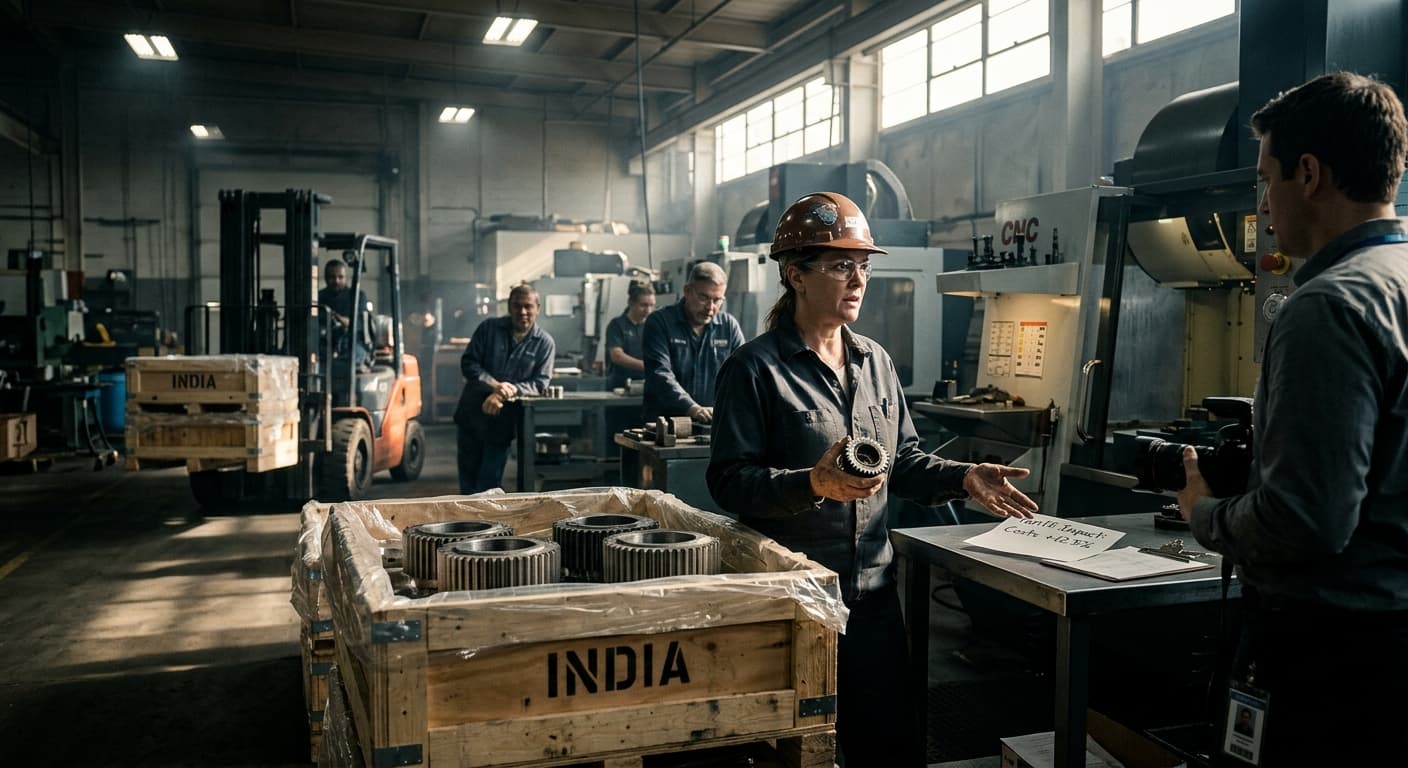
US Giants Warn Trump's 12.5% Tariff on India Backfires on Manufacturing
Intel, Ford, Honeywell and Dell told USTR on July 7 that the proposed 12.5% Section 301 tariff on India and 44 other economies would make it costlier to build in America than abroad.
The 12.5% additional tariff the US Trade Representative wants to impose on imports from India, China, Japan, South Korea and 41 other economies over "forced labor" enforcement is being publicly panned this week by the very American companies the White House says its industrial policy exists to defend — and their argument, filed in the July 7 USTR hearing docket, is that the levy would raise the cost of building in the United States above the cost of building offshore. That warning matters because these Section 301 tariffs are the Trump administration's legal Plan B after the Supreme Court gutted its emergency-powers tariff regime on February 20, 2026, and the hearings closing this week are the last procedural gate before Washington rebuilds a tariff wall that its own manufacturers say will tax them, not their foreign competitors.
The setup: a Plan B born of a Supreme Court defeat
The proceeding underway this week at the US International Trade Commission is not a routine trade action. It is the load-bearing pillar of the administration's post-IEEPA tariff architecture, and it is being litigated in real time by the largest US technology, aerospace and auto manufacturers against their own government.
On February 20, 2026, the Supreme Court ruled 6-3 in Learning Resources v. Trump and Trump v. V.O.S. Selections that the International Emergency Economic Powers Act does not authorize the president to levy tariffs, striking down the "reciprocal" duties Trump had built his second-term trade policy around. According to the Supreme Court's opinion, Chief Justice Roberts wrote that "when Congress grants the power to impose tariffs, it does so clearly and with careful constraints. It did neither here." A Congressional Research Service
legal sidebar published three days later confirmed that the ruling left Section 232 and Section 301 tariff authorities untouched — an opening the White House moved into within hours. As
NPR reported, Justice Kavanaugh's dissent warned that the decision would force the government to refund "billions of dollars to importers who paid the IEEPA tariffs" — an estimated $130 billion collected through late 2025.
USTR Jamieson Greer's response was fast and structural. On March 11-12, 2026, he launched 60 Section 301 investigations into foreign governments' enforcement of forced-labor import bans, plus 16 parallel investigations into "structural excess capacity." On June 2, USTR issued findings that every one of the 60 economies had failed to adequately enforce a forced-labor import prohibition, and
proposed additional tariffs of 10% on 14 economies with partial programs and 12.5% on the other 46 — including India, China, Japan, South Korea, Vietnam, Australia, Nigeria, and New Zealand. Even close allies — Britain, Canada, the EU, Australia, New Zealand — were swept in. Greer framed the move in stark terms, telling reporters the "failure of our most important trading partners to address the importation of goods made with forced labour is unacceptable," creating a "dynamic where American workers are forced to compete globally on an unlevel playing field," as
Al Jazeera reported.
The Center for Strategic and International Studies' William Reinsch wrote last week that the USTR's 98-page investigative report devoted "two or three paragraphs each" to the individual country findings and presented "no evidence" for its conclusions on individual economies — "There are few signs any real investigations were conducted." That weakness will invite litigation but has not slowed the tariff schedule, because Section 301, per a
Brookings analysis by Maricarmen Barron Esper and Christopher Sands, requires only "public notice, the development of an administrative record, and a legal determination before action is taken" — no congressional vote, no injury finding by the ITC.
What the American giants actually said
The written submissions filed by US companies for the July 7 hearing, first reported by The Economic Times and
The Times of India, read as a coordinated warning that the White House's own reshoring goals collapse under its Section 301 arithmetic.
Intel's submission is the sharpest. It argues the tariff's "practical effect would be to make it more expensive to build in America than to build elsewhere, which runs directly counter to the administration's goal of expanding domestic manufacturing." This is Intel — the flagship of the CHIPS Act reshoring effort, an $8 billion federal subsidy recipient — telling the executive branch that its trade policy is undoing its industrial policy. Honeywell Aerospace flagged that its US production lines depend on imported critical minerals, rare earths, chips, displays and specialized commercial components, and that "a tariff would primarily increase the cost of maintaining and producing aerospace products rather than accelerate a feasible sourcing transition." Dell warned the levy would risk "operational delays of key products and components." Ford asked for exemption of four categories already carrying up to 50% Section 232 duties, calling the stacked burden "excessive and overly burdensome" on US auto manufacturing. De Beers said additional duties on natural diamonds "would function primarily as a cost increase for US manufacturers, retailers, and consumers."
The pattern is the load-bearing point: every named objector runs US-based manufacturing operations that consume imported inputs the domestic supply base cannot substitute at scale. That is not a lobbying flourish. The Information Technology Industry Council's House Energy & Commerce testimony filed on April 15, 2026 warned Congress in identical language that "imposing overly broad tariffs would undermine certainty and increase the costs of manufacturing in the United States throughout the entire technology ecosystem," making certain fab investments "economically non-viable" and hindering exports to markets abroad.
The academic consensus reached the same conclusion nearly a decade ago and has hardened since. The Peterson Institute for International Economics' foundational Section 301 policy brief by Mary Lovely and Yang Liang found that because roughly 74% of targeted capital goods came from foreign-invested enterprises supplying US manufacturers, tariffs "drive up costs for US-based manufacturers and disadvantage American workers competing in global markets" — an "own goal," in the authors' words. Even the Economic Policy Institute, generally sympathetic to strategic tariffs, told the House Oversight Committee in April 2025 that up to 45% of the value of US manufactured output consists of
imported intermediate content, meaning "levying tariffs on these inputs may have the perverse effect of raising production costs and pricing U.S. manufacturers out of the competition."
The evidence on the ground has been running the same direction. In a Supreme Court amicus brief filed by more than 200 small businesses in the V.O.S. Selections litigation, one Florida electronics distributor, Rokland LLC, told the court that "sudden tariff announcements under claimed 'emergency' authority disrupted planned shipments, increased costs by an average of 50%, and threatened contracts with government and corporate clients," per the amicus filing. Another declared surprise bills of $15,000 per container of finished product. That was under the IEEPA regime the court struck down; the Section 301 replacement, though smaller in headline rate, stacks on top of Section 232 duties already in place.
India's leverage — and its problem
New Delhi's own submission is narrower and more legalistic than the corporate objections, but arrives at the same conclusion. Its filing argues that "a mere absence of a forced labour import prohibition, without meeting the evidentiary basis of other statutory requirements, cannot be construed as 'unreasonable' within the meaning of Section 301," and that USTR performed no economy-specific analysis of the 60 targets, per reporting from The Economic Times. India also noted that "evidence across sectors of major exports of India to the US does not suggest any linkage with forced labour inputs" — an implicit challenge to USTR to name a specific tainted supply chain, which the report does not do.
India has cause to press hard. Its US-bound goods trade reached $86.5 billion in 2025, according to the Observer Research Foundation, dominated by electrical machinery ($15.9 billion), gems and jewellery ($10 billion) and pharmaceuticals ($9.8 billion). The 2025 experience is fresh: after Trump raised India's tariff to 50% in August, Indian exports to the US fell 20% year-on-year in September and nearly 40% across the four subsequent months,
the BBC reported, with labour-intensive textiles, gems and engineering goods absorbing the heaviest losses. Ludhiana's hosiery cluster and Tiruppur's knitwear belt — the latter accounting for 68% of India's knitwear exports —
halted orders within weeks of the levy taking effect, per Al Jazeera.
That is the context in which New Delhi accepted the February 6, 2026 US-India Joint Statement locking in a reciprocal tariff rate of 18%, down from 50%, in exchange for eliminating or reducing tariffs on "all U.S. industrial goods and a wide range of U.S. food and agricultural products" and a commitment to purchase $500 billion of US energy, aircraft parts, precious metals and technology products over five years. India's Press Information Bureau
subsequently noted that tariffs on $30.94 billion of Indian exports were cut from 50% to 18%, and on a further $10.03 billion to zero. Stacking a fresh 12.5% Section 301 duty on top of that 18% would push India's effective tariff burden back above 30%, undoing much of the deal Modi accepted in exchange for cutting Russian oil purchases.
India's problem, though, is that the Section 301 lever is precisely the kind of instrument that survives court scrutiny. As Emily Kilcrease of the Center for a New American Security  testified at the May 5 hearing on the parallel excess-capacity investigations, unilateral Section 301 tariffs have historically "succeeded primarily in pushing the burden of China's excess capacity to other markets" rather than changing Beijing's behavior — "domestic U.S. producers may enjoy protection from Chinese imports while selling within the U.S. market, but they will remain substantially disadvantaged when trying to export to third-party markets in which Chinese imports flow unimpeded." Kilcrease's proposed alternative — a plurilateral agreement with allies on shared standards and coordinated tariffs — is not the approach USTR has chosen.
The legal robustness is exactly what makes Section 301 useful to Greer. Unlike IEEPA duties that can vanish "overnight by executive order," as one Atlantic Council analyst put it to Al Jazeera, Section 301 tariffs are "much harder to change." Peterson Institute's
Michael Froman-era analysis notes the flaw, though: Section 301 is a "selective, not comprehensive, authority and not designed to be imposed on all countries all at once." Using it against 60 economies simultaneously with a boilerplate finding is exactly the type of overreach a well-positioned plaintiff can attack.
Who actually benefits
Follow the incidence, not the intent. The proposed 12.5% surcharge has three sets of first-order beneficiaries — none of them the mid-tier American manufacturer the administration says it wants to help.
First, US Treasury revenue. Treasury Secretary Scott Bessent has publicly acknowledged that combining Section 122, 232 and 301 duties "will result in virtually unchanged tariff revenue in 2026" versus the invalidated IEEPA regime — his express purpose in stacking the layers. That $130-billion-a-year revenue stream is what the Section 301 pillar is designed to protect, not incidental to it.
Second, foreign competitors of US manufacturers who source from outside the 60 investigated economies. The Peterson Institute's Section 301 analysis found that when tariffs land on intermediate inputs, rivals in Germany, Japan or Korea "will be able to purchase their capital goods and supplies from China untaxed and use them to build final goods that compete directly with American producers thus disadvantaged." This is the mechanism Intel's submission is flagging in plainer language — and the reason ITI's testimony warns tariffs "hurt the competitiveness of U.S. manufacturing operations vis-à-vis those operations without a U.S. nexus."
Third, incumbent US producers with vertical integration and no import dependence — a small subset, concentrated in bulk commodities and politically protected sectors. The 76-page exemption list USTR published on June 2 already carves out energy, rare earths, several metals, pharmaceuticals, aircraft parts, coffee, beef and much of fresh produce, precisely because their US price would be politically radioactive. As CSIS's Reinsch reads it, the exclusions map "items where higher prices have become a political liability" — bananas, tropical inputs, tomatoes — plus "intermediate goods essential for U.S. electronic and aircraft manufacturing." The administration knows where the cost pain lands; the carve-outs are the map.
The losers are the named companies, their US employees, and the export-dependent Indian sectors — textiles, gems, engineering goods — that just clawed back access under the February deal. The historical parallel is not encouraging: the CFR trade-deal tracker shows that of the framework agreements Greer negotiated in 2025 (UK, EU, Japan, South Korea, Indonesia, Cambodia, Argentina, Ecuador, Guatemala, Switzerland), every counterparty pledged forced-labor import bans as part of the deal — and USTR has now proposed to tariff most of them anyway, on forced-labor grounds.
Diplomat View
The forced-labor tariff wall will go into effect roughly as proposed, and by late July it will replace the expiring Section 122 stopgap as the White House's primary revenue tool. The corporate objections filed this week — Intel, Ford, Honeywell, Dell, IBM, GE Appliances, De Beers — will yield product-specific exemptions, not a rate cut. USTR's 76-page carve-out list is the tell: the administration will trade scope for headline rate.
The forecast that matters is second-order. Expect three consequences by year-end. First, India's February trade deal with Washington will hold in name but degrade in economics; New Delhi will slow-walk the $500 billion procurement pledge and accelerate the EU-India free trade agreement that entered into effect on May 1. Second, the excess-capacity Section 301 investigations — 16 economies including the EU, Japan and India — will deliver a second tariff layer in the fourth quarter; the EU has
publicly warned that new tariffs above the 15% framework rate will be treated as a breach of its July 2025 agreement. Third, litigation from a well-chosen plaintiff, likely a mid-market importer of a non-substitutable input, will test whether USTR's evidence-free country findings survive Administrative Procedure Act review — the argument CSIS flagged and that a careful choice of plaintiff and target country "could well lead to persuading a judge that in specific cases the administration was guilty of overreach."
What would change this forecast: a US federal court granting a preliminary injunction against the Section 301 forced-labor duties before September, or a Republican revolt in the Senate over the Section 232-plus-301 stacking on autos and semiconductors. Neither is the base case. The Supreme Court explicitly declined to address Section 232 and 301 tariffs in its February ruling, and no Republican senator has yet signalled willingness to force a floor vote on tariff repeal in an election year.
What to watch
- July 24, 2026 — Section 122's 150-day statutory clock expires; USTR is expected to trigger the forced-labor Section 301 duties within days to prevent a revenue gap.
- September 2026 — first litigation from a US importer challenging the forced-labor findings' evidentiary basis is likely to reach the Court of International Trade.
- Fourth quarter 2026 — USTR determinations in the parallel Section 301
structural excess capacity investigations covering 16 economies, which would stack a further tariff layer above the forced-labor duties and test the EU and Japan framework deals.
The Bottom Line
The 12.5% Section 301 forced-labor tariff is not a trade remedy — it is the legal scaffolding the White House is building to replace the $130-billion revenue stream the Supreme Court took away in February. Its own beneficiaries — Intel, Ford, Honeywell, Dell — are telling USTR on the record that the levy taxes American manufacturing more than it protects it, and the 76-page exemption list already concedes the point. Expect the tariffs to take effect anyway, expect India's February deal to degrade, and expect the fight to move from the USTR hearing room to the Court of International Trade by autumn.
Discover more

US Politics
SNAP Food Assistance Faces Legal Challenges
In 2026, SNAP faces stricter eligibility rules and mounting legal challenges, threatening food assistance for the millions of Americans who rely on the program.

US Politics
House Ethics Committee Pushes Sexual Miscond.
The House Ethics Committee has shifted responsibility for sexual harassment settlement records to the Office of Congressional Workplace Rights, complicating disclosure efforts.
Global Politics
Xi Jinping Calls China-Russia Ties 'Precious'
Xi Jinping's description of China-Russia ties as 'precious' reflects a strategic imbalance, with Beijing dictating terms in the partnership.

Conflict & Security
Drone Warfare Killing Aid Workers at Unprec
Over 1,000 humanitarian workers killed in three years as cheap armed drones collapse legal protections. Gaza, Sudan, Ukraine, and DRC see deliberate targeting of aid convoys and hospitals with zero prosecutions.