Trump Pushes Congress to Regulate College Ath
Trump backs bipartisan bill to regulate college athletics.
Model Diplomat5 min readUnited States
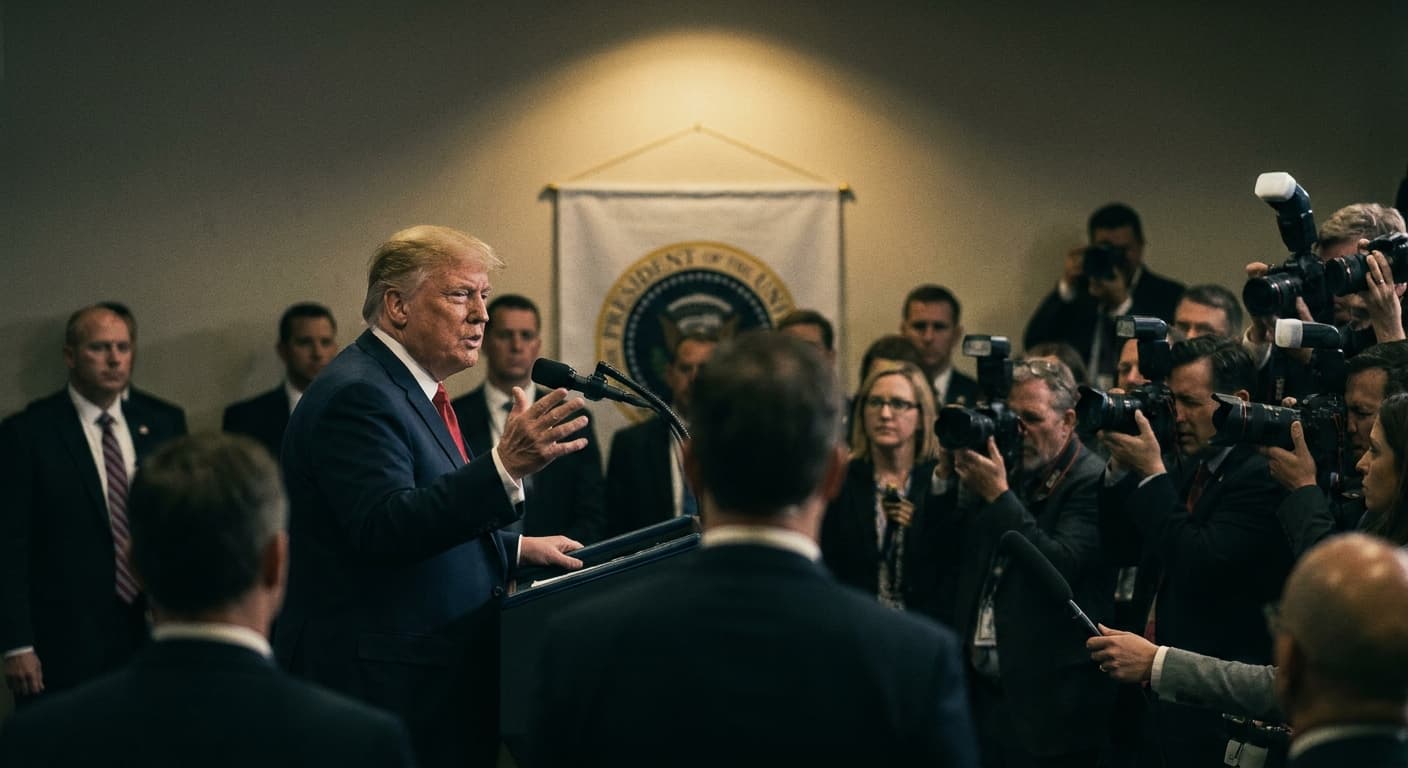
Trump Pushes Congress to Regulate College Athletics This Summer
Trump is backing the bipartisan Protect College Sports Act (S. 4668) to lock the $20.5M pay cap into federal law and shield the NCAA from antitrust suits.
President Donald Trump's push to have Congress pass the Protect College Sports Act "this summer" is not, at its core, a rescue mission for college athletics. It is a legislative bid to convert a private class-action settlement — the $2.8 billion House v. NCAA deal approved in June 2025 — into federal statute, freezing a $20.5 million per-school pay cap, preempting state NIL laws, and granting the NCAA the antitrust shield it has failed to win in court for three decades. The bill's beneficiaries are the Southeastern Conference, the Big Ten, and their broadcast partners; the losers are booster-run NIL collectives, non-Power-4 schools, and any athlete who might otherwise be classified as an employee. Whether Trump gets his signing ceremony hinges on seven Democratic senators no one in the White House has yet named.
What Trump actually endorsed
Trump posted his endorsement on Truth Social on June 4, 2026, two days after Sens. Ted Cruz (R-Texas), Maria Cantwell (D-Wash.), Eric Schmitt (R-Mo.) and Chris Coons (D-Del.) introduced S. 4668. "I urge the House and Senate to come together to pass a final Bipartisan Law, that I can sign this summer," Trump wrote, according to The Hill. He framed the status quo as a "total mess" in which "Women's Sports, and the Olympics, itself, are in the most danger."
The endorsement followed Executive Order 14400, issued April 3, 2026, which directed federal agencies including the Department of Education to enforce eligibility, transfer and compensation rules — and, per an NBC News account, threatened to cut off funding to schools that refused to comply. The White House
fact sheet laid out the policy skeleton: a five-year eligibility window, structured transfer rules, a ban on "pay-for-play agreements facilitated by collectives," and revenue-sharing "in a manner that protects and expands opportunities in women's and Olympic sports."
Cruz's bill is the statutory version of that skeleton. Its text — 230 pages as reported out of the Senate Commerce Committee on June 18, 2026, according to the GovTrack status page — writes the House settlement's mechanics into Title 15 of the U.S. Code.
The load-bearing provision no one is talking about
Section 115 of S. 4668 does the real work. It adopts, verbatim, the "Benefits Pool Limit set forth in the Injunctive Relief Settlement Agreement" in the House case, according to the engrossed bill text of its House companion, H.R. 9137. It then makes that cap permanent, with an annual inflation adjustment, and — through Section 118 — declares that enforcing it "shall not be unlawful under the antitrust laws."
Translation: the $20.5 million-per-school figure that starts the 2025-26 academic year, and which a Congressional Research Service legal sidebar confirms is capped at 22% of average Power Five shared revenue, would become a federal ceiling on athlete compensation. Any conference or booster collective that tried to pay above it would face a private right of action; any athlete or state attorney general trying to challenge it as a wage-fixing conspiracy — the theory that won House — would be foreclosed.
The bill also does something the settlement cannot: it preempts state NIL laws, kills collectives (defined in the bill as "associated entities") as recruitment vehicles, and declares "neutrality" on employee status while structuring the entire compensation regime around the premise that athletes are not employees.
Who wins, who loses
The winners are the four remaining power conferences and their television partners. Title II of the bill grants a limited antitrust exemption to joint sales of media rights, provided at least 75% of Football Bowl Subdivision institutions participate, according to the House bill summary. That threshold is designed to enable, not restrain, the consolidation of college football broadcasting into a single national package — the long-standing ambition of the SEC's Greg Sankey and the Big Ten's Tony Petitti, both of whom praised Trump's April executive order in the
White House release.
The losers are more numerous. NIL collectives — booster-funded shell entities that funneled an estimated $2 billion to athletes in 2024-25 — would be gutted. Ramogi Huma's National College Players Association told the House Energy and Commerce Committee in written testimony on June 12, 2025 that the framework "would permanently eliminate about $2 billion in athlete NIL pay by gutting NIL collectives" and would "re-monopolize this money" for universities. The bill would also strip athletes of the antitrust leverage that produced the House settlement in the first place — an argument the American Enterprise Institute's Nat Malkus laid out in a February 2025
debate framing: once the exemption is granted, the courthouse door closes.

Legal scholars are more direct. In a 2024 SSRN essay, "Of Labor, Antitrust, and Why the Proposed House Settlement Will Not Solve the NCAA's Problem," Marc Edelman argues that the NCAA "cannot establish a salary cap through its antitrust settlement" without collective bargaining — because unlike the NFL's 1993 White v. NFL settlement, no non-statutory labor exemption protects it. S. 4668 is the workaround: instead of recognizing a union, Congress writes the cap into law and calls it lawful.
Why the Senate math is ugly
The politics are the problem Trump has not solved. The Republican majority in the Senate falls "seven votes shy of the 60 votes required to defeat a filibuster on new legislation," as sports-law analyst Sam Ehrlich told NPR after Trump's July 2025 executive order. Cruz has two Democratic cosponsors — Cantwell and Coons, according to the
Senate cosponsor list — and needs five more.
That is a heavy lift for a bill that organized labor and civil-rights groups oppose. The NCPA testimony flagged that the framework "would exclude college athletes from equal rights under antitrust and labor law" and would "prevent unionization." Sen. Cory Booker (D-N.J.) and Sen. Richard Blumenthal (D-Conn.), the leading Democratic voices on athlete rights in prior Congresses, have not signed on. Nor have any senators from states — California, New Jersey, Illinois — whose NIL statutes the bill would preempt.
The House side has less friction and less relevance. Rep. Michael Baumgartner (R-Wash.) introduced the identical H.R. 9137 on June 4, 2026, according to the primary text posted to Congress.gov. But the older SCORE Act, H.R. 4312 — introduced by Rep. Gus Bilirakis (R-Fla.) in July 2025, per its
reported text — has been the House vehicle for a year and remains stuck. GovTrack currently gives H.R. 9137 a 1% chance of enactment.
Discover more

US Politics
House Ethics Committee Pushes Sexual Miscond.
The House Ethics Committee has shifted responsibility for sexual harassment settlement records to the Office of Congressional Workplace Rights, complicating disclosure efforts.
US Politics
Congress Targets AI Chatbot Access for Terror
The House passed the Generative AI Terrorism Risk Assessment Act, focusing on AI's role in terrorism and potential surveillance implications.
India
Congress Accuses Modi of Stalling Women's Law
Congress accuses Modi of stalling women's reservation law by linking it to delimitation, revealing a deeper electoral strategy.

Economics
Fed's Amex AML order puts correspondent banking on notice
Federal Reserve's Amex AML order requires board-level controls and a 90-day plan; OCC fined the bank $350 million over enterprise-wide deficiencies.