Trump Reasserts the Poland Line on Russia
Trump's troop promise to Poland strengthens NATO's eastern flank.
Model Diplomat3 min readEurope
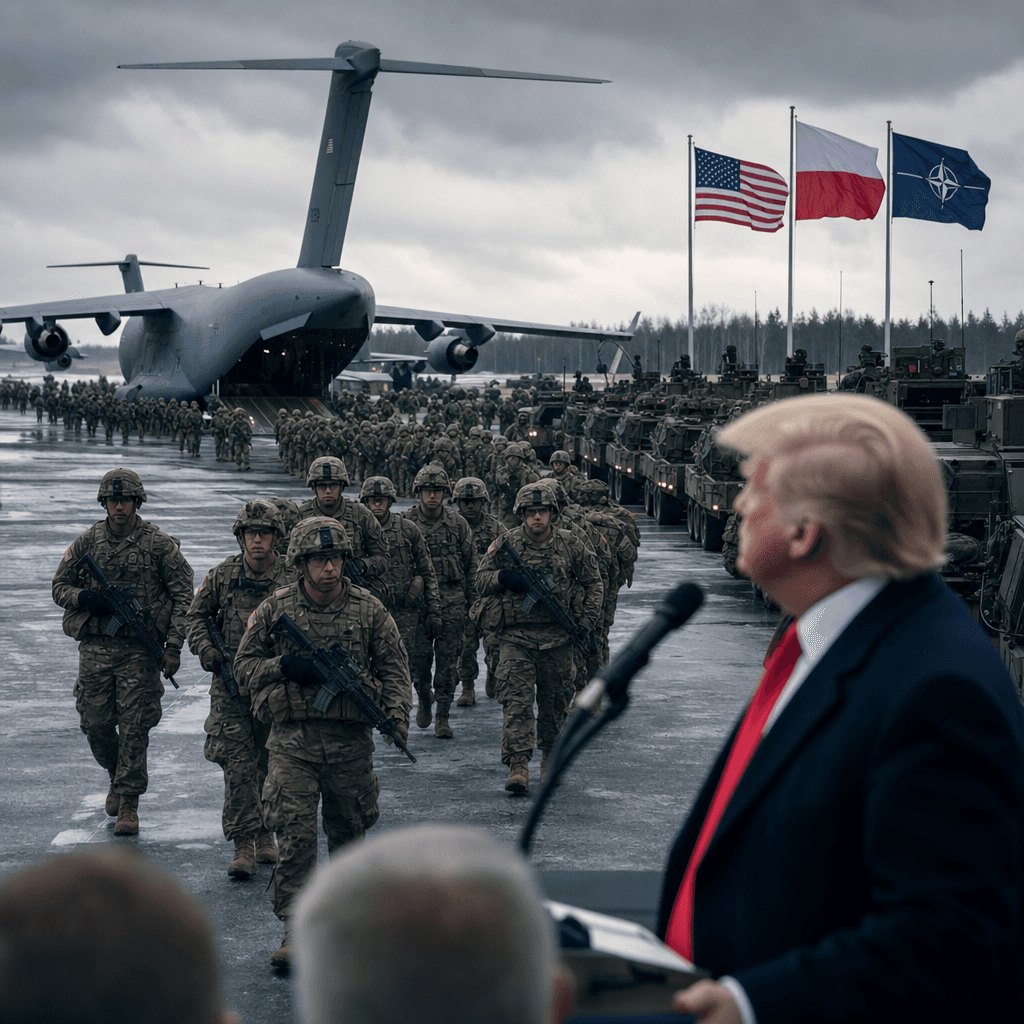
Trump Reasserts the Poland Line on Russia
Trump’s 5,000-troop promise to Poland undoes a Pentagon cut, calming Warsaw and tightening the U.S. deterrent on NATO’s eastern flank.
Trump’s decision to send an additional 5,000 U.S. troops to Poland is a reversal of the Pentagon’s earlier move to cancel a planned deployment to the country, and it is the clearest signal yet that he does not want a public rupture with Warsaw over Russia policy (BBC;
POLITICO). The White House framed the shift around Trump’s relationship with Polish President Karol Nawrocki, whom he backed in last year’s election, but the practical effect is simpler: Poland keeps a stronger U.S. military footprint while Europe is still trying to read Trump’s broader NATO posture (
BBC;
DW).
Warsaw gains leverage by being the model ally
Poland has spent years turning itself into Washington’s preferred front-line partner. It is one of NATO’s top defense spenders as a share of GDP and has bought heavily into U.S. armor, air defense and aircraft, which gives it a stronger case than Germany or Spain when Trump is deciding who gets rewarded and who gets squeezed (POLITICO;
DW). That matters because Trump’s alliance management has become transactional: countries that spend, flatter and align politically get proximity; those that do not get uncertainty.
That dynamic benefits Warsaw and weakens critics inside Europe who argue the United States is retreating from deterrence. It also helps Nawrocki domestically, because a visible U.S. commitment is the strongest proof point for his camp that Poland’s security runs through Washington, not Brussels (POLITICO;
BBC). For Ukraine, the message is mixed: a stronger Poland still helps the eastern flank, but the decision appears driven more by alliance politics than by a fresh strategic doctrine toward Russia (
Al Jazeera).
The real signal is not the number, but the reversal
The troop count is less important than the fact that Trump overruled or corrected a Pentagon decision that had alarmed Warsaw and irritated lawmakers in Washington (Washington Post/AP;
POLITICO). That tells allies two things. First, Congress still matters when reductions look like they undercut deterrence. Second, Trump is willing to preserve a visible U.S. line in Poland even while he continues to push Europe to carry more of NATO’s conventional burden (
DW;
POLITICO).
This is where Russia enters the picture. Poland sits on NATO’s eastern edge, and every U.S. unit there is read in Moscow as a test of alliance resolve. A pullback would have suggested hesitation; this reversal suggests Trump still sees value in forward deterrence, even if he wants to manage it more selectively than his predecessors (BBC;
DW). For a brief analysis of the wider U.S. security shift, see
United States and
Global Politics.
What to watch next
The key question is whether these 5,000 troops are a true addition or a repackaging of the canceled rotation, and whether the Pentagon’s broader drawdown in Europe continues elsewhere, especially Germany (BBC;
POLITICO). The next decision point is NATO’s ministerial follow-up and any clarification from U.S. Defense Secretary Pete Hegseth. If the White House keeps using Poland as the exception rather than the model, allies will read this as political damage control, not a stable force posture.
Discover more
Global Politics
Trump's Conflicting Messages on Iran War
Trump's mixed messages on Iran reflect a strategy of audience management, benefiting Tehran amid a complex geopolitical landscape.

Conflict & Security
Drone Warfare Killing Aid Workers at Unprec
Over 1,000 humanitarian workers killed in three years as cheap armed drones collapse legal protections. Gaza, Sudan, Ukraine, and DRC see deliberate targeting of aid convoys and hospitals with zero prosecutions.
Global
World Normalises Taliban as Afghan Women Eras
UN data shows Afghan women erased from public life as Russia recognises the Taliban, EU hosts officials in Brussels, and ICC warrants for gender persecution go unenforced.
Conflict & Security
West Africa Food Crisis: Three Shocks in 2026
Conflict, climate extremes, and the Strait of Hormuz closure drive a severe food crisis in West and Central Africa, with fertilizer prices surging 80% and millions displaced.