Trump Prosecutor's Legitimacy Under Scrutiny
Second Circuit questions Trump's federal prosecutor appointments
Model Diplomat8 min readNorth America
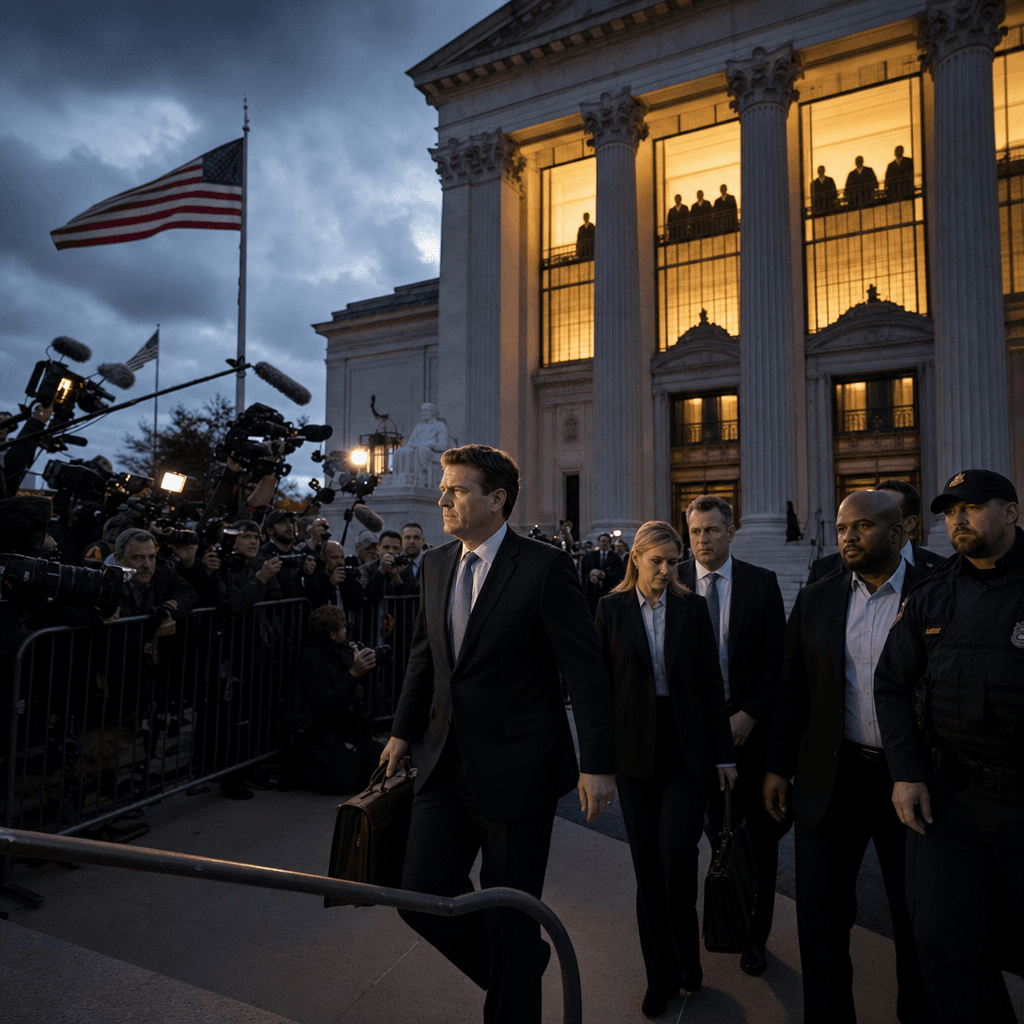
Trump Prosecutor's Legitimacy Under Scrutiny at Second Circuit
Federal appeals courts have now disqualified Trump's hand-picked U.S. attorneys in five districts, threatening indictments — including in the Manhattan probe of Michael De La Rosa.
A three-judge panel of the U.S. Court of Appeals for the Second Circuit spent May 4, 2026 doing something that would have been unthinkable a year ago: openly questioning whether President Donald Trump's system for installing federal prosecutors is legal at all. The immediate case involves John A. Sarcone III, the former interim U.S. Attorney for the Northern District of New York whose orders touched everything from a voting-rights suit against New York State to a criminal probe of Attorney General Letitia James. The larger question is whether every indictment signed by a Trump-picked prosecutor still serving past the 120-day statutory cap is now legally void — a doctrine that has already erased the criminal cases against James Comey and Letitia James, and that now threatens the standing of Michael De La Rosa, the former Trump appointee under investigation by the Manhattan District Attorney's office.
That is the story the wire coverage keeps missing. This is not a personnel scandal about Alina Habba's résumé or Lindsey Halligan's inexperience — it is a slow-motion collision between a president who treats U.S. attorneys as his private prosecutors and a federal statute — 28 U.S.C. § 546 — that gives district judges, not the White House, the last word on who fills the job after 120 days. The judiciary is winning, on paper. The Justice Department is winning on the ground, by firing anyone the judges appoint.
The statute the White House keeps trying to bend
The mechanics are narrow and unforgiving. Under Section 546, the Attorney General may name an interim U.S. Attorney for a district for up to 120 days. After that, the Congressional Research Service wrote in its December 2025 Legal Sidebar, "appointment power (1) shifts to the district court . and (2) does not revert to the Attorney General if a court-appointed U.S. Attorney leaves office before a Senate-confirmed U.S. Attorney is installed."
That single sentence is what has cost the Trump Justice Department five districts in nine months. The administration's answer has been to invoke the Federal Vacancies Reform Act instead — resigning an interim U.S. attorney one day, redesignating her as "First Assistant" the next, and letting her ascend to "Acting" U.S. Attorney under a separate statute. Judge Matthew Brann in the Middle District of Pennsylvania, sitting by designation on the Habba case, called the maneuver "a novel series of legal and personnel moves," according to Al Jazeera.
The Third Circuit went further in December 2025. In the first appellate ruling on the practice, a unanimous panel disqualified Habba outright. Judge Michael Fisher wrote that "the current administration has been frustrated by some of the legal and political barriers to getting its appointees in place," language that reads as a rare judicial rebuke of executive tactics. Within days, Habba resigned, saying via NPR that she was leaving "to protect the stability and integrity" of her office, per an NPR account of her departure.
The Comey and James dominoes
The consequences are not theoretical. On November 24, 2025, U.S. District Judge Cameron McGowan Currie — a Clinton appointee flown in from South Carolina to avoid conflicts among Eastern District of Virginia judges — dismissed the criminal indictments against former FBI Director James Comey and Letitia James. Her opinion, summarized by NPR, was that "all actions flowing from Ms. Halligan's defective appointment, including the indictments against Comey and James, were unlawful exercises of executive power and are hereby set aside."
That is not a procedural rebuke. It is a rule of decision: every grand-jury act signed by an unlawfully installed U.S. attorney is void from the start. The Justice Department's fallback argument — that Attorney General Pam Bondi had "ratified" the indictments — collapsed when Currie noted the grand-jury transcript was missing sections the government could not explain, according to Al Jazeera's reporting on the November 13 hearing. Halligan resigned in January 2026,
NPR reported, after Judge David J. Novak wrote that the "charade of Ms. Halligan masquerading as the United States Attorney . must come to an end."
For Comey, the ruling is close to fatal: the statute of limitations expired days after his September 25 indictment. For James, the fraud case can theoretically be refiled — by a lawfully appointed prosecutor the administration has yet to install.
Why the Second Circuit hearing matters more than the others
The Sarcone case is the next hinge. The Second Circuit — historically the most consequential federal appeals bench for white-collar and public-corruption law — is now weighing whether the same theory that killed the Habba and Halligan appointments also unwinds Sarcone's work in the Northern District of New York. The Associated Press wire, carried by the Boston Globe, reported that the appellate panel "expressed skepticism" of the administration's practice of stretching interim prosecutors past their statutory ceiling.
The stakes cascade in three directions. First, if the Second Circuit affirms disqualification, three of the four federal appeals courts to have reached the question will have ruled against the administration — the beginning of the consensus that forces Supreme Court review. Second, a Second Circuit ruling reaches New York's federal criminal docket, including the collateral proceedings in which Michael De La Rosa's standing is being litigated. Third, a January 9, 2026 ruling by U.S. District Judge Lorna G. Schofield had already barred Sarcone from the criminal investigation of Letitia James, according to DNYUZ's account of the decision — the second time a court has forced Sarcone out of a James-related matter.
Sarcone is still signing court filings. A January 6, 2026 Justice Department brief in the Northern District of New York lists him as "Acting United States Attorney" over the signature block, even though a district panel had already declined to keep him past his 120-day term. That is the standoff in one document.
The DOJ's real strategy: exhaust the judiciary
The pattern is now unmistakable. Judges appoint a replacement; the Justice Department fires the replacement; the disqualified prosecutor stays on under a new title. It happened to career prosecutor Desiree Grace in New Jersey, whom Bondi fired within hours of her judicial appointment, per Al Jazeera's July 22 reporting. It happened again on May 2, 2026, when judges in the Eastern District of Virginia named veteran litigator James W. Hundley to fill Halligan's vacated seat. Within hours, Deputy Attorney General Todd Blanche posted on X: "EDVA judges do not pick our US Attorney. POTUS does. James Hundley, you're fired!" the
BBC reported.
That is not compliance — it is institutional attrition: daring the courts to escalate, betting that dismissals of individual indictments will remain politically survivable, and denying the Senate its Article II role in confirming U.S. attorneys. As University of Baltimore constitutional scholar Kim Wehle told NPR in March 2026 after a New Jersey judge disqualified an entire "triumvirate" of prosecutors the administration installed to replace Habba: "You're trying to outmaneuver the appointments process, I'm not going to let you do it, and if you keep trying to do these things, I'm going to start dismissing indictments."
There is a hidden beneficiary here that the political coverage keeps missing: defense counsel. Every criminal defendant in a district led by a disqualified U.S. attorney now has a colorable motion to dismiss. In the District of Nevada, defendants have already argued in filings — including a lengthy motion to dismiss in the Sigal Chattah litigation — that when "the 'United States attorney' is unlawfully serving, every . certification, and the government's corresponding right to interlocutory appeal, is compromised." That is a windfall the Justice Department did not anticipate when it decided a year ago to keep loyalists in place at any cost.
What primary law actually says
The Congressional Research Service's June 2025 sidebar captures the constitutional geometry: "Two appeals courts have rejected constitutional challenges to the appointment of interim U.S. Attorneys under Section 546, holding that U.S. Attorneys are inferior officers and Congress could therefore choose to vest their appointment in the Attorney General or district courts." Translation: the Framers-era arguments the Justice Department is now floating — that judges cannot appoint executive officers — were settled adversely to the executive long before Trump's second term. The statute has been on the books since 1898.
The Supreme Court has flirted with narrowing that space: in Seila Law v. CFPB (2020) and again in a 2022 opinion, the justices emphasized presidential control over officials wielding executive power. Congress has not amended the 120-day cap since 2007, and the statute's plain terms remain the operating law.
Diplomat View
The forecast: the Second Circuit will affirm disqualification, and the case reaches the Supreme Court by the fall 2026 term. Three appellate rulings against the administration in a single year — Third Circuit on Habba, and, on current trajectory, Second Circuit on Sarcone plus Fourth Circuit on Halligan — produces the kind of factual consensus even a sympathetic Court cannot ignore. The likely question presented will be narrow: whether the Attorney General may make successive 120-day appointments under Section 546 after the district court has been vested with appointment authority. If the Court says yes, the Senate's confirmation role in these 93 offices is functionally dead. If it says no, hundreds of indictments signed since mid-2025 in Nevada, California, Virginia, New Jersey, and Northern New York become legally suspect.
What would change the forecast: a Senate deal by August 2026 that confirms compromise nominees in Virginia and New Jersey — the two most fraught districts — moots the underlying disputes and gives the Court cover to deny cert. That deal is not visible. The forecast holds.
Watch these dates:
- Second Circuit ruling in the Sarcone case — expected before the summer 2026 recess; it will either extend the Habba doctrine to New York or create the first circuit split.
- Fourth Circuit argument on the Halligan appeal — the Justice Department's cert vehicle if it loses; a decision reversing Judge Currie would restore the Comey/James indictments but faces long odds.
- Senate Judiciary action on Habba's re-nomination and pending Virginia and New Jersey picks — the political off-ramp Trump has so far refused to take.
The Bottom Line
The Trump administration is losing the legal fight over its U.S. attorneys because the statute is clear and the appellate math is now against it — but it is winning the operational fight by firing every court-appointed replacement and daring judges to escalate. That impasse converts the Section 546 dispute into the sharpest separation-of-powers case of Trump's second term, and its resolution at the Supreme Court will decide whether the Senate's advice-and-consent role over federal prosecutors survives this presidency. Every indictment signed in the interim carries an asterisk — and the 93 U.S. attorneys who were never confirmed by the Senate are the asterisk.
Discover more

US Politics
SNAP Food Assistance Faces Legal Challenges
In 2026, SNAP faces stricter eligibility rules and mounting legal challenges, threatening food assistance for the millions of Americans who rely on the program.

Conflict & Security
Drone Warfare Killing Aid Workers at Unprec
Over 1,000 humanitarian workers killed in three years as cheap armed drones collapse legal protections. Gaza, Sudan, Ukraine, and DRC see deliberate targeting of aid convoys and hospitals with zero prosecutions.

Global
World Normalises Taliban as Afghan Women Eras
UN data shows Afghan women erased from public life as Russia recognises the Taliban, EU hosts officials in Brussels, and ICC warrants for gender persecution go unenforced.

Conflict & Security
West Africa Food Crisis: Three Shocks in 2026
Conflict, climate extremes, and the Strait of Hormuz closure drive a severe food crisis in West and Central Africa, with fertilizer prices surging 80% and millions displaced.