Trump Takes His Economy Pitch Into Lawler Country
Trump is using Mike Lawler’s swing district to sell tax cuts and affordability, testing whether his economic message can still hold suburban New York ahead of the midterms.
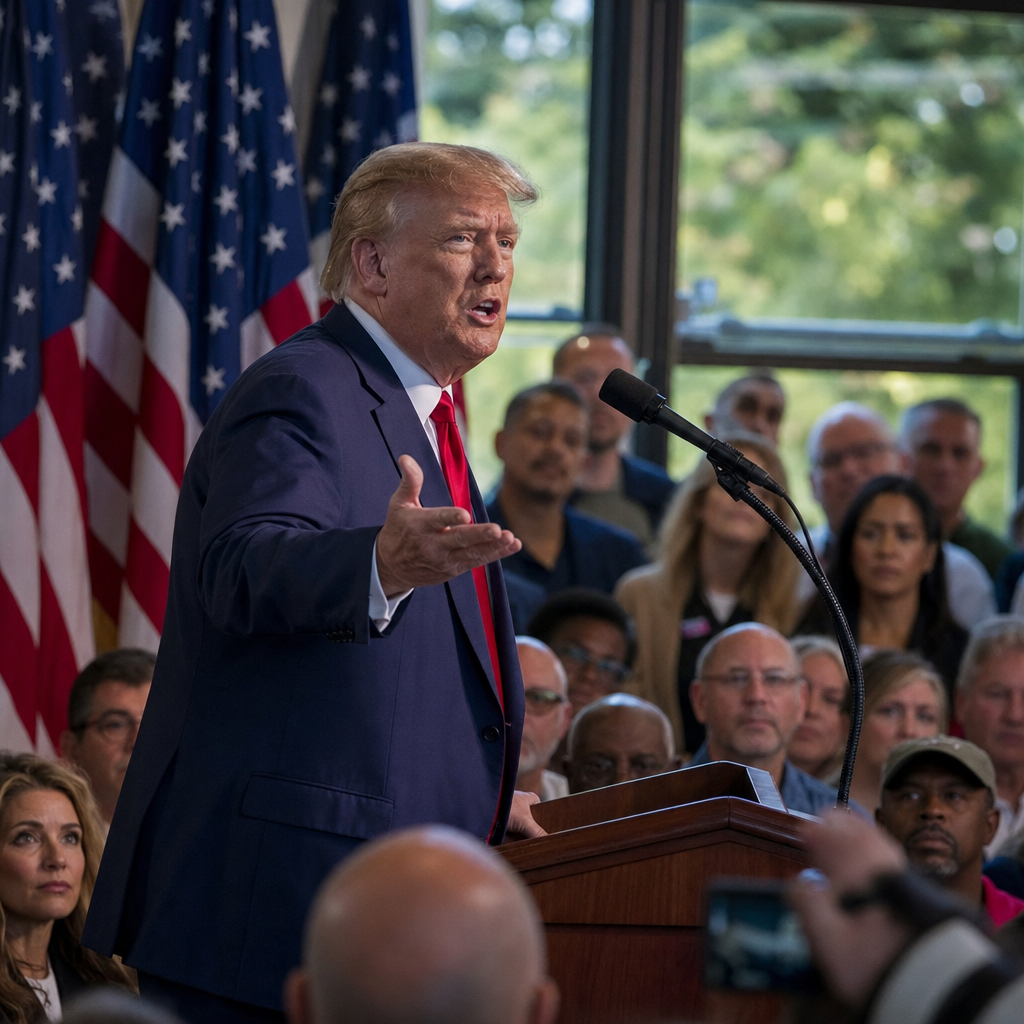
President Trump is in New York’s 17th Congressional District Friday with GOP Rep. Mike Lawler to tout his economic agenda — especially affordability and tax cuts — in a district that will be one of the House’s closest fights this year, according to  The Hill and the
  Associated Press. The power play is obvious: Trump is trying to turn a weak national economy into a local Republican asset, while Lawler is betting that a presidential visit can help him survive in a district Kamala Harris carried in 2024.
Why this district matters
Lawler is one of only three House Republicans representing districts won by Harris, which makes him a live test case for whether the GOP can still win high-income suburban seats by leaning on Trump’s economic record, the AP reported through Associated Press. That matters because New York’s suburbs reward candidates who can talk tax relief without sounding captive to Trump. Lawler has made that argument by embracing the state and local tax deduction fight, even wearing a “Mr. SALT” hat in public, according to the AP.
The event also tells you what Republicans think their best 2026 message is. Trump’s White House wants to highlight the 2025 tax law and the expanded SALT deduction as proof that he is making life cheaper for working families, while Democrats are trying to frame the same law as a giveaway that does little for voters who are still squeezed by prices, gas and housing costs, the AP said. In  US Politics, that is the central midterm contest: personal loyalty and local economics versus national mood.
The risk for Trump is the economy itself
The problem is that Trump is selling optimism into a sour market. An AP-NORC poll cited by  USA Today found only 33% of Americans approve of how he is handling the economy, with just 63% of Republicans still backing him on that issue.
  The New York Times reported a broader second-term low of 37% approval and said 64% of voters disapproved of his handling of the economy.
That leaves Trump with a narrow route: turn the tax-cut message into a local defense in districts like NY-17, where state and local taxes are a kitchen-table issue. But it also exposes Lawler to a simple Democratic attack line — that he is hitching his reelection to a president whose economic brand is weakening. The DCCC is already using that frame, while the NRCC says Trump’s numbers remain strong enough in the district to help, not hurt, according to the AP.
What to watch next
The immediate test is not the speech; it is whether Lawler can keep his coalition together after the June 23 Democratic primary and whether the White House can turn a one-day appearance into a repeatable midterm message. If Trump’s economy pitch cannot travel in a district he needs to hold, the Republican House map gets thinner fast. If it does, NY-17 becomes the template for how Trump plans to campaign in suburban battlegrounds all fall — and the next proof point will be whether other vulnerable Republicans invite him in, or keep their distance.