Trump Fires 96-Year-Old Tariff Cannon at
Trump uses 1930 law to impose 50% tariffs on $20B of Canadian goods, breaching USMCA.
Model Diplomat8 min readNorth America
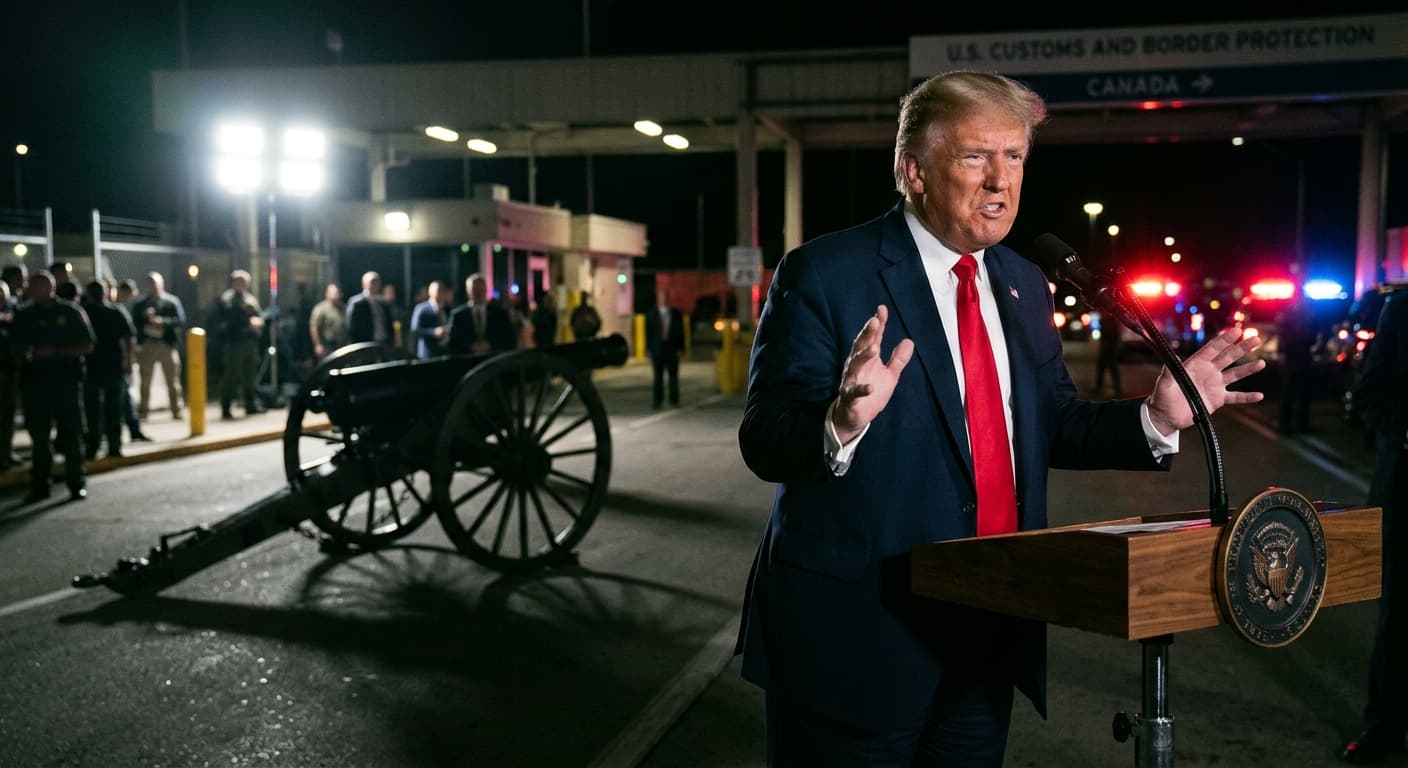
Trump Fires a 96-Year-Old Tariff Cannon at Canada — and Pierces the USMCA Shield for the First Time
Washington imposed 50% tariffs on $20 billion of Canadian goods using a never-before-invoked 1930 law, explicitly breaching the USMCA free-trade agreement. The move is less about dairy and hockey sticks than about forcing Ottawa to the USMCA negotiating table before Mexico gets a deal alone.
WASHINGTON — President Donald Trump on July 21 signed three proclamations imposing 50% tariffs on roughly $20 billion of Canadian imports, including milk, cream, hockey sticks, cement, furniture, clothing, and synthetic wigs, using Section 338 of the Tariff Act of 1930, a provision that has sat dormant for 96 years and has never before been used by any American president to levy duties. The tariffs are scheduled to take effect on August 19, according to the White House proclamation.
The legal novelty is the story, but the real payload is structural: for the first time, Trump's trade team explicitly refused to exempt goods compliant with the United States-Mexico-Canada Agreement. The USMCA's firewall — the guarantee that playing by the rules shields you from punitive import taxes — has been breached. That changes the geometry of North American trade.
"The United States did not agree to renew the USMCA in its current form," USTR Jamieson Greer had declared on July 1. Three weeks later, the administration used the non-renewal as a platform to escalate.
The unused weapon
Section 338 has been hiding in plain sight since Herbert Hoover signed the Smoot-Hawley Tariff Act. Its text gives the president authority to impose duties of up to 50% against any country that "discriminates in fact against the commerce of the United States, directly or indirectly, by law or administrative regulation or practice," according to the statute codified at 19 U.S. Code § 1338.
No president ever pulled the trigger. That changed Monday.
The Trump administration's decision to dust off Section 338 is not a random archival discovery. It is the direct consequence of the Supreme Court's February 2026 ruling in Learning Resources, Inc. v. Trump, which struck down the International Emergency Economic Powers Act as the legal basis for broad-based tariffs. The Court held that IEEPA's grant of authority to "regulate importation" does not include the power to tax — a power the Constitution reserves to Congress.
The administration scrambled. It imposed a 10–15% global tariff under Section 122 of the Trade Act of 1974, a temporary authority that expires on July 24. Section 338 is being tested as a replacement weapon in the legal arsenal, and Canada is the laboratory.
According to the CSIS analysis, the administration "has always considered Section 338 as a viable backup option for imposing tariffs." Using it against Canada — one of only two countries, alongside China, that retaliated against Trump's earlier tariffs — "sends a clear message that the United States will punish trading partners that retaliate against it."
The USMCA firewall is gone
The most consequential sentence in the White House fact sheet is the one that says the new 50% tariffs apply regardless of whether the product is covered under the USMCA. That is a break from the entire pattern of Trump's trade war to date.
Throughout 2025 and early 2026, USMCA-compliant goods enjoyed a de facto safe harbor. Even as tariffs climbed on steel, aluminum, lumber, and autos, the agreement's rules of origin offered a path to duty-free treatment for most cross-border trade. The Royal Bank of Canada estimated that by mid-2025, roughly 90% of Canadian exports were accessing the U.S. market under USMCA preference rules.
The Section 338 tariffs eliminate that shelter for the targeted categories. Canadian Prime Minister Mark Carney called the move "the latest in a series of unilateral US trade actions that began with the US imposing a series of tariffs in direct violation" of the USMCA, according to Al Jazeera.
The economic scale is modest: the $20 billion of goods targeted represent about 5.2% of the $382 billion the U.S. imported from Canada in 2025, based on U.S. Census Bureau data compiled by the USTR. Energy — the largest component of bilateral trade — is exempt. So are potash, critical minerals, and fish. Goods already subject to separate national-security tariffs, including steel and aluminum, are carved out.
But the symbolic and legal significance is enormous. As CSIS noted: "Tariffing goods that meet the agreement's strict provisions risks raising uncertainty about the willingness of the United States to abide by the terms of the agreement, as well as the sustainability of the interconnected auto supply chains."
The squeeze: Mexico races ahead, Canada stalls
The timing is not accidental. USTR Jamieson Greer is in Mexico City this week for a third round of bilateral USMCA negotiations with Mexican President Claudia Sheinbaum's team. Those talks are reportedly advancing quickly. The BBC reported that U.S.-Mexico talks "appear to be progressing more quickly, adding more squeeze on Carney to reach an agreement."
The parallel is unmistakable: during the first Trump administration's NAFTA renegotiation, the U.S. cut a deal with Mexico first, then used steel and aluminum tariffs in May 2018 to pressure Canada into joining at the last minute. The Section 338 playbook is the same strategy with a different legal chassis.
Greer has been explicit about the asymmetry. Last week at the Aspen Security Forum, he said that while he and his Canadian counterparts speak weekly, "we just haven't seen a lot of movement" on negotiations. Mexico, by contrast, has taken what Brookings scholar
Duncan Wood described as an existential approach: "The Mexicans have made this decision that the USMCA is an existential issue for them, and that they're willing to give up a lot of things in order to make sure that the agreement continues."
Carney's bind
Carney spoke with Trump on Tuesday, and both leaders agreed to "intensify" trade discussions. But the Canadian prime minister is caught between provinces demanding retaliation and the reality that escalation burns political capital he needs for negotiations.
Ontario Premier Doug Ford called for Canada to respond "dollar for dollar," according to NPR. The opposition Conservatives, in an unusual move, backed the government's right to stand firm: "President Trump's latest tariffs are another unacceptable and unjustified attack on Canadian workers and our businesses. Canadians are not a punching bag,"
the party said in a statement.
But Canada's room for maneuver is shrinking. Lawrence Herman, a trade expert with the C.D. Howe Institute, told the BBC: "Giving in and trying to get along with the United States by making concessions now is not the right strategy, and it would be, I think, harmful to Canada's national pride and our international standing."
The Canadian dollar dipped to C$1.4083 per U.S. dollar on the news, and the trade-weighted exchange rate reflects a market pricing in prolonged uncertainty. The Bank of Canada has been criticized for projecting GDP growth of 1.4% for 2026 based only on "tariffs in place or officially agreed on as of January 23" — a baseline already overtaken by events.
The U.S. goods trade deficit with Canada was $46.4 billion in 2025, according to the Office of the U.S. Trade Representative — a decline of 25% from 2024, driven largely by reduced energy prices and the dampening effect of existing tariffs.
The three grievances, examined
The White House built its case around three claims of Canadian discrimination:
Alcohol: After Trump's 2025 tariffs and repeated suggestions that Canada become "the 51st state," all but two Canadian provinces — Alberta and Saskatchewan — pulled U.S. liquor from government store shelves. The boycott became a national symbol of resistance. U.S. alcohol exports to Canada totaled approximately $1.9 billion in 2025, according to U.S. trade data cited by Bloomberg.
Dairy: Canada's supply-management system imposes tariffs of up to 300% on dairy imports above quota. Trump's proclamation alleges Canada discriminates against U.S. cheese compared to European imports. However, as CSIS researchers have pointed out, U.S. dairy exports to Canada remain "far below the quota threshold after which the higher tariff rate comes into effect."
Autos: Canada maintained a 25% tariff on U.S. vehicle imports not qualifying for USMCA preference — a retaliatory measure imposed after Trump's own auto tariffs. The administration characterizes this as discrimination.
What to watch
The 30-day clock to August 19, 2026 creates a compressed negotiating window. Three catalysts will determine whether these tariffs bite or become another threat that recedes:
- July 24 — Section 122 global tariffs expire. The administration must decide whether to seek congressional extension, reimpose them, or rely on Section 338 and Section 301 as the new tariff architecture.
- This week — Greer's Mexico City meetings. If the U.S. and Mexico announce a bilateral agreement in principle, Canada's negotiating position weakens substantially.
- August 19 — Tariff implementation date. Either the duties take effect, Carney extracts a deal, or Trump extends the deadline — a pattern he has used before.
Diplomat View
The Section 338 tariffs are not about dairy, hockey sticks, or synthetic wigs. They are a deliberate escalation ladder aimed at forcing Canada into USMCA renegotiations on American terms — and testing a new legal weapon before the Section 122 tariffs expire on Friday. The choice of Canada as the first target for this untested provision is not random: it is the only country that both retaliated against Trump's tariffs and lacks China's rare-earth leverage.
The most likely scenario is a deal before August 19. Trump uses tariff deadlines as negotiating leverage, not as policy endpoints. Carney cannot afford a full-blown trade war with an economy where exports to the U.S. represent roughly 15% of value-added GDP — but he also cannot afford to be seen folding. The compromise will likely involve Canada lifting provincial alcohol bans in exchange for U.S. relief on steel and aluminum tariffs, with dairy and auto rules of origin deferred to USMCA talks.
The risk scenario is that Carney overestimates his leverage. If Mexico cuts a bilateral USMCA deal this week — and Greer's presence in Mexico City makes that plausible — Canada faces a take-it-or-leave-it proposition on far worse terms than it could negotiate now. The historical parallel is May 2018, when Trump's steel and aluminum tariffs pushed a reluctant Canada into the original USMCA at the final hour. Section 338 is the same hammer, swung from a different legal angle.
What would change the forecast: a Canadian decision to levy dollar-for-dollar retaliatory tariffs before August 19 — as Doug Ford demands — would likely trigger a genuine trade rupture, because Section 338 was chosen precisely to demonstrate that retaliation will be met with escalation. If Carney resists that pressure while extracting a face-saving concession on metals tariffs, the crisis de-escalates. If the provinces force his hand, August 19 becomes a genuine cliff.
Discover more
US Politics
House Ethics Committee Pushes Sexual Miscond.
The House Ethics Committee has shifted responsibility for sexual harassment settlement records to the Office of Congressional Workplace Rights, complicating disclosure efforts.

India
Delhi CM Rekha Gupta Blasts Opposition's Delm
Delhi CM Rekha Gupta's remarks on women's quota defeat reveal BJP's strategy for the 2029 Lok Sabha elections, focusing on delimitation.

India
Congress Advocates 33% Women’s Quota
Congress calls for a 33% women's reservation in the existing 543 Lok Sabha seats, countering Modi's plan to expand the house to 850 seats.

Economics
Fed's Amex AML order puts correspondent banking on notice
Federal Reserve's Amex AML order requires board-level controls and a 90-day plan; OCC fined the bank $350 million over enterprise-wide deficiencies.