Trump Ends Iran MoU as Gulf Tensions Rise
U.S.–Iran relations deteriorate amid military strikes.
Model Diplomat8 min readMiddle East
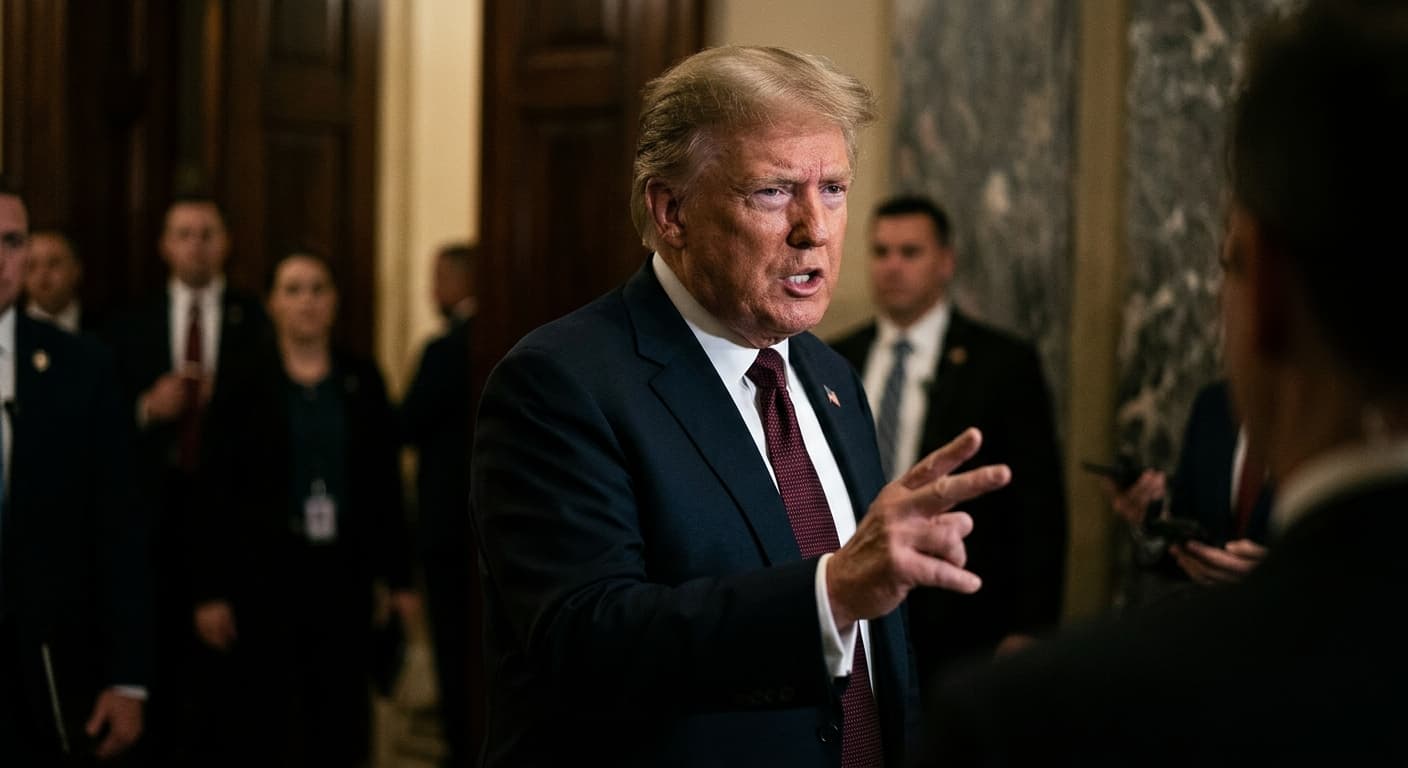
Trump Kills Iran MoU as Gulf Slides Back Toward Open War
Trump declared the U.S.–Iran memorandum "over" on July 8, 2026, after CENTCOM struck 80+ targets and Iran hit Bahrain and Kuwait. Here is what breaks next.
President Donald Trump's declaration in Ankara on July 8, 2026 that the U.S.–Iran memorandum of understanding is "over" is not the end of a diplomatic experiment — it is the moment the Gulf's off-ramp closed and the Strait of Hormuz became, once again, the world's most dangerous piece of water. Within 24 hours, CENTCOM had hit more than 80 Iranian targets, Iran had fired missiles and drones at U.S. bases in Bahrain and Kuwait, the Treasury had revoked Iran's oil-sales waiver, Brent crude had jumped 6% to $78 a barrel, and Defense Secretary Pete Hegseth had scrapped his first-ever trip to Israel. The MoU's fatal flaw was always the same: it was a Hormuz deal, not a peace deal, and once Iran began enforcing tolls-by-another-name on shipping, Washington had no politically survivable middle option between capitulation and bombardment.
What actually collapsed, in precise sequence
Three commercial tankers — the Marshall Islands-flagged LNG carrier Al-Rekayyat, the Saudi crude tanker Wedyan, and the Liberian-flagged Cyprus Prosperity — were struck near the Omani coast late on July 6 and into July 7, according to reporting by Al Jazeera citing CENTCOM and UKMTO advisories. All three were sailing the southern route close to Oman rather than the northern lane Iran has demanded shipping use. Iranian television said the vessels had ignored warnings; Qatar's foreign ministry called the strike on Al-Rekayyat "an unacceptable assault on the security and safety of international navigation," per the
BBC.
CENTCOM's response, launched overnight July 7–8, hit Bandar Abbas, Bushehr, Qeshm Island and the port of Sirik. In its own statement, quoted by Al Jazeera, the command said U.S. forces struck "Iranian air defence systems, command and control networks, coastal radar sites, anti-ship missile capabilities, and more than 60 Islamic Revolutionary Guard Corps small boats." Iranian state media reported eight army personnel killed and shrapnel injuries at the Sirik commercial pier. The IRGC then said it had targeted 85 U.S. sites in Bahrain and Kuwait — including the Fifth Fleet's Bahrain headquarters and Kuwait's Ali Salem airbase — and had killed the first Iranian casualty of this round, Guardsman Mohammadreza Khazini, per the
BBC. Kuwait's armed forces said they intercepted two ballistic missiles and 13 drones; power lines were damaged and later restored, according to
Al-Monitor.
Then came the political kill shot. Speaking on the sidelines of the NATO summit in Ankara, Trump told reporters: "To me, I think it's over. I don't want to deal with them anymore. They're scum." He added that further strikes were likely that night and floated a return to naval blockade, saying "we may take over Kharg Island" — Iran's principal oil export terminal — again per Al-Monitor.
The MoU was never a peace deal — it was a toll dispute
The angle the wires are missing: the 14-point memorandum signed on June 17 was fundamentally a transaction over the Strait of Hormuz, not a settlement of the underlying war. As the Council on Foreign Relations' Michael Fishman put it bluntly in a July 8 analysis, the deal "is thus best understood less as a deal that addresses Iran's nuclear ambitions or military capabilities than as a Hormuz deal: the United States agreed to provide Iran with sanctions relief in exchange for Iran allowing commercial vessels safe passage through the strait," according to the Council on Foreign Relations.
The MoU's language locked in that trade for only 60 days and, crucially, obliged Iran and Oman to negotiate "the future administration and maritime services" of the strait — wording Tehran has read as a licence to charge "service fees" of up to $2 million per ship, according to reporting on wartime tolling by Al Jazeera. Secretary of State Marco Rubio has publicly rejected any such tolling regime; Treasury Secretary Scott Bessent on May 28 warned via X that Washington would "aggressively target any actors involved — directly or indirectly — in facilitating tolls," according to a Congressional Research Service brief posted at
Congress.gov.
The tanker strikes of July 6–7 were not, therefore, a random flare-up. They were Iran enforcing its preferred northern-lane routing against ships that used the U.S.-backed southern lane near Oman. In effect, the two sides had signed a document they interpreted in opposite ways, and only one interpretation could survive contact with a moving tanker.
Who benefits, who loses
The clearest winner is the IRGC's coastal-forces command. Iran's conventional military was, by the U.S. military's own admission, gutted this spring: on May 14, CENTCOM commander Adm. Charles Cooper told the Senate Armed Services Committee that Iran's ability to project power had been degraded to a "tactical" level and that its factories and workforce "cannot replace its lost capabilities" in the near term, per the Congressional Research Service. What Tehran has left is cheap: small boats, anti-ship missiles, drones and mines in a 33-kilometre-wide waterway. That asymmetry is precisely what forced Trump to negotiate in June and is what forced him to strike again in July.
The clearest loser is Prime Minister Benjamin Netanyahu. Hegseth's abrupt cancellation of what would have been his first Israel visit — reported by Al-Monitor as scheduled to include a discussion of the sale of F-35s to Turkey — is being read in Jerusalem as a snub. Netanyahu told CNN this week that an F-35 sale to Ankara "would destroy the power balance in the Middle East"; Trump on July 7 promised Recep Tayyip Erdoğan he would lift the 2020 CAATSA sanctions that block the sale. As Chatham House's Yossi Mekelberg wrote on July 1, the Trump–Netanyahu relationship "seems to have reached an all-time low," with the Israeli premier viewed inside the administration as the man who dragged Washington into an unwinnable Hormuz war, according to
Chatham House.
Congress is the other loser, and by extension the War Powers framework itself. The House and Senate both passed a joint resolution on June 23 directing the removal of U.S. forces from hostilities in Iran — the first time in the statute's history both chambers have passed such a measure without needing the president's signature, per Sen. Tim Kaine's office at kaine.senate.gov. The administration's response, per a May 1 letter to Congress cited by Sen. Adam Schiff at
schiff.senate.gov, has been to argue that hostilities have "terminated" and that the 60-day WPR clock "pauses" during ceasefires — a novel legal reading that Wednesday's strikes have now stress-tested to breaking point.
The economics: why oil didn't spike more
Brent's 6% jump to $78 a barrel sounds significant until you compare it to the $126 peak in late April, when the strait was fully shut. Prices had crept back toward pre-war levels around $70 in early July as tanker crossings recovered — Al Jazeera reported 108 verified crossings over the weekend of July 3–5. The market's muted reaction reflects two structural realities. First, Iran's leverage over Hormuz decays as global inventories rebuild; Oxford Economics chief global economist Ryan Sweet told Al Jazeera the peace deal is "the key domino" but that stockpiles now provide a cushion. Second, roughly 10 million barrels per day of Gulf supply were shut in for over 100 days during the spring, and the CFR analysis notes there is "simply no precedent for unwinding a market disruption of this magnitude" — meaning traders had already priced in structural volatility.
The pain point is Iran, not Washington. The reimposed Treasury sanctions on Iranian oil, effective July 7, sever what Al Jazeera's Tehran correspondent Resul Serdar Ataş called "almost the only lifeline to sustain the economy." Tehran's incentive to keep tacit compliance with the MoU has evaporated with the waiver.
Historical parallel: the 1987–88 Tanker War, run in reverse
There is a template for what comes next, and it is not encouraging. During the 1987–88 Tanker War, the U.S. Navy escorted reflagged Kuwaiti tankers through the strait while Iran mined shipping lanes; the conflict culminated in Operation Praying Mantis, still the U.S. Navy's largest surface engagement since World War II. What is different in 2026 is that Iran's conventional navy has already been destroyed — the CENTCOM inventory of struck targets no longer includes frigates because there are essentially none left — and the fight has compressed into IRGC small-boat swarms, anti-ship missiles fired from mobile launchers, and mines whose locations Tehran has deliberately obscured. The MoU acknowledged this by tasking the International Maritime Organization with evacuating "more than 11,000 stranded seafarers" through a temporary corridor with Oman, per the Council on Foreign Relations. On July 7, three of those ships transiting an IMO route were struck.
The 1988 war ended when Iran, exhausted, accepted UN Security Council Resolution 598. There is no equivalent stabiliser now. Ayatollah Ali Khamenei is dead — killed on February 28 — and the transitional leadership under his son Mojtaba has domestic revenge politics of its own. Pro-government accounts on X circulated satellite images of Trump's Ankara hotel on July 8 demanding a missile strike, according to Al Jazeera.
What to watch
- The Kharg Island threat. Trump floated seizing Iran's main crude export terminal on July 8. A strike or blockade there would push Brent well above the $100 mark and end any pretence of MoU survival. Watch Treasury guidance in the next 72 hours.
- The August 21 waiver expiry that no longer matters. The oil sanctions waiver was set to expire on August 21 under the MoU; its early revocation on July 7 has pulled that deadline forward. Iranian crude flows will collapse within weeks unless the waiver is reinstated.
- Netanyahu's Washington visit. Trump hinted on July 4 that the Israeli premier could visit the U.S. "as early as next week." With Hegseth's Israel trip canceled and F-35s-to-Turkey now on Trump's ledger, that meeting — if it happens — is the single most important diplomatic event of July.
- Congressional response. A ninth War Powers vote is expected. The question is whether any Senate Republicans defect after July 8's strikes; three previously did in June.
- The Khamenei funeral cycle. Iranian negotiations were paused for the week of mourning. Talks either resume around July 12–13 — or they don't, and the "waste of time" line becomes policy.
The Bottom Line
The U.S.–Iran MoU was never a peace agreement; it was a $2-million-per-ship dispute dressed in diplomatic language, and it collapsed the first time enforcement met interpretation on the water. Trump's declaration that the deal is "over" ratifies a reality already made by three struck tankers, 80 CENTCOM impact points, and a Treasury waiver revocation — and it leaves the Gulf with no institutional off-ramp, a decapitated Iranian leadership, and a defense secretary who won't get on the plane to Tel Aviv. The next escalation is not a policy choice. It is a scheduling question.
Discover more

US Politics
SNAP Food Assistance Faces Legal Challenges
In 2026, SNAP faces stricter eligibility rules and mounting legal challenges, threatening food assistance for the millions of Americans who rely on the program.
US Politics
House Ethics Committee Pushes Sexual Miscond.
The House Ethics Committee has shifted responsibility for sexual harassment settlement records to the Office of Congressional Workplace Rights, complicating disclosure efforts.
India
Romanian Coalition Party Demands PM Resign
Romania's Social Democrats withdrew from coalition, joining far-right AUR to topple PM Bolojan, risking €10 billion in EU funds by August 2026.

Conflict & Security
Guatemala: El Niño 2026–27 becomes regional security test
UNICEF: 25.8M children face El Niño risks in Latin America; Guatemala maps 188 municipalities for drought and food insecurity amid regional security test.