Toyota's Tacoma Exit: Sheinbaum's Challenge
Sheinbaum's response to Toyota's move raises concerns for Mexico's auto industry.
Model Diplomat7 min readNorth America
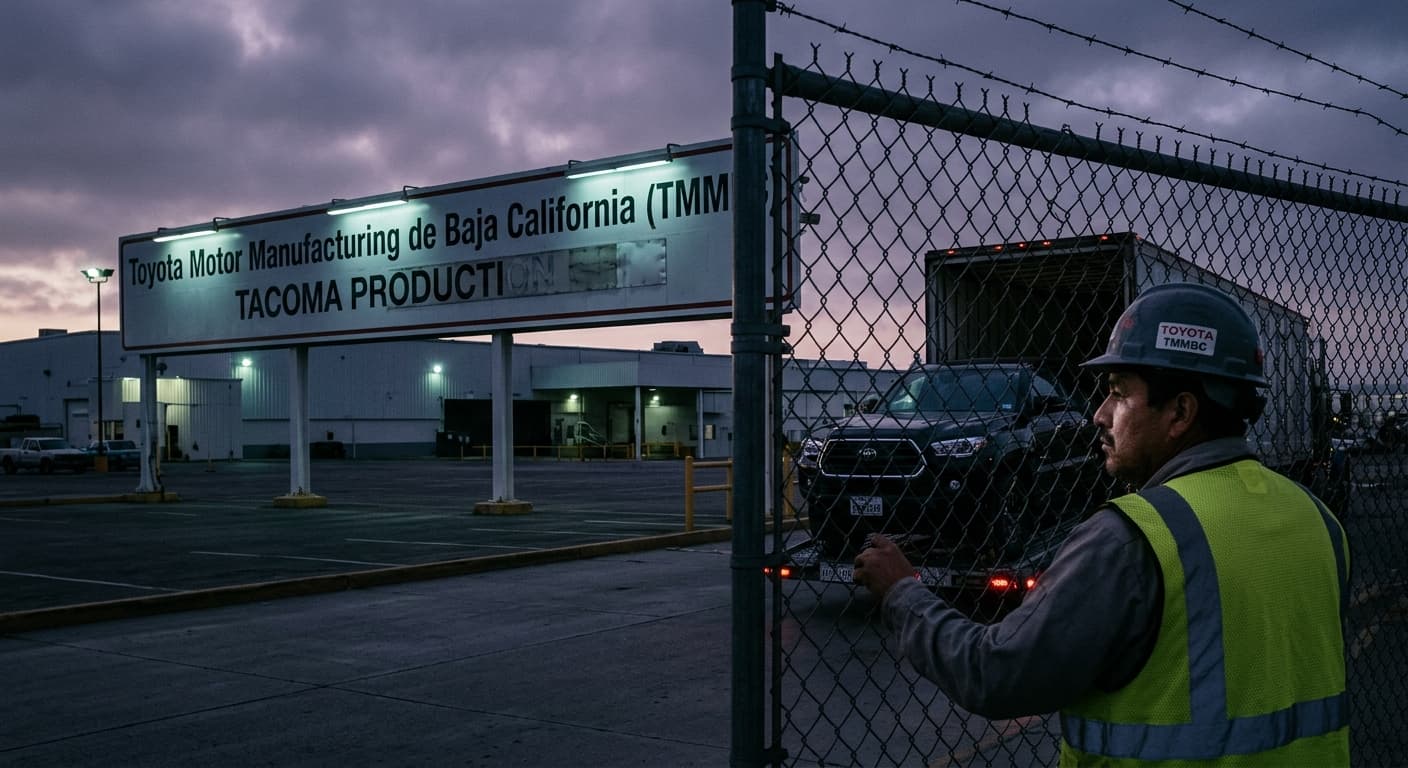
Toyota's Tacoma exit from Tijuana: why Sheinbaum's four-year clock matters
Sheinbaum says Toyota's $3.6B move to Texas will take until 2030 and cost no Mexican jobs. The bigger story is who now controls North America's auto map.
Claudia Sheinbaum's message from the National Palace on July 7, 2026 was calibrated to one audience: the roughly 3,300 workers at Toyota's Tijuana plant, and the millions more in Mexico's auto belt watching for the first crack. Her line — "no habrá despidos" and the transfer will not conclude until 2030 — is defensible on paper. But the more consequential fact is what Toyota's $3.6 billion San Antonio expansion, announced the day before, tells us about the direction of travel: for the first time since NAFTA took effect in 1994, a marquee Japanese automaker is publicly moving a flagship vehicle line out of Mexico and into the United States on political timelines, not commercial ones. The Sheinbaum government is right that the pain will be gradual. It is wrong, or at least premature, in treating this as an isolated corporate reshuffle rather than the opening move of the U.S.–Mexico–Canada Agreement (USMCA) renegotiation.
What Toyota actually announced
Toyota Motor North America (TMNA) said on July 6 that it will invest $3.6 billion to build a second vehicle assembly line at its San Antonio complex, add 2.5 million square feet of factory space, and hire 2,000 new workers. According to the company's press release carried by the Financial Times, TMNA will "transition Tacoma production from Toyota Motor Manufacturing Baja California (TMMBC) to the expanded Toyota Texas plant over an approximate four-year period." The same statement includes an unusually direct policy plea: Toyota "encourages a quick resolution to USMCA to make the North American region globally competitive."
That single sentence is the tell. The Tacoma has been Tijuana's signature vehicle since 2010 and one of the best-selling mid-size pickups in the United States. Toyota does not move it lightly. According to the Council on Foreign Relations, Toyota exported 92% of its Mexican output — roughly 228,000 vehicles — to the U.S. market in 2024, the highest cross-border dependence of any major carmaker operating south of the Rio Grande.
Sheinbaum's damage-control math
Sheinbaum's defensive line rests on three claims. First, that Toyota's other Mexican operation — the sprawling Apaseo el Grande complex in Guanajuato that produces the Tacoma and the hybrid Tacoma at 260,000-unit capacity — is unaffected. According to the Guanajuato state government's cluster data, the plant produced 204,000 units in 2025 and remains the anchor of a Japanese supply chain that employs more than 48,000 people in the state. Second, that the Tijuana site will keep its 3,300-plus workforce doing "otras operaciones," as Economy Secretary Marcelo Ebrard's team put it. Third, that Mexico has secured commitments of more than US$500 million in additional automotive investment as a partial offset.
The 2030 timeline is her strongest card. Auto lines are not moved by press release; they are moved by tooling contracts, supplier requalifications, and North American Free Trade Commission notices. That gives Mexico four years to lock in replacement production — a bet that CSIS analysts have called a "complementarity mindset," arguing Mexico must position itself as an indispensable input into U.S. reshoring rather than a competitor to it.
But there is a mismatch buried in the numbers. In November 2024, Toyota had confirmed a $1.45 billion expansion of its Baja California and Guanajuato plants precisely to grow Tacoma production, per CFR. Twenty months later, roughly a third of that ambition — the Tijuana line — is being redirected north. The $500 million Sheinbaum cites is meaningful, but it does not close the gap opened when a company that just committed to Mexico reverses course under a different political regime.
The USMCA is the real variable
This story is not fundamentally about Toyota. It is about the second Trump administration's willingness to weaponize the USMCA review — and about how quickly a Japanese carmaker read the room.
On July 1, 2026, the Office of the U.S. Trade Representative made it official: the USMCA "is not renewed" in its current form, and the administration reserved the right to unilateral withdrawal. That statement, reported by Inside U.S. Trade, came just five days before Toyota's Texas announcement. USTR Jamieson Greer had already told House appropriators in April that "
we've already had conversations about changing the rules of origin" for the auto sector, and the U.S. International Trade Commission is running the
third of five statutorily required fact-finding investigations into automotive rules of origin.
Layer on the tariffs. According to Al Jazeera, Mexico already pays a 25% U.S. duty on cars falling outside USMCA coverage, plus a 25% "fentanyl tariff" on non-USMCA goods and 50% on steel, aluminum and copper. In December 2025, Trump added a further 5% tariff over a cross-border water dispute,
Al Jazeera reported. For an automaker whose Mexican output is 92% U.S.-bound, that arithmetic is coercive. It is also why seven U.S. auto trade associations wrote to Greer in May urging him to "
preserve the trilateral USMCA structure" ahead of the review — a plea that reads, in retrospect, like an epitaph.
Who benefits, who loses
The Texas beneficiaries are named and celebratory. Governor Greg Abbott hailed the "Texas Enterprise Fund and JETI program" incentives; Senator Ted Cruz called it "another powerful vote of confidence in our state's workers." Bexar County Judge Peter Sakai said Toyota's local workforce will climb to roughly 6,000, supported by 23 on-site suppliers. The White House shared Trump's celebration of what he framed as Toyota's "salida de México," language the Mexican Economy Ministry publicly rejected.
The Mexican loser is not Tijuana in 2026 — it is Mexico's future FDI pipeline in 2027 and 2028. Gabriela Siller of Banco Base has warned in Cronista that the Tijuana announcement "could be only the beginning of an exodus of automakers from Mexico to the United States." That view is echoed, from a different angle, by CSIS analyst Diego Marroquín Bitar: in a June 2026 analysis, CSIS observed that despite record FDI headlines in 2025, total Mexican investment (private, public and foreign combined) had contracted by roughly 10%, with public investment down more than 26%. The paradox: Mexico still attracts marginal dollars but not the multi-decade capital commitments a new assembly plant requires.
The subtler loser is Canada. Ontario's auto workers — with RAV4 production and long-standing Toyota commitments — are watching a template develop in which Japanese automakers preempt USTR pressure by moving assembly, not just parts, into U.S. right-to-work states. If Tacoma is the pilot, RAV4 could follow. That is what makes Toyota's own line about "quick resolution to USMCA" more than boilerplate: without a renewed pact, integration unravels one model at a time.
What the primary data show
Mexico's automotive sector is not collapsing, and Sheinbaum has the INEGI numbers on her side. The Registro Administrativo de la Industria Automotriz de Vehículos Ligeros (RAIAVL) shows total light-vehicle production reached 1,081,948 units in the January–April 2026 window, up 4.68% year-on-year, according to the
INEGI monthly report. Toyota's Mexican output in the same period rose 3.8%. The Guanajuato state economy secretariat says the
Cluster Automotriz de Guanajuato still integrates over 9,000 economic units and 207,000 jobs, with transport-equipment exports of US$27.8 billion.
The problem is directional, not level. As Brookings has documented, roughly 5.4 million Mexican jobs in 2021 were directly tied to exports to the United States, and the auto complex alone accounts for more than half of those. The Tijuana line's four-year phase-out affects an estimated 1,200 to 1,500 direct assembly jobs — small in aggregate, symbolic in signal. Companies are pricing in political risk, not walking out.
Diplomat View
Sheinbaum's "no habrá despidos" is technically correct and strategically insufficient. The Tacoma move is not a business decision dressed up in politics; it is a political decision dressed up in business, executed by a company that read Trump's tariff behavior, USTR Greer's rules-of-origin agenda, and the July 1 non-renewal statement and priced them into a four-year capital plan. The through-line to watch is whether other Japanese automakers — Honda in Celaya, Mazda in Salamanca, Nissan across five Mexican states — announce similar "gradual" transitions before the USMCA review closes. If two more do so before December 2026, Sheinbaum's containment narrative collapses and Mexico enters the 2028 election cycle defending a shrinking export franchise. If none do, and if Guanajuato's $1.75 billion in new 2026 auto commitments hold, Toyota's Tacoma exit will look like an idiosyncratic Tijuana story about a border plant Toyota had already outgrown. Our forecast: base case is one more major Japanese line shift by mid-2027; the forecast revises if either (a) USTR publishes an unchanged USMCA text with no auto-content tightening, or (b) Trump's 25% auto tariff is formally suspended.
What to watch next
- USMCA review milestones: USTR's next public engagement with Mexico and Canada during the 90-day negotiating window announced July 31, 2025. Any signal on tightened auto rules of origin — particularly a higher regional value content threshold — is the trigger event.
- ITC final report on the third fact-finding probe of USMCA automotive rules of origin, expected to feed directly into the 2026 review deliberations.
- Mexican Economy Ministry disclosures on the promised >$500 million in offsetting automotive investment — specifically, which OEMs and which plants, and whether they land before Q1 2027.
The Bottom Line
Toyota's decision to move Tacoma assembly from Tijuana to San Antonio by 2030 is the first concrete case of a global automaker choosing U.S. tariff shelter over USMCA integration, and Sheinbaum's "no layoffs" reassurance protects the near term at the cost of the harder question: whether Mexico can hold the auto sector's marginal investment dollar once the USMCA is either renegotiated on U.S. terms or allowed to lapse. If the pattern spreads to Honda, Mazda or Nissan before 2027, this July 6 announcement will be remembered as the day North American nearshoring quietly began running in reverse.
Discover more

Conflict & Security
West Africa Food Crisis: Three Shocks in 2026
Conflict, climate extremes, and the Strait of Hormuz closure drive a severe food crisis in West and Central Africa, with fertilizer prices surging 80% and millions displaced.

Economics
US Tariffs on Brazil: A Political Play
US imposes 25% tariff on Brazil but exempts 66% of exports, targeting manufactured goods ahead of Brazil's October election. Analysis of the political calculus, exemptions, and Brazil's response options.
Tech Policy
US Restarts China Export Controls With 52-Ent
US Commerce Department adds 52 Chinese entities to Entity List and tightens controls on five-axis CNC machine tools, ending eight-month enforcement pause after Trump-Xi Busan truce.

Economics
Trump's 50% Tariff on Canada Ends USMCA's Tar
Trump invokes Section 338 of the Tariff Act of 1930 for the first time, imposing 50% tariffs on $20 billion of Canadian goods and ending the USMCA tariff shield.