India's Refineries Become World's Fuel Swing
How India's refineries turned crude dependence into fuel export leverage
Model Diplomat8 min readSouth Asia
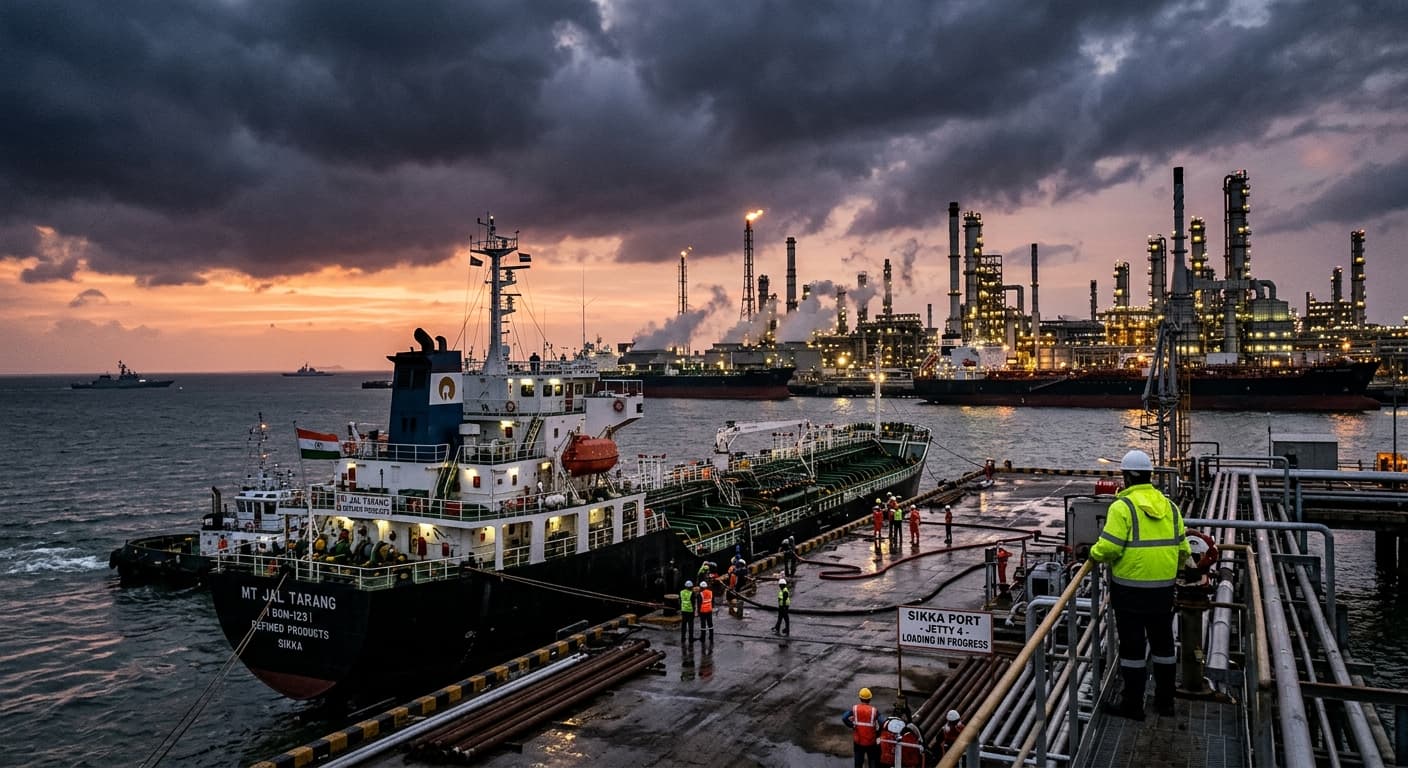
India's Refineries Are Quietly Becoming the World's Fuel Swing Producer
India is converting 88% crude-import dependence into refined-product export leverage, routing diesel to the highest bidder while Gulf and Russian flows fracture — a swing-producer role built on refinery complexity, not crude reserves.
India exported roughly 1.4 million barrels per day of refined products in July 2026, a 50% jump from May and the highest monthly volume since September 2025, with more than 80% of its diesel cargoes routed to Africa and none to Europe, according to Moonbvc. The shift marks the moment India stopped being merely the world's third-largest crude importer and started behaving like the refined-products equivalent of Saudi Arabia — a swing producer that flexes output toward whichever market pays the premium. The leverage New Delhi is accumulating is not in the oil it buys but in the fuel it sells, and it is converting a structural vulnerability into a geoeconomic asset just as the Gulf supply chain fragments.
The anatomy of a swing producer
The textbook swing producer holds spare crude capacity and releases or withholds it to balance the market. India holds almost no spare crude — it imports roughly 88–90% of the oil it consumes, a figure the Petroleum Planning and Analysis Cell tracks at record highs, according to ORF. What India holds is something rarer and, in 2026, more useful: a refining base flexible enough to run nearly any crude grade and large enough to redirect finished fuel across continents within weeks.
The International Energy Agency's World Energy Outlook 2025 projects India will account for nearly half of incremental global oil demand growth through 2035, with demand rising from 5.5 million barrels per day in 2024 to 8 mb/d in 2035 — the largest increase for any country, as CFR reports. That demand pull coincides with a refining build-out the IEA frames as globally singular: capacity is slated to rise from roughly 256.8 million metric tonnes per annum in 2023–24 to 309–310 MMTPA by 2028–30, a 20% expansion even as European and Northeast Asian refining capacity ages or closes, according to
India's Press Information Bureau.
The physical edge sits at Jamnagar. Reliance Industries' Gujarat complex carries a Nelson Complexity Index of 21.1 — the highest of any single-site refinery in the world — and has processed more than 216 different crude grades, according to ORF. That complexity is the technical prerequisite for swing behavior: it lets refiners run heavy, sour, sanctioned, or discounted barrels — Russian Urals, Venezuelan Merey, Iraqi Basrah — and still yield the diesel and jet fuel that deficit markets will pay up for. India now sources crude from roughly 40 countries, up from 27 in 2006–07, and routes about 70% of imports via non-Hormuz corridors, compared with 55% before the current conflict, as
ORF documents. Diversification is not ideology; it is refinery feedstock arithmetic.
The historical parallel is Singapore in the 1990s, which leveraged its Jurong Island refining complex and Malacca Strait location to become Asia's refining hub — buy crude anywhere, sell product everywhere. India is executing the same model at an order of magnitude greater scale, with a domestic demand base Singapore never had, and at a moment when the global fuel map is being redrawn by war and sanctions rather than by commercial logic.
The 2026 stress test
The Iran war and the effective closure of the Strait of Hormuz from late February 2026 were the catalyst that turned latent flexibility into visible market power. The IEA described the disruption as the largest supply shock in the history of the global oil market, as ORF reports. India's crude basket price surged from US$69 per barrel in February to US$126 in March — an 82% single-month spike — while roughly 2.5–2.7 million barrels per day of its imports, about 40% of the total, transit Hormuz, according to
Carnegie.
New Delhi's response exposed both the strength and the limits of the swing-producer model. On March 27, 2026, the government cut excise duty on petrol and diesel by ₹10 per litre, froze retail pump prices, and imposed export levies of ₹21.5 per litre on diesel and ₹29.5 per litre on aviation turbine fuel to keep refined product at home, as India's Press Information Bureau announced. The export duty on diesel was then raised to ₹55.5 per litre on April 11, as the
World Bank documented in its June 2026 tax-cuts briefing, which noted India "went furthest in shielding consumers" among major economies, absorbing losses through state oil marketing companies rather than passing prices through.
The domestic-first move was the mirror image of swing-producer behavior abroad. When Middle Eastern refineries were damaged in the Iran–US war and Russian diesel exports collapsed under Ukrainian drone strikes on refining infrastructure, Indian refiners stepped in, sending cargoes to wherever the highest premium was offered, according to Moonbvc. In one telling shift, more than 80% of India's diesel exports went to Africa while Europe received none — because Europe had shut out fuels refined from Russian crude, while Africa needed replacement supplies after the Hormuz crisis disrupted Middle Eastern trade flows. Indian cargoes simply changed direction.
The human cost of the shock fell hardest on cooking gas. India imports over 60% of its LPG consumption, with about 90% of those imports transiting Hormuz, as ORF details in its inflation-impact study. Refineries can tweak operations to squeeze out more LPG, but even a 10–20% boost would only lift domestic supply to about 47–50% of demand, Kpler analyst Sumit Ritolaia told the
BBC. The government ordered refineries to maximise LPG yields, lifting domestic output by about 30% compared with pre-March 5 levels — largely from the same crude input, as
ORF notes. That is the refining flexibility thesis in microcosm: same barrels, different product slate, emergency buffer created within days.
Winners and losers
The winners are visible. Reliance Industries, which operates the Jamnagar export refinery and has historically accounted for the bulk of India's product exports, captures the margin when crude discounts widen and product premiums spike. Indian state refiners — Indian Oil, Bharat Petroleum, Hindustan Petroleum — benefit from higher throughput but bear the under-recovery burden when pump prices are frozen. The exchequer forfeits revenue: the State Bank of India estimated the March excise cut alone would cost roughly ₹1.1 lakh crore (about $12 billion) for the fiscal year, as ORF reports. African buyers — Nigeria, Ghana, Senegal — gain a reliable diesel supplier when Gulf and Russian flows dry up. India's neighbours benefit directly: approximately 38,000 metric tonnes of petroleum products were dispatched to Sri Lanka in late March, covering nearly 45% of its immediate shortfall, and the India-Bangladesh Friendship Pipeline delivered about 15,000 tonnes of diesel from the Numaligarh refinery, according to
ORF.
The losers are equally concrete. European refiners face margin compression when Indian product — refined from crude they cannot legally touch — undercuts their own output. Russian crude producers see their discounted barrels arbitrage away into Indian export revenue rather than Moscow's direct earnings. Pakistan, Bangladesh, and Sri Lanka, with Gulf dependency ranging from 65% to over 80%, have far less room to reroute; their exposure to Hormuz is structural, and India's swing capacity becomes a bargaining chip in regional diplomacy. The Atlantic Council frames India's position as unique: fourth-largest refiner globally, fifth-largest exporter of refined petroleum, and the only Asian economy that can absorb sanctioned Russian crude through US waivers while simultaneously selling product to Western-aligned buyers.
The second-order effect is a quiet rewiring of the global fuel trade. India's petroleum product exports to Europe rose from 9,741 metric tonnes in FY2018–19 to 24.73 million metric tonnes in FY2023–24, according to CFR. By 2024, India was the world's third-largest refined-product exporter by value at $69.2 billion, behind only the United States and the European Union, as
World Bank WITS data shows. The
CSIS analysis underscores the bind: India's share of Russian crude had been declining from 30%+ to 19.4% in January 2026 under US pressure, but the Hormuz crisis reversed the trend, with Russia re-emerging as a Gulf-tier supplier "not by choice, but by necessity."
The constraint — margins and reserves
India's swing role pays only when the economics hold. Indian Oil Corporation's gross refining margin swung from about US$11.3 per barrel in FY2021–22 to US$19.5 in FY2022–23, then fell to roughly US$4.8 by FY2024–25 with only modest recovery in 2025–26, as ORF tracks. When margins compress, the incentive to maximise throughput weakens — and the export-duty regime further erodes it. The ₹55.5-per-litre diesel levy imposed in April is, in effect, a tax on the very export flexibility that makes India a swing producer.
The reserve position is the harder ceiling. India holds roughly 40 billion liters of crude across underground caverns in Mangalore (50% capacity), Padur (82%), and Visakhapatnam (full), enough for about eight weeks of complete supply disruption, according to Carnegie. The IEA requires full members to hold 90 days of net imports; India, an associate member since 2023, is short. The government is expediting a commercial-cum-Strategic Petroleum Reserve at Chandikhol, Odisha, and plans to augment reserves by 6 million metric tonnes — extending the buffer by ninety days. Until that capacity exists, India's swing role is funded by refinery flexibility and political will, not by strategic depth.
Diplomat View
India's refining swing is real but brittle. The thesis holds as long as three conditions are met: Jamnagar-class complexity remains unmatched globally, the US waiver architecture tolerates Russian crude flowing into Indian export refineries, and domestic political tolerance for frozen pump prices survives the fiscal cost. If any one breaks — a US sanctions tightening that closes the Russian crude tap, a refinery outage at Jamnagar, or a domestic backlash against OMC under-recoveries — the swing role narrows fast. The forecast revision trigger is specific: if the diesel export levy stays above ₹40 per litre through Q4 2026, India is prioritising domestic supply security over global market-making, and the swing-producer narrative downgrades to "crisis exporter."
What to watch:
- September 2026 OPEC+ ministerial — any decision to restore Gulf volumes will compress the premium Indian exports capture and test whether the swing role survives normalisation.
- Chandikhol SPR commissioning timeline — the Odisha reserve is the single project that would extend India's disruption buffer to 90 days and underwrite deeper swing behaviour.
- US sanctions waiver expiry — the March 5 waiver's renewal or expiration determines whether Russian crude remains the marginal barrel for India's export refineries or is forced out by enforcement.
- Indian Oil Q2 FY2026–27 earnings — the GRM trajectory will show whether refining margins are recovering enough to sustain high throughput under the export-duty regime, or whether the swing model is bleeding cash at the refinery gate.
Discover more

India
Delhi CM Rekha Gupta Blasts Opposition's Delm
Delhi CM Rekha Gupta's remarks on women's quota defeat reveal BJP's strategy for the 2029 Lok Sabha elections, focusing on delimitation.
India
BJP Congress Clash Over MP Bill Defeat
The BJP's defeat of the women's quota amendment sparks a political narrative war with Congress, impacting future elections.

US Politics
House Ethics Committee Pushes Sexual Miscond.
The House Ethics Committee has shifted responsibility for sexual harassment settlement records to the Office of Congressional Workplace Rights, complicating disclosure efforts.

Economics
Fed's Amex AML order puts correspondent banking on notice
Federal Reserve's Amex AML order requires board-level controls and a 90-day plan; OCC fined the bank $350 million over enterprise-wide deficiencies.