Tonga Ratifies CTBT After China Missile Test
Tonga's ratification sends a strong message to China.
Model Diplomat7 min readPacific
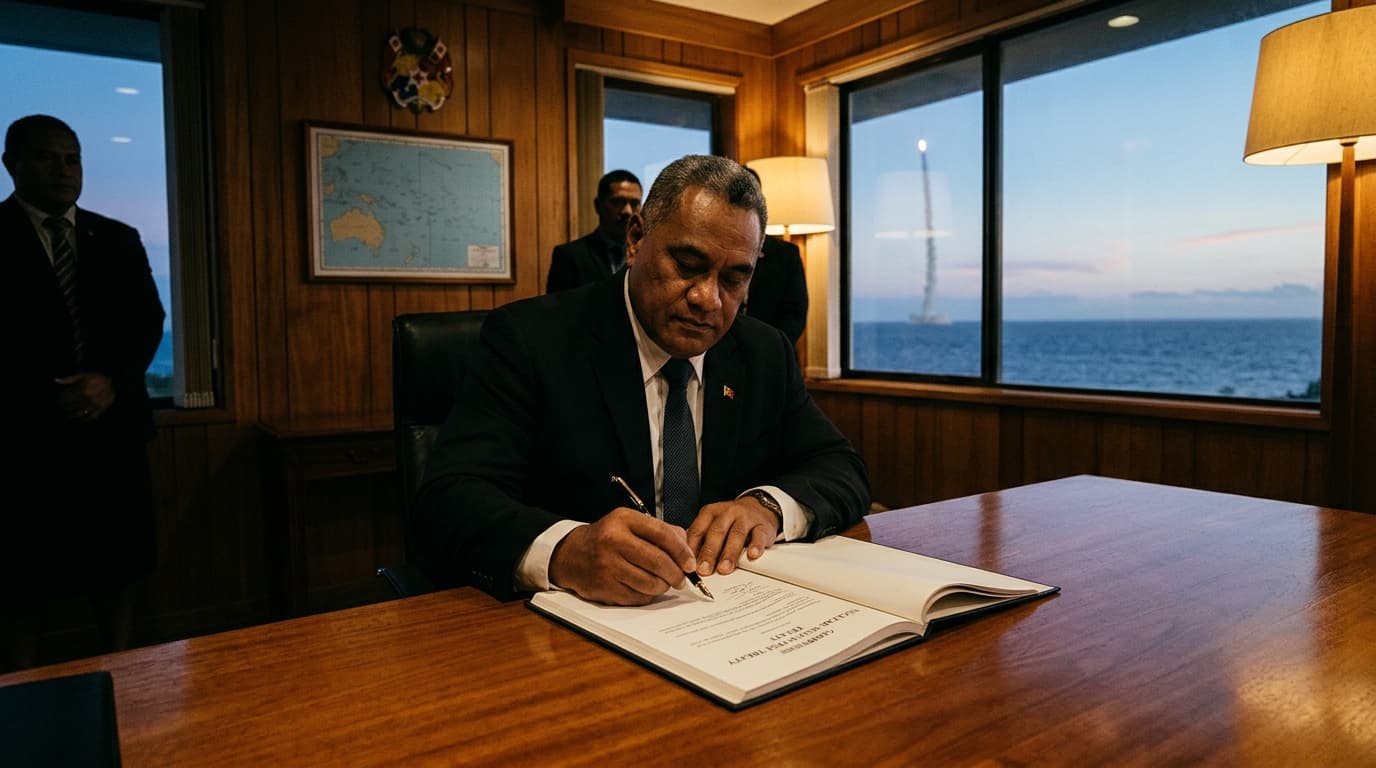
Tonga Ratifies CTBT One Day After China Fires Missile Into Pacific
Tonga became the 179th state to ratify the nuclear test-ban treaty on July 7, 2026 — 24 hours after a Chinese SLBM landed in the South Pacific Nuclear Free Zone.
Tonga deposited its instrument of ratification for the Comprehensive Nuclear-Test-Ban Treaty (CTBT) at UN headquarters in New York on July 7, 2026 — one day after a People's Liberation Army submarine fired a nuclear-capable JL-3 ballistic missile 7,300 kilometres into the South Pacific Nuclear Free Zone. The sequencing was not accidental. A kingdom of 100,000 people, holding no cards in the missile-defence conversation, used the one instrument small states retain — treaty law — to convert China's demonstration of reach into a diplomatic liability, completing CTBT universalisation across the Pacific and making Beijing the loudest holdout in a region that has now closed ranks on the norm.
Tonga's Permanent Representative to the UN, Viliami Va'inga Tōnē, framed the deposit in language calibrated for the moment. "The Pacific has felt the pain of nuclear testing. Ratifying the CTBT is our contribution to ensuring that no one, anywhere, has to go through that again," he said at the ceremony, according to RNZ Pacific. CTBTO Executive Secretary Robert Floyd called it "a meaningful contribution to the global effort to ban nuclear test explosions for good." The Preparatory Commission attributed the ratification to Crown Prince Tupoutoʻa ʻUlukalala's "strong commitment to international peace and security,"
per Pacific Island Times.
Tonga did not stop there. On the same day it also became the 100th state party to the UN Treaty on the Prohibition of Nuclear Weapons, Bytes Europe reported. Two deposits, one day, one message.
What China did — and why the timing bites
At 04:01 UTC on July 6, 2026, a PLA Navy submarine launched a JL-2 or JL-3 intercontinental submarine-launched ballistic missile from the South China Sea. The missile flew roughly 7,300 kilometres carrying a dummy warhead, likely overflew parts of the Philippines, and landed inside the South Pacific Nuclear Free Zone, according to a CSIS technical analysis by Kari Bingen and colleagues. CSIS assessed the launch as "the first time that China has ever launched a submarine-launched ballistic missile (SLBM) into international open waters" and only the second Chinese ballistic-missile launch into international waters since 1980.
The launch coincided, to the hour, with Australian Prime Minister Anthony Albanese and Fijian Prime Minister Sitiveni Rabuka signing the Ocean of Peace Alliance in Suva — Fiji's first formal defence alliance and Australia's fourth. The BBC reported that Beijing gave Canberra hours of notice, well short of the standard laid out in the Hague Code of Conduct against Ballistic Missile Proliferation, which China has not signed.
Foreign Minister Penny Wong, standing in Suva, said the test was "destabilising" and "in the context of a rapid military build-up by China." New Zealand's Winston Peters called it "an unwelcome and concerning development." Papua New Guinea and Japan both objected to the notice given; Japan received 90 minutes' warning, Al Jazeera reported. Solomon Islands Prime Minister Matthew Wale — a former China hawk elected in May 2026 — said publicly the test was "not something a friend does," a phrase
Lowy Institute analyst Oliver Nobetau called Beijing's clearest diplomatic loss in the region in years.
The legal squeeze Tonga just tightened
The awkward fact for Beijing is that China is already bound, on paper, to keep this kind of hardware out of the South Pacific. China signed and ratified Protocols 2 and 3 of the 1985 Treaty of Rarotonga in 1987 — undertakings not to use or threaten nuclear weapons against zone states, and not to test any "nuclear explosive device" in the zone. The treaty text, hosted by the Pacific Islands Forum Secretariat, defines the zone to cover the waters where the JL-3 impacted. The warhead was a dummy, so Beijing has a technical argument that no "explosive device" was tested. The political argument is harder: the missile that carried it is designed to carry a real one, and Chinese state outlet Global Times said as much, boasting that "our national nuclear triad had another upgrade" and that PLA sea-based nuclear forces could now "carry out stable, reliable strategic counterstrikes from anywhere in the vast open seas of the Pacific Ocean" —
a claim carried in a New York Times analysis flagged by the Carnegie Endowment.
Into that gap between the letter and the spirit walked Tonga. The CTBT bars all nuclear-test explosions everywhere; the CTBTO's International Monitoring System — a network of seismic, hydroacoustic and infrasound sensors — is designed to detect them. By ratifying, Tonga did not add legal constraints on China, which signed the CTBT in 1996 but has never ratified. It did something more surgical: it completed universalisation of the CTBT across the Pacific region, the CTBTO said via Post Courier, isolating Beijing as the last major regional actor outside the treaty's ratification list at the precise moment its Navy demonstrated why the region wanted the treaty in the first place.
That leaves China alongside the United States, India, Pakistan, Israel, Iran, Egypt and North Korea as the eight Annex 2 states still blocking entry into force, after Russia revoked its ratification in November 2023, per the UN Secretary-General's spokesperson. The treaty now counts 188 signatories and 179 ratifying states.
Who benefits — and who is boxed in
Three actors gain from the sequence.
Canberra. Albanese arrived at July 5 with three fresh Pacific pacts — the Nakamal Agreement with Vanuatu, the Vuvale Union and Ocean of Peace Alliance with Fiji — and a domestic case to make for more. China's missile handed him the picture he needed. Lowy's Nobetau argued the launch "may have just handed Albanese the ammunition he needs to put the tussle for regional security to bed." Michael Green of the United States Studies Centre told The Australian the launch was a clear attempt to "intimidate Pacific island nations and Australia" — an assessment that plays directly into Canberra's regional pitch.
The Kingdom of Tonga. For a state whose leverage rests on legitimacy, not force, back-to-back ratifications of the CTBT and TPNW are cheap, high-visibility signalling. They tie Nuku'alofa to the CTBTO's monitoring network, to the anti-nuclear identity Pacific electorates broadly share, and — usefully — to Australia, New Zealand and the European donor bloc that funds most Pacific diplomacy.
The CTBTO itself. Executive Secretary Floyd has spent his mandate chasing ratifications precisely because entry into force is stuck. In an October 9, 2024 briefing to the UN Security Council 1540 Committee, the organisation noted nine ratifications in the preceding eighteen months and framed universalisation as the practical objective when Annex 2 states will not move. Pacific completion is the strongest advertisement for that strategy.
Two actors are boxed in.
Beijing. The Chinese Foreign Ministry, via spokesperson Mao Ning, said the test was "consistent with international law and customary international practice" and warned critics they would "have to accept and get used to" this kind of reach. That framing collides with the Rarotonga Protocols China itself ratified in 1987, and with the CTBT it signed in 1996. Diplomatic argument in the Pacific for the rest of 2026 will be built around that contradiction.
Washington. The United States has never ratified the CTBT — the Senate voted it down 51–48 in 1999 and has not revisited it — and has still not ratified the Rarotonga Protocols despite Obama-era commitments, as the Australian Institute of International Affairs' Nic Maclellan detailed. At the 2025 NPT Preparatory Committee, the US declined to mention the nuclear-test moratorium in its Article VI statement,
the Japan Institute of International Affairs noted. That absence is now conspicuous. When Pacific states point at Beijing, they can point at Washington in the next breath.
Diplomat View
Tonga's ratification will not stop the next Chinese SLBM test, and it will not, on its own, bring the CTBT into force. What it does is convert a Pacific micro-state's principal asset — moral standing — into an instrument that makes each successive Chinese demonstration of reach more expensive in the currency Beijing has spent a decade trying to accumulate in the region: legitimacy. Our forecast: within the next six months, the Pacific Islands Forum will formally invoke the Rarotonga Consultative Committee mechanism over the July 6 launch, and at least one further Annex 2 state — most plausibly Egypt or Iran, given the CTBTO's current lobbying — will not ratify, leaving China's non-ratification the region's central non-proliferation grievance heading into the 2026 NPT Review Conference. What would falsify that call: a Chinese diplomatic pivot — a public reaffirmation of its Rarotonga Protocol obligations, or accession to the Hague Code of Conduct — before the September UN General Assembly high-level week. Absent that, the missile that was meant to intimidate the Pacific will instead have chartered its diplomatic realignment.
Key Takeaways
- Tonga's CTBT deposit on July 7, 2026 makes it the 179th state party and completes CTBT universalisation across the Pacific — 188 signatories, 179 ratifiers.
- The ratification came 24 hours after a Chinese JL-3 SLBM landed in the South Pacific Nuclear Free Zone; Tonga simultaneously became the 100th state party to the TPNW.
- China is a party to Rarotonga Protocols 2 and 3 (1987) but has never ratified the CTBT; it now stands alongside the US, India, Pakistan, Israel, Iran, Egypt and North Korea as the eight Annex 2 holdouts.
- Australia signed defence pacts with Vanuatu and Fiji in the same week; Solomons PM Matthew Wale publicly rebuked Beijing.
- The July 6 launch was China's first SLBM ever fired into international waters, per CSIS.
What to watch
- August 2026 Pacific Islands Forum leaders' meeting: whether Rarotonga Consultative Committee mechanisms are formally invoked over the July 6 launch.
- NPT Review Conference (2026): whether the United States and China issue Article VI statements referencing the nuclear-test moratorium — Russia and the US both went silent in 2025.
- US Senate Foreign Relations Committee: whether Rarotonga Protocols, referred on May 2, 2011, finally advance under pressure from Pacific partners.

For broader coverage, see Model Diplomat's International desk.
Discover more

US Politics
Virginia GOP Rallies Rural Voters Against Red
Virginia Republicans are mobilizing rural voters against a Democratic-led redistricting referendum, a fight seen as pivotal to control in the 2026 midterms.

India
Women's Reservation Bill 2026: A Political Sh
India's Lok Sabha rejected the Women's Reservation Bill, exposing a political maneuver to redraw electoral maps favoring the north over the south.
US Politics
U.S. House Passes Alert Act for Aviation
The House passed the ALERT Act 396–10, replacing the ROTOR Act after Pentagon intervention, impacting aviation safety regulations.

Conflict & Security
Drone Warfare Killing Aid Workers at Unprec
Over 1,000 humanitarian workers killed in three years as cheap armed drones collapse legal protections. Gaza, Sudan, Ukraine, and DRC see deliberate targeting of aid convoys and hospitals with zero prosecutions.