Tigray's Government Revival Threatens Peace
TPLF's actions threaten peace in Ethiopia as tensions rise.
Model Diplomat8 min readHorn of Africa
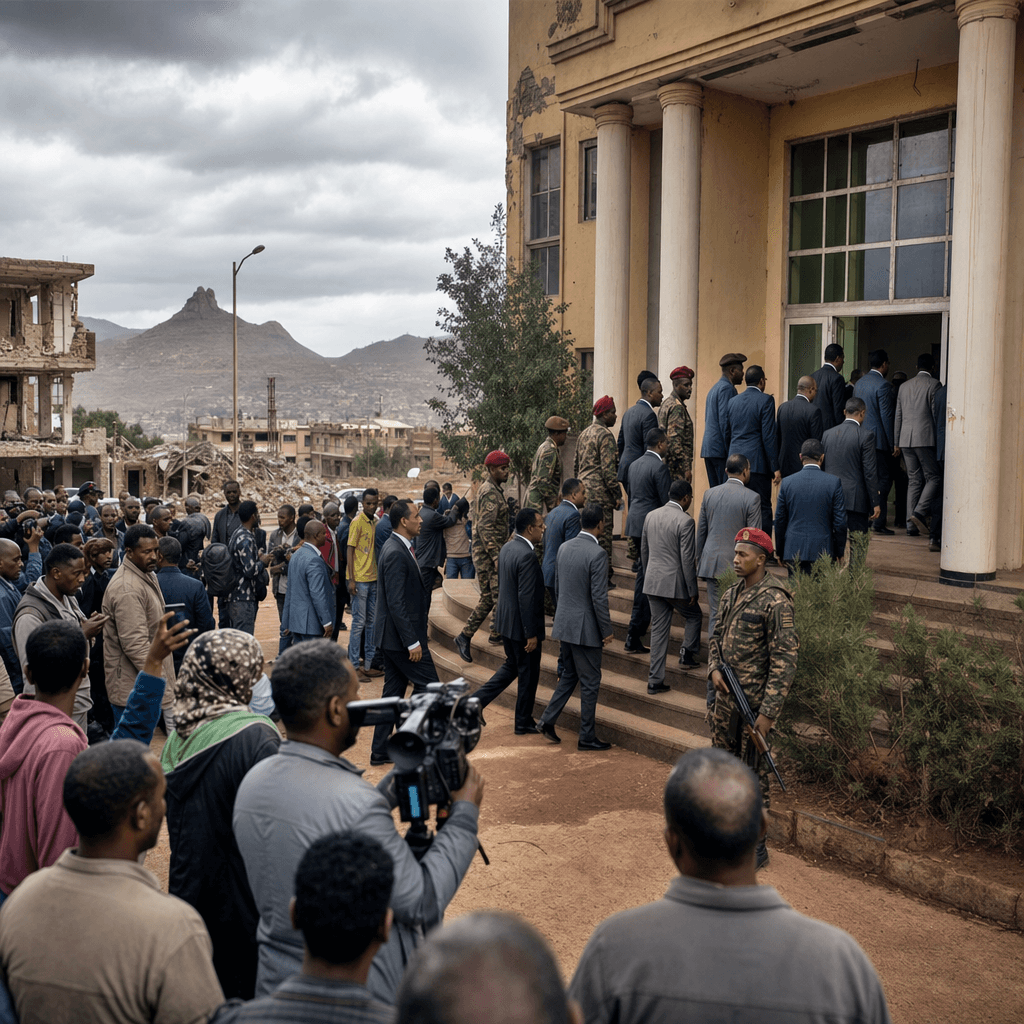
Tigray's Revived Government Puts Ethiopia on War Footing
The TPLF's May 5 seizure of Tigray's government, a June conscription law, and a fuel-starved Addis Ababa have collapsed the 2022 Pretoria peace deal in slow motion.
On May 5, 2026, a parliament that had been dissolved for six years reconvened in Mekelle and elected Debretsion Gebremichael — the man who ran Tigray during the last war — as president of the region. Since then the Tigray People's Liberation Front (TPLF) has ousted the federally-backed interim administration, passed a security proclamation that imposes the death penalty for "collaborating with the enemy," and launched a door-to-door conscription drive that Human Rights Watch compares directly to Eritrea's indefinite national service. The Pretoria Agreement that ended Africa's deadliest recent war is not dying — it is being killed, deliberately, by a party that concluded it could not survive without a state and an army of its own.
The bet in Mekelle is that Prime Minister Abiy Ahmed cannot afford a second Tigray war in 2026: he is fuel-starved by the closure of the Strait of Hormuz, politically absorbed by an election supermajority he needs to consolidate, and diplomatically boxed in by a hostile Eritrea. The TPLF is using that window to rebuild a conventional army before it closes. Whether it closes with an Ethiopian offensive, an Eritrean-Tigrayan tactical alliance, or a slow economic strangulation is now the central question in the Horn of Africa.
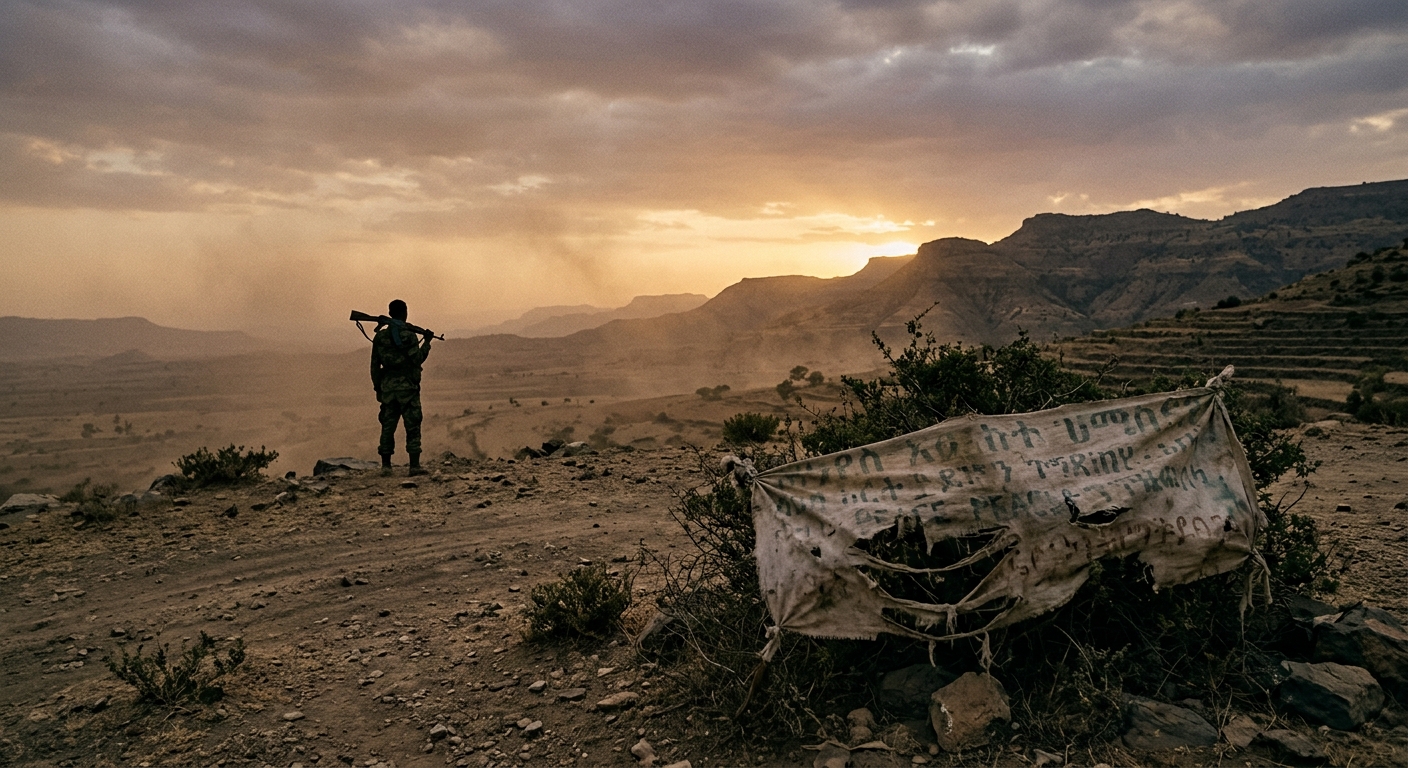
The takeover, step by step
The immediate trigger was procedural. On April 8, 2026, Abiy's cabinet unilaterally extended the mandate of Tigray's interim administration and reappointed Lt. Gen. Tadesse Werede — a former TPLF general who had drifted toward the federal camp — to another year in office. According to the International Crisis Group, the TPLF's central committee met on April 19 and rejected the extension outright, resolving instead to reinstate the regional council elected in the disputed 2020 vote that federal authorities had ruled unconstitutional.
Two weeks later that plan was executed. As BBC News Somali reported, the reinstated council held its sixth ordinary session on May 5, elected Debretsion president against one dissent and three abstentions, and appointed Kiros Hagos speaker and Mihret Berhe deputy speaker. Within days, Debretsion had taken over Tadesse's office in Mekelle, convened a cabinet, and instructed local administrators to answer to the new council rather than the interim administration. Crisis Group notes the federal government issued no formal statement — but sent fighter jets over Mekelle and left a substantial troop deployment on Tigray's borders in place.
The peace architecture built at Pretoria in November 2022 is now, functionally, a dead letter. The African Union, which mediated the Cessation of Hostilities Agreement, urged both parties in a March 2025 statement to "uphold the obligations enshrined" in the deal. That statement has not been operationalised. The AU Monitoring, Verification and Compliance Mission in Mekelle — established under the
March 2024 AU strategic reflection chaired by then-AUC chairperson Moussa Faki Mahamat — has issued no public findings on either the TPLF's takeover or the federal blockade that preceded it. The mission's silence during the two most consequential violations of the deal it was designed to police tells its own story about African Union leverage.
The conscription law is the tell
The clearest sign that the TPLF is preparing for war, not negotiation, is the security and mobilisation proclamation adopted in early June by the reconstituted regional council. In a June 23 statement, Human Rights Watch reported that the law imposes the death penalty for causing damage to "strategic defence supplies," "seriously threatening the peace and security of Tigray," "collaborating with the enemy," or "undermining or dissolving the unity and territory of Tigray irrespective of citizenship." Prison sentences of up to 25 years apply to those who criticise or advocate resistance to the recruitment drive; fines of up to 50,000 birr (roughly US $315) target draft evaders.
Laetitia Bader, HRW's deputy Africa director, said local authorities and Tigrayan forces are conducting mass, door-to-door round-ups — including of children — and are punishing parents and young siblings of those who evade the draft. The proclamation, HRW noted, "bears troubling similarities" to Eritrea's national service system, the same system Tigrayans fled in tens of thousands during the last war. A follow-up HRW briefing on July 6 documents accelerating forced recruitment and civilians fleeing the region.
That is unusual. The TPLF is not simply consolidating an existing force; it is regenerating one under legal cover. Under the Pretoria deal, the Tigray Defence Forces were meant to hand over heavy and medium weapons and enter a disarmament, demobilisation and reintegration process — a process the AU chairperson claimed had received an initial disbursement of one million dollars from the AU Peace Fund's Crisis Reserve Facility. The new proclamation reverses that trajectory in a single document.
Getachew Reda, the former TPLF spokesman who now advises Abiy, called the party's April announcement "a clear repudiation" of the Pretoria structure, according to Al Jazeera. In a June 11
Al Jazeera op-ed co-authored with former federal negotiator Redwan Hussein, he went further, accusing what he called the "rump TPLF" of "taking a few pages from the Eritrean playbook" and turning Tigray into "another dystopia of liberation." That framing matters: Getachew is not a neutral analyst but the man Abiy tried to install as Tigray's interim president before the TPLF drove him to Addis Ababa in early 2025.
Why Mekelle moved now — and why Addis Ababa hasn't hit back
The timing is not coincidence. The Crisis Group assesses that the TPLF chose the May window because Addis Ababa was uniquely vulnerable on three fronts at once.
First, fuel. Ethiopia depends almost entirely on imported diesel, and the closure of the Strait of Hormuz during the U.S.-Israeli war with Iran triggered acute shortages. The IMF's fourth review of Ethiopia's Extended Credit Facility, released December 22, 2025, records cumulative fuel price increases of about 43% for diesel and 42% for gasoline since the start of 2025 as subsidies were phased out. From a purely operational standpoint, Crisis Group notes, a major armoured offensive against Tigray is difficult under those conditions — armour and rotary wing platforms burn what Ethiopia does not have.
Second, politics. The June 1 election delivered Abiy's Prosperity Party 438 of 501 contested seats — a supermajority the prime minister will not want to muddy by rebroadcasting scenes of a burning Mekelle before his October swearing-in. Tigray's 38 constituencies were excluded from the vote entirely. As
Foreign Affairs argued before the election, the electoral board had already put its thumb on the scale by barring the TPLF and favouring the Abiy-aligned Simret party, a decision the
Centre for Strategic and International Studies says removes precisely the incentive to accommodate ethnic-federalist grievances where accommodation is most needed.
Third, alliances. Eritrea, once Ethiopia's co-belligerent against the TPLF, is now Addis Ababa's principal rival. On February 7, Ethiopia's foreign minister Gedion Timothewos formally demanded that Eritrean troops withdraw from Ethiopian territory, calling their presence "acts of outright aggression." Asmara
denied the accusations and countered that Addis Ababa was "itching to unleash" war. Credible reports cited by
Chatham House in March 2025 suggested Eritrea had held secret talks on a tactical alliance with elements of the TPLF — a striking reversal for two forces that spent 2020–22 slaughtering each other's fighters over the same terrain.
The federal response so far has been calibrated coercion rather than open war. Crisis Group reports that after the May 2025 deregistration Addis Ababa "started to restrict government budget subsidies and fuel supplies to Tigray, imposing a kind of economic blockade on the region," and quietly backed a Tigray Peace Force splinter that began a low-level insurgency against the TPLF. The January 31 drone strike in Gendebta was the first direct federal engagement of Tigrayan forces since 2022. It is a template — cheap, deniable, and immune to the fuel constraint — that Addis Ababa can scale.
Who wins, who loses
The winner in the short term is Debretsion personally. Sidelined by his own party's peace faction in 2023, he has recaptured the presidency, the party chairmanship, and — through the new proclamation — the coercive apparatus of the state. The Clingendael Institute has documented how federal moves since 2018 systematically stripped the TPLF of its business empire and independent revenue base, from the METEC conglomerate to the EFFORT holding group. Reviving the pre-war state is Debretsion's only remaining lever to rebuild patronage — and to price himself back into any successor deal to Pretoria.
The loser is the Tigrayan civilian. Ethiopia's May 2026 IDP figures, compiled by UNHCR, record 1.92 million internally displaced people nationwide and 2.81 million returnees, with Tigray hosting the largest share of returnees at roughly 38% per
IOM's 2026 Ethiopia Crisis Response Plan. These are the people the new conscription law targets. The
IMF Article IV estimated in 2025 that 21.4 million Ethiopians — one-fifth of the population — needed humanitarian assistance in 2024, at the same moment U.S. aid was being cut. A second Tigray war would land on a population already at the edge.
The second-order loser is the African Union's peacemaking brand. Pretoria was sold as the vindication of "African solutions to African problems," a phrase Abiy invoked in his own AU speech celebrating the accord. If the deal collapses without the AU High-Level Panel — Olusegun Obasanjo, Uhuru Kenyatta, Phumzile Mlambo-Ngcuka — publicly diagnosing the breakdown, future mediators in the Horn will have a harder case to make that continental frameworks bind.
Diplomat View
The Pretoria Agreement is over in substance if not in name. The operative question for the next quarter is not whether the deal survives, but which coercive instrument Addis Ababa uses to answer the TPLF's fait accompli. My call: Abiy will not launch a full ground offensive before his October 2026 inauguration, because the fuel constraint documented in the IMF's December 2025 review and the political cost of shredding a supermajority mandate are both binding. He will tighten the economic blockade, expand drone strikes on Tigrayan units and materiel, and let the Tigray Peace Force splinter absorb attention as a proxy. That posture holds unless one of three things changes: Eritrean forces move openly into Tigray in support of the TPLF; the Strait of Hormuz reopens and Ethiopian fuel stocks recover to pre-June 2025 levels; or a mass-atrocity event inside Tigray forces the AU or the United States to visibly re-engage. Any of those would collapse the calibration and put a ground war on the table within weeks.
What to watch next:
- Abiy's October 2026 inauguration speech — the first authoritative signal of whether federal policy on Tigray moves from calibrated coercion to open confrontation.
- The AU Peace and Security Council's next Ethiopia agenda item — the test of whether the MVCM in Mekelle will publicly report on the conscription drive HRW documented on June 23 and July 6.
- The next Ethiopian budget cycle (FY26/27) — whether federal subsidies to Tigray are formally zeroed out or quietly restored as a negotiating card.
The Bottom Line
The bottom line: Tigray's revived pre-war government is not a symbolic gesture — it is a party rebuilding a state and an army under legal cover because it concluded the Pretoria Agreement offered neither survival nor leverage. The question is no longer whether the peace holds, but whether Abiy Ahmed, constrained by fuel, an election, and Eritrea, chooses strangulation over invasion. Either path ends with Tigrayan civilians paying the price for a war fought in slow motion.
Discover more

Global Politics
US Seizes Iranian Ship, Tensions Surge
The US seizure of the Iranian ship Touska highlights a shift in control over the Strait of Hormuz, favoring Iran's strategic position.
India
Romanian Coalition Party Demands PM Resign
Romania's Social Democrats withdrew from coalition, joining far-right AUR to topple PM Bolojan, risking €10 billion in EU funds by August 2026.

Conflict & Security
Drone Warfare Killing Aid Workers at Unprec
Over 1,000 humanitarian workers killed in three years as cheap armed drones collapse legal protections. Gaza, Sudan, Ukraine, and DRC see deliberate targeting of aid convoys and hospitals with zero prosecutions.

Global
World Normalises Taliban as Afghan Women Eras
UN data shows Afghan women erased from public life as Russia recognises the Taliban, EU hosts officials in Brussels, and ICC warrants for gender persecution go unenforced.