The Drone-Corridor Sleight of Hand
How a Tamil Nadu factory floor becomes Taiwan's second line of defense
Model Diplomat9 min readAsia
The Drone-Corridor Sleight of Hand: How a Tamil Nadu Factory Floor Becomes Taiwan's Second Line of Defense
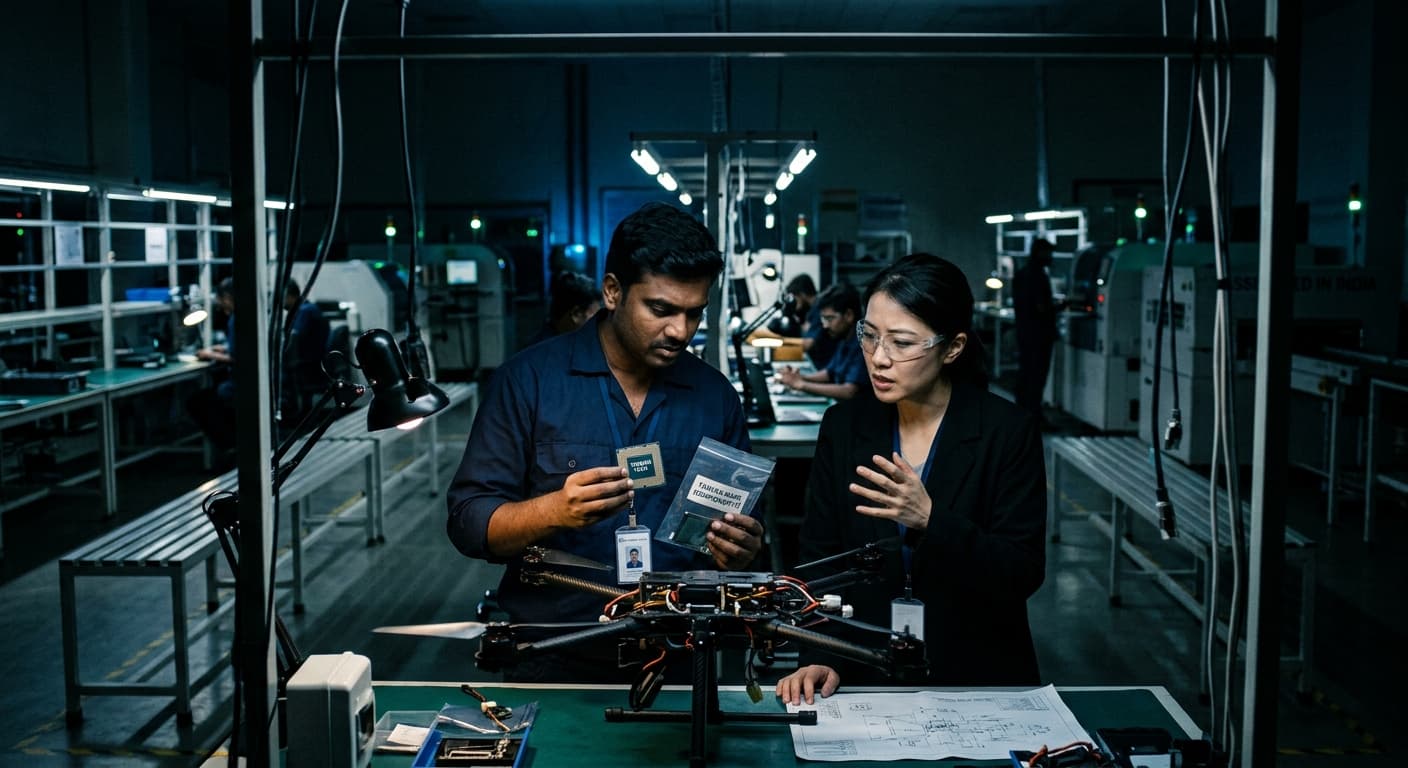
A single editorial in the Taipei Times on July 22 proposes a step-change in the India-Taiwan relationship. It is not a proposal for a formal alliance, an arms deal, or a security guarantee. It is a blueprint for factory floors in Tamil Nadu to build drone components for Taiwan, and its strategic weight rests on a single, deliberate ambiguity: the parts are dual-use industrial technology, not weapons. That classification is the entire architecture. It allows India to deepen military-relevant cooperation with Taiwan without crossing Beijing's red lines on the One-China principle, while giving Taiwan a secondary manufacturing base that is blockade-proof, non-Chinese, and politically deniable.
The editorial, written by Akankshya Ray, a graduate researcher at National Chengchi University in Taipei, is a response to a July 2 speech by Raymond Greene, the director of the American Institute in Taiwan and de facto US ambassador to the island. Greene told a drone forum in Taichung that "nothing will deter conflict more effectively than turning Taiwan into a hornet's nest of air, surface, and subsurface drones," according to Al Jazeera. The reference to Ukraine's drone-heavy defense was explicit. But Ray's editorial identifies what Greene's framing omitted: Taiwan lacks the manufacturing scale to build that nest alone. India has the capacity but lacks the precision components. The inverse fit is structural and, critically, commercially legible in ways that arms sales are not.
The Regulatory Puzzle That Makes the Corridor Possible
The editorial's most important operational detail is its treatment of India's drone import ban. On February 9, 2022, the Directorate General of Foreign Trade issued Notification No. 54/2015-2020, which prohibits the import of drones in Completely Built Unit (CBU), Completely Knocked Down (CKD), or Semi-Knocked Down (SKD) forms — with exceptions only for research and development, defense, and security purposes. Drone components, however, remain free to import. This regulatory wedge, recorded in the WTO Import Licensing Portal, means that exporting finished Taiwanese drones to India is legally impossible.
The workaround that Ray sketches is "joint ventures in India's aerospace hubs" where Taiwanese component makers are "directly embedded into the Indian assembly lines." This is not a technical afterthought. It is the only legally viable model. And that model transforms what would be a conventional arms-export relationship into something diplomatically quieter: a commercial supply-chain partnership between firms in two economies that do not have formal diplomatic relations. As Ray writes, the arrangement "respects India's diplomatic boundaries, as drone subcomponents such as GPS modules and AI chips are fundamentally dual-use industrial tech rather than lethal weapon systems." The fiction is thin, but legally it holds.
The Component Gap: Where the Numbers Converge
The economic logic is grounded in two deficits that interlock. India's domestic drone market is projected at NT$59.8 billion (US$1.85 billion) in 2026, according to KPMG data cited in the Taipei Times editorial. Yet 85% of critical electronic components, including autopilots, sensors, and GPS units, are imported. India's 32 domestic component manufacturers supply only low-tech mechanical parts such as airframes and cables, a pattern confirmed by the
Institute for Defence Studies and Analyses, which noted that more than 75% of drone components are imported, with the main sources being China, Taiwan, and the United States. India also faces a shortfall of certified drone pilots. Demand is estimated at 40,000, with supply far below that figure, especially for medium and large drones.
Taiwan faces the inverse problem. It has advanced ICT design capacity and is racing to build a "China-free" drone supply chain. In April 2026, The Economist profiled Taiwan's efforts to pioneer drones free of Chinese components, a project made urgent by the fact that China dominates the international drone industry. Taiwan's government has proposed a NT$210 billion (US$6.59 billion) package for surveillance, coastal attack, and small unmanned surface drones through 2031, but in May 2026 the opposition-dominated parliament passed only two-thirds of the $40 billion in extra defense spending that President William Lai had requested, earmarking funds exclusively for US arms, according to
Al Jazeera. A $14 billion US arms sale to Taiwan was simultaneously put on hold to preserve munitions for the US-Israel war against Iran. Taiwan's drone ambitions and its reliance on US-supplied alternatives are thus doubly constrained.
This is where the convergence becomes operational. Taiwan has components India needs; India has manufacturing scale Taiwan lacks. And both have a structural imperative to purge Chinese hardware from their defense supply chains. India's Ministry of Defense launched a comprehensive audit in 2025 to eliminate Chinese-made parts from all weapons platforms, according to the Council on Foreign Relations, and in February 2026 canceled drone procurement orders after discovering that many final products contained numerous Chinese parts. Taiwan's drone makers have been working since 2022 to purge every Chinese-made part from their supply chains, a process that initially tripled production costs, as Geosat founder Lo Cheng-Fang told
NPR.
The Tamil Nadu Blueprint
The spatial architecture of the proposal is precise. Ray cites Gaurav Daga, senior vice president of the Tamil Nadu Investment Promotion Agency, who presented a blueprint at the Taiwan-India Investment Partnership Forum in Taipei on June 2, 2026. The decentralized ecosystem maps three nodes across southern India:
- Chennai, home to several Taiwanese electronics firms, for avionics and electronics production
- Hosur, the main base for mass production of drone airframes
- Coimbatore, building expertise in advanced precision machinery and heavy tooling parts
These are not aspirational sites. Tamil Nadu was designated as one of India's two Defense Industrial Corridors in the 2018-19 Union Budget, with five nodes — Chennai, Coimbatore, Hosur, Salem, and Tiruchirappalli — identified by the Ministry of Defence. The state's drone ecosystem has accelerated under policy support: the Production-Linked Incentive scheme allocated ₹120 crore over three financial years; GST on drones was cut to a uniform 5% from the earlier 18-28% in September 2025; and Garuda Aerospace inaugurated a 35,000-square-foot Agri-Drone Indigenization Facility in Chennai in June 2025, with a target of manufacturing over 100,000 drones in two years, according to the
Press Information Bureau. The state also houses a drone testing facility near Sriperumbudur and counts Zuppa Geo Navigation, Big Bang Boom Solutions, Dhaksha, ePlane, and Data Patterns among its private-sector UAV players, as detailed by
FlyandTech.
The component gap in India's drone ecosystem
| Component Category | Domestic Capability | Import Dependence |
|---|---|---|
| Autopilots, sensors, GPS | Minimal (32 manufacturers, low-tech only) | ~85% imported |
| Airframes, cables, mechanical parts | Established domestic supply | Low |
| Motors, power packs, payloads | Limited | High (China, Taiwan, US) |
| Medium/large drone production | Underdeveloped | Critical shortage of certified pilots |
Sources: KPMG via Taipei Times; IDSA Journal of Defence Studies, 2026
A separate ₹20 billion (US$234 million) scheme is in planning, aiming for at least 40% of key drone components to be manufactured indigenously by 2028. The policy scaffolding is in place; the missing piece is access to precision electronic components that are not Chinese — and that is precisely the slot Ray's editorial argues Taiwan can fill.
The Strategic Calculus: What India Gains
The proposal's appeal to New Delhi rests on three reinforcing incentives. None require India to abandon strategic autonomy.
First, the arrangement deepens India's hedging against Chinese military pressure without triggering escalation. The Observer Research Foundation has characterized India's approach as a "soft-hedging strategy that leverages asymmetric economic interdependence with Taiwan while preserving strategic ambiguity." The drone corridor fits this model precisely — it is economic engagement with military-relevant spillovers, not a defense pact. ORF noted in a separate analysis that "many in China believe that the intensification of security cooperation between India and Taiwan is only a matter of time," but also that Beijing struggles to respond as long as the red lines of "official recognition" and "military alliance" are not crossed.
Second, it addresses a genuine vulnerability. The Lowy Institute has documented that approximately 40% of India's trade passes through the Malacca Straits, that India's 15 submarine cables connecting it to Silicon Valley are all anchored near Taiwan, and that critical imports of semiconductors, microprocessors, and medical equipment would be blocked in any Taiwan Strait crisis. Former Indian Foreign Secretary Vijay Gokhale has warned that "we are totally unprepared for a crisis in the Taiwan Strait." Diversifying drone supply chains southward — into India's own industrial base — serves India's economic security as directly as Taiwan's military security.
Third, the proposal creates leverage for India's domestic manufacturing ambitions. The "Make in India" and "Atmanirbhar Bharat" (self-reliant India) initiatives have identified drones as a priority sector, with the Ministry of Civil Aviation setting a target for India to become a global drone hub by 2030. Embedding Taiwanese component technology into Indian assembly lines transfers know-how into India's defense-industrial base without requiring formal technology-transfer agreements between governments — the joint-venture model keeps the exchange at the firm-to-firm level.
What Beijing Sees
The Chinese strategic community has been tracking India-Taiwan ties with growing unease. The ORF reported in 2025 that "some Chinese scholars argue that India's current approach towards Taiwan mirrors how the United States once played its 'Taiwan card' — beginning with visits by low-level officials to test the waters, followed by unofficial exchanges, and eventually progressing to arms sales and defense assistance." Chinese state media outlet Global Times previously warned that "by challenging China over the Taiwan question, India is playing with fire."
Yet the drone corridor is structurally harder for Beijing to counter than official visits or arms sales. It unfolds in the private sector, uses dual-use components, and can be justified entirely through commercial and supply-chain-resilience rationales. The arrangement is an exercise in what the Carnegie Endowment for International Peace called "calibrated soft balancing" — maximizing gains while minimizing the risk of triggering a systemic backlash from the dominant power. Carnegie also warned that Beijing would likely view any Indian logistical assistance to the US in a Taiwan contingency — including use of the Andaman and Nicobar Islands — as a red line. The drone corridor stays well short of that threshold.
The second-order effect for China is the complication of its blockade calculus. If Taiwan can draw on manufacturing capacity in southern India — geographically distant from the Taiwan Strait, embedded in a nuclear-armed state with its own border disputes with China — then any Chinese attempt to blockade the island's supply lines faces an additional geographic and political obstacle. The Hudson Institute has argued that India is "critical to deterring a Chinese invasion of Taiwan" precisely because "China cannot mass its military resources if it needs to devote a significant share to guarding against India." A drone production corridor in Tamil Nadu operationalizes that logic at the industrial level.
The Diplomat View
The Ray editorial is not a policy document — it is a graduate researcher's op-ed. But it lands at a moment when the structural conditions it describes are hardening into alignment. India's defense ministry is purging Chinese components from its supply chains. Taiwan's legislature is debating drone funding packages. The US is signaling that its own munitions supply — strained by the Iran conflict — cannot be Taiwan's sole source. The gap the proposal identifies is real, and the regulatory architecture to exploit it already exists: India's 2022 import ban on finished drones forces joint ventures rather than arms-transfers, which is precisely what makes the corridor diplomatically viable.
Three conditions would determine whether this blueprint moves from editorial page to factory floor. First, whether Taiwanese component firms — particularly in GPS modules, autopilot systems, and AI chips — are willing to establish joint ventures in Tamil Nadu without formal investment-protection agreements between the two governments. Second, whether India's Ministry of Defense is prepared to certify dual-use components from Taiwanese joint ventures for use in Indian defense platforms, given the sensitivity of the China relationship. Third, whether Beijing chooses to interpret the corridor as a commercial arrangement — or as the thin end of an India-Taiwan defense wedge that it has long anticipated and warned against.
The bottom line: The Taipei Times editorial proposing a Taiwan-India drone corridor is a diplomatic architecture disguised as a supply-chain proposal. By exploiting the dual-use nature of drone components and India's ban on fully assembled imports, the arrangement creates a legally and politically deniable path for Taiwan to anchor a secondary manufacturing base in South Asia — one that serves India's own component needs, deepens the strategic entanglement Beijing most fears, and does so without requiring either Taipei or New Delhi to cross the red line of formal military cooperation.
Discover more
Global Politics
Xi Jinping Calls China-Russia Ties 'Precious'
Xi Jinping's description of China-Russia ties as 'precious' reflects a strategic imbalance, with Beijing dictating terms in the partnership.
India
Congress Accuses Modi of Stalling Women's Law
Congress accuses Modi of stalling women's reservation law by linking it to delimitation, revealing a deeper electoral strategy.
India
BJP's Misunderstanding of Women's Quota Needs
The BJP's linking of the Women Reservation Bill to delimitation risks delaying women's empowerment in India, misreading the aspirations of female voters.

Conflict & Security
Drone Warfare Killing Aid Workers at Unprec
Over 1,000 humanitarian workers killed in three years as cheap armed drones collapse legal protections. Gaza, Sudan, Ukraine, and DRC see deliberate targeting of aid convoys and hospitals with zero prosecutions.