The Donroe Doctrine: Trump’s Latin America
Trump's hemispheric strategy reshapes U.S.-Latin relations.
Model Diplomat8 min readAmericas
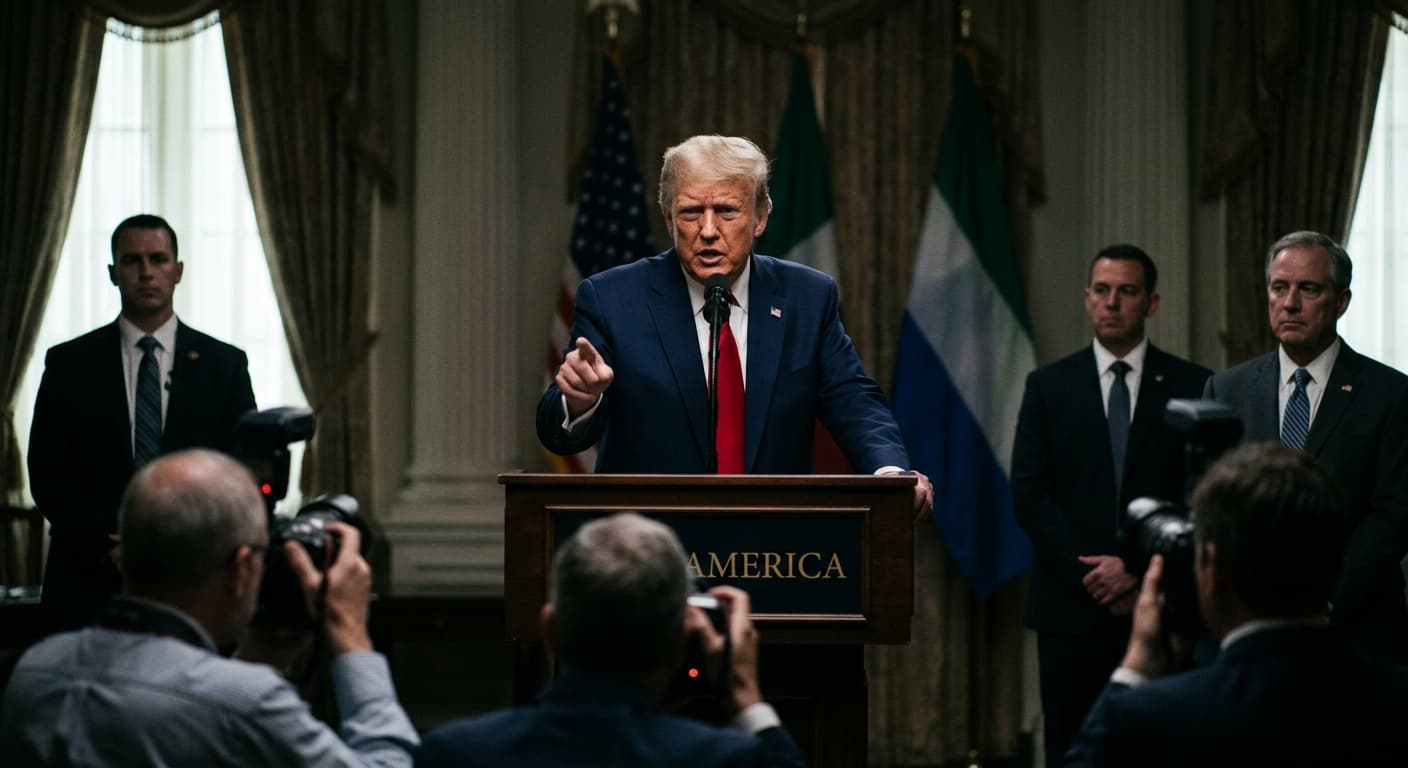
The Donroe Doctrine: How Trump Turned Latin America Into a Protectorate
Trump's "Donroe Doctrine" replaces America First with hemispheric primacy — military strikes, right-wing partners, and a Venezuela-style oil escrow that turns U.S. security guarantees into fiscal control.
Pentagon policy chief Elbridge Colby stood in Cusco on July 8, 2026, and told the Conference of Defense Ministers of the Americas that Washington's new hemispheric doctrine is not imperial — because, he said, "America doesn't need your assets or your dependency." The speech, reported by The Independent, formalized what has been visible since January: the so-called Donroe Doctrine is a protectorate model, not a Monroe revival — Washington provides the security umbrella, right-wing partners provide political cover, and the United States controls the money. Venezuela's oil revenue, now flowing through a U.S.-supervised account in Qatar, is the template. The question for the region is whether any partner can accept the security bargain without eventually accepting the fiscal one.
From slogan to codified strategy
The Trump administration first inscribed the doctrine into policy in late 2025. Its National Security Strategy declares that "after years of neglect, the United States will reassert and enforce the Monroe Doctrine to restore American preeminence in the Western Hemisphere." A Congressional Research Service assessment published in early 2026,
U.S. Foreign Policy in the Western Hemisphere: Issues for Congress, catalogues the break with 30 years of policy: heavier emphasis on migration control and "extra-hemispheric" competitors, less on democracy and free trade, and greater reliance on "hard power tools, including U.S. military force and tariffs."
The rhetorical rebrand followed the action, not the reverse. In September 2025 the Pentagon began striking suspected drug boats in the Caribbean and eastern Pacific in a campaign that Al Jazeera characterized as repurposing the post-9/11 "war on terror" against Latin American criminal networks. On November 13, Defense Secretary Pete Hegseth announced Operation Southern Spear, with the USS Gerald R. Ford strike group off Venezuela's coast — a deployment that
CSIS analysts noted was "poorly structured for striking drug boats" but "well-structured for strikes against Venezuela." On January 3, 2026, U.S. special forces executed Operation Absolute Resolve: a raid on Caracas that killed roughly 75 Cuban and Venezuelan guards, extracted Nicolás Maduro and his wife, and flew them to New York, according to the
Council on Foreign Relations.
At the Mar-a-Lago press conference that morning, Trump dusted off the 1823 doctrine and rebranded it "Donroe." American dominance in the Western Hemisphere, he said, "will never be questioned again," according to the BBC. A December 2, 2025 presidential message on the anniversary of the Monroe Doctrine locked the language into the record: "Reinvigorated by my Trump Corollary, the Monroe Doctrine is alive and well," according to
the White House.
[Timeline card: "From boat strikes to Cusco: 10 months of the Donroe Doctrine" — see card above]
The Venezuela template: security guarantee, fiscal capture
The real analytical content of the Donroe Doctrine is not in Colby's speech. It is in the Qatar account.
Since January, Venezuela's interim President Delcy Rodríguez has moved 30 to 50 million barrels of crude to U.S.-controlled buyers. Proceeds — a first tranche of $500 million — do not enter Venezuela's central bank. They sit in a restricted account in Qatar, disbursed against U.S.-approved budget requests for salaries and essential services, Al Jazeera reported. The U.S. Department of Energy stated bluntly on January 7 that sales "will continue indefinitely" and be "disbursed for the benefit of the American people and the Venezuelan people at the discretion of the US government," according to
Al Jazeera.
Rodríguez signed a hydrocarbons reform on January 29 that unwound 25 years of nationalization-first policy, opening the sector to foreign investors, Al Jazeera reported. Chevron is expanding output; Exxon is sending a technical team. But at a February White House meeting, Exxon chief executive Darren Woods called Venezuela "uninvestable" without physical security and enforceable contracts,
the BBC reported — the tell that the U.S. security umbrella is the enabling condition for the fiscal architecture, not a separate policy. Trump has asked for at least $100 billion in oil-industry commitments; Rystad Energy's chief economist told the BBC that companies would only invest at that scale with subsidies and political stability, calling the $100 billion figure "fantastical."
[Stat card: "$500M — First tranche from Venezuelan oil sales, deposited in a U.S.-controlled account in Qatar" — see card above]
This is not the Roosevelt Corollary and not the Good Neighbor Policy. It is closer to a receivership. Jose Manuel Puente of Caracas's IESA administration school told Al Jazeera plainly: "Venezuela is a state under tutelage right now by the US. The US took control of all its income." NPR analysis characterized Trump's own worldview as neither neoconservatism nor America First isolationism, but what CFR's James Lindsay called
"ultra-realism" — "a nationalist… a unilateralist… sounding more and more like an imperialist." Colby's Cusco speech, urging partners to "protect your critical assets," is the diplomatic wrapper on that operating logic.
The right-wing regional bloc — and its ceiling
The doctrine leans on an electoral shift. Argentina under Javier Milei, El Salvador's Nayib Bukele, Ecuador's Daniel Noboa, and — after this year's runoff — Colombia's incoming Abelardo de la Espriella, who has pledged to join Trump's "Shield of the Americas," form the core. Chile's president-elect José Antonio Kast joined at Mar-a-Lago in March. Argentina, Ecuador, El Salvador and Guatemala have signed reciprocal trade agreements with counter-China clauses, according to CSIS — provisions that in some cases stretch beyond trade into space cooperation and telecoms.
The bloc's ceiling, however, is visible. Brazil, Mexico and Colombia — three of the four largest economies — did not attend Shield of the Americas. NPR's coverage from March 7 confirmed that only 12 handpicked conservative leaders made the guest list, and that Brazil, Mexico and Colombia were absent, according to NPR. Mexico's Claudia Sheinbaum has traded confrontation for compromise but has not signed onto military strikes on Mexican soil. Colombia's outgoing Gustavo Petro told the
BBC in January that he saw a "real threat" of U.S. military action against his own country after Trump said an operation against Bogotá "sounds good to me."
The second-order economic problem is that the doctrine's political base cannot rewrite regional trade flows. China is now the leading trade partner of every country in South America except Colombia, NPR reported, and Beijing's trade with the region hit a record $518 billion in 2024 with more than $120 billion in outstanding loans across the hemisphere, per
CSIS. When Trump placed tariffs on China last year, Beijing halted U.S. soybean purchases and turned to Argentina — a Milei ally — instead. The Council on Foreign Relations, in a March 27 analysis, argued the Donroe Doctrine "leans on sticks but needs carrots" and cannot displace Chinese capital without reauthorizing the U.S. Export-Import Bank and mobilizing the Development Finance Corporation, according to
CFR.
[Table card: "The Donroe bloc: who's in, who's out" — see card above]
Where the doctrine bites — and where it may snap
The doctrine's flagship instrument, extrajudicial boat strikes, is producing diminishing returns even in the eyes of the officer who runs the campaign. SOUTHCOM Commander General Francis Donovan told the Senate Armed Services Committee this spring that "the boat strikes aren't the answer," according to CSIS. At least 44 aerial strikes had killed roughly 150 people by early March,
Al Jazeera reported, with no independently released evidence that any target was trafficking narcotics. Adam Isacson of the Washington Office on Latin America described the campaign as an attempt to "normalise something that is illegal," per
Al Jazeera.
The ground-operations pivot is also expanding. On March 3, U.S. and Ecuadorian troops carried out a joint operation on Ecuadorian soil against a "Designated Terrorist Organization," the BBC reported — the first such combined action of the campaign — followed a week later by an FBI field office in Quito. Ecuador's population had voted against foreign military bases in 2024, yet Noboa has become the doctrine's most enthusiastic partner, deploying more than 75,000 soldiers and police against cartels in March, according to
the BBC. The bilateral bear-hug is a template Colombia's incoming government has signaled it wants to replicate.
Push-back is congressional and legal, not diplomatic. A February 2026 House resolution, H.Res. 1056, calls on the State Department to "formally confirm that the Monroe Doctrine is no longer a part of United States policy" and to develop a "New Good Neighbor" policy — a direct rebuke to the White House. The resolution has no majority behind it, but it establishes the domestic legal framing for any future court challenge to strike authorizations. The CFR's Charles Kupchan argues Trump has "dramatically overcorrected," creating a "wide gap between his neo-isolationist rhetoric and his neo-imperial policies" that is
already dragging on his political support.
The historical parallel is not Theodore Roosevelt. Michael Cullinane of Dickinson State University's Theodore Roosevelt studies program told NPR that "the lead-up to what Trump did is very similar to what Roosevelt did, but the 'speak softly' bit was missing. He didn't conduct diplomacy before using the big stick. He just used the big stick." A closer analogy is Woodrow Wilson's Caribbean occupations of 1915–1934 — invaded countries whose customs receipts were routed through U.S.-controlled accounts to service foreign creditors. The Qatar escrow rhymes.
Diplomat View
The Donroe Doctrine's viability turns on Venezuela's oil, not on Cusco's rhetoric. If Rodríguez holds through the U.S. midterms — the deadline James Story, a former U.S. ambassador to Venezuela, told NPR she is quietly betting on — and if Chevron plus one European supermajor commit at least $8 billion a year in reinvestment, the protectorate model becomes durable and exportable to a future Colombia. If either fails, the doctrine collapses back into the boat-strike theater that SOUTHCOM's own commander says is not working, and Trump will face a choice between de-escalation and a ground campaign inside Venezuela that no Latin American partner has publicly endorsed. The revision trigger to watch: whether Exxon and Shell make firm capital commitments before Congress returns from August recess. If they don't, the "fiscal capture" phase of Donroe will start to look, at home and abroad, like an unfunded occupation.
Forward look — what to watch next:
- August 2026: Exxon technical team's assessment of Venezuelan assets due; without a firm reinvestment number, the Qatar escrow becomes the only revenue mechanism keeping Caracas solvent.
- November 3, 2026: U.S. midterm elections. A weakened Trump majority in the House would empower H.Res. 1056-style challenges and War Powers Resolution votes on strike authority.
- May 2026 (Colombia) and later Peru: Presidential transitions to Abelardo de la Espriella and Keiko Fujimori close the doctrine's electoral map — or, if either loses momentum, open the first cracks in the right-wing bloc that Colby needs in Cusco.
The Bottom Line
The Donroe Doctrine is not a Monroe revival — it is a receivership model in which U.S. security guarantees purchase U.S. control over partner-state revenue, with Venezuela's Qatar escrow as the working prototype. It will hold as long as right-wing governments in Buenos Aires, Quito, San Salvador and Bogotá deliver political cover and Chevron delivers barrels; it will fracture the moment either the boats or the oil stop flowing on Washington's terms.
Discover more
US Politics
Virginia's Redistricting Referendum
Virginia's redistricting referendum is drawing a flood of dark money, shaping future elections and the fight for congressional control amid party stakes.

India
Yamini Aiyar on Modi's Federalism Shift
Yamini Aiyar critiques Modi's shift from equity-based to performance-based federalism, highlighting implications for India's political landscape.
Global Politics
U.S. Maritime Pressure on Iran
Washington escalates maritime security operations and sanctions on Iran, disrupting Gulf shipping and reshaping global energy flows in a major strategy shift.

Economics
Fed's Amex AML order puts correspondent banking on notice
Federal Reserve's Amex AML order requires board-level controls and a 90-day plan; OCC fined the bank $350 million over enterprise-wide deficiencies.