Tariff Rebuild: Forced Labor and Section 301
USTR's new tariffs impact 60 economies amid legal challenges.
Model Diplomat8 min readNorth America
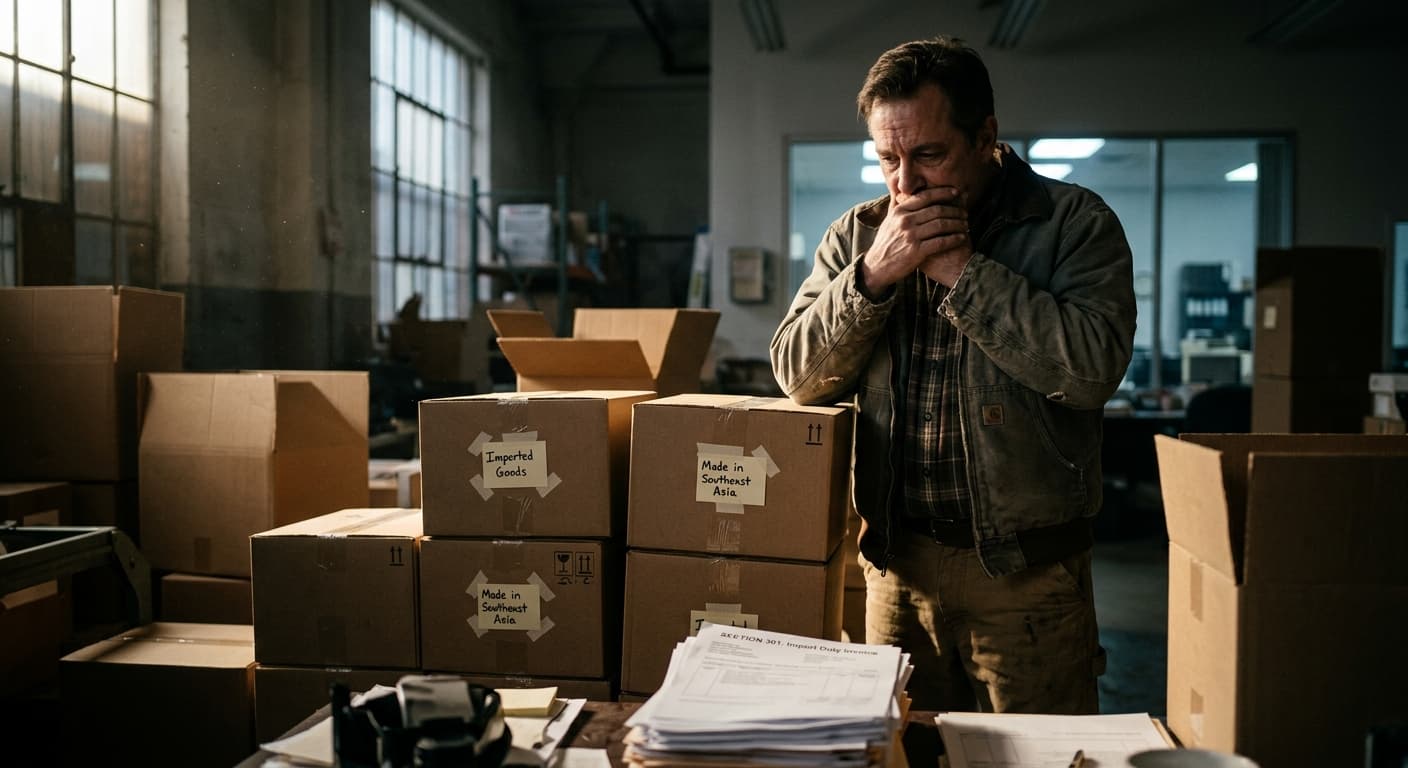
The Tariff Rebuild: Forced Labor Is the Excuse, Section 301 Is the Weapon
USTR's 10–12.5% tariffs on 60 economies replace the tariffs the Supreme Court struck down. Importers, not exporters, will pay ~94% of the bill.
The United States Trade Representative began three days of hearings on July 7, 2026, on additional tariffs of 10% to 12.5% on 60 economies — a package that industry, 22 state attorneys general, and most named trading partners are urging Washington to drop. The proposal is dressed as a forced-labor enforcement action. It is functionally the Trump administration's second attempt to erect a permanent tariff wall after the Supreme Court dismantled the first one in February, and the economic incidence has already been settled by two years of data: U.S. importers and consumers will absorb almost the entire cost, while the geopolitical price is being paid in credibility with the EU, Japan, India, Canada and Mexico — the same partners Washington needs to counter China.
What USTR Is Actually Doing
On June 2, 2026, USTR published findings in 60 Section 301 investigations initiated on March 12, concluding that every economy examined "failed to impose and effectively enforce a prohibition on the importation of goods produced with forced labor." The USTR Federal Register notice, docket USTR-2026-0265, proposes an additional 10% duty on 15 economies that already operate partial import bans — Canada, the EU, the UK, Mexico, Indonesia, Pakistan and others — and 12.5% on 45 economies that USTR concluded have no comparable statute, including China, India, Japan, South Korea, Vietnam and Australia.
Ambassador Jamieson Greer's statement framed the action as leveling "an unlevel playing field" for U.S. workers. The record on which those findings rest is thin. According to the
Center for Strategic and International Studies, the 98-page underlying report devotes most of its length to a general condemnation of forced labor; the country-specific findings run to "two or three paragraphs each," with "no evidence presented" for the conclusion that each economy failed to enforce a ban.
The forced-labor framing is a legal wrapper for a much older policy. Section 307 of the Tariff Act of 1930 already bars U.S. imports made with forced labor, enforced by Customs and Border Protection through withhold release orders and the Uyghur Forced Labor Prevention Act, as a Congressional Research Service brief updated in May 2026 lays out. The 60 investigations do not target foreign production of forced-labor goods. They target foreign governments' failure to copy U.S. import-ban architecture — a novel and, according to the
Peterson Institute for International Economics, a legally strained use of Section 301.
Why USTR Needs This Package by July 24
The context is the February 20, 2026 Supreme Court decision striking down the International Emergency Economic Powers Act (IEEPA) tariffs. In a 6-3 ruling authored by Chief Justice John Roberts, the Court held that "the Framers did not vest any part of the taxing power in the Executive Branch," as Al Jazeera reported. The Penn Wharton Budget Model put IEEPA collections at more than $175 billion — money that may have to be refunded.
The White House replaced the IEEPA tariffs the same day with a 10% (later 15%) global tariff under Section 122 of the Trade Act of 1974, which the BBC noted is limited to 150 days without congressional extension. That clock runs out on July 24, 2026. Twenty-two states, led by New York and California, sued in March 2026 to block the Section 122 levy as well.
Section 301 is Washington's fallback. Treasury Secretary Scott Bessent told markets that stacking Section 301, Section 232 and Section 122 tariffs would keep 2026 tariff revenue "virtually unchanged" from IEEPA-era levels — a strategy the Brookings Institution has traced through USTR's parallel probes on excess capacity, digital services taxes, pharmaceutical pricing and seafood. As the Atlantic Council's Elizabeth Chalecki observed to Al Jazeera, Section 301 tariffs, once imposed, "cannot be raised, lowered or suspended overnight by executive order," which is precisely their appeal to an administration that has now lost the flexible tool.
Who Pays: The Question the Administration Won't Answer
The evidence on tariff incidence is now decisive, and it cuts against USTR's political frame. A 2026 NBER working paper by Gita Gopinath and Brent Neiman, summarized by NBER, estimates a 94% pass-through rate for 2025 U.S. tariffs into tariff-inclusive import prices — meaning foreign exporters absorbed roughly 6% and U.S. importers paid the rest. A Federal Reserve Bank of New York analysis cited by the
BBC found that 90% of the tariff burden fell on U.S. firms, with the effective tariff rate climbing from 2.6% at the start of 2025 to 13% by year-end.
The consumer share is rising as inventory built at pre-tariff cost runs out. The American Enterprise Institute, drawing on Federal Reserve analysis, concluded in April 2026 that tariffs implemented through November 2025 raised core goods PCE prices by 3.1% through February 2026, "explaining the entirety of excess inflation in the core goods category" and contributing 0.8 percentage points to core PCE. The Tax Foundation estimates that 2026 tariffs will cost the average U.S. household about $1,300, up from $1,000 in 2025.
Council on Foreign Relations analysis of the pass-through path projects that by mid-2026, U.S. consumers will bear roughly two-thirds of the tariff burden, importers 8%, and foreign exporters 25%. Stacking a 12.5% Section 301 duty on top of existing Section 232 metals tariffs and China-specific Section 301 duties from 2018-19 pushes some effective rates past 45%. Wisconsin-based LaCrosse Technology told USTR its Chinese supply chain already faces "a combined effective tariff of approximately 45 percent from existing Section 301 and IEEPA measures" and that additional forced-labor tariffs "would cause serious supply disruption and economic harm without addressing forced labor practices."
The Industry Comment File Reads Like an Indictment
By the July 6 deadline, 1,512 public comments had been filed, according to the Global Times. The pattern is consistent: importers argue there is no domestic substitute, and the tariffs will not build one. Schneider Mills, a North Carolina textile manufacturer, told USTR the "question is whether American manufacturers should be penalized when no American-made machinery exists." Santosh Krinsky of Lotus Brands wrote that his firm "suffered serious, almost catastrophic damages from the prior round of tariffs on goods that we are unable to obtain in the US."
The furniture case is a canary. The Economist reported in November 2025 that Ashley Furniture raised prices across most of its catalog last summer; NPR
documented that even High Point, North Carolina factories run on imported fabrics, handles and electronics that no U.S. producer supplies. New 25% tariffs on kitchen cabinets, vanities and upholstered furniture already imposed under Section 232 pathways are scheduled to rise as high as 50% in January 2027 — before any 10% or 12.5% forced-labor surcharge stacks on top.
California Attorney General Rob Bonta, co-leading a 22-state coalition, filed a comment on July 6 calling the proposed tariffs "unlawful." That group already has a Section 122 lawsuit pending in the Court of International Trade, filed March 5, 2026, per the BBC. Section 301 challenges will follow — CSIS analyst William Reinsch predicts litigation will target the perfunctory country findings rather than the statute itself, opening a "careful selection of plaintiff and target country" strategy that could unwind specific tariffs even if the framework survives.
The Second-Order Story: Allies Under the Same Tariff as China
The non-obvious loser is U.S. diplomacy in the Indo-Pacific. India, Japan, South Korea, Australia, Vietnam and the Philippines — every non-Chinese pillar of Washington's China-containment architecture — are on the 12.5% list, the same rate as the People's Republic. India's commerce ministry, according to Al Jazeera, has flagged that the Section 301 action cuts across a bilateral framework agreement announced February 2, 2026. Ajay Srivastava of Delhi's Global Trade Research Initiative told the BBC that
India should "consider stepping away from the bilateral trade agreement, as Malaysia has done."
The EU has a separate problem: its own Forced Labour Regulation, adopted in 2024, takes effect in December 2027, and Brussels considers itself compliant. Bernd Lange, chair of the European Parliament trade committee, called USTR's findings "utterly absurd." Under the July 2025 EU-U.S. framework, Brussels reads the deal as capping U.S. tariffs at 15%; layering a 10% forced-labor duty on top of existing Section 232 measures on European steel and autos will breach that ceiling. CSIS's Reinsch warned this will trigger "stronger foreign opposition, particularly from those countries that have made framework agreements but have not signed anything. Expect a lot of slow-rolling of negotiations."
The forced-labor framing itself is designed to embarrass. As the International Chamber of Commerce's Andrew Wilson told Al Jazeera, treating "failure to enforce" as an actionable trade violation could "become a global template" — one under which "anyone can make a claim, get a shipment impounded and the company has to prove no forced labor in supply chain." That template threatens exactly the compliance regimes the U.S. spent a decade selling its partners on.
What to Watch
- July 9–10, 2026 — Remaining USTR hearing days at the U.S. International Trade Commission. Watch for testimony from apparel, electronics and agricultural retailers on stacking with Section 232.
- July 24, 2026 — Section 122 tariffs expire. If Section 301 tariffs are not in force, tariff revenue drops sharply; if they are, the legal challenge will be filed within days.
- Late July 2026 — USTR expected to release findings in the parallel 16-country structural excess-capacity investigation. Any additional stacking on China, EU, Japan, Korea, Vietnam, India would push effective tariffs above negotiated caps and, per CSIS, trigger the EU to declare the July 2025 deal breached.
- Fall 2026 — Court of International Trade rulings on Section 122 challenges. A loss there accelerates administration reliance on Section 301, hardening the tariff wall the Supreme Court thought it dismantled.
Diplomat View
The forced-labor rationale is a legal argument in search of a policy. The policy is a permanent 10–15% effective tariff floor on almost every U.S. trading partner, and Section 301 is the only remaining statute that gets Washington there without asking Congress. Expect USTR to impose the tariffs substantively as proposed by early August, expect the EU and India to slow-roll bilateral commitments in response, and expect a targeted Section 301 lawsuit from a mid-size importer to reach the Federal Circuit by early 2027. The forecast changes if either (a) the Court of International Trade issues a preliminary injunction against Section 122 that spills over into Section 301 procedural attacks, or (b) core PCE goods inflation crosses 4% year-over-year in the August or September prints, at which point the political cost of stacking begins to bite Republican midterm messaging. Absent those triggers, the tariff wall is being rebuilt in plain sight — with the invoice sent to U.S. households.
Discover more

US Politics
House Ethics Committee Pushes Sexual Miscond.
The House Ethics Committee has shifted responsibility for sexual harassment settlement records to the Office of Congressional Workplace Rights, complicating disclosure efforts.
India
BJP's Delimitation Strategy
Congress leader K.C. Venugopal claims the BJP uses women's reservation to advance delimitation, raising fears over electoral fairness ahead of the 2029 polls.
India
Congress Accuses Modi of Stalling Women's Law
Congress accuses Modi of stalling women's reservation law by linking it to delimitation, revealing a deeper electoral strategy.

Conflict & Security
Drone Warfare Killing Aid Workers at Unprec
Over 1,000 humanitarian workers killed in three years as cheap armed drones collapse legal protections. Gaza, Sudan, Ukraine, and DRC see deliberate targeting of aid convoys and hospitals with zero prosecutions.