Tariff Pass-Through Complicates Fed Policy
New York Fed data reveals ongoing tariff-driven price hikes.
Model Diplomat7 min readNorth America
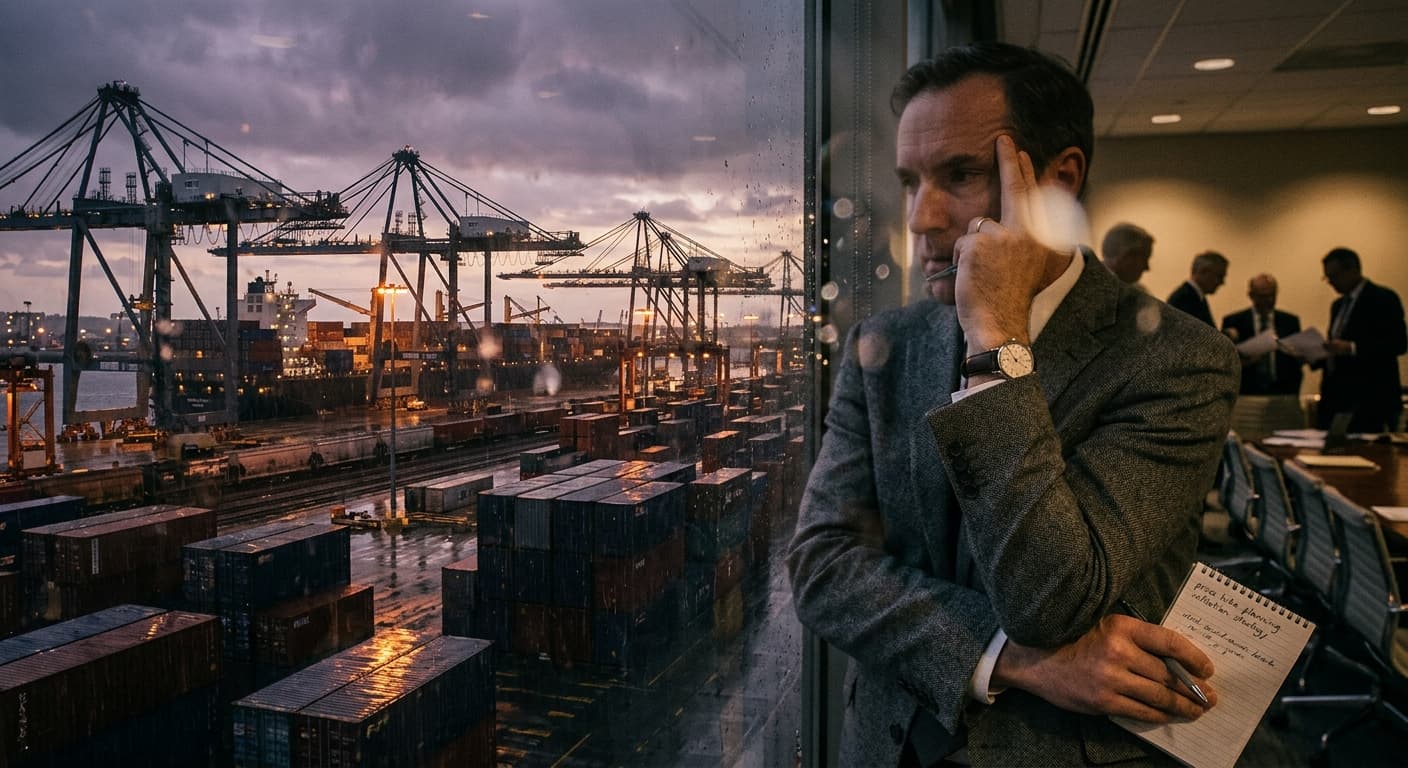
Tariff Pass-Through Isn't Done — and Neither Is the Fed
New York Fed data show 47% of service firms and 44% of manufacturers still plan tariff-driven price hikes, complicating the Warsh Fed's fight to hold rates.
The Federal Reserve Bank of New York quietly published the July surprise policymakers were hoping to avoid: more than a year after President Donald Trump's tariff wall went up, nearly half of the firms that paid those duties say they still have price increases to push through — some of them six months or more into the future. That is the punchline of a survey-based note by economists Jaison Abel, Mary Amiti, Richard Deitz, Sebastian Heise and Nick Montalbano on the New York Fed's Liberty Street Economics blog. The thesis: what economists routinely dismiss as a "one-time price-level adjustment" is behaving like a slow-drip inflation shock, and it lands on Kevin Warsh's desk exactly as he is trying to convince markets that inflation is a "choice" the Fed will unmake.
What the New York Fed actually found
The May 2026 regional business surveys asked firms that directly paid tariffs over the prior twelve months a simple question: are you done raising prices to cover them? For a majority, the answer is no.
According to the Liberty Street Economics authors, 47% of tariff-paying service firms and 44% of tariff-paying manufacturers said further price increases are still coming. Roughly 30% of service firms and nearly 40% of manufacturers plan those hikes within six months; 16% of service firms and 7% of manufacturers say more than six months out. Only around half of the sample — combining firms that reported insignificant tariff impact, those that had fully passed the tariffs through, and those simply not planning further hikes — considers the adjustment complete.
Two-thirds of service firms and almost all manufacturers in the surveys import at least some inputs. Among importers, 40% of service firms and 70% of manufacturers said they directly paid tariffs in the past year; many others faced higher supplier prices. That is the mechanical reason the pass-through is stretching: tariffs propagate through a chain of contracts and inventories, not a single till.
The authors offer two behavioural explanations. First, fixed-price contracts mechanically delay pass-through; the research they cite shows long-term contracts materially blunt cost transmission. Second, firms are deliberately "trickling up" prices to avoid shocking customers and to preserve optionality if tariff rates change again. In an environment where the statutory tariff schedule has been rewritten three times in eighteen months, that caution is rational — and inflationary.
Why the pass-through won't die: the legal whiplash
The tariff regime firms are pricing against is not the one Trump announced on Liberation Day in April 2025. On February 20, 2026, the Supreme Court struck down the IEEPA-based tariffs 6-3, with Chief Justice John Roberts writing that "the president must 'point to clear congressional authorization' to justify his extraordinary assertion of the power to impose tariffs. He cannot," as reported by Al Jazeera. Roughly $175 billion in duties were suddenly in legal limbo.
Trump signed a proclamation the same afternoon invoking Section 122 of the Trade Act of 1974 — a rarely used balance-of-payments authority — for a 10% global tariff, then raised it to 15% by the weekend, per the BBC. Treasury Secretary Scott Bessent told reporters that combining Section 122 with expanded Section 232 and Section 301 measures would leave 2026 tariff revenue "virtually unchanged."
That has largely held. Brookings economists Kari Heerman and Elena Patel estimate the trade-weighted statutory tariff rate rose from 2.6% in January 2025 to 13.4% by January 2026, briefly fell after the Supreme Court ruling, then climbed back to about 11.1% following the April 2026 restructuring of Section 232 metals tariffs. A
Congressional Research Service report prepared for the 119th Congress puts the September 2025 peak at 17.4% — the highest since the 1930s.
The Section 122 patch is itself under legal attack. On May 7, 2026, a three-judge panel of the Court of International Trade ruled in State of Oregon v. Trump that Proclamation 11012 exceeded the statute's balance-of-payments limits, ordering refunds for the plaintiffs, per the court's judgment. The Federal Circuit stayed the injunction pending appeal, finding the government had made a "strong showing of likelihood of success on the merits" in its
order. Section 122's 150-day clock, meanwhile, forces the administration to conclude Section 232 and 301 investigations before autumn or watch the tariff wall crack.
For firms, this is the point: the rate they are pricing to keeps moving, so they price incrementally and keep the option open. The New York Fed authors are explicit — "uncertainty surrounding future tariff policies… may be causing some firms to adopt cautious, incremental pricing strategies rather than making large, discrete adjustments."
The number that broke "one-time"
The near-consensus of Fed officials through 2025 was that tariffs would produce a level shift, not persistent inflation. Chair Jerome Powell told the House Financial Services Committee in June 2025 that "a reasonable base case is that the tariff-related effects on inflation will be relatively short-lived — a one-time shift in the price level," per NPR.
The empirical work that has piled up since undermines that framing. Gita Gopinath and Brent Neiman, in NBER Working Paper 34620 summarised by the NBER Digest, estimate a 94% pass-through rate for the 2025 tariffs — meaning foreign exporters absorbed almost none of the cost. Marina Azzimonti and Jacob Titcomb of the
Richmond Fed find pass-through into import prices "close to one hundred percent." A Brookings paper by Afrouzi and Bhattarai on
supply-side shocks documents how tariff shocks on intermediate inputs generate inflationary persistence via downstream sectoral realignment — precisely the "trickle up" dynamic the New York Fed survey has now documented in firms' own words.
The IMF was blunter. In its March 2026 Article IV consultation, IMF staff wrote that "as the passthrough of tariffs to consumer prices wanes, core PCE inflation is expected to fall to 2 percent by 2027H1" — a forecast that implicitly concedes the pass-through is still waxing, per the IMF country report.
And the CPI print is following the pipeline the New York Fed just mapped. May 2026 headline CPI rose 4.2% year-on-year, a three-year high, according to BBC News. Energy did the heavy lifting — petrol prices climbed after the February 2026 US-Israel strikes on Iran — but core categories heavy in imported goods have been drifting up since mid-2025. Trump, per the BBC, told reporters "I love the inflation."
Warsh's problem, in one paragraph
Kevin Warsh inherited the Fed on the assumption he would cut. On June 17, 2026, he held rates at 3.5-3.75% and, per the Financial Times, delivered a hawkish debut in which "all the focus was on inflation and maintaining price stability." The median dot pointed to a quarter-point increase by year-end, and
FOMC minutes released July 8 — the same day as the Liberty Street note — showed policymakers broadly agreed "some policy firming would likely be warranted" if inflation stayed elevated.
The Liberty Street survey hands Warsh both a shield and a sword. The shield: he can point to real firm-level evidence that inflation is not primarily a demand story, insulating him from Trump's rate-cut demands. The sword: it also forecloses the argument that tariff inflation is transitory. If nearly half of tariff-paying firms plan further hikes past year-end, and if the effective tariff rate stays north of 10% through the Section 232/301 rebuild, then core goods inflation has a mechanical floor no amount of demand suppression can efficiently push through in 2026. The Council on Foreign Relations noted the Yale Budget Lab estimate that tariffs would push prices up 1.8% in the short term — but "short term" in the New York Fed data means well over a year.
The domestic beneficiary is not obvious. Federal tariff receipts have surged — Penn Wharton estimated IEEPA collections alone at more than $175 billion, per Al Jazeera — but the Supreme Court has ordered that pool refunded, subject to litigation that Bessent said would "drag on for years." Import-competing sectors got modest labour-market lift; the
Richmond Fed paper found the local employment gains "economically negligible." The clearest winners are the very firms in the New York Fed's survey — those with pricing power to trickle costs upward without losing customers. The clearest losers are households, whom the
Yale Budget Lab estimates are paying roughly $2,400 a year more.
For the United States' trading partners, the geopolitical read-through is that Trump's tariff instrument is now legally shakier, but the price wall it built keeps rising through the pipeline whether or not any single legal challenge succeeds. Xi Jinping, Ursula von der Leyen and Mark Carney will bargain in autumn against a Fed that is unlikely to be cutting and an effective tariff rate that will not have unwound.
Diplomat View
Our call: the New York Fed note has just retired the "one-time price-level shift" framing that dominated Fed communication in 2025. Expect Warsh's July 29 FOMC statement to describe tariff-related inflation in more persistent language, and expect at least one dissent in favour of a hike by the September 15-16 meeting if July core CPI prints above 0.3% month-on-month. We forecast the Fed holds at 3.5-3.75% through July, delivers a 25bp hike in December 2026, and does not cut before Q3 2027 — a full year later than the pre-Warsh consensus. What would change this call: (a) the Federal Circuit affirms the CIT and strikes Section 122, forcing an emergency tariff climb-down before Section 232/301 investigations conclude; (b) a decisive break in oil prices below $60 that pulls headline CPI back toward 3% and gives Warsh political room to hold; or (c) a labour-market crack — payrolls below +50k for two consecutive months — that flips the reaction function. Absent those, the pipeline the New York Fed just documented becomes 2026's dominant inflation story.
What to watch:
- July 29, 2026 — FOMC decision and Warsh press conference; watch the statement's inflation language for the word "persistent."
- August 12, 2026 — July CPI release; core goods ex-autos is the pass-through tell.
- Autumn 2026 — Federal Circuit ruling in Oregon v. Trump on Section 122; concurrent USTR final determinations on the Section 301 overcapacity and forced-labour investigations covering more than 75% of US imports, per the
Atlantic Council.
Discover more

Economics
Dangote's Dollar Pricing Exposes Nigeria's Cr
Dangote Refinery switched fuel pricing from naira to dollars on July 13, 2026, exposing a structural crude supply gap that undermines Nigeria's naira-for-crude framework and threatens currency stability.

Economics
Dangote Dollar Pivot Breaks Nigeria's Naira-C
Dangote refinery ends naira pricing for fuel, exposing Nigeria's crude supply gap. The shift breaks Tinubu's currency stability policy and threatens inflation as NNPC fails to deliver enough domestic crude.
Economics
Warsh's Fed Tilts Hawkish: June Minutes
The Federal Reserve's June minutes reveal a hawkish shift, with policymakers favoring interest rate hikes, impacting global currencies and rates.
Economics
Tariff Pass-Through: Inflation's New Reality
New York Fed's survey shows 47% of firms expect ongoing price hikes from tariffs, challenging inflation forecasts and Fed rate decisions.