Serbia Holds Rates at 5.75% Amid Sanctions
Central bank maintains rate as NIS sanctions loom.
Model Diplomat9 min readEurope

Serbia Holds Rates at 5.75% as NIS Sanctions Clock Ticks
Serbia's central bank kept its key policy rate at 5.75% on July 9, 2026 — a 22-month hold shaped less by inflation than by an OFAC waiver expiring July 31 and an autumn election.
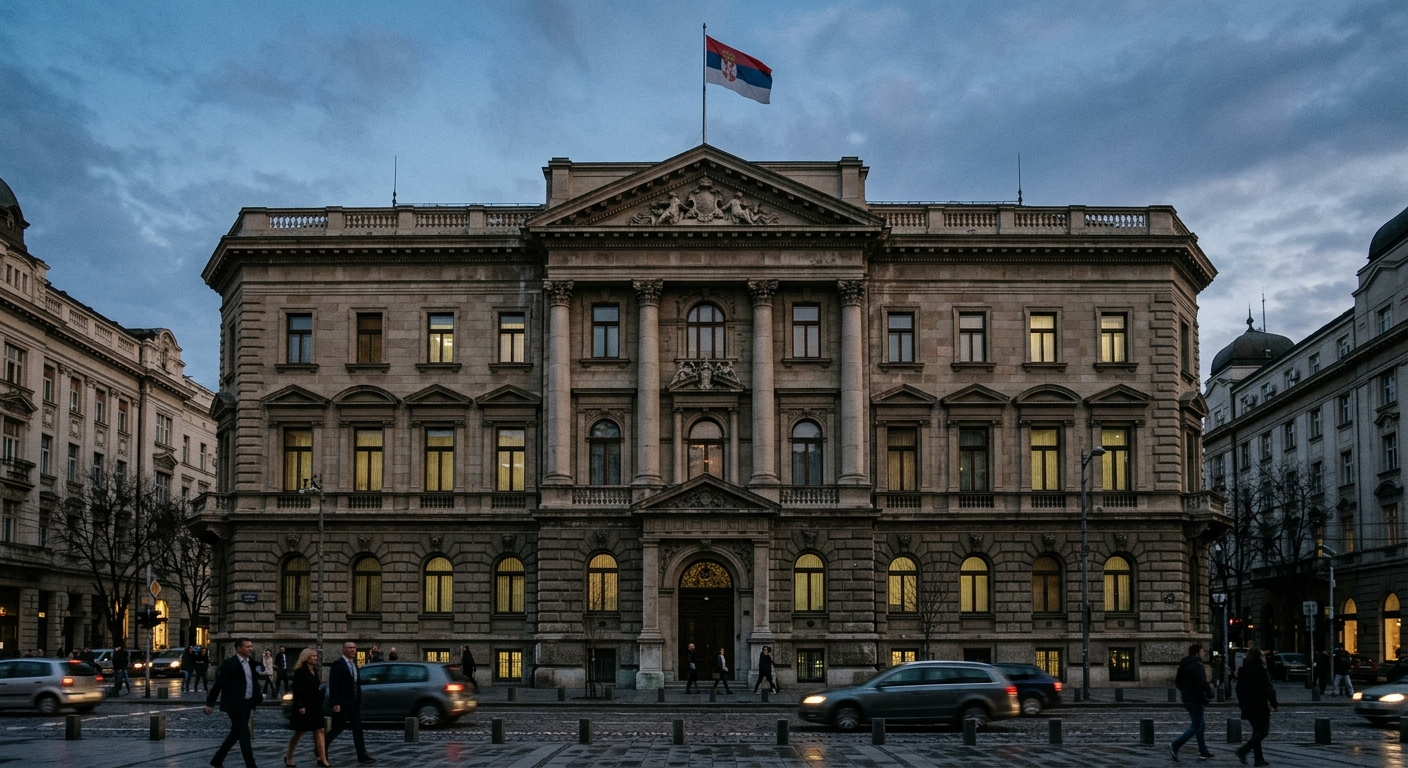
The National Bank of Serbia left its key policy rate unchanged at 5.75% on July 9, 2026, extending a hold now stretching to a 22nd consecutive meeting — and the decision has almost nothing to do with the 3.5% headline inflation print the bank cited in its statement. The real constraint is the dinar peg to the euro, the OFAC licence on Naftna Industrija Srbije (NIS) that expires on July 31, and an autumn election that Aleksandar Vučić is now expected to contest as prime minister. Cut, and the dinar weakens into an energy-security shock. Hike, and you strangle a growth rebound the IMF has staked its Policy Coordination Instrument on. Governor Jorgovanka Tabaković's board did the only thing it could: nothing.
What the statement actually said
The NBS Executive Board kept the deposit facility rate at 4.5% and the lending facility rate at 7.0% alongside the headline decision, according to Tanjug, the state news agency that published the central bank's release verbatim. Year-on-year inflation reached 3.5% in May 2026, "in line with the Executive Board's expectations, largely owing to the increase in global oil prices and the consequent rise in domestic petroleum product prices during that period," the bank said in the same statement.
The pass-through was blunted by fiscal action, not monetary tightening. The government cut fuel excise duties and released fuel from state reserves "to supply the domestic market," per the NBS release carried by Tanjug. Food prices, meanwhile, are doing the disinflationary work: they have posted a year-on-year decline every month since November 2025, reaching –1.5% in May 2026, "even three months after the expiry of the decree capping retail trade margins." That decree — Belgrade's price-cap regime — was the principal driver of the inflation collapse of late 2025, as the NBS itself documented in its March 12, 2026 rate statement, when it noted that food and non-alcoholic beverage prices fell 1.0% on average from January 2025 under the caps.
"The Middle East conflict remains one of the principal sources of global uncertainty, although tensions eased for a time following the agreement on a ceasefire during negotiations aimed at bringing the conflict to an end." — NBS Executive Board, July 9, 2026
That is the sentence the market should read twice. The NBS is publicly hedging against a second oil spike. The European Commission's Joint Research Centre modelled a prolonged Strait of Hormuz disruption in a Spring 2026 scenario in which Brent peaks near USD 180 per barrel in Q4 2026 and EU headline inflation runs 1.1 percentage points above baseline through 2027. For a small, energy-import-dependent economy where fossil fuels — coal, oil, and gas — supply 82% of the energy mix, per the
European Commission energy fiche, that scenario is not a background risk. It is the entire reason the rate is not moving.
Why the peg is the policy, not the rate
To read the NBS statement as a conventional Taylor-rule communication is to miss what Serbian monetary policy actually is. The IMF's 2025 Article IV report documented a "de-facto stabilized exchange rate regime" against the euro, with the central bank intervening in size during the first half of 2025 to defend the dinar before reserves rebuilt to a record €29.4 billion by end-October 2025, or 158% of the Fund's Assessing Reserve Adequacy metric. Dinarisation — the share of dinar deposits in total household and corporate deposits — was still only 45% in April 2025, which means the transmission channel from a policy rate to household balance sheets is materially weaker than in a fully de-euroised economy.
A rate cut, in that architecture, does not primarily loosen credit. It widens the spread against a European Central Bank rate that just moved the other way. The ECB raised its deposit rate by 25 basis points to 2.25% in June 2026 after euro-area inflation hit 3.2% in May, according to the NBS statement itself. That leaves Serbia running a 350-basis-point premium over the euro area — sufficient to keep dinar deposits attractive and reserve accumulation intact, but not so high that it chokes the credit revival the IMF's Second Review is banking on for 2026 growth.
The Q1 2026 growth print of 3.2% was the pivot. It confirmed the IMF's projection that Serbia would rebound from the slowdown that dragged 2025 growth to roughly 2%, per the Fund's staff report, and it removed the last dovish argument. There is no output gap urgent enough to justify cutting into an oil shock or an election.
The NIS file is the monetary-policy risk
The variable most likely to force the NBS's hand next is not inflation — it is a US Treasury licence. Naftna Industrija Srbije accounts for roughly 80% of Serbia's fuel market and 50% of retail sales, according to the OSW Centre for Eastern Studies. US sanctions on the majority-Russian-owned company took effect on October 9, 2025 after eight waivers, cutting Pančevo — Serbia's only refinery — off from crude via Croatia's JANAF pipeline and taking the country within days of a full shutdown in late November, as
Al Jazeera reported at the time. The NBS itself warned then that it would stop processing NIS payments if the operating licence lapsed.
The exit route is the MOL–Gazprom Neft transaction. Hungary's MOL signed a binding heads-of-agreement on January 19, 2026 to acquire the 56.15% Russian stake, with the UAE's ADNOC entering as a minority partner and the Serbian state adding 5 percentage points to its own holding, per the BBC's Serbian service. But the deal is not closed. As the BBC's
June update documented, OFAC has extended the operating and negotiation licences on a rolling monthly basis, with the current pair expiring on July 31, 2026.
That date, not the September inflation reading, is the next binding constraint on the NBS. If OFAC extends again, the peg holds, reserves stay above 158% of ARA, and the August 6 rate meeting is a repeat of July 9. If it doesn't — if the MOL closing slips past Viktor Orbán's Hungarian election calendar and the sanctions bite — Pančevo re-enters hot standby, imported petroleum-product prices spike again, and the NBS is defending the dinar in a spot market rather than tuning a policy rate.
Who benefits, who pays
The decisive winner from Belgrade's hold is Hungary. MOL's move on NIS — its first extraction of a Russian oil asset in Europe under US sanctions pressure — locks in a regional refining monopoly that already includes Slovakia's Slovnaft and Croatia's INA, per OSW. Combined with the January 2026 tender for a Druzhba-southern extension carrying up to 5.5 million tonnes of crude a year, mostly Russian, MOL becomes the single indispensable node between Russian barrels and Balkan pumps. Orbán's political leverage over Belgrade rises with every waiver extension.
The loser is the European Union's conditionality architecture. The European Parliament adopted a report on July 8, 2026 by 468 votes to 116, with 79 abstentions, declaring Serbia's accession process "effectively stalled" and criticising the Commission's "appeasing approach." Rapporteur Tonino Picula (S&D, Croatia) attributed the freeze to "democratic backsliding, weakened rule of law, failure to implement key reforms and lack of alignment with EU foreign policy." A day later the NBS's cautious hold — grounded in ECB alignment on rates and a Middle East risk read that mirrors Frankfurt's — is a reminder that Serbia's technocracy is more European than its politics. That gap is what the Clingendael Institute called "geopolitical hedging" in its
February 2026 policy brief on Belgrade's sharpening edge between Moscow and Brussels.
Domestic households take a subtler hit. Core inflation is "hovering around the upper bound of the target tolerance band for headline inflation," the NBS acknowledged — meaning underlying price pressures sit at 4.5% while the headline benefits from margin caps that have already expired and a favourable agricultural season that may not repeat. The World Bank's 2026 Serbia country brief flagged exactly this: inflation "expected to remain elevated in 2026 in part due to the expected impact of the conflict in the Middle East on energy prices" even if it stays inside the target band. Real wages are protected by 10.1% minimum-wage growth from January 1, 2026, per the IMF's
Second Review staff report, but that same wage growth is one of the reasons the NBS cannot cut.
The political variable
The last piece is Vučić. The president told a Serbian Progressive Party rally on June 27, 2026 that he would step down within weeks, per BTA, before the SNS floated him as its candidate for prime minister and confirmed presidential and parliamentary elections for the autumn. Mass student-led protests, running since the November 1, 2024 collapse of the Novi Sad railway canopy that killed 16 people, continued through late June 2026,
Al Jazeera reported.
For the NBS, this is a fiscal-stance signal. Pre-election welfare spending — the pattern flagged by One Place News — adds to the case for holding restrictive rates through the ballot, not easing into it. Cutting in August or September would look like political accommodation. Governor Tabaković's institutional interest is to be seen as neither obstructing the government nor financing it — which is what a 22-month hold, in an inflation-targeting country whose regime is de facto exchange-rate-targeting, delivers.
What to watch
- July 31, 2026 — OFAC's NIS operating and negotiation licences expire. Extension is the base case; failure re-opens Pančevo's shutdown scenario and forces NBS FX intervention.
- August 6, 2026 — Next NBS rate-setting meeting. A hold is priced; any move would signal either a NIS breakdown or a decisive fall in core inflation.
- September–November 2026 — Presidential and parliamentary elections. Watch for pre-election cash transfers that would push the NBS into a hawkish posture on the November meeting.
- End of 2026 / early 2027 — NBS itself flagged a "temporary overshoot" of the target band as possible on base effects; the ECB's own inflation trajectory back to 2% by 2027 is the reference path.
Diplomat View
The July 9 decision is a signal that Serbia's monetary sovereignty is a fiction the NBS is careful to preserve. What actually anchors prices in Belgrade is a peg to the euro, a fiscal decree on retail margins, and a US Treasury licence for a Hungarian-Russian oil deal. The rate is the last variable, not the first. Our call: the NBS holds again on August 6 and stays at 5.75% through the autumn vote, cutting only in Q1 2027 if the OFAC file closes cleanly and core inflation prints below 4%. That forecast breaks if OFAC lets the NIS licence lapse — in which case the next move is not a cut but euro sales to defend the dinar, and reserves start falling below the €29 billion threshold that has been the IMF's comfort zone. The historical parallel worth watching is 2012–2013, when a previous NBS held rates through political turnover and a currency test; that episode ended with a 60-basis-point depreciation and forced tightening. If Belgrade repeats the sequence, the story stops being about Serbia and becomes about how many more Western Balkans currencies quietly track ECB decisions while pretending to run their own policy.
The Bottom Line
Serbia's 22-month rate hold is not a monetary decision — it is a bet that the OFAC waiver on NIS gets extended, the dinar peg holds, and Vučić wins the autumn election without a fiscal blowout. If any one of those three assumptions breaks between July 31 and November, the NBS will be defending the currency, not managing inflation. That is the story the 5.75% number is quietly telling.
Discover more
US Politics
SNAP Food Assistance Faces Legal Challenges
In 2026, SNAP faces stricter eligibility rules and mounting legal challenges, threatening food assistance for the millions of Americans who rely on the program.

India
Congress Advocates 33% Women’s Quota
Congress calls for a 33% women's reservation in the existing 543 Lok Sabha seats, countering Modi's plan to expand the house to 850 seats.
India
BJP's Misunderstanding of Women's Quota Needs
The BJP's linking of the Women Reservation Bill to delimitation risks delaying women's empowerment in India, misreading the aspirations of female voters.

Conflict & Security
Drone Warfare Killing Aid Workers at Unprec
Over 1,000 humanitarian workers killed in three years as cheap armed drones collapse legal protections. Gaza, Sudan, Ukraine, and DRC see deliberate targeting of aid convoys and hospitals with zero prosecutions.