Takaichi Lands in Delhi as China Squeezes
Japan's PM arrives amid rising tensions with China.
Model Diplomat3 min readAsia
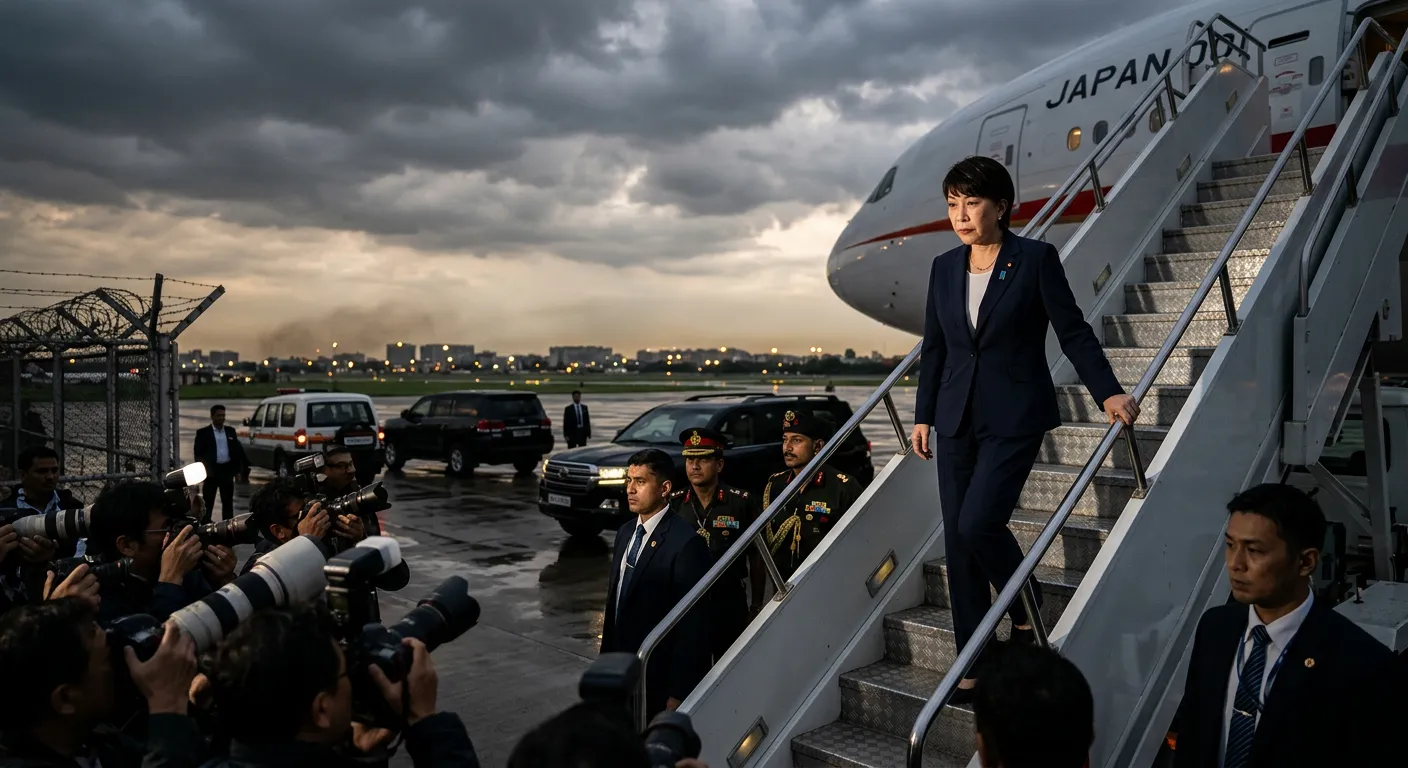
Takaichi Lands in Delhi as China Squeezes Japan — This Summit Is About Beijing
Japan's PM arrives for the 16th annual summit just 48 hours after China blacklisted 40 Japanese entities. The timing is no accident.
Japanese Prime Minister Sanae Takaichi touched down in New Delhi today for a three-day visit that will test whether the India-Japan partnership can function as a genuine third pole in Asia — one that hedges against both Chinese coercion and American unpredictability. The 16th India-Japan Annual Summit, the first since March 2022, comes with a backdrop Beijing wrote for it: on June 29, China imposed export controls on 40 Japanese entities, including Mitsubishi Precision and Japan's Naval Systems Research Center, citing national security concerns Al Jazeera.
That move is the second wave of Chinese economic warfare against Tokyo this year — 40 entities were blacklisted in February — and it flows directly from Takaichi's insistence that a Chinese move on Taiwan could trigger Japan's right of collective self-defence. The Indian side understands the dynamic intimately. Both countries share a contested border with China; both are building alternatives.
The summit agenda reflects that urgency. Roughly a dozen government-to-government Memorandums of Cooperation are expected, covering artificial intelligence, semiconductors, pharmaceuticals, battery technology, and critical minerals The Savera Times. Alongside them, nearly 120 private-sector agreements will be showcased — a signal that the relationship is moving from diplomatic choreography to supply-chain integration.
The Guwahati choice is a message
The summit venue is reportedly shifting to Guwahati, the gateway to India's northeast NewsBytes. That is not ceremonial. Japan has invested heavily in northeast India under its Act East policy, and the two sides are expected to announce progress on an industrial value chain linking the Bay of Bengal to the region. The geography matters because it sits on China's southern flank — and because it signals that Japanese infrastructure and connectivity projects are now aimed at territories Beijing considers within its strategic periphery.
The two leaders are expected to formally link Japan's Free and Open Indo-Pacific (FOIP) vision with India's MAHASAGAR initiative — maritime security frameworks that, taken together, stretch from the Pacific to the western Indian Ocean. Concrete deliverables include a large-scale green ammonia project in Odisha, expanded biogas cooperation, and the POWERR Asia initiative for regional energy resilience The Savera Times.
Takaichi's bet — and Modi's calculus
Takaichi took office in October 2025 and led the LDP back to power in snap elections this February. She has since raised defence spending to 2% of GDP and pushed to amend Japan's pacifist constitution — moves that make her, by some distance, the most hawkish Japanese leader in generations Al Jazeera. Her bet is that deepening partnerships with India can offset the economic cost of that posture. India is the world's most populous market, a Quad partner, and — crucially — a country that has shown it will absorb Chinese pressure without folding.
For Modi, the summit caps an intensive diplomatic season. He met Takaichi on the sidelines of the G7 in France last week, calling it a "great interaction" and pledging deeper ties in trade and investment NewsBytes. India has sealed a free-trade pact with the EU, reset ties with Canada, and now hosts Japan — all while pausing trade talks with Washington amid tariff uncertainty
The Indian Awaaz.
The pattern is clear: India is building a trade-and-defence architecture that does not depend on any single patron.
What to watch
The joint statement, expected July 2, will be the first test. Watch for whether it names Taiwan or the South China Sea explicitly — language Beijing will parse for escalation. The number and sector-mix of private-sector agreements will reveal whether supply-chain decoupling is accelerating in practice or remaining in rhetoric. And the defence deliverables — joint exercises, technology transfers, ACSA expansion under the existing 2+2 framework — will signal whether this partnership is becoming operational or staying declaratory The Indian View.
If Takaichi leaves Delhi with a semiconductor partnership, a defence-industrial roadmap, and language on Taiwan that doesn't flinch, Beijing will have its answer on how seriously to take this axis.
Discover more

US Politics
House Ethics Committee Pushes Sexual Miscond.
The House Ethics Committee has shifted responsibility for sexual harassment settlement records to the Office of Congressional Workplace Rights, complicating disclosure efforts.
US Politics
Virginia's Redistricting Referendum
Virginia's redistricting referendum is drawing a flood of dark money, shaping future elections and the fight for congressional control amid party stakes.

US Politics
US Launches $166B Tariff Refund Portal
The US is launching a $166 billion tariff refund portal to aid importers hit by Trump-era tariffs, with major implications for trade and supply costs.

Conflict & Security
Drone Warfare Killing Aid Workers at Unprec
Over 1,000 humanitarian workers killed in three years as cheap armed drones collapse legal protections. Gaza, Sudan, Ukraine, and DRC see deliberate targeting of aid convoys and hospitals with zero prosecutions.