Taiwan's Tsai Defies China After Eswatini
Taiwan's president visits Eswatini despite Chinese pressure.
Model Diplomat8 min readAsia

Taiwan's Lai Defies China After Eswatini Airspace Blockade
Taiwan President Lai Ching-te's May 2026 Eswatini visit — after China pressured three states to revoke his flight permits — hardens Taipei's 12-ally strategy.
Taiwan President Lai Ching-te landed back in Taoyuan on May 5, 2026, escorted by F-16s of the Republic of China Air Force, after a three-day state visit to Eswatini that Beijing tried, and failed, to prevent. The trip matters not because Lai reached Africa — his predecessor Tsai Ing-wen did the same in 2018 and 2023 — but because he reached it after China convinced Seychelles, Mauritius and Madagascar to revoke his overflight permits on April 21, the first known instance of a Taiwanese president being physically blocked from a diplomatic partner. Beijing crossed a line from persuasion to interdiction, and Lai answered by turning a routine bilateral into a set-piece demonstration that the "one-China" wall has enforcement gaps.
That is the story. The second-order story is uglier for Taipei: China's April airspace play and its May 1 zero-tariff regime — from which Eswatini is the sole African exclusion — are not two events but one integrated coercion package aimed at Taiwan's remaining 12 partners.
What actually happened between April 21 and May 5
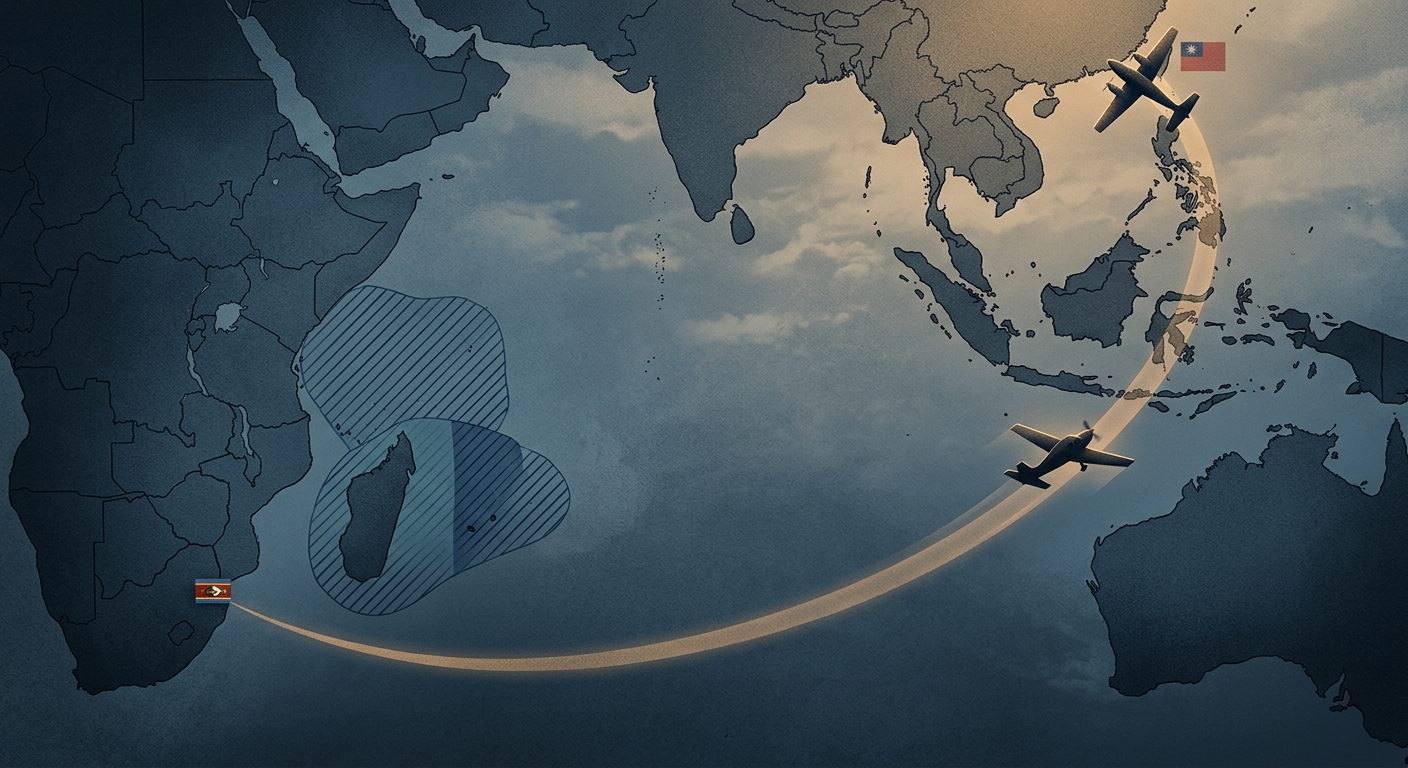
Lai had been scheduled to travel to Eswatini from April 22 to 26 to mark the 40th anniversary of King Mswati III's accession. On April 21, three Indian Ocean states — Seychelles, Mauritius and Madagascar — unilaterally revoked flight permits for his presidential aircraft with no notice. Taiwan's presidential office called the sequence "without precedent in the international community," attributing the cancellations to "intense pressure" and "economic coercion" from Beijing, Al Jazeera reported. Seychelles and Madagascar told Reuters they had acted because they do not recognise Taiwan; Beijing publicly expressed "high appreciation" for the three governments, according to
the BBC's report on the cancelled trip.
Eleven days later, Lai flew anyway. Details of the route remain classified — Taiwan's Ministry of Foreign Affairs said only that the trip proceeded "in accordance with international law, international norms, diplomatic practices," per NPR — but reporting confirms he arrived on an Eswatini government aircraft after a long southern arc across the Indian Ocean, avoiding the three hostile airspaces. He met King Mswati III at Mandvulo Grand Hall, signed a customs agreement and, on return, told reporters at Taoyuan airport that Taiwan "would not give in to pressure,"
Channel News Asia reported.
Beijing's response was calibrated for scorn, not for damage. A Ministry of Foreign Affairs spokesperson called Lai's trip a "laughable stunt" and accused him of being "smuggled" out of Taiwan on a foreign aircraft — a formulation the ministry then upgraded to a "stowaway-style escape farce," the BBC reported. The US State Department pushed back, telling reporters that "every democratically elected Taiwan president has made overseas trips to visit Taiwan's diplomatic partners" and warning that such travel "should not be politicised."
The tariff weapon behind the airspace weapon
The airspace incident did not happen in isolation. On February 14, 2026, President Xi Jinping used the African Union Summit in Addis Ababa to announce that China would extend zero-tariff market access to all 53 African states with which it holds diplomatic relations. The policy took effect on May 1 — the day Lai was airborne to Eswatini — and it excludes exactly one country: Eswatini itself, according to the Manohar Parrikar Institute for Defence Studies and Analyses.
The BBC put the arithmetic plainly: 53 African states enjoy duty-free access to the Chinese market until at least April 30, 2028; Eswatini, alone on the continent, does not.
The economic damage to Eswatini is modest — the Institute for Security Studies notes that roughly 70% of African exports to China already entered duty-free before May 1, and Eswatini's trade is dominated by South Africa rather than China. But the signalling value is exactly the point. As Australian National University political scientist Wen-Ti Sung told the BBC, "China wants to show the world how it treats its friends, versus Taiwan's friends." Read together with the April airspace revocations, this is not two coincidental episodes but a compound message: recognise Taiwan and lose market access; help Taiwan's president fly and gain Beijing's "appreciation."
Why Eswatini stays — and why it matters more than $12 million in trade
Eswatini is Taiwan's 156th-largest trading partner. Bilateral trade sat around $12.7 million in 2020, per the Australian Institute of International Affairs. The financial case for Taipei is negligible. The political case is not.
Eswatini has been the last African redoubt of Taipei recognition since Burkina Faso switched to Beijing in May 2018. The European Parliamentary Research Service's April 2026 briefing on Taiwan's status — a primary EU document — lists just 12 states as recognising the Republic of China, including the Holy See, Guatemala, Paraguay and three Pacific Compact of Free Association partners of the United States. The
US Congressional Research Service report IF12646 records that between December 2016 and January 2024, Beijing peeled off 10 of Taiwan's partners: São Tomé and Príncipe, Panama, the Dominican Republic, Burkina Faso, El Salvador, Solomon Islands, Kiribati, Nicaragua, Honduras and Nauru.
Losing Eswatini would leave Taiwan with zero African allies and cascade into questions about Paraguay (soy exports to China rising), the Vatican (in quiet dialogue with Beijing since 2018) and the three Pacific states that give Washington basing access under the Compact of Free Association. The Atlantic Council warned in late 2025 that a successful Chinese flip of Palau would "rob the US of basing access" and "undermine the US military's ability to operate" in the western Pacific. In that light, keeping a landlocked southern African monarchy in the Taipei column is not sentimental — it is a firebreak.
The Tsai continuity, and where Lai has broken with it
The story searches for "Tsai" because Tsai Ing-wen made two Eswatini visits, in 2018 and 2023, and pioneered the theatrics of Taiwanese presidential travel — stopovers in US cities, Order of the Elephant ceremonies at Mswati's palace, careful choreography with Washington. Lai, sworn in on May 20, 2024, inherited that playbook and its constraints. His August 2025 attempt at a Latin America trip was quietly killed when the Trump administration declined to approve New York and Dallas transit stops, apparently over concerns about ongoing US–China trade talks, the Stimson Center reported — a snub Taipei absorbed in silence.
The Eswatini trip is where he stopped absorbing. Lai's team chose to reschedule rather than accept the airspace veto, kept the routing secret, announced arrival only after landing, and put F-16s in the frame on return. That is a doctrinal shift: Tsai negotiated her way around Chinese pressure; Lai is prepared to be seen defying it. It aligns with his March 13, 2025 declaration — cited in the European Parliament briefing — that the People's Republic is a "foreign hostile force" exploiting Taiwan's freedoms to "divide, destroy, and subvert us from within."
The domestic ballast is thinner than it looks. In May 2026, the Legislative Yuan — where the KMT and Taiwan People's Party hold a combined majority — approved Lai's defence supplemental at roughly $25 billion, down from a proposed $40 billion, per the same EU briefing. Lai is escalating diplomatically at a moment when his own parliament is throttling the resources that back the escalation up.
The multilateral response — such as it is
Two primary documents show the shape of external support. On May 21, 2026, the British Office Taipei published a joint press release with the Australian, Canadian, French, German, Japanese, Lithuanian, New Zealand and Polish offices in Taipei backing Taiwan's observer participation at the 79th World Health Assembly — a nine-nation coalition that reads as pointed given the timing weeks after the Eswatini episode. Separately, the US Congress has advanced the Taiwan Allies Fund Act (H.R. 2559 / S. 1216), which per
CRS IF12646 would authorise $40 million annually across FY2026–FY2028 to support countries that maintain relations with Taiwan or are subject to PRC pressure for doing so. Eswatini would be the marquee beneficiary.
Beijing, for its part, has framed the entire episode in the language of legal inevitability. In an April 22 briefing, a State Council Taiwan Affairs Office spokesperson said the "so-called 'President of the Republic of China' no longer exists in the world," per the BBC. That formulation — grounded in Beijing's interpretation of UN Resolution 2758 of 1971 — is what China is trying to convert from rhetoric into operational reality through instruments like overflight coordination.
Diplomat View
Lai's Eswatini gambit works as a one-off but does not scale. Beijing has now demonstrated that with roughly a week's notice it can lock a Taiwanese head of state out of the air routes to two entire continents; Taipei has demonstrated it can still get through once, at high cost, with a friendly host aircraft. The equilibrium favours China over time, because permits are needed for every trip and Xi needs to succeed only occasionally.
The forecast: Taiwan will lose at least one more formal partner before the end of Lai's first term in May 2028 — Paraguay and one of the Caribbean states are the likeliest — unless the Taiwan Allies Fund Act clears the Senate and translates into visible, per-country subsidy packages by 2027. Watch three catalysts that would revise this call:
- Whether the Taiwan Allies Fund Act (H.R. 2559/S. 1216) is enacted and appropriated in the FY2027 cycle. Passage without appropriation is theatre; appropriation is deterrence.
- The next scheduled Lai overseas visit — likely to a Pacific ally in the second half of 2026 — and whether transit through Hawaii or Guam is approved by the Trump administration. Another denial would confirm Washington is prioritising trade over Taipei's diplomatic space.
- Any move by Paraguay's Peña government to open a "trade office" in Beijing. That is historically the first step before a full switch, and Asunción's soy exporters have lobbied for it since 2023.
If any two of those break Taipei's way, the Eswatini trip will look like the inflection point at which Lai stopped ceding ground. If none do, it will look like a well-lit last stand.
The Bottom Line
The bottom line: China's decision to weaponise third-country airspace against a Taiwanese head of state — synchronised with a tariff regime that isolates Taipei's last African ally — is a qualitative escalation that Lai answered with a symbolically potent but structurally fragile counter-move. Taiwan retains 12 diplomatic partners today; whether it retains 12 in 2028 depends less on Lai's willingness to defy Beijing than on whether Washington converts rhetorical support into the $40 million-a-year subsidy package now stalled in Congress.
Discover more

Global Politics
US Seizes Iranian Ship, Tensions Surge
The US seizure of the Iranian ship Touska highlights a shift in control over the Strait of Hormuz, favoring Iran's strategic position.

International Relations
Pakistan's Key Role in US-Israel-Iran Meddle
Pakistan is seeking to mediate the US-Israel-Iran conflict, balancing high-stakes diplomacy against severe economic pressures and steep regional challenges.

Conflict & Security
Drone Warfare Killing Aid Workers at Unprec
Over 1,000 humanitarian workers killed in three years as cheap armed drones collapse legal protections. Gaza, Sudan, Ukraine, and DRC see deliberate targeting of aid convoys and hospitals with zero prosecutions.
Global
World Normalises Taliban as Afghan Women Eras
UN data shows Afghan women erased from public life as Russia recognises the Taliban, EU hosts officials in Brussels, and ICC warrants for gender persecution go unenforced.