World Normalises Taliban as Afghan Women Eras
ICC warrants, EU talks, Russia recognition — but 2.4M girls locked out
Model Diplomat10 min readSouth Asia
The World Is Normalising the Taliban as Afghan Women Are Erased — and the ICC Can't Stop It
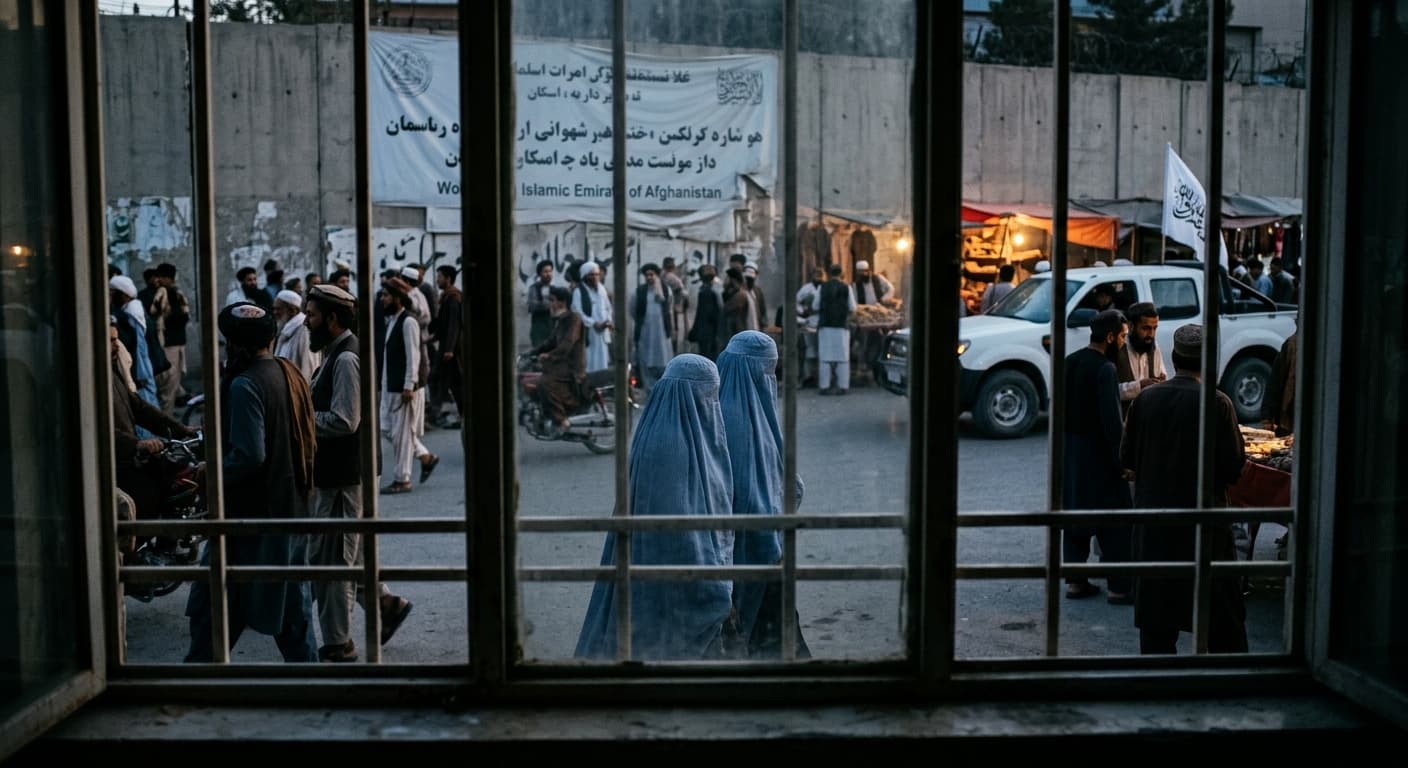
Five years after the Taliban seized Kabul, more than 100 decrees have stripped Afghan women of education, work, and movement. Yet Russia has granted formal recognition, the EU is hosting Taliban officials in Brussels, and the ICC arrest warrants for gender persecution have nowhere to go.
On August 12, 2026 — exactly five years to the day since Taliban fighters entered Kabul — UN Women and UNESCO released new data confirming what aid workers, doctors, and Afghan women themselves have been documenting in real time: Afghan women have been systematically erased from public life, and the pace of that erasure is accelerating even as the international community's willingness to confront it collapses.
The numbers are no longer projections. Half of Afghan women leave home no more than once or twice a month, according to UN Women. An estimated 2.4 million girls remain locked out of secondary education. Nearly three-quarters of women-led organisations in Afghanistan saw their funding cut in 2025. And the country now faces a deficit of over 25,000 female teachers and health workers by 2030, according to a
UNICEF analysis published in April — a projection that assumes current restrictions remain in place, which there is no evidence they will not.
Afghanistan is the only country in the world to formally prohibit access to education for girls and women beyond the primary level.
That sentence, from UNESCO's August 12 statement, captures the singularity of the crisis. No other government on earth has made the exclusion of half its population from schooling a matter of written law. The UN's gender equality agency now calls it "the world's most severe women's rights crisis."
And yet, on the diplomatic track, the Taliban have never been less isolated.
The Architecture of Erasure
The Taliban's de facto authorities have now issued more than 100 decrees targeting women and girls, UN Women confirmed on Wednesday. The restrictions form a closed loop: a woman cannot study beyond grade six, therefore cannot qualify for most paid work, therefore cannot support herself independently, therefore cannot move freely without a male guardian — whose permission she now requires even to marry, under an April 2026 Code on Judicial Separation of Spouses documented by
UNAMA.
The enforcement machinery has escalated sharply in the past year. Between April and June 2026 alone, UN human rights monitors recorded arrests over hairstyles, public floggings, and the 296th consecutive day that Afghan women were barred from UN premises simply for being women, according to the UNAMA quarterly report. In Herat, at least 30 women were arrested in a single weekend in June for "improper hijab." In Kandahar, shopkeepers were instructed to report unaccompanied women and deny them entry. In Logar province, a woman received a verbal warning for buying groceries without a mahram — while the male shopkeeper was slapped and taken to the Propagation of Virtue and Prevention of Vice office.
What distinguishes this moment from earlier years of Taliban rule is that the enforcement is no longer ad hoc. The August 2024 "Law on the Promotion of Virtue and Prevention of Vice" codified the mahram requirement and mandatory dress codes into formal statute, as the UN Special Rapporteur on human rights in Afghanistan, Richard Bennett, documented in a February 2026 report to the Human Rights Council. What was once enforced unevenly by local commanders is now national law, backed by a dedicated ministry and a network of inspectors.
The Medical Training Ban: Closing the Last Door
The single most consequential decision of the past year was the December 2024 directive from Supreme Leader Haibatullah Akhundzada banning women from attending medical training institutes. The BBC reported that five separate institutions confirmed they had been ordered to close, and videos shared online showed students weeping at the news.
This was not just another restriction — it was the closure of the last remaining loophole. After the university ban of December 2022, nursing and midwifery training had become the only post-secondary education available to Afghan women. Ministry of Public Health officials had successfully lobbied hardline Taliban leaders in February 2024 to keep those programmes open, according to Ashley Jackson of the Center on Armed Groups, precisely because the regime's own gender-segregation rules made female health workers indispensable: male doctors could not treat women without a mahram present.
The December 2024 ban severed that logic. An estimated 35,000 women were forced out of training programmes, according to the UN Special Rapporteur's report, which warned:
"The ban is completely unjustifiable, and unless it is reversed, will lead to unnecessary suffering, illness, and deaths, and could amount to femicide."
The health consequences are already measurable. The BBC's investigation into maternal deaths in Badakhshan province documented that by August 2026, maternal mortality in the provincial capital Faizabad had already matched the entire previous year's total — putting it on track for a 50% increase. More than 400 medical facilities had closed after the Trump administration cut nearly all US aid. One doctor told the BBC that his hospital's annual budget had collapsed from $80,000 to $25,000 in three years.
A World Health Organization public health analysis from March 2026 found that 17.4 million Afghans — over one-third of the population — face crisis or emergency levels of hunger, a sharp increase of three million from the previous year. Acute malnutrition affects 3.7 million children under five and 1.2 million pregnant and breastfeeding women. The WHO noted bluntly: "For women and girls, the cuts are converting an oppressive framework into a health catastrophe."
The Aid Collapse: A Second Shock
If the Taliban's decrees are the primary driver of erasure, the global retreat from aid funding is the accelerant. In 2024, US funds constituted 43% of all aid entering Afghanistan, according to the BBC. The Trump administration's dismantling of USAID and cancellation of humanitarian contracts — including $280 million with the World Food Programme alone — removed the financial backbone of the country's health and food systems.
NPR reported that all US humanitarian aid contracts for Afghanistan were terminated in 2025. Jeremy Lewin, Trump's Under Secretary for Foreign Assistance, stated explicitly in December 2025 that Afghanistan would receive none of the $2 billion in new US humanitarian funding, telling the UN it must "adapt or die,"
according to the BBC.
Other donors followed. The UK nearly halved its foreign aid budget to redirect resources to defence spending. European countries announced successive rounds of cuts, citing budgetary constraints and the pivot to national self-interest. Heather Barr of Human Rights Watch told NPR: "It seems that other donors are following the US down — and what Trump has done, really, is give everyone a license to give up on funding aid."
The UN Humanitarian Coordinator for Afghanistan, Bruno Lemarquis, warned that funding gaps could force health centre closures, "leaving thousands of mothers and newborns vulnerable to preventable complications and death." UN Women reported that nearly three-quarters of women-led organisations surveyed in Afghanistan experienced funding cuts in 2025.
Accountability Without Enforcement
On July 8, 2025, the International Criminal Court issued arrest warrants for Supreme Leader Haibatullah Akhundzada and Chief Justice Abdul Hakim Haqqani, finding "reasonable grounds" to believe they had committed the crime against humanity of persecution on gender grounds — the first such warrants the ICC has ever issued in its Afghanistan investigation, which dates back to 2007.
ICC judges stated that the Taliban had "severely deprived girls and women of the rights to education, privacy, family life and the freedoms of movement, expression, thought, conscience and religion." The court specified that the crimes were committed from August 15, 2021, and continued at least until January 2025. Amnesty International called the warrants "an important development that gives hope" and Human Rights Watch welcomed them as "a crucial step."
But the warrants have nowhere to go. The ICC has no police force and relies on member states to carry out arrests. Akhundzada rarely, if ever, leaves Afghanistan. The Taliban's foreign ministry dismissed the warrants as "a clear act of hostility" and "an insult to the beliefs of Muslims around the world." No ICC member state has indicated any willingness or capability to enforce them.
Meanwhile, the diplomatic landscape has shifted decisively in the Taliban's favour. In July 2025, Russia became the first country to formally recognise the Taliban as Afghanistan's legitimate government. Moscow had already removed the Taliban from its list of designated terrorist organisations in April 2025. On May 27, 2026, Russia and the Taliban signed a military-technical cooperation agreement, according to the
Observer Research Foundation.
The cascade of normalisation is broader. ORF's assessment notes that at least 28 foreign missions and international organisations now have representation in Kabul, while the Taliban government has 42 representative offices abroad. China appointed an ambassador in 2023 and accepted Taliban diplomatic credentials. The UAE, Uzbekistan, Türkiye, and Pakistan have upgraded relations to ambassadorial level. India and Gulf states are deepening engagement.
In June 2026, the European Union hosted Taliban officials in Brussels for migration talks — the first official interaction between the Islamic Emirate and the EU on European soil. The EU framed the meeting as "technical" and insisted it did not constitute recognition. But as Hannah Neumann, a Member of the European Parliament, argued, the talks symbolise political normalisation without securing accountability in return. The Taliban delegation used the visit to push for consular access across Europe and the transfer of Afghan embassies to Taliban-appointed diplomats.
The Lowy Institute captured the dynamic in a recent analysis: "Western diplomats publish photographs of their meetings with Taliban figures in Kabul on social media platforms, which are quickly repurposed as legitimacy-building propaganda. UN bans are lifted so sanctioned terrorists can travel extensively, again boosting their legitimacy." The institute noted that the United Nations has begun referring to the Taliban as Afghanistan's "relevant authorities" — narrowing the linguistic distance between the regime and a recognised government.
The UN Special Rapporteur Richard Bennett, in an interview with ISPI, called this a "paradox or double standards: on one hand, countries who say they support human rights, who throw up their hands and make very strong statements in the Human Rights Council and the Security Council and the General Assembly about the appalling treatment of women, which is totally unacceptable. And on the other hand, they are starting to normalise the Taliban."
What the UN Is Doing — and What It Can't
UN agencies maintain programmes on the ground, but the scale of what they can deliver is shrinking in direct proportion to funding. UN Women supports nearly 200 women-led civil society organisations and runs livelihood programmes. UNESCO provides community-based vocational training. UNFPA trains midwives and operates Family Health Houses in hard-to-reach areas. UNICEF delivered emergency education support to 3.7 million children in public schools in 2025 and built or rehabilitated 232 schools.
But these are holding operations, not solutions. The Taliban's restrictions are structural, codified in law, and enforced by a dedicated state apparatus. No UN programme can substitute for the right to attend secondary school, to enter a university, to work without a male guardian's permission, to walk to a clinic alone.
Diplomat View
The central contradiction of the five-year mark is this: the Taliban's gender persecution regime is more entrenched, more legally codified, and more lethal than at any point since 2021 — and the international community's response is more fragmented, more transactional, and more accommodating than ever.
Russia's formal recognition and the EU's Brussels talks are not outliers. They reflect a structural shift in how the world calculates its interests in Afghanistan. Security cooperation — particularly against Islamic State Khorasan Province (IS-KP), which carried out the March 2024 Crocus City Hall attack killing 145 people — now overrides human rights conditionality as the organising principle of engagement. Migration management provides the second lever: European capitals want deportation agreements, and the Taliban knows it. Trade routes, energy corridors, and the Trans-Afghan Railway give Central Asian states their own reasons to deal with Kabul.
The ICC warrants are symbolically significant and operationally irrelevant. Akhundzada faces no realistic prospect of arrest. The court's intervention may even have backfired: by raising the stakes of formal recognition, it pushed Russia to demonstrate exactly how little weight it assigns to The Hague's jurisdiction.
The forecast: barring a major IS-KP attack that reorders Western threat perceptions, normalisation will deepen. More countries will accept Taliban-appointed diplomats, more aid will be channelled through the Taliban-controlled central bank, and the de facto regime's international standing will inch forward — all while 2.4 million girls remain locked out of classrooms and maternal mortality climbs toward a 50% increase over last year.
What would change the forecast:
- A mass-casualty IS-KP attack on a Western target, definitively linked to Afghanistan-based cells, forcing a reassessment of the Taliban's counterterrorism reliability.
- A split within the Taliban leadership between pragmatists who favour concessions on education in exchange for recognition and hardliners around Akhundzada who regard the restrictions as non-negotiable — a split that UNAMA reporting suggests exists but has not yet broken open.
- A coordinated donor ultimatum — unlikely given the competitive dynamics now driving normalisation, but the only pathway to linking the restoration of girls' education to the diplomatic and financial benefits the Taliban seek.
The bottom line: Five years after the Taliban promised a more moderate rule, Afghan women have been erased from public life by a legal apparatus that now exceeds anything the regime imposed in the 1990s — and the world has decided, quietly, that it can live with that.
Discover more

Global Politics
U.S. Naval Blockade Heightens Iran Tensions
The U.S. naval blockade of Iran collapsed oil exports, creating a new maritime regime in Hormuz that favors Tehran.

Global Politics
US Naval Blockade on Iran
The US fully imposed a naval blockade on Iranian ports, escalating tensions even as Trump hinted the conflict may soon end while serious risks of war remain.
Global Politics
US-Iran Tensions Rise
Tensions escalate in the Strait of Hormuz as Iran and the US clash over maritime control, with a ceasefire hinging on a contested MoU paragraph.

Economics
Fed's Amex AML order puts correspondent banking on notice
Federal Reserve's Amex AML order requires board-level controls and a 90-day plan; OCC fined the bank $350 million over enterprise-wide deficiencies.