Taiwan's Gray-Zone Coalition Faces Test
Taiwan's democratic cooperation meets Chinese military actions.
Model Diplomat7 min readAsia
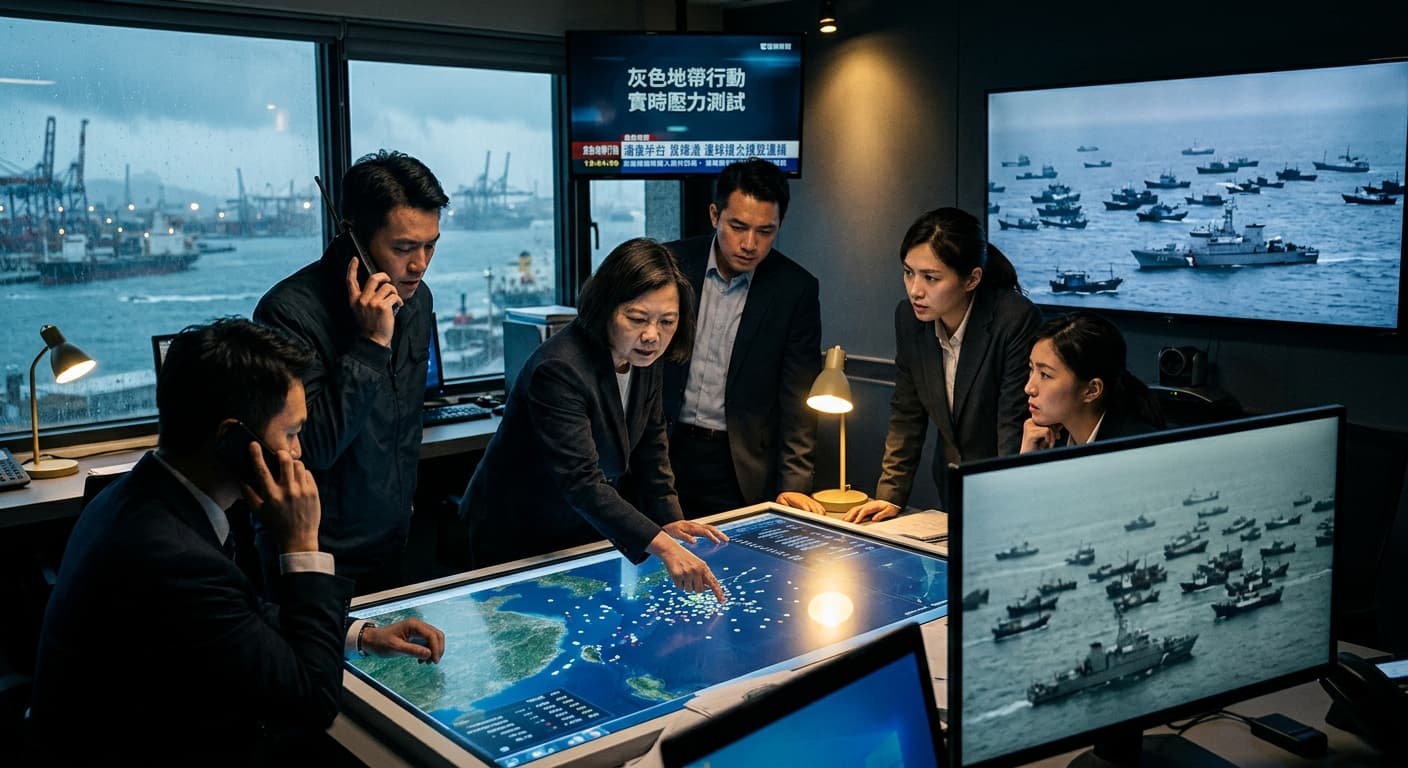
Taiwan's Gray-Zone Coalition Faces Its First Live Test
Lai Ching-te's pitch for democratic cooperation collides with a Chinese SLBM over the Pacific, Australia's Fiji treaty, and a stalled US$14bn arms package.
Taiwan spent July 7, 2026 doing two things simultaneously: President William Lai Ching-te told a U.S. National Endowment for Democracy delegation that democracies must cooperate to counter China's "gray zone," and his national security chief posted a map showing that a Chinese submarine-launched ballistic missile had just flown roughly 7,000 kilometres from the South China Sea, over the northern Philippines, and into international waters between Nauru and Tonga. Those two events are the same event. Taiwan's bet — that a values-branded coalition of the United States, Japan, Australia, Canada and Europe can raise the political cost of Beijing's coercion faster than the People's Liberation Army can normalise it — is now being stress-tested in real time, and the current scoreboard favours Beijing.
What Lai actually said, and what it papered over
At the Presidential Office in Taipei on July 7, Lai received NED President Damon Wilson on the latter's fifth visit to the island, alongside the four NED core institutes — the International Republican Institute, the National Democratic Institute, the Center for International Private Enterprise, and the Solidarity Center. According to the Taipei Times, Lai said China's "continuous military activities and 'gray zone' coercion" in the East China Sea, South China Sea and Taiwan Strait had "seriously affected regional peace and stability," and framed Taiwan's answer as deepened cooperation with the United States "across democracy, security and trade."
The Presidential Office's own English readout is more specific: Taiwan will "deepen security and economic cooperation with democratic partners" to "build secure and stable supply chains, prevent infiltration by authoritarian regimes, and advance our nations' democratic resilience." Lai flagged last month's Global Cooperation and Training Framework workshop in Taipei, dedicated for the first time to transnational repression — the Taipei-Washington-Tokyo-Canberra-Ottawa mechanism that a Prospect Foundation analysis describes as Taiwan's most usable
multilateral vehicle for resilience diplomacy without formal recognition.
Vice President Hsiao Bi-khim, receiving the Inter-Parliamentary Alliance on China the same day, was blunter: the July 6 missile launch and Beijing's continuing pressure were evidence of "expanding malign influence operations." National Security Council Secretary-General Joseph Wu — the former foreign minister — identified the weapon as a JL-2, not the newer JL-3 many analysts initially suspected, and called China a "regional bully." The distinction matters: a range consistent with the 7,200–9,000 km JL-2 profile documented by the CSIS ChinaPower project points to an operational drill, not the debut of a new strategic system.
The 48-hour arc: three signals, one message
Read as isolated stories, the week looked like noise. Read together, it was a choreographed lesson in leverage.
On July 5 in Suva, Australian Prime Minister Anthony Albanese and Fijian counterpart Sitiveni Rabuka signed the "Ocean of Peace" treaty — Fiji's first alliance and Australia's fourth after the United States, New Zealand and Papua New Guinea. The BBC reported the pact is backed by more than A$1 billion over a decade for transnational-crime, health and infrastructure work. Within roughly 24 hours, a PLA Navy SSBN fired a JL-2 with a dummy warhead into a splash zone between Nauru and Tonga — inside the maritime neighbourhood the treaty was designed to lock down. Beijing informed Canberra 90 minutes in advance and called the launch "routine annual training," per
Al Jazeera. Foreign Minister Penny Wong, still in Fiji, called the timing "destabilising."
The Economist noted this is only the second such Pacific ICBM/SLBM test in more than 40 years — the first was in September 2024. Twice in 22 months is no longer a curiosity; it is a pattern of strategic signalling aimed at both Washington's homeland vulnerability and the Pacific micro-states that host U.S. Compact of Free Association bases. That is the frame in which Lai's NED meeting the next morning should be read.
The gray-zone ledger: where Taiwan is actually losing
Taiwan's rhetorical coalition is broad. Its operational leverage is thinner than the communiqués suggest.
Start with the airspace. The American Enterprise Institute's China-Taiwan Weekly Update documents that PLA aircraft have crossed into Taiwan's Air Defence Identification Zone more than 200 times a month every month since Lai's May 2024 inauguration — averaging above 300 monthly, more than double the prior two-year mean. NPR reported that Taiwan's MND
logged 3,570 PLA sorties around the island through 2025. Taiwan quietly shortened its air-raid warning threshold from 70 to 24 nautical miles in late 2022 because the volume had become unmanageable — a concession that would leave civilians in some regions with three minutes to shelter in a real strike.
Now add the budget. Lai announced in the Washington Post on November 25, 2025 that Taiwan would raise defence spending to 3.3% of GDP in 2026 and 5% by 2030, funded by a $40 billion "special defence budget" underwriting the "T-Dome" integrated air-defence network. The Brookings Institution's Dina Smeltz and Craig Kafura note that the opposition-controlled Legislative Yuan — the KMT-TPP majority elected alongside Lai in 2024 — blocked the special budget at least eight times between December 2, 2025 and January. By June,
Al Jazeera reported, the legislature had approved roughly two-thirds of the $40 billion — cutting the portions earmarked for drones and indigenous weapons.
And then the arms pipeline. In December 2025 the Trump administration notified Congress of an $11 billion Foreign Military Sale to Taiwan — later revised to $14 billion. In late May, a senior U.S. military official told reporters Washington was pausing the $14 billion package to conserve munitions for its war against Iran. Lai's June 18 press conference publicly asked Washington to release it "as soon as possible." As of July 8, the package remains paused.
The angle: Lai is running out of runway, not partners
The conventional read — that Taiwan is assembling a broadening coalition of democracies to isolate Beijing — is half right and dangerously incomplete. Look at the specific partnerships Taipei touts:
- NED and its four institutes. Political and civil-society support. Cannot deploy a frigate, sanction a bank, or approve a howitzer.
- The Global Cooperation and Training Framework. Since inception it has run 63+ workshops for 7,000+ attendees from 126 countries, according to
MP-IDSA — a resilience knowledge network, not a defence pact.
- The European Parliament's European Democracy Shield committee. The
EUDS mission report filed after its July 2025 Taipei visit calls for real-time intelligence-sharing and undersea-cable protection. It contains no binding commitments.
- The Inter-Parliamentary Alliance on China. Legislators, not governments.
The muscle in this coalition sits with two actors: Washington and Tokyo. Washington is the one that paused the arms package. Meanwhile, according to a June Brookings paper by Ryan Hass and Stephen Tan, "the United States and Taiwan have yet to develop a coherent, unified response" to gray-zone coercion because U.S. planners view it as "a distraction from the urgent task of pursuing a strategy of denial," while allies "urge a more cautious approach" to avoid retaliation. The Council on Foreign Relations has separately catalogued a spike in Chinese
transnational repression reaching into 23 countries and the United Nations — the specific threat Lai's GCTF workshop was designed to name and shame.
The result: Beijing can accumulate operational facts — ADIZ normalization, submarine cable sabotage, Pacific missile splashdowns, the March 2026 Law on Promoting Ethnic Unity that criminalises Taiwanese identity abroad — faster than Taipei's partners can convert speeches into deterrence. Foreign Minister Lin Chia-lung's "value-added diplomacy" pitch in Foreign Affairs — Taiwan as the moat that anchors Indo-Pacific supply chains and teaches the free world how to resist coercion — is intellectually elegant. It does not compress a JL-2's flight time.
Where Beijing miscalculates
The gray-zone playbook has one exposed nerve: the more Beijing signals across the wider Indo-Pacific, the more it produces the coalition Lai is trying to build.
Consider what the July 6 launch generated within 48 hours. Japan filed a formal protest despite 90 minutes' notice. New Zealand's Winston Peters — an unlikely China hawk — called it "unwelcome." Australia formalised a treaty with Fiji and, per the BBC, moved to the Solomon Islands to negotiate a further pact with Prime Minister Matthew Wale, a China sceptic who ran on renegotiating Honiara's 2022 security agreement with Beijing. The Atlantic Council's Indo-Pacific Security Initiative is now running cross-strait-and-Philippines gray-zone seminars — evidence that Manila and Taipei are being treated as a single learning system.
Taipei's real leverage, in other words, is not the coalition itself. It is Beijing's habit of forcing its neighbours to shop for insurance.
Diplomat View
The forecast: Taiwan's democratic-cooperation frame will hold rhetorically through 2026, but the substantive test is whether Washington unfreezes the $14 billion arms package and whether the Legislative Yuan restores the drone and indigenous-weapons lines it cut from Lai's special defence budget. If both happen before Q4, deterrence in the Strait is intact. If neither happens by year-end, Beijing will have learned that a JL-2 into the South Pacific, a March identity-criminalisation law, and 300+ monthly ADIZ incursions cost nothing — and the next gray-zone escalation will be cheaper still. The falsifier: a joint U.S.-Japan-Australia statement pinning specific costs to specific PLA behaviours, not just deploring them. Absent that, Lai's coalition is a diagnostic, not a deterrent.
What to watch:
- Late July 2026: Whether the Trump administration lifts the pause on the $14bn arms package; the next Legislative Yuan session on the remaining third of the special defence budget.
- August–September 2026: Signing (or not) of Australia's Solomon Islands treaty with PM Matthew Wale; any follow-on PLA Navy SLBM tests.
- October 10, 2026: Lai's National Day address — the historical trigger for the largest PLA drills of the year, including October 15, 2024's record 153-aircraft day.
The bottom line
Taiwan's pitch that democracies can jointly blunt China's gray zone is now measurable, not aspirational: it either produces released munitions and a passed defence budget within six months, or it doesn't. The JL-2 that flew over Luzon while Lai briefed the NED is Beijing's demonstration that speeches and workshops have not yet imposed a cost — and until they do, the gray zone is not a stalemate. It is a slow-motion Chinese win._
Discover more

US Politics
White House Pressures Congress for Crypto Leg
The Trump administration's push for the CLARITY Act aims to reshape crypto regulation, impacting trillions in market value and the Trump family's wealth.
Global Politics
Xi Jinping Calls China-Russia Ties 'Precious'
Xi Jinping's description of China-Russia ties as 'precious' reflects a strategic imbalance, with Beijing dictating terms in the partnership.
Global Politics
US-Iran Tensions Rise
Tensions escalate in the Strait of Hormuz as Iran and the US clash over maritime control, with a ceasefire hinging on a contested MoU paragraph.

Economics
Fed's Amex AML order puts correspondent banking on notice
Federal Reserve's Amex AML order requires board-level controls and a 90-day plan; OCC fined the bank $350 million over enterprise-wide deficiencies.