Taiwan's Coast Guard Names Chinese Fleet
Taiwan tracks 41 Chinese vessels for blockade prep.
Model Diplomat8 min readAsia
Taiwan's Coast Guard Names the Fleet: Why Beijing's Research Ships Are the Quiet Front of the A2/AD Push
Taipei says 41 Chinese "research" vessels tracked since 2023 are mapping the seabed for a blockade — a dual-use campaign that redraws Indo-Pacific security around Taiwan's eastern flank.
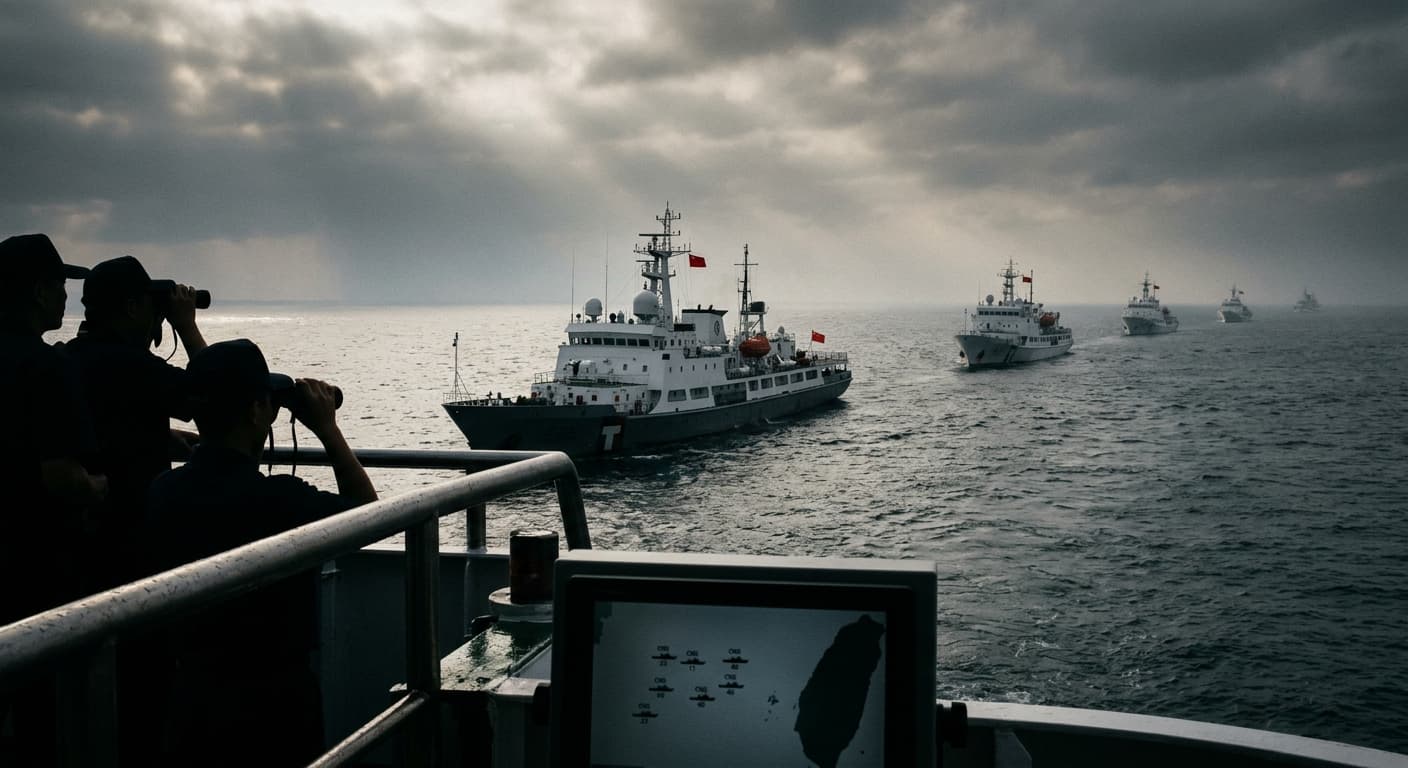
A Taiwanese coast guard captain has, for the first time, put a number on what analysts have long argued from satellite tracks: 41 Chinese "scientific" research vessels monitored by Taiwan since July 2023 have been deployed not for oceanography but to prepare the battle space for a quarantine or blockade of Taiwan. Speaking at the Taiwan International Ocean Forum in Taipei on July 8, 2026, Coast Guard Administration captain Arthur Yang framed the survey fleet as a third instrument of pressure alongside the China Coast Guard and flag-of-convenience shipping — a claim that, if institutionalised by Washington, Tokyo and Manila, would reclassify a large civilian fleet as a legitimate military target for surveillance and interdiction. That reclassification, more than any single ship's crescent-shaped track, is the story.
What Yang actually said — and why the timing matters
Yang, who commands the Sixth Offshore Flotilla stationed in Hualien, told the forum that Chinese survey ships had "extensively mapped the waters east of Taiwan and the Bashi Channel between 2023 and 2025," citing an Institute for the Study of War assessment, according to Focus Taiwan. Of the 41 vessels the CGA logged over 26 months, the deployments reached the second and third island chains and the Arctic and Atlantic oceans — footprints that, Yang argued, cannot be reconciled with the bounded geography of genuine marine science. "This bathymetric and hydrographic data serves Beijing's anti-access/area-denial strategy," he told the forum, per the same
Focus Taiwan report.
The timing is not accidental. Chinese research-vessel activity east of Taiwan surged after Tokyo and Manila announced on May 28, 2026 that they would open exclusive economic zone delimitation talks in a triangle of overlapping claims that includes waters China asserts through its Taiwan claim, as documented by AEI. Within three weeks, the PRC Ministry of Natural Resources' East China Sea Bureau had dispatched the vessel Xiang Yang Hong 22 to conduct a "marine environmental survey" east of Taiwan from June 16–18, escorted by two China Coast Guard cutters — the first documented instance of a Chinese research ship operating in the contested zone under armed law-enforcement cover, again per
AEI. Yang's public accounting three weeks later is Taipei's response: name the fleet, count the ships, and reclassify the mission.
The dual-use case, built from open source
The evidence Yang leaned on is not new — it is the accumulated open-source case built by CSIS's Hidden Reach initiative, Australian and Japanese think tanks, and Indian analysts tracking the Indian Ocean. China now operates the world's largest oceanographic research fleet, expanding from 19 active vessels in 2012 to 64 today, according to the Observer Research Foundation. Around 80 percent of the 64 Chinese research and survey vessels active in the Indian Ocean Region are assessed to have organisational links to the People's Liberation Army, and at least 13 have conducted comprehensive undersea-terrain surveys,
ORF noted in late 2025.
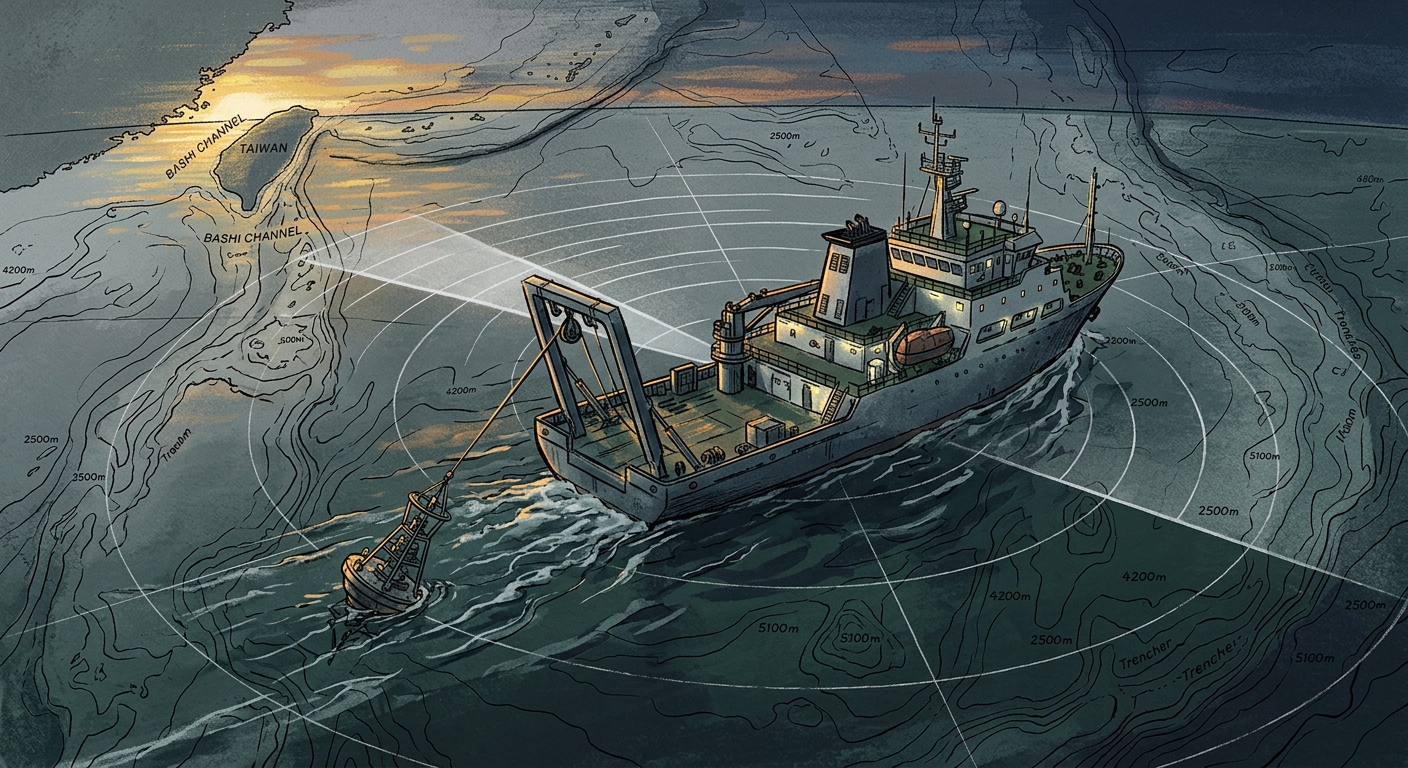
Two specific voyages sharpen the pattern. The 6,900-ton Zhong Shan Da Xue left "two distinctive crescent-shaped tracks" in the Bashi Channel between April and May 2025, then traced the outer edge of the nine-dash line through the South China Sea, according to a Japan Institute of International Affairs research report. The Institute for the Study of War, in an assessment cited by JIIA, judged that the crescent pattern was "most likely part of a strategic operation to potentially blockade Taiwan," collecting data usable in both peacetime and wartime. In parallel, the Tan Suo 3, operating with a manned deep-sea submersible, spent a week in the Philippines' northern EEZ southwest of the Luzon Strait in early May 2025 — a survey the Philippine Coast Guard escorted out of Philippine waters, per
AEI/ISW.
Taiwan's own defence think tank has gone further, describing the Xiang Yang 22 as a "military-civilian dual-use vessel" whose 89-metre hull, 60-tonne A-frame crane and capacity to deploy 10-metre subsurface buoys align with three plausible missions: seeding deep-sea hydrophone arrays across the first-to-second island chain, gathering acoustic-propagation data to support PLA submarine transits of the Bashi and Miyako corridors, and maintaining an underwater sensor network that would provide early warning against US, Japanese and Taiwanese fleets, according to INDSR. That is not oceanography; it is anti-submarine and anti-surface preparation dressed in a university flag.
The legal seam Beijing is exploiting
The dual-use posture works because the law of the sea leaves a wide grey zone. Under Article 246 of UNCLOS, marine scientific research in a coastal state's EEZ requires prior consent, but the treaty's silence on "hydrographic" and "bathymetric" surveys has produced a scholarly split — with China itself historically arguing that such surveys require prior notification when foreign vessels operate in its own EEZ, an interpretation catalogued in a Taylor & Francis legal review of Caribbean state practice. That is the seam: Beijing insists on consent when the US Navy's USNS Bowditch operates near its coast, but its own survey fleet has drawn crescent tracks inside the Philippine EEZ without permission and transited Japan's Osumi Strait to survey beyond the second island chain without notice, per
JIIA.
The asymmetry has now attracted state response. Sri Lanka imposed a year-long moratorium on foreign research vessels starting January 1, 2024, effectively targeting Chinese ships including the Xiang Yang Hong 3, as documented by the Lee Kuan Yew School of Public Policy. India's concerns over the ballistic-missile-tracking Yuan Wang 5 at Hambantota in August 2022 and Shi Yan 6 in Colombo in October 2023 forced Colombo to condition access on switched-on AIS and a no-research pledge — thin conditions, but a template. The Philippines, in June 2026, is moving toward formal maritime delimitation with Japan precisely because these incursions have made ambiguity untenable, as the
BBC's Chinese service reports.
The wider pressure architecture
Yang's briefing lands inside a broader escalation that Taipei is now framing as an attempted "new status quo." Between January 2020 and December 2025, the daily average of distinct China Coast Guard vessels entering Taiwan's near waters rose more than 500 percent, while daily incursions into Taiwan's second maritime security ring more than quadrupled, according to CSIS's Futures Lab. On the same day Yang spoke,
Hong Kong Free Press reported that analysts saw Beijing signalling its intent to maintain a new coast guard patrol east of Taiwan indefinitely — a zone that had, until this year, been the one flank China Coast Guard cutters largely avoided.
Research vessels supply the intelligence that makes such patrols useful. As the Atlantic Council has argued, the China Coast Guard was moved to the People's Armed Police under the Central Military Commission in 2018 and increasingly operates under theatre-command control during exercises against Taiwan, per the Atlantic Council. That means the bathymetric data collected by a "university" ship in April can feed a CCG-escorted quarantine drill in June and a PLA submarine transit corridor in a future contingency — a full-spectrum civil-military fusion the
ORF describes as "formal cooperation agreements between the controlling agencies and the PLA (Navy)."
Who wins, who loses
The immediate winner from Yang's public reframing is Taipei's coalition-building agenda. Naming the research fleet as A2/AD infrastructure gives Japan, the Philippines and Australia a legal and rhetorical hook to deny port calls, escort surveys out of EEZs, and share tracking data — exactly what the 2025 National Ocean Policy White Paper called for when it allocated $206 million to the CGA for uncrewed maritime vehicles, per CSIS. The US Coast Guard is the second beneficiary: the FY2026 NDAA authorises deepened US Coast Guard training with Taiwan's CGA, giving Washington a below-the-threshold tool to counter CCG coercion without deploying the Navy, per an
INDSR defence brief.
The losers are two. First, China's remaining plausible-deniability space: once the coast guard of an affected state has publicly enumerated 41 dual-use vessels, every subsequent voyage carries a diplomatic price tag. Second, small coastal states — Sri Lanka, the Maldives, Pacific Island states — whose scientific cooperation deals with Chinese institutions now sit under a permanent security shadow. The Cook Islands' February 2025 agreements with Beijing, and the PLAN's live-fire drills in the Tasman Sea that followed, showed how quickly a "research" partnership can slide into a hard-power signal, as CSIS has documented. Those governments will now be pushed to choose sides earlier than they wanted to.
What to watch next
Three catalysts will decide whether Yang's speech becomes doctrine or footnote:
- Japan–Philippines EEZ delimitation talks, second half of 2026. If Tokyo and Manila publish coordinates that overlap with Beijing's Taiwan-derived claim, expect Chinese research vessels — and the coast guard cutters escorting them — to become the enforcement tool.
- Taiwan's Han Kuang exercise and the CGA's uncrewed-vessel rollout. The $206 million allocated in September 2025 is meant to produce results in 2026; joint drills that fuse CGA and Navy command-and-control will show whether Taipei can actually track and interdict a dual-use fleet.
- US Coast Guard deployments to the Western Pacific under the FY2026 NDAA. Any Palau-model joint patrol between the USCG and Taiwan's CGA — inside Taiwan's 24-nautical-mile contiguous zone — would translate Yang's argument into operational pressure on Beijing.
Diplomat View
Yang's speech is not an intelligence revelation; the CSIS Hidden Reach team, ISW, JIIA and ORF have been documenting China's dual-use survey fleet for two years. What is new is that a serving Taiwan coast guard officer has publicly enumerated the fleet and labelled its mission A2/AD, at a forum designed for foreign audiences. That is a deliberate policy choice by Taipei to force Japan, the Philippines, Australia and the United States into a shared classification framework — because once the CCG and the PLA-linked research fleet are treated as one integrated system, allied coast guards can respond as one integrated system. The forecast: over the next twelve months, expect at least one G7 or Quad statement referencing "dual-use" Chinese survey vessels by name, and expect Manila or Tokyo to publicly deny port access to a Xiang Yang- or Zhong Shan-class ship. What would falsify this call is a quiet Beijing–Manila or Beijing–Tokyo understanding that trades survey access for delimitation restraint — unlikely, but the Cook Islands precedent shows Beijing will pay for silence.
The bottom line: Taiwan has stopped debating whether Chinese research vessels are dual-use and started counting them — 41 ships, 26 months, three oceans. The strategic significance is not the bathymetry Beijing is collecting; it is that Taipei has now handed its partners the vocabulary and the numbers they need to treat a "scientific" fleet as a legitimate target of coalition maritime enforcement.
Discover more
Global
Solomon Islands Signs US Coast Guard Patrol
Solomon Islands PM Matthew Wale signs US Coast Guard shiprider deal 68 days after taking office, reversing four years of Chinese-aligned maritime policy and signaling a strategic balancing act in the Pacific.
Global
China's Kinmen Campaign: The Deceptive Calm
China's coast guard entered Kinmen's restricted waters 24 times in 2026, desensitizing Taiwan's public and eroding territorial jurisdiction through a deliberate gray-zone campaign.
Global
China's Grey-Zone Pressure on Taiwan
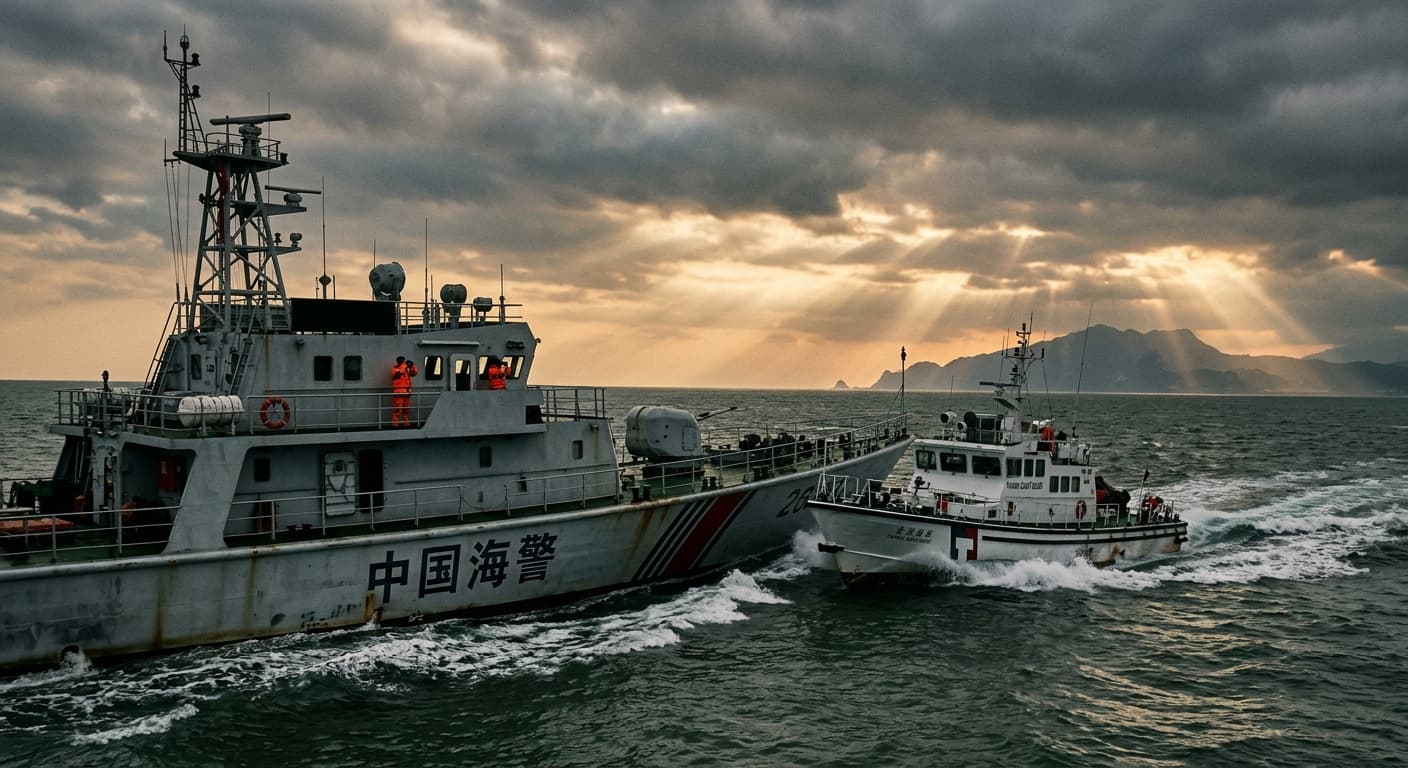
Analysis of China's June 2026 deployment east of Taiwan: CCG and navy vessels maintain round-the-clock presence, using 'law enforcement' to assert jurisdiction and test Taiwan's defenses.
Global
China's Taiwan Blockade Playbook: White Hulls
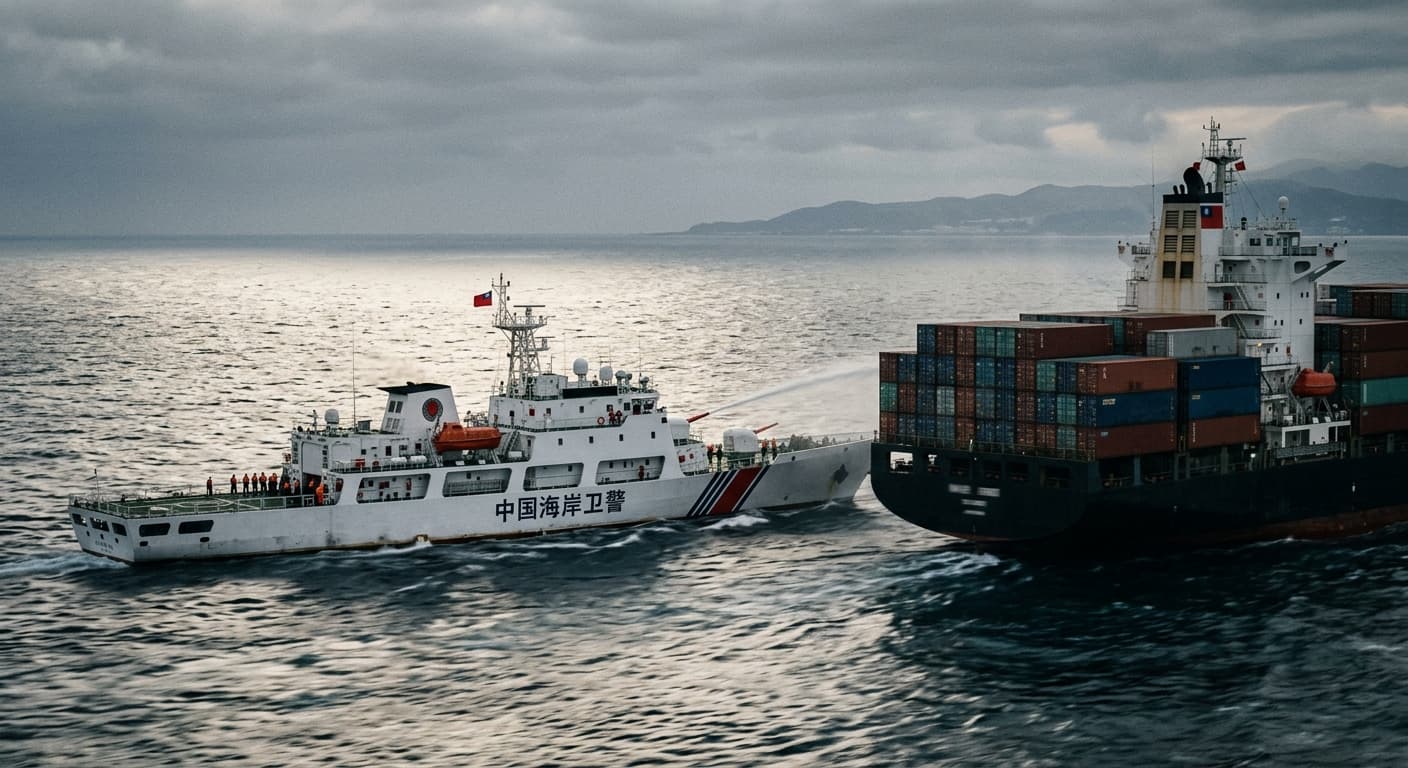
Senator Tammy Duckworth warns China will likely blockade Taiwan by 2028 using coast guard vessels under legal cover, not military invasion, citing rehearsed exercises and economic stakes of $2.45 trillion in trade.