Taiwan's Drone Doctrine Against China
Taipei's strategy focuses on drones over ships.
Model Diplomat9 min readAsia
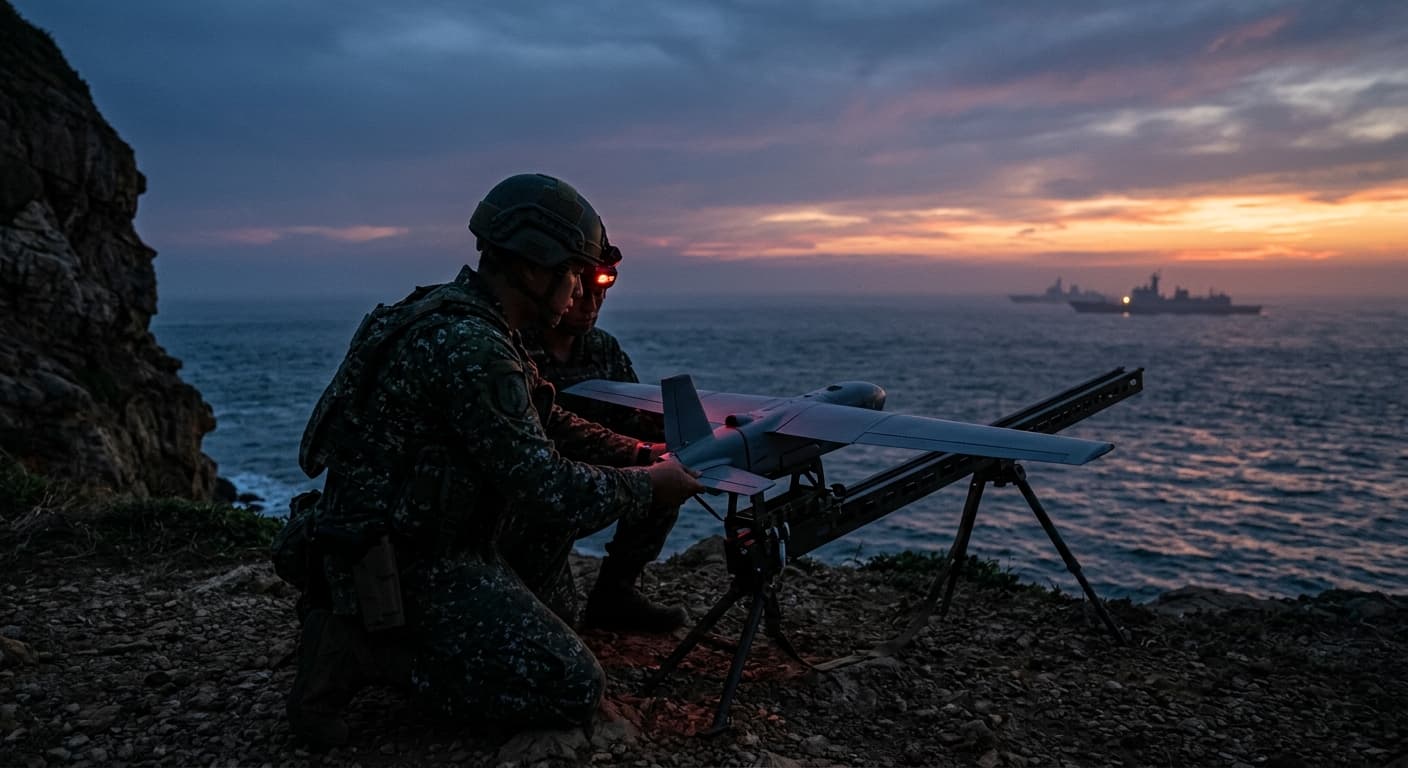
Taiwan's Drone Doctrine: Why Taipei Won't Match China Hull-for-Hull
Taiwan's security analysts are pushing an uncrewed-systems doctrine to counter China's gray-zone pressure — offloading detection to drones and reserving hulls for enforcement.
Taiwan's answer to a China Coast Guard that outweighs it three-to-one is not a bigger fleet — it is 1,320 uncrewed attack boats, an emerging drone-first doctrine, and a bet that surveillance drones plus a small number of crewed ships can raise Beijing's costs faster than shipyards can churn out steel. That was the through-line at the Taiwan International Ocean Forum in Taipei on July 9, 2026, where the government-linked Research Institute for Democracy, Society and Emerging Technology (RIDSET) told coast guard and navy officials to stop trying to shadow Chinese vessels one-for-one and instead build an integrated architecture of uncrewed aerial, surface and undersea systems. The pitch reframes Taiwan's problem: not too few ships, but too few drones fused to the ships it has.
The stakes reach well beyond the Taiwan Strait. Beijing is running the same gray-zone playbook — swarming coast guard vessels, "research" ships, cable-severing anchor drags — from the Second Thomas Shoal to the Senkakus. If Taiwan cracks the response, the doctrine travels. If it doesn't, the "Kinmen Model" becomes the template for every disputed reef between Manila and the Kuril Islands.
The forum's core argument: mass is the wrong metric
RIDSET analyst Cathy Fang laid the arithmetic out plainly at the Ocean Affairs Council forum, according to the Taipei Times. The People's Liberation Army Navy fields more than 370 combatants and is projected to reach 435 by 2030. The China Coast Guard operates over 150 patrol vessels of 1,000 tonnes or heavier. Taiwan's Coast Guard Administration has 167 patrol vessels total — most of them small — spread across Kinmen, Matsu, the Pratas atoll and Itu Aba in the Spratlys.
Matching that force posture is neither affordable nor operationally sound. The Brookings Institution's Ryan Hass and Stephen Tan warned in March that Taiwan's current playbook — scrambling jets and frigates at every Chinese incursion — is "exhausting Taiwan's military readiness and personnel" while Beijing operates "with near impunity." Fang's proposal follows that logic: drones do the detection and tracking, uncrewed surface vessels form security cordons, autonomous underwater vehicles monitor cables, and crewed ships handle only enforcement. The Institute for National Defense and Security Research's Benjamin Blandin added the counterweight the analysis needs — Beijing has an inventory of "experimental platforms" (arsenal ship, electronic-warfare barge, cable-cutting UUV rated to 3,500 meters), but "most of these platforms remain in an experimental phase and possess more propaganda value than military utility."
What Taipei is actually buying — and what the legislature isn't
The 1,320-boat program is not aspirational. It is the industrial spine of Taiwan's asymmetric turn, built around Lungteh Shipbuilding's Kuaiqi USV and CSBC's Endeavor Manta drone boat, both modeled on Ukrainian Black Sea platforms like the Magura V5. The Hudson Institute reported in May that Taiwanese industries are building "more than 1,300 uncrewed naval platforms from the Kuaiqi USV baseline", with AI-assisted swarm variants coming behind them.
The aerial side is scaling faster. Taiwan's Drone National Team — a consortium of over 60 firms anchored by the state-owned National Chung-Shan Institute of Science and Technology — is targeting 15,000 dual-use drones per month by 2028 and roughly 180,000 per year by 2030, per Singapore's RSIS. Al Jazeera reported that Taiwan's Ministry of National Defence has ordered 700 military-grade UAVs and 3,422 dual-use drones domestically, layered on top of 1,000 UAVs from the United States and a
May 2025 target to procure another 47,000 drones over four years.
The financing is where the story bends. President Lai Ching-te's proposed NT$1.25 trillion ($40 billion) eight-year special defense budget — announced November 25, 2025 in a Washington Post op-ed and formally unveiled to underwrite the T-Dome integrated air defense system, long-range fires and mass drone procurement — is stuck. As NPR reported in January, the opposition Kuomintang and Taiwan People's Party used their legislative majority to reject the full package six times through late December 2025. On February 1, the Legislative Yuan advanced a slimmed alternative capped at roughly $12.7 billion that, per the Heritage Foundation,
cuts 70% of the original funding and jettisons T-Dome altogether. The American Enterprise Institute's April tally noted that both opposition versions of the budget
omit funding for large-scale drone procurement and integrated air and missile defense — the two capabilities Taiwan's own analysts say the war in Ukraine has made non-negotiable.
The subtext at last week's forum: even if the doctrine is right, the money to execute it is not yet secure.
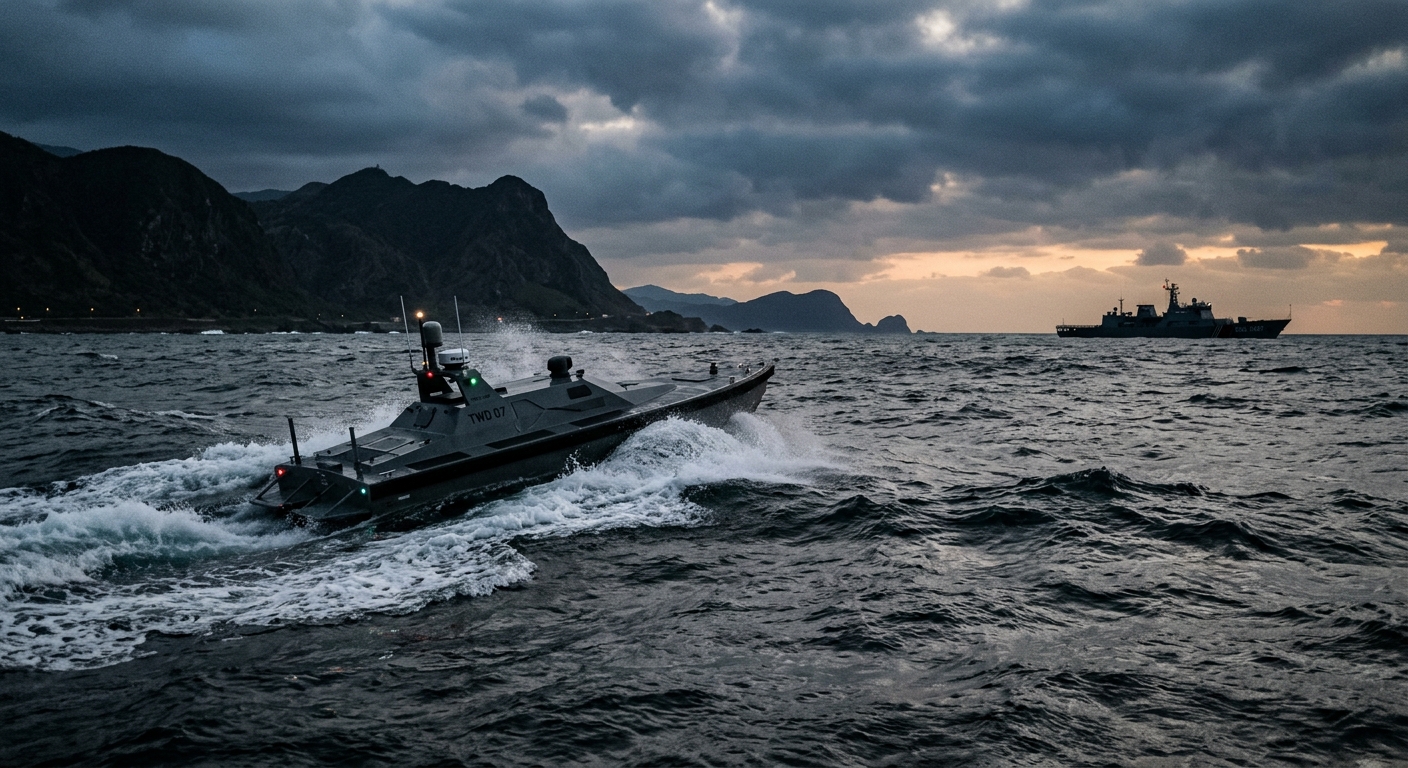
The Pratas problem — why this doctrine gets tested first
Pratas Island — Dongsha to Taipei — is the near-term stress test, and the reason the forum's tone was urgent rather than academic. The CSIS Asia Maritime Transparency Initiative documented that China Coast Guard and Maritime Safety Administration vessels patrolled within Pratas's contiguous zone for 60 days in 2025, up from zero in 2021 and 25 in 2024. A PLA drone entered Pratas airspace in January 2026 — the first such reported incursion. Japan's JIIA logged
77 Chinese incursions into Pratas restricted waters by 18 vessels between January and March 2025 alone.
The Macdonald-Laurier Institute's Joe Varner argued in June that Pratas is Beijing's optimal test case: an isolated island with roughly 500 Taiwanese personnel, no civilian population, sitting astride the Bashi Channel — the chokepoint the PLA Navy must transit to break into the western Pacific. Ocean Affairs Minister Kuan Bi-ling used the forum to urge partners to "draw clearer lines" against gray-zone pressure. Coast Guard Sixth Offshore Flotilla captain Arthur Yang went further at the same event, telling attendees that China's deployment of "scientific research" vessels near Taiwan's east coast carries a military motive: preparing to deny foreign naval access to strategically vital waters, according to
Taipei Times reporting.
Fang's logic follows the geography. Taipei cannot forward-deploy enough hulls to police Pratas continuously. But long-endurance UAVs, satellites and undersea sensors can — with human enforcement dispatched only when detection produces something worth escalating over. Biosphere Dynamics founder Peter Houlihan told the forum that his firm is already doing exactly this in Palau, using drones with eight-hour loiter times and hundreds-of-nautical-mile ranges to feed law enforcement suspect-vessel data for illegal fishing interdiction.
Washington: nudging, spending, hedging
The United States is running a parallel campaign. AIT Director Raymond Greene, the de facto US ambassador, told a Taipei audience on July 2 that Taiwan must become a drone "hornet's nest" — a public statement whose timing bracketed the ocean forum. That message rests on legislation. S. 3163, introduced in the 119th Congress, would direct the Secretary of Defense to
engage Taiwan in a joint program to field uncrewed and counter-uncrewed capabilities. The Fiscal Year 2026 National Defense Authorization Act already directs the Department of War (as the DOD was renamed in 2025) to work with Taiwan on co-development and co-production of uncrewed systems, and to deepen US Coast Guard–CGA training, per the
Institute for National Defense and Security Research.
The Trump administration's stance is more transactional. CNAS notes that the 2026 National Defense Strategy released January 23 makes no explicit mention of Taiwan but reaffirms a "strong denial defense" along the First Island Chain — while insisting allies "step up and spend." Taipei's uncrewed-systems bet is thus doubly load-bearing: it satisfies Washington's demand that Taiwan carry more of the burden, and it prepares the island to fight alone if the demand for U.S. intervention is refused.
The Hong Tai 58 precedent
The doctrine also has a legal anchor most coverage misses. On June 12, 2025, the Tainan District Court sentenced the captain of the Togo-flagged, Chinese-crewed Hong Tai 58 to three years in prison for severing Taiwan-Penghu Cable No. 3 — Taiwan's first conviction for subsea cable sabotage. The Taiwan High Court's Tainan Branch upheld the ruling on August 29. The Prospect Foundation's legal analysis explains the court used Article 72(1) of the Telecommunications Management Act and grounded jurisdiction in
Taiwan's straight-baseline internal waters, citing UNCLOS Article 8(2) and finding the vessel's zigzag anchoring maneuver rendered passage non-innocent under Articles 19(2)(c) and (l).
That precedent is what Fang's doctrine operationalizes. Detection and evidence collection — via drones and AUVs on the cables — provides the forensic backbone; the Hong Tai 58 case shows Taipei can convert that evidence into prosecution and, crucially, into imposition of cost on individual mariners crewing Beijing's "dark fleet." China's response was telling: in late December 2025, Weihai public security authorities accused two Taiwanese nationals of controlling the ship as part of a smuggling ring, offering a 250,000-yuan bounty. Attribution warfare, in other words, is now bidirectional.
What could still break this
Three fragilities deserve naming. First, the supply chain. CNAS notes Taiwan's drone industrial base remains constrained by high non-PRC component costs and dependencies on U.S. subsystems; DSET puts current component self-sufficiency at 70–80%. Second, orders. Taiwan's Institute for National Defense and Security Research warned in June that shifting uncrewed procurement from the eight-year special budget into annual budgets — as the KMT proposals do —
strips the long-horizon contracts that manufacturers need to scale. Third, Taiwan's Institute for National Defense and Security Research's Blandin was right that most Chinese platforms are experimental — but experiments become fielded systems. The PRC's cable-cutting UUV is the platform Taiwan's AUV-monitoring doctrine is designed to catch. If deployment outpaces detection, the doctrine loses.
Diplomat View
The forum did not announce a new weapon — it announced a doctrine, and the doctrine is the story. Taiwan is telling Washington and Beijing simultaneously that it will not fight the last war. It will not build a hull-count navy to shadow China's, and it will not stake deterrence on a U.S. cavalry that the 2026 National Defense Strategy no longer promises by name. The uncrewed-systems doctrine — detection and evidence by drone, enforcement by ship, prosecution by court — is coherent, cheap enough to survive austerity, and defensible even if the special budget stays gutted.
Our call: this doctrine holds and scales through 2027 only if the Legislative Yuan restores at least half of the drone and IAMD funding stripped from the special budget by Q4 2026, and if Taiwan converts one more gray-zone incident into a Hong Tai 58–style prosecution before year's end. Miss both, and Beijing will read the drone talk as rhetorical cover for a hollowed force, and calibrate its Pratas pressure accordingly. What would change the forecast: a KMT–DPP compromise budget above NT$800 billion with T-Dome intact; a formal U.S.–Taiwan uncrewed-systems co-production MOU under S. 3163; or a successful cable-cutting attack Taipei cannot attribute in court.
What to watch
- Q3–Q4 2026, Legislative Yuan: Compromise vote on a restored special defense budget. KMT figures including Taichung Mayor Lu Shiow-yen have floated NT$800 billion–1 trillion. A compromise at that level, with drones and T-Dome intact, is the single most important indicator that Taiwan's doctrine can be resourced.
- Late 2026, Pratas patrols: AMTI's next data drop on CCG patrol days near Pratas. A jump above 90 days would signal Beijing has decided the drone doctrine is not yet a deterrent.
- FY2026 NDAA implementation: Whether the Department of War issues an actual co-production plan under S. 3163 and the NDAA drone directive, or lets the mandate expire — the tell on whether Washington's "hornet's nest" language has budget behind it.
The Bottom Line
Taiwan's shift to uncrewed systems is not a technology story — it is a doctrine story about who bears the cost of gray-zone pressure. By offloading detection to drones and reserving hulls for enforcement, Taipei is trying to invert the exhaustion economics that have favored Beijing since 2020. It will work only if the Legislative Yuan pays for it and the coast guard learns to prosecute what the drones catch.
Discover more

US Politics
White House Pressures Congress for Crypto Leg
The Trump administration's push for the CLARITY Act aims to reshape crypto regulation, impacting trillions in market value and the Trump family's wealth.
Global Politics
Xi Jinping Calls China-Russia Ties 'Precious'
Xi Jinping's description of China-Russia ties as 'precious' reflects a strategic imbalance, with Beijing dictating terms in the partnership.

US Politics
US Launches $166B Tariff Refund Portal
The US is launching a $166 billion tariff refund portal to aid importers hit by Trump-era tariffs, with major implications for trade and supply costs.

Economics
Fed's Amex AML order puts correspondent banking on notice
Federal Reserve's Amex AML order requires board-level controls and a 90-day plan; OCC fined the bank $350 million over enterprise-wide deficiencies.