Taiwan Turns Coast Guard Into Diplomatic
Foreign lawmakers join Taiwan coast guard patrol off Kinmen
Model Diplomat9 min readEast Asia
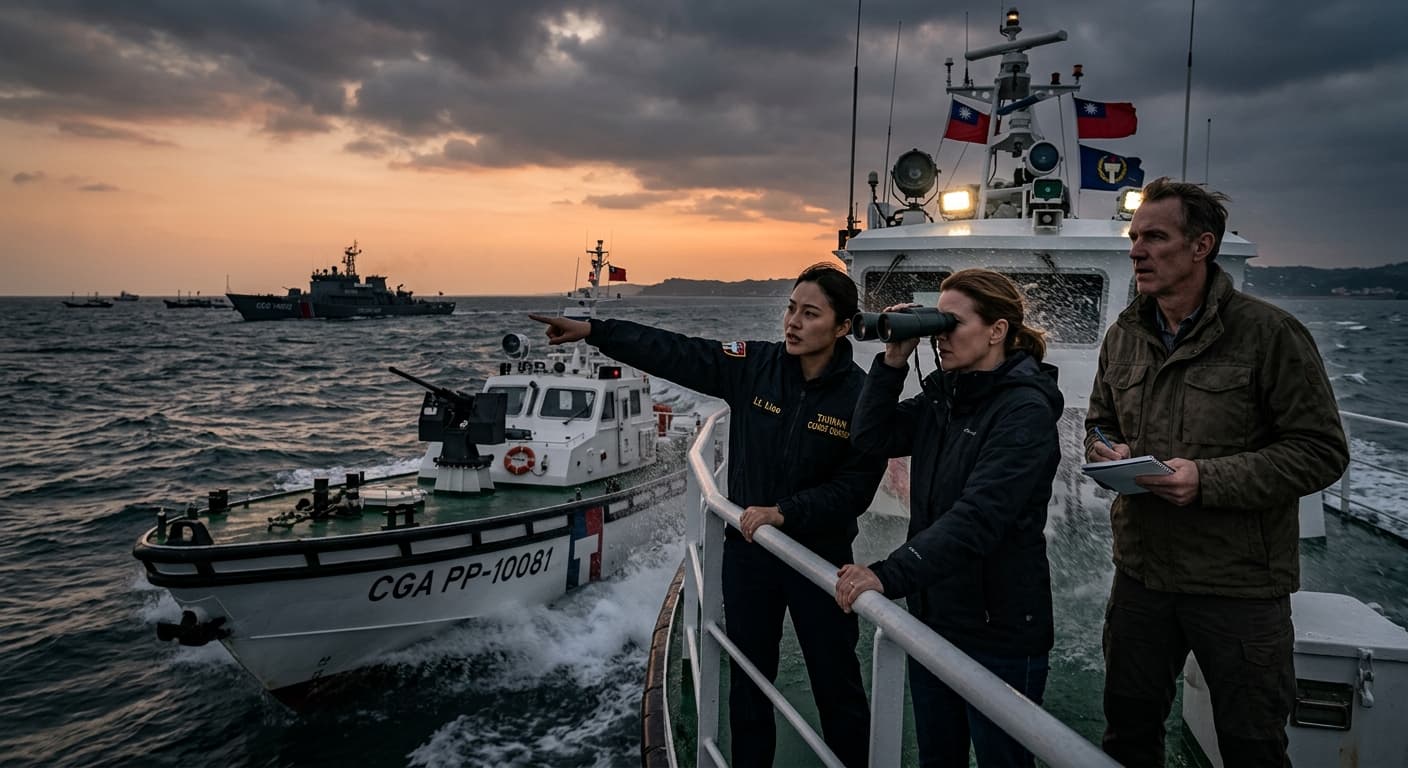
Taiwan Turns Its Coast Guard Into a Diplomatic Weapon — and Beijing's Gray Zone Just Got Harder to Hide
[Seven foreign lawmakers aboard a Taiwanese coast guard ship off Kinmen signals a new phase in cross-strait competition: Taipei is internationalizing its front line, one patrol at a time.]
On July 9, 2026, Taiwan put seven foreign parliamentarians aboard Coast Guard Administration vessel PP-10081 for a 90-minute patrol through the contested waters off Kinmen — the first time an international delegation has joined a Taiwanese coast guard mission. The voyage was organized by the Ministry of Foreign Affairs and the Ocean Affairs Council and carried lawmakers from the United Kingdom, Ukraine, the Czech Republic, India, and New Zealand, all members of the Inter-Parliamentary Alliance on China (IPAC), alongside Taiwanese legislators Fan Yun of the Democratic Progressive Party and Chen Gau-tzu of the Taiwan People's Party. Taipei's calculation is clear: if Beijing can normalize coast guard pressure, Taiwan can normalize international witnesses.
The trip did not produce a treaty, a communique, or an arms sale. It produced something more durable — nine lawmakers who can now describe, from personal observation, what China's maritime gray-zone campaign looks like from a 100-tonne patrol boat that is unarmed and outnumbered.
The Patrol and What It Showed
The CGA vessel departed Shuitou Port in Kinmen and sailed north along the main island's coast, bringing Xiamen's skyline — and the construction site of Xiamen Xiang'an International Airport on Dadeng Island — into clear view. CGA officials briefed the delegation on what Taiwan calls "gray-zone" activities by Chinese coast guard vessels in nearby waters, including the erosion of prohibited and restricted maritime boundaries that have been tacitly observed since 1993, when Taiwan's Ministry of National Defense set zones of just 2.2 and 3.2 nautical miles around Kinmen — far smaller than the 12- and 24-nautical-mile boundaries applied to Taiwan's main island under the UN Convention on the Law of Sea framework, as documented by AMTI/CSIS.
No Chinese coast guard vessels appeared during the patrol. The CGA said they had returned to port to shelter from approaching Typhoon Bavi. But the agency noted that Chinese ships had made one of their "regular forays" into Kinmen waters the previous day, according to the Taipei Times.
IPAC co-founder and executive director Luke de Pulford told Taiwan's Central News Agency that the visit marked the first time an international parliamentary delegation had joined a Taiwanese coast guard patrol. "It is quite a significant visit, but the fact that they want to do it shows you how great the concern is about cross-strait peace around the world," he said, as reported by Focus Taiwan.
British MP Tom Tugendhat, formerly the UK's Minister of State for Security, framed the visit in terms of the international order rather than Taiwan's bilateral interests. "I'm in Taiwan. I'm in Taiwanese waters. This has nothing to do with Beijing. This is to do with simply defending the international rules-based system that the Chinese government in Beijing claims to have signed up to," he said, according to the Taipei Times.
Ukrainian lawmaker Yulia Sirko drew an explicit parallel to her own country's experience. "If you want peace, start preparing for war. And unfortunately, we didn't do it in the right time, so this is lesson No. 1 from the Ukrainian experience," she said aboard the vessel, per the Taipei Times.
CGA Fleet Branch Deputy Director Tsai Chung-mou said the government hoped the trip would help the international community grasp the pressure Taiwan faces. "We hope that all countries around the world that support freedom and democracy can understand that Kinmen stands on the front line of the Taiwan Strait, facing the Chinese Communist Party," he said, as quoted by Focus Taiwan.
The Escalation That Made the Trip Necessary
The July 9 patrol did not occur in a vacuum. It was a response to a quantitative shift in Chinese maritime pressure that has accelerated over the past 30 months.
The catalyst was a February 14, 2024 incident in which a Chinese motorboat entered Kinmen's prohibited waters, refused inspection, and capsized after a collision with a Taiwan CGA vessel — killing two Chinese nationals. Beijing responded on February 18 by vowing to increase China Coast Guard (CCG) patrols around Kinmen and other Taiwan-administered areas, and the following day, six CCG officials boarded a Taiwanese tourist boat near Kinmen, inspecting certificates and crew licenses for 30 minutes, as reported by Al Jazeera.
By May 2024, a record 11 Chinese government vessels entered Kinmen waters simultaneously during the Joint Sword-2024A exercise, some conducting maritime drills with Chinese fishing boats, according to AMTI/CSIS. Taiwan's 2025 National Ocean Policy White Paper, released in September 2025, documented 679 unauthorized CCG transits into restricted waters around Kinmen and Matsu in 2024 alone, describing them as "normalized law enforcement operations," as analyzed by
CSIS.
The pressure has not been confined to the Taiwan Strait. Since June 1, 2026, CCG vessels have patrolled almost continuously in waters east of Taiwan — a new frontier that Beijing's state media has signaled could become regularized under what it calls a model of "nearshore governance," extending the so-called "Kinmen model" to the Pacific side of the island, according to AEI.
The scale is documented. According to a May 2026 CSIS Futures Lab report, the daily average of distinct China Coast Guard vessels entering Taiwan's near waters increased by more than 500 percent between January 2020 and December 2025, while daily incursions into Taiwan's second maritime security ring more than quadrupled, as documented by CSIS.
This escalation prompted the United States, the United Kingdom, France, and Germany to express concern over the CCG's east-coast patrols, according to the Taipei Times. On June 17, 2026, G7 leaders reaffirmed their "opposition to any unilateral attempts to change the status quo, in particular by force or coercion, in the East and South China Seas and across the Taiwan Strait," according to the
G7 leaders' statement.
The Strategy: Converting Gray-Zone Pressure Into Legislative Capital
The IPAC patrol represents a specific strategic logic. China's gray-zone campaign is designed to stay below the threshold that triggers international military response. It relies on ambiguity, plausible deniability, and the fact that coast guard incidents rarely generate sustained headlines. Taiwan's counter is to eliminate that ambiguity by putting named, credentialed foreign lawmakers physically in the contested space.
This matters because the alternative channels for international Taiwan support are narrowing. In December 2025, the US approved its largest-ever weapons package for Taiwan. But by mid-2026, Washington paused a $14 billion arms sale to Taiwan to conserve munitions for the war on Iran, as reported by Al Jazeera. The Trump administration has also cautioned Taipei against formally declaring independence. The reliability of the US security pipeline is, at minimum, in question.
Into that gap steps parliamentary diplomacy. IPAC, founded in 2020, has grown to over 100 members from more than 19 countries, spanning Australia, Canada, Germany, Japan, Lithuania, Norway, Sweden, the UK, the US, and the European Parliament, according to the Asia Pacific Foundation of Canada. Its members operate across party lines and are not dependent on executive-branch agreement to shape China policy in their home legislatures. A lawmaker who has stood on a Taiwanese coast guard vessel in sight of Xiamen becomes a different kind of advocate — one with firsthand proximity to the issue, not just a briefing paper.
The delegation's composition was deliberate. Tugendhat brings weight on security policy in Westminster. Sirko brings the Ukraine analogy — the argument that deterrence failed in Eastern Europe because warnings were ignored. Priyanka Chaturvedi, a former Indian lawmaker, extends the network into a country that has historically been cautious on Taiwan but is increasingly central to Indo-Pacific security architecture. Helen White of New Zealand represents a jurisdiction where China influence operations have been a live political issue.
The presence of legislators from both the DPP and the TPP — Taiwan's ruling and third-largest parties — signals that the coast guard issue is not a partisan project. That cross-party coordination matters for foreign observers who might otherwise discount Taiwan's messaging as factional.
Beijing's Problem: The Witness Effect
China's coast guard strategy depends on a specific information environment: one where incidents occur frequently enough to become routine, but rarely enough in the international spotlight that each one fades quickly. The "Kinmen model" — described by Beijing's own state-affiliated media as a template for expanding maritime jurisdiction — works best when the audience is domestic Chinese and the international press is absent, as noted by AEI.
The IPAC patrol inverts that logic. It manufactures an audience. It also creates a documentary record: photos, statements, and firsthand accounts from elected officials whose governments will be asked about their positions. IPAC posted images from the visit, and the delegation held a closed-door meeting with CGA's Ninth Fleet Branch after returning to port, according to Focus Taiwan.
This does not stop the patrols. But it raises their political cost. Each future CCG incursion that coincides with a visiting delegation becomes a diplomatic incident rather than a routine event. And each delegation that visits creates a constituency in its home parliament for monitoring, legislation, or joint coast guard cooperation — exactly the outcome CSIS analysts have recommended, arguing that Washington should designate the CCG as an arm of the PLA and encourage allies to conduct joint patrols with Taiwan's coast guard, as outlined by CSIS.
Taiwan is already preparing for the scenario the IPAC delegation witnessed in microcosm. On June 25, 2026, the Lai administration held a tabletop exercise simulating a PRC maritime quarantine, including CCG boarding, inspecting, and detaining commercial vessels bound for Taiwan, as reported by AEI. On July 1, Taiwan commissioned its new Littoral Combat Command, integrating Taiwanese and US-produced missile systems with an unmanned surface vessel unit to streamline coastal defense within 24 nautical miles, according to
AEI. The September 2025 Special Resilience Budget allocated $894 million to the Ocean Affairs Council, with $206 million earmarked specifically for the CGA's development of uncrewed maritime vehicles, as documented by
CSIS.
The Decisive Detail: Who Was Not There
The most telling fact of the July 9 patrol is who was absent: no Chinese coast guard vessels. They had sheltered from Typhoon Bavi. But the broader pattern is that CCG patrols around Kinmen are choreographed — present enough to assert jurisdiction, absent enough to avoid direct confrontation with foreign observers, as NPR reported in its analysis of local Kinmen sentiment, where residents described the patrols as "political theater" carefully timed to avoid affecting daily life, according to NPR.
Beijing's calculus may shift if these delegations become routine. A coast guard presence that avoids foreign witnesses is sustainable; one that retreats every time an IPAC delegation arrives undermines the narrative of normalized jurisdiction. China's options narrow: intercept or shadow the vessel and risk an international incident, or stay away and cede the visual narrative to Taiwan.
Diplomat View
The IPAC coast guard patrol is not symbolism — it is a deterrence-by-witnessness strategy that exploits the gap between China's gray-zone tactics and its desire to avoid overt confrontation with Western legislatures. Taiwan is betting that each foreign lawmaker who physically observes the front line creates a permanent constituency for monitoring, sanctions legislation, and coast guard cooperation that outlasts any single government's defense policy.
The forecast: if Taiwan repeats these visits — and all indications are that it will — Beijing faces a binary choice between escalating its coast guard presence in front of international observers or tacitly conceding that its patrols are calibrated for plausible deniability rather than genuine jurisdictional control. Either outcome degrades the "Kinmen model" that Beijing's own state media has championed as a template for the Pacific.
What would change the forecast: a CCG decision to shadow, board, or aggressively maneuver near a vessel carrying foreign legislators — which would instantly convert a coast guard patrol into a diplomatic crisis involving multiple G7 and Indo-Pacific governments simultaneously. The alternative — a sustained Chinese decision to withdraw from Kinmen waters whenever international observers are present — would be its own form of concession.
What to watch:
- Taiwan's Ministry of Interior has announced interdepartmental drills for July 2026 to practice securing supply chains and escorting commercial ships through a simulated PRC blockade — the next concrete test of the quarantine-response architecture.
- IPAC's annual summit, expected in late 2026, will indicate whether the Kinmen model of coast guard visits becomes a recurring program or a one-off.
- The US Coast Guard's forward deployment posture in the Western Pacific — currently just four ships homeported in Guam — remains the structural constraint on any allied joint-patrol response, as flagged by
CSIS.
The bottom line: Taiwan's decision to put foreign lawmakers on a coast guard vessel in contested waters is the sharpest move yet in its campaign to internationalize China's maritime pressure — and it forces Beijing into a choice between confrontation with witnesses and quiet retreat that undermines its own jurisdictional claims.
Discover more

US Politics
White House Pressures Congress for Crypto Leg
The Trump administration's push for the CLARITY Act aims to reshape crypto regulation, impacting trillions in market value and the Trump family's wealth.
US Politics
U.S. House Passes Alert Act for Aviation
The House passed the ALERT Act 396–10, replacing the ROTOR Act after Pentagon intervention, impacting aviation safety regulations.

India
Women’s Reservation in India
India's 33% women's reservation law is enacted but won't take effect until after 2029 due to political setbacks and census delays.

Economics
Fed's Amex AML order puts correspondent banking on notice
Federal Reserve's Amex AML order requires board-level controls and a 90-day plan; OCC fined the bank $350 million over enterprise-wide deficiencies.