US Strikes Iran Again as Hormuz Ceasefire F
U.S. hits over 80 targets in Iran amid tensions.
Model Diplomat8 min readMiddle East
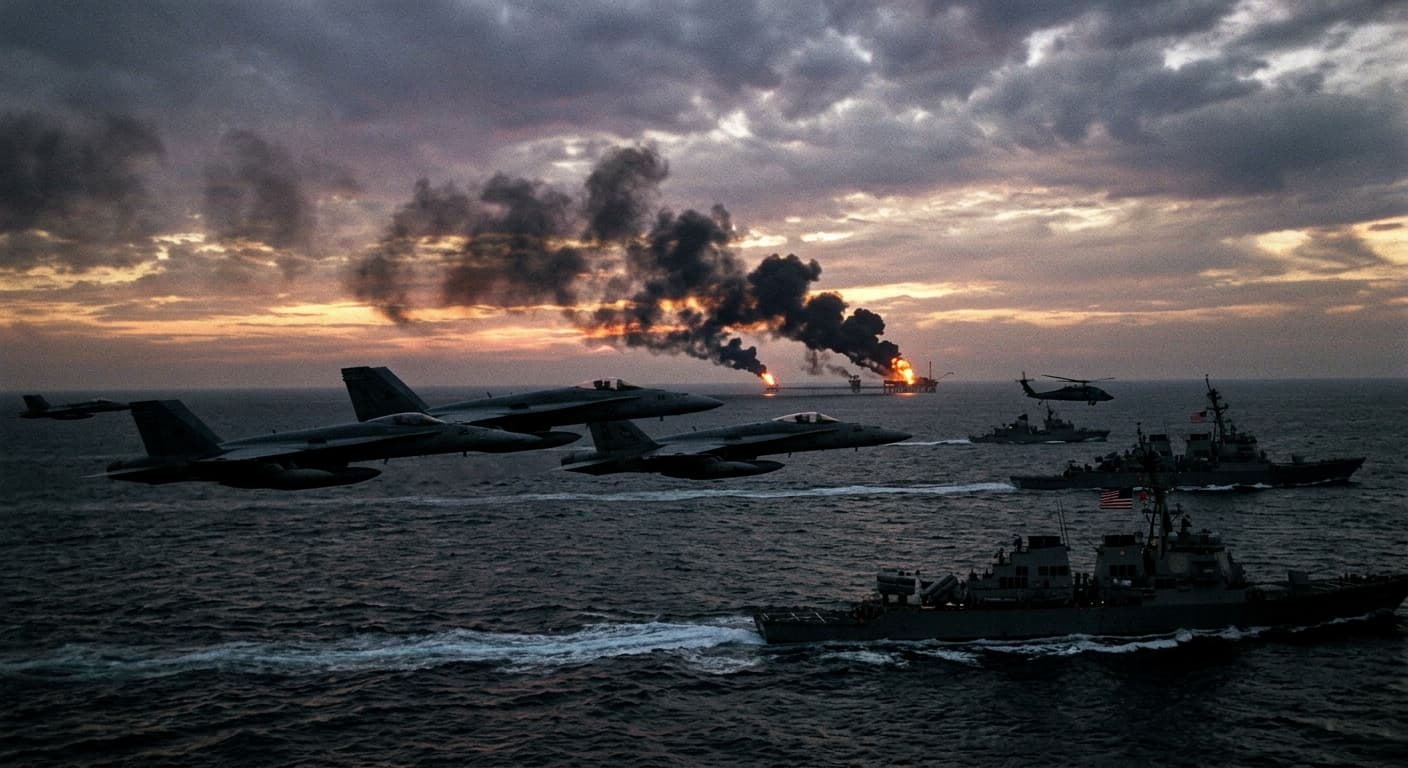
US Strikes Iran Again as Hormuz Ceasefire Collapses
U.S. Central Command hit more than 80 targets across Iran on July 8, 2026 as the June 17 ceasefire unravels over control of the Strait of Hormuz.
The second U.S. wave of strikes on Iran in 36 hours — announced by U.S. Central Command on the evening of July 8, 2026 — is not a fight about Iran's nuclear program, its proxies, or even the tankers that were hit this week. It is a fight about who writes the operating manual for the Strait of Hormuz. Washington is using force to lock in the principle that the world's most important oil chokepoint is an international waterway; Tehran is using force to establish that it is not. Every subsequent decision — on sanctions, on oil prices, on whether the June 17 memorandum survives past its August 21 expiry — flows from that single unresolved question.
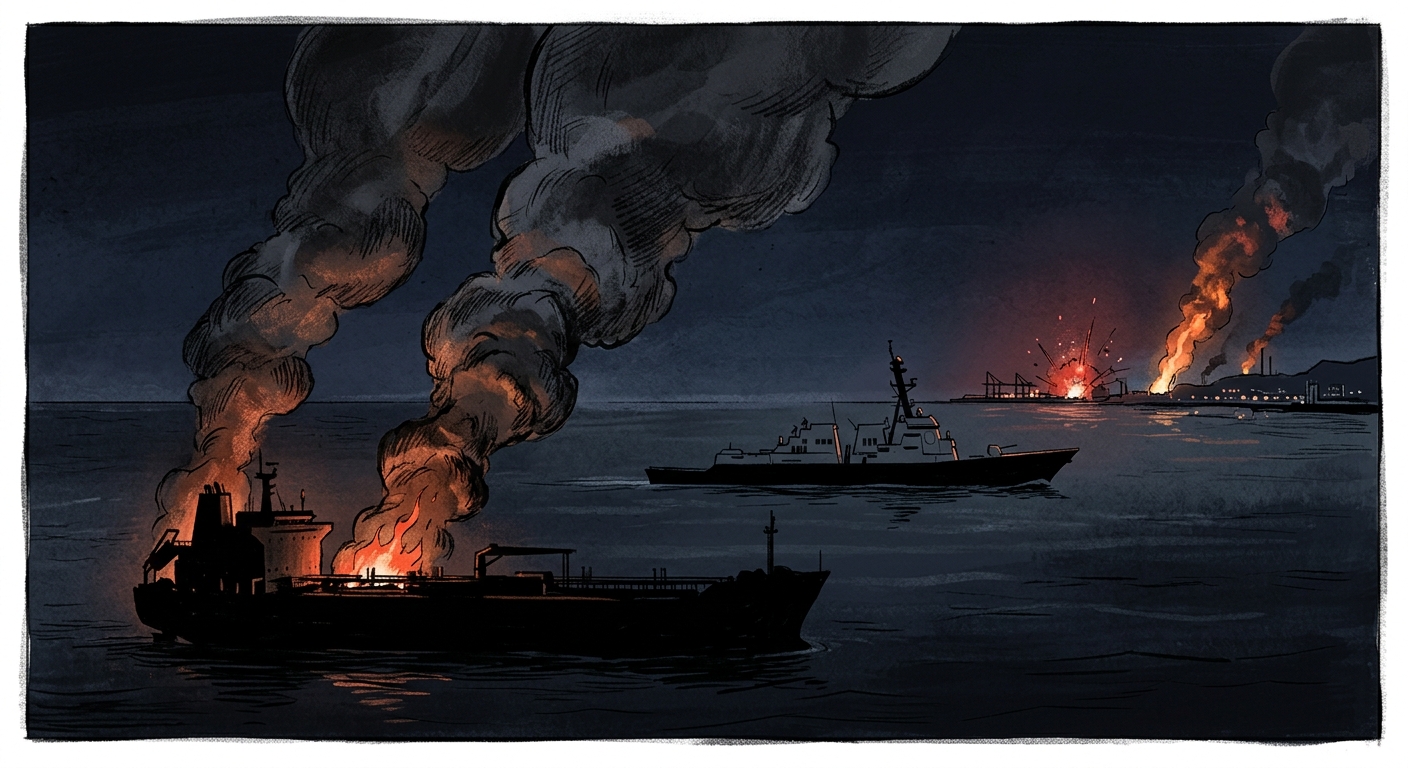
What CENTCOM hit, and why
CENTCOM's July 8 statement, posted on X, said forces "have started conducting additional strikes against Iran to further degrade their ability to threaten freedom of navigation in the Strait of Hormuz," and framed the operation as "holding Iran accountable" for attacks on commercial shipping, according to Al Jazeera. The initial wave on July 7 struck "over 80 targets with precision munitions" — Iranian air-defence systems, command-and-control nodes, coastal radars, anti-ship cruise-missile batteries and "more than 60 Islamic Revolutionary Guard Corps small boats," per the BBC's
reconstruction. Iranian state media confirmed explosions in Bandar Abbas, Bushehr, Sirik, Konarak, Chabahar, Jask and Qeshm Island, and reported eight army personnel killed.
The trigger was narrower than the response. Between July 6 and July 7, three tankers were struck near Oman — the Marshall Islands-flagged M/T Al Rekayyat, the Saudi-flagged M/T Wedyan and the Liberian-flagged M/T Cyprus Prosperity. The United Kingdom Maritime Trade Operations agency logged the first hit as a projectile strike 8 nautical miles off Limah, Oman. All three, according to Al Jazeera reporting, were sailing along the U.S.-preferred southern corridor hugging the Omani coast — outside the "safe route" the IRGC has been pushing since April, which runs closer to Iran and treats a slice of Omani territorial water as a "restricted zone."
The clause the war is being fought over
The 14-point Memorandum of Understanding signed June 17 halted a war that began with joint U.S.-Israeli strikes on February 28, 2026 that killed Supreme Leader Ali Khamenei and roughly 50 senior officials. It gave both sides most of what they immediately needed: Iran got the lifting of the U.S. naval blockade and a Treasury waiver allowing crude sales; the United States got the Strait of Hormuz reopened and Iranian assets partially unfrozen.
What it did not settle is who runs the strait. Clause five obliges Iran to make "best efforts for the safe passage of commercial vessels, with no charge for 60 days only," while a companion provision requires Iran and Oman to negotiate the "future administration and maritime services" of the waterway, per the BBC. Tehran reads that as recognition of Iranian sovereignty, complete with permit-issuing authority through its new "Persian Gulf Strait Authority" and the eventual right to charge "service fees." Washington reads it as a 60-day standstill before an internationally administered regime.
That gap is the war. According to the Council on Foreign Relations, "the MoU is thus best understood less as a deal that addresses Iran's nuclear ambitions or military capabilities than as a Hormuz deal," and Iran's push to convert territorial control into a "tollbooth" is precisely what the U.S. is trying to break with force, CFR's analysis argues. Michael Wahid Hanna of the International Crisis Group told
Al Jazeera that Iran "hasn't yet achieved what it set out to do as the fighting ended, which was to establish a system that both recognised its control of the strait and established a mechanism for its monetisation."
The U.S. Treasury moved on the same clause from the other end. On July 7, OFAC revoked the 60-day waiver that had allowed Iranian crude sales through August 21, a document logged among its selected general licenses. Iran's chief negotiator, parliament speaker Mohammad Bagher Ghalibaf, immediately called the revocation and the southern-Iran strikes "major MoU violations."
The chokepoint economics
The reason the strait is worth fighting a war over is arithmetic. A June 2025 Congressional Research Service report, Iran Conflict and the Strait of Hormuz, documents that roughly 27% of global maritime crude and petroleum-products trade — around 20 million barrels a day in 2024 — and 22% of global LNG exports transit the strait. There is no meaningful bypass: over 90% of the world's spare crude production capacity sits inside the very Gulf economies whose exports depend on it.
Markets are pricing that reality in real time. Brent crude jumped 4.2% to $77.24 a barrel on July 8, its highest in two weeks, after tumbling from a late-April high of $126, according to Al Jazeera. U.S. retail gasoline, which had fallen to $3.79 from a May peak of $4.48, is now at risk. Oxford Economics chief global economist Ryan Sweet told the outlet the U.S.-Iran arrangement is "the key domino that will determine whether other risks are amplified or dampened" in the second half of 2026.
The insurance market tells the same story in a different currency. War-risk premiums for Hormuz transits, roughly 0.25% of hull value before the war, spiked to as high as 5% during it and remain in a 1–3% range even after the ceasefire, marine insurers told Al Jazeera. Roughly 80 mines are still estimated to be in the strait's main navigation channels. Traffic that once ran 120–140 ships a day is averaging 30 to 40. Even without a single additional strike, the shipping economy has not recovered from March.
The war widens, but only just
Iran's response so far has been calibrated rather than catastrophic. The Islamic Revolutionary Guard Corps says it fired missiles and drones at "85 key US military facilities" in Bahrain and Kuwait, including a U.S. Navy headquarters and an air base; Kuwait's defence ministry reported intercepting the incoming volley, and Bahrain sounded air-raid sirens twice on July 9, per Al Jazeera's war live blog. The Gulf Cooperation Council condemned the attacks. Oman — the mediator that midwifed the June MoU — condemned both the tanker strikes and the Iranian volleys at its GCC neighbours. The United Kingdom and France, in a joint statement dated July 3, said they stood ready to deploy a "wider Multinational Military Mission" to support freedom of navigation, according to
Downing Street.
Trump's rhetoric ran further than his military. At a NATO summit in Ankara he called the MoU "over," said the United States could reinstate the naval blockade, target Iran's electricity and water plants — strikes international-law experts describe as prima facie war crimes — and "may take over" Iran's Kharg Island crude terminal. In his own telling to reporters on Air Force One, Iranian officials had reached out and "want to make a deal so badly," but he did not consider them "worthy," per The Epoch Times.
The Iranian side is constrained by a specific date: Ayatollah Ali Khamenei's weeklong funeral, still under way. His son Mojtaba was named Supreme Leader in March and, according to the Stimson Center, governs by consensus with the IRGC, parliament speaker Ghalibaf, former president Hassan Rouhani and Ali Larijani. Israeli officials have threatened to assassinate him too. The Gulf International Forum argues Mojtaba's succession has effectively formalised
IRGC dominance over Iranian decision-making — which is precisely why the strait, an IRGC-controlled asset, has become the regime's non-negotiable red line. Backing down on Hormuz means backing down on the institution now running the state.
The historical parallel that reframes this
The instinct is to read this week as the 2019 tanker war rerun. It is closer to the 1987–88 "Tanker War" phase of the Iran–Iraq conflict, when the U.S. Navy escorted reflagged Kuwaiti tankers through the Gulf and Operation Praying Mantis destroyed roughly half the Iranian navy in a single day. That episode ended with Iran accepting UN Security Council Resolution 598 — but only after its leverage collapsed. Today the leverage is inverted: it is Iran, not Iraq, sitting on the strait, and it is the United States, not the Soviet Union, that has already bombed its nuclear sites and killed its head of state. Tehran's calculation is that if it does not extract something durable from Hormuz now, it never will. Washington's calculation is that any concession on transit fees or Iranian permits sets a precedent every future chokepoint operator — from Bab al-Mandeb to the Malacca Strait — will study.
What to watch
- August 21, 2026 — expiry of the 60-day MoU window and of the Treasury oil-sales waiver already revoked on July 7. Absent a new instrument, both sides will legally be back at war.
- The next tanker transit hit — Trump warned on July 8 that "if it happens again, it will get much worse," including a potential ground operation against Iran's Kharg Island crude terminal, per
Al Jazeera. Kharg handles the overwhelming majority of Iran's seaborne oil exports; a U.S. seizure would cross a threshold none of the previous strikes has approached.
- Oman's mediation — the Sultanate is the only party trusted by both sides and by the U.K.-France maritime coalition announced July 3. Whether Muscat can produce a face-saving formula on strait administration before August 21 is the single most important variable in whether this becomes a shooting war again.
- Brent above $85 — Ian Lyngen of BMO Capital Markets
The Bottom Line
The July 8 strikes are the United States enforcing an unwritten rule — that no state can gate the Strait of Hormuz — with the only tool that has ever worked. Iran's counter-bet is that the IRGC's control of the coastline, hardened by six months of war and Khamenei's death, gives it a permanent tollbooth it will fight to monetise. The MoU expires on August 21; whichever side sets the precedent before then will define freedom of navigation in the world's most important waterway for the next decade. For Global Politics, that is the stake — not the strikes themselves, but the operating manual being written under them.
Discover more
US Politics
House Ethics Committee Pushes Sexual Miscond.
The House Ethics Committee has shifted responsibility for sexual harassment settlement records to the Office of Congressional Workplace Rights, complicating disclosure efforts.

US Politics
White House Pressures Congress for Crypto Leg
The Trump administration's push for the CLARITY Act aims to reshape crypto regulation, impacting trillions in market value and the Trump family's wealth.
India
Congress Accuses Modi of Stalling Women's Law
Congress accuses Modi of stalling women's reservation law by linking it to delimitation, revealing a deeper electoral strategy.

Economics
Fed's Amex AML order puts correspondent banking on notice
Federal Reserve's Amex AML order requires board-level controls and a 90-day plan; OCC fined the bank $350 million over enterprise-wide deficiencies.