Suvendu Adhikari gives BJP its Bengal breakthrough
From TMC fixer to BJP chief minister, Adhikari’s rise shows how anti-Mamata power, not ideology alone, is now driving Bengal politics.
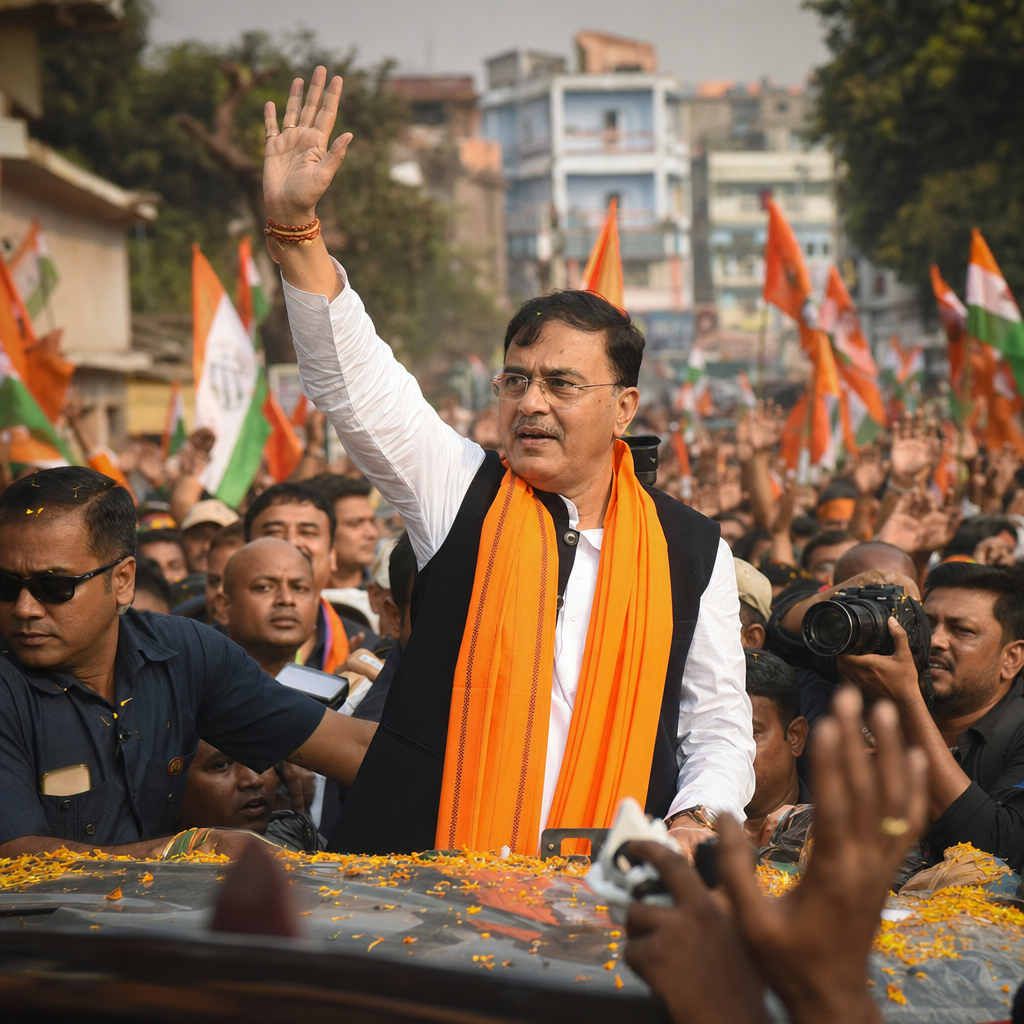
Suvendu Adhikari was sworn in on May 9 as West Bengal’s first BJP chief minister, capping the party’s first full takeover of the state after its sweep over Mamata Banerjee’s Trinamool Congress,  The Hindu reported. The power dynamic is plain: Adhikari now has the leverage because he delivered the two things the BJP needed most in Bengal — a face rooted in the state and a symbol that could beat Mamata Banerjee on her own turf. The BJP’s victory in the 2026 Assembly election ended TMC’s 15-year run, and Adhikari’s own defeats of Banerjee in Nandigram and Bhabanipur made him the party’s strongest claim to the top job, The Hindu said. For readers following
  India politics, this is the rare state-level transfer of power that also recasts the national opposition map.
The BJP’s leverage came from one man’s local machine
Adhikari is not a parachuted national figure. He built his base in Purba Medinipur, rose through the Congress student wing and then the TMC, and was once Mamata Banerjee’s trusted organiser in the Nandigram movement, before switching to the BJP in December 2020, The Hindu reported. That history matters because the BJP’s Bengal breakthrough has never been just about ideology; it has been about finding a local operator who can convert anti-incumbency into seat wins. CNBC TV18 noted that Adhikari’s margin over Banerjee in Bhabanipur widened to 15,105 votes in 2026, while the BJP also swept his Purba Medinipur stronghold, winning all 16 seats in the district,  CNBC TV18 reported. That is not just personal vindication; it is organizational proof that the BJP’s Bengal campaign can now run through a Bengali face with proven district control.
What changes when the anti-Mamata brand becomes the government
Adhikari’s ascent also changes the terms of competition inside Bengal. The BJP has spent years painting the TMC as weak on corruption, unemployment and law and order; Adhikari was the party’s sharpest street-level amplifier on those themes, mobilising protests after the 2021 post-poll violence and leading marches to Nabanna, The Hindu said. Now that rhetoric has to become administration. That helps the BJP in the short term: it can claim continuity between opposition agitation and governance. It also creates risk. A leader built for confrontation has to manage a state where expectations are immediate and the TMC still controls large social constituencies, even after its loss, The Hindu noted.
What to watch next
The next test is not Adhikari’s biography; it is whether he can translate his personal vote into a durable cabinet and district-level control. Watch the first ministerial appointments, the BJP’s handling of post-poll violence, and whether the party keeps him at the centre of its Bengal strategy or tries to balance him with a broader caste-and-region coalition. The key date is the opening weeks of the new government: if Adhikari cannot impose discipline fast, the BJP’s historic win will look bigger on paper than in practice.