Supreme Court Upholds ECI Law Challenge
Court's decision signals importance of ECI appointments law
Model Diplomat2 min readAsia
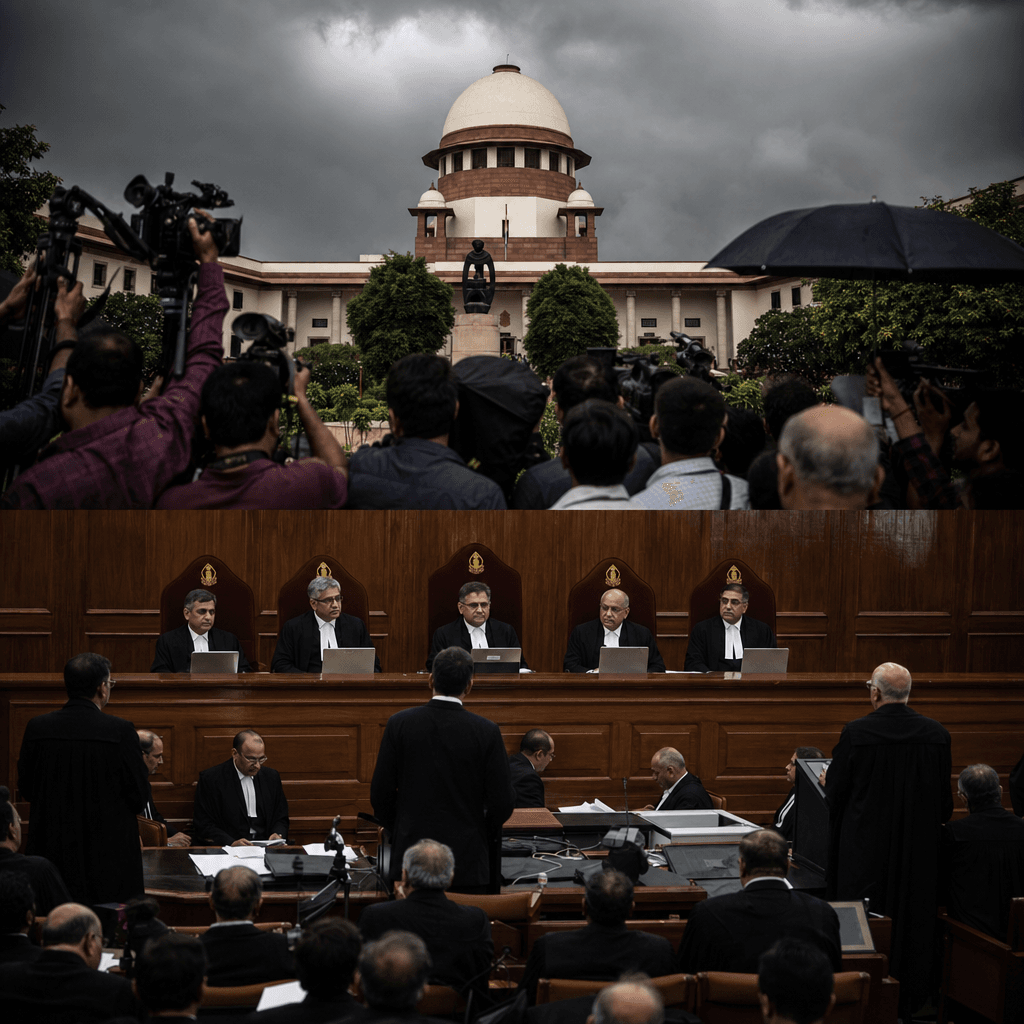
Supreme Court Keeps ECI Law Fight on Track vs Centre
By refusing to delay the case, the court turned the ECI appointments law into a live test of who controls the election referee.
The Supreme Court kept the challenge alive on the Election Commission appointments law by refusing to adjourn the hearing, even after the Centre asked for time because Solicitor General Tushar Mehta was tied up before a nine-judge bench in the Sabarimala reference. The court’s line — that this matter was “more important” — was a signal: the judges are treating control over the poll body as a constitutional question, not a routine scheduling dispute. The bench also declined to freeze appointments made under the 2023 law. The Hindu
Why this matters
The fight is over who gets to pick the people who run India’s elections. The 2023 law replaced the Chief Justice of India with a Union Cabinet Minister on the three-member selection committee, giving the government the deciding edge in appointments to the Election Commission. Petitioners — including the Association for Democratic Reforms and activist Jaya Thakur — say that guts the March 2023 Constitution Bench ruling in Anoop Baranwal, which was meant to insulate the commission from executive control. The Hindu
For India, this is not a procedural skirmish. It goes to the credibility of the referee in a system where the ruling party already controls the state, the bureaucracy and most of the campaign machinery. If the executive can shape the appointment process, it gains influence over the institution that certifies fairness at the moment fairness matters most.
Who benefits if the law survives
The immediate beneficiary is the Centre. A law that keeps a Union minister on the selection committee preserves government primacy over appointments, and the court has so far allowed the regime to operate. In March 2024, it refused to stay the law and rejected attempts to freeze the appointments of Sukhbir Singh Sandhu and Gyanesh Kumar as Election Commissioners. The Hindu
That leaves the petitioners with a narrower but still serious argument: Parliament cannot simply legislate around a Constitution Bench ruling without either confronting its logic head-on or changing the Constitution itself. If the court accepts that theory, it does more than revisit one appointment law. It restores the principle that binding judicial rulings cannot be diluted by redesigning the committee they were meant to control. The Hindu
What to watch next
The next hearing is the real decision point: whether the bench moves from adjournments to merits, and whether it says the 2023 Act can stand alongside Anoop Baranwal or must yield to it. If the court keeps pressing the case forward, the Centre’s room to defend the law narrows; if it slows again, the current appointment structure stays intact by default. That is the fault line to watch — and it will shape every future vacancy at the top of the Election Commission.
Discover more
India
CPI(M) Calls to Decouple Quota from Delimita
CPI(M) demands the Indian government to separate quota policies from delimitation to enhance representation for marginalized communities.
Global Politics
Iran Demands US Enforce Ceasefire
Iran insists the US must enforce a ceasefire in Lebanon to uphold the MoU.
India
India Takes Vice-Presidency at FATF
India's Vivek Aggarwal becomes FATF vice president, paving the way for future leadership.

Global Politics
Israel's Red Sea Gambit: Why Somaliland
Israel's partnership with Somaliland aims to counter Houthi threats and enhance Red Sea influence.