Modi's Historic Mandate Strengthens BJP Power
BJP's victory reshapes India's political landscape
Model Diplomat9 min readAsia

Modi's Bengal Sweep Turns 207 Seats into a National Lock
BJP's April 2026 conquest of West Bengal — 207 of 294 seats — hands Modi 22 of 28 state governments, a Rajya Sabha runway, and the 2027 presidential vote.
The Bharatiya Janata Party's 207-seat sweep of West Bengal on May 4, 2026 — confirmed by the Election Commission of India — ended 15 years of Mamata Banerjee's rule and delivered Prime Minister Narendra Modi the one electoral prize that had eluded him across three general elections. The "historic mandate" Modi claimed from the balcony of BJP headquarters in Delhi is not, on inspection, a state-level story at all. It is the moment the BJP crossed from national plurality into structural dominance of India's federal architecture — enough state legislators to reshape the Rajya Sabha, enough MLAs to decide the July 2027 presidential election, and enough coattails to effectively end the succession ambitions of every BJP figure not named Amit Shah.
According to the NUS Institute of South Asian Studies, the BJP polled 46% of the vote to the TMC's 41% — a near-mirror inversion of 2021, when Banerjee's party won 215 seats to the BJP's 77. The 5-point popular-vote swing translated into a 130-seat swing, the kind of amplification that only occurs when a hegemonic-party system flips completely. As BBC News reported,
West Bengal's electorate of more than 100 million is larger than Germany's, and the state has seen only one change of government in nearly half a century — 34 years of Communist Left Front rule, followed by Banerjee's 15. It has now flipped a second time, and in a direction no analyst forecast six months ago.
The map, redrawn
Four states and one union territory counted votes on May 4, in polls the Election Commission of India had scheduled on March 15, 2026. The BJP-led National Democratic Alliance retained Assam for a third straight term with 92 seats of 126, held Puducherry, lost Kerala's Left government to a Congress-led United Democratic Front, and — the shock nobody priced in — watched actor Joseph Vijay's two-year-old TVK party wipe out the DMK in Tamil Nadu with 108 seats. As
Al Jazeera reported, the BJP now governs or shares power in 21 of India's 28 states, covering roughly 80% of the country's 1.4 billion people — a concentration last seen when the Congress dominated the 1960s under Nehru and Indira Gandhi.
A U.S. Congressional Research Service brief updated after the results puts the composition more precisely: the BJP itself now controls 16 state governments outright, with NDA-allied chief ministers running four more, Congress holding four, and only three states run by parties outside either national coalition. Half of India's population lives in five states — Uttar Pradesh, Bihar, Maharashtra, West Bengal, and Madhya Pradesh — and, per the same CRS brief, all five are now for the first time run by BJP chief ministers. Kerala's return to Congress hands the opposition a genuine consolation, but it also marks something almost as significant: with Pinarayi Vijayan's Left Democratic Front out,
there is no longer a single Indian state governed by the Left, for the first time in the republic's history.
The BBC's post-count analysis captures the historical weight of the Bengal swing. Political scientists have long described West Bengal as a "hegemonic" system that flips only when it flips completely, and BBC News quoted Rahul Verma of the Centre for Policy Research noting that the BJP had "consistently polled around 39% of the popular vote" over three consecutive elections — a floor that made the eventual conquest a question of timing, not possibility. Once anti-incumbency broke against the TMC, the BJP mopped up an additional 5 to 6 percentage points and crossed the line at 44–46%. In BJP internal history, this is the state its ideological forefather Shyama Prasad Mookerjee came from — the one prize the party had promised its cadre for three decades and never delivered until now.
The mechanism that mattered: SIR
The 5-point vote-share margin does not, by itself, explain a 127-seat gap. The mechanism that widened it is now the central legal controversy of Modi's third term: the Election Commission's Special Intensive Revision (SIR), first piloted in Bihar in 2025 and then rolled out across 13 states and territories before Bengal.
Between October 2025 and April 2026, the ECI struck more than 9 million names — roughly 12% of West Bengal's 76 million voters — from the state's rolls. About 6 million were classified as absentee or deceased. Another 2.7 million were flagged under an AI-driven "logical discrepancy" review that, according to Kolkata's SABAR Institute, treated Urdu- and Arabic-derived names transliterated inconsistently into Bengali as suspect. The Supreme Court, after multiple petitions from Banerjee's government and civil-society groups, allowed the April poll to proceed with those 2.7 million cases still pending before tribunals.
Muslims are 27% of Bengal's population, but according to figures reported by Al Jazeera, 65% of the 2.7 million voters under adjudication were Muslim, and in Nandigram — the constituency Suvendu Adhikari has represented since defecting from the TMC — more than 95% of deleted names were Muslim in a constituency that is roughly one-quarter Muslim. The
BBC's field reporting documented that the deletions were concentrated in the border districts of Murshidabad and Malda, where TMC had swept 84 of 88 Muslim-majority seats in 2021.
The ISAS post-mortem is careful: the SIR alone could not have flipped the state, because anti-incumbency and Hindu consolidation were also decisive. But it flags a datapoint that any court will have to reckon with: on 105 of the 207 seats the BJP won, the number of deleted voters exceeded the party's margin of victory. Yogendra Yadav, quoted in Al Jazeera, put the arithmetic most sharply: the 2.7 million disputed deletions equal 4.3% of votes cast, in an election the BJP won by roughly 5 points.
The Election Commission, led by Chief Election Commissioner Gyanesh Kumar, insists the exercise is a routine "clean-up" mandated by the Representation of the People Act, aimed at producing a "pure electoral roll." Modi and Shah, on the stump, framed it as removing "illegal Bangladeshi infiltrators" — a phrase the TMC argues is code for Muslim voters. The BBC notes that a majority (63%) of those deleted were in fact Hindus, many of them Dalits from the Matua community in North 24-Parganas and Nadia. The ECI denies partisan intent. But the disproportion in the adjudication tranche — where 65% of the pending cases were Muslim — is the piece of the record that will define the next four years of Indian election law.
The prize inside the prize: Rajya Sabha and the presidency
The immediate power transfer is visible. Suvendu Adhikari — the TMC defector who defeated Banerjee in Bhabanipur while retaining Nandigram — was sworn in as West Bengal's first-ever BJP chief minister on May 9, 2026, on Rabindranath Tagore's birth anniversary, with Modi in attendance. Post-poll violence claimed at least four lives in the first 48 hours,
including Chandranath Rath, Adhikari's personal assistant, a reminder that Bengal's political transitions rarely happen quietly.
The structural transfer is less visible and more consequential. India's Rajya Sabha, the upper house of parliament, is elected by state legislators to staggered six-year terms. Observer Research Foundation's institutional analysis notes that the BJP on its own holds 98 of the Rajya Sabha's 245 seats and has relied on NDA allies to pass legislation and, at times, on the money-bill route to bypass upper-house scrutiny altogether. Bengal's 16 Rajya Sabha seats, currently dominated by the TMC, will rotate out over the next six years. Assam's return, Bihar's 2025 realignment, and Odisha's 2024 breakthrough feed the same pipe. Carnegie's Milan Vaishnav documented in September 2024 that the
BJP's share of India's state legislators had already reached 38% — the highest ever — and that regional parties' share of MLAs had fallen from 52% in 2014 to 45%. The 2026 sweep pushes the BJP share meaningfully past 40%.
That matters most for one date: the presidential election due by July 2027. Under Article 54 of the Constitution, the president is elected by an electoral college of MPs and state MLAs, with each MLA's vote weighted by state population. The Election Commission's own presidential-election primer sets the value of a Uttar Pradesh MLA's vote at 208 and a Sikkim MLA's at 7; a Bengal MLA's vote carries a value in the 150s. Adding 207 Bengal legislators and 92 in Assam to the NDA column adds tens of thousands of electoral-college votes at a stroke. The
2022 electoral-college arithmetic, which Draupadi Murmu won with 64% of the value cast, is now obsolete; the 2027 arithmetic starts from a much higher NDA base and no longer needs the Biju Janata Dal, YSR Congress, or any other regional swing vote to clinch a majority.
The second-order effects: opposition and succession
Two political careers took the direct hit. Banerjee, once positioned as the INDIA bloc's most credible national challenger to Modi, lost her seat and her chief ministership on the same day and has refused to resign publicly, calling the result "an immoral victory" and alleging that "more than 100 seats were looted." Congress leader Rahul Gandhi retained Kerala but watched Tamil Nadu — a state where Congress has ridden in the DMK's alliance for two decades — fall not to his party but to a two-year-old outfit led by a film star. Chief Minister M. K. Stalin lost his own Kolathur seat, per ISAS. The opposition's map now runs through Kerala, Karnataka, Himachal Pradesh, Telangana, and the Punjab-Delhi AAP redoubt. Nothing else has 20 million voters attached to it.
Inside the BJP, the shift is quieter but sharper. The BBC's post-count analysis quotes political commentator Nilanjan Mukhopadhyay: Bengal will be read as "a personal political victory not only for Narendra Modi, but also for Home Minister Amit Shah," who ran the state campaign and, in Mukhopadhyay's phrase, will emerge as the "man of the match" — echoing the way Modi elevated Shah after the BJP's landmark Uttar Pradesh sweep in 2014. In the succession contest that will define the BJP after Modi — currently a four-way conversation between Shah, Uttar Pradesh Chief Minister Yogi Adityanath, Nitin Gadkari, and Rajnath Singh — a Bengal trophy reorders the field. Shah is now the man to beat.
For Adhikari, the ceiling is different. The BBC notes he now faces pressure to shift from firebrand campaigner to administrator — reassuring investors, delivering jobs, and governing a state whose economic stagnation Modi's own campaign spent months indicting. A second Assam is the harder path: a hard-Hindutva government pursuing a Uniform Civil Code, anti-conversion laws, and further voter-roll deletions framed as infiltrator removal. The softer, developmentalist path — Gujarat-style investment inflows over Assam-style demolition drives — is what BJP's national economic pitch demands. The choice will define whether "double-engine" government in Bengal means Gujarat-style investment inflows or Assam-style demolition drives.
Diplomat View
The story of May 4 is not that Modi won an election. It is that India's federal opposition — regional parties, historically the ballast against one-party dominance — has run out of firewalls. Bengal was the last big one. Tamil Nadu's simultaneous fall to a two-year-old party rather than to the Congress-DMK alliance tells you the regional pushback is no longer channelling into the INDIA bloc; it is fragmenting into figures the BJP can either cohabit with or absorb. Expect three concrete moves in the next 18 months: an accelerated SIR rollout in states heading for polls before 2029; a BJP push to install a party-aligned president in July 2027, ending the post-1974 convention of consensus nominees; and a pre-2029 attempt to complete the delimitation exercise that would add Lok Sabha seats disproportionately to BJP-dominant northern states. The forecast revises if the Supreme Court, hearing the pending SIR petitions, rules the exercise unconstitutional or orders restoration of the 2.7 million deleted voters — which would reopen every closely-contested Bengal seat and set a limiting principle for future revisions. Absent that ruling, the arithmetic locks in.
What to watch next
- July–September 2026: Supreme Court hearings on SIR petitions from TMC, Congress, and civil-society groups. A ruling either legitimises the mechanism or constrains it before the next state rolls out.
- Late 2026 – 2027: SIR announcements for states heading into subsequent poll cycles, likely including Karnataka and Telangana; opposition legal strategy will pivot on the Bengal precedent.
- July 2027: Presidential election. President Droupadi Murmu's term ends; NDA electoral-college arithmetic is now well past majority without needing swing-state support.
- 2029: Modi's expected bid for a fourth term. The delimitation question — whether Lok Sabha seat counts are redrawn on 2021 census or later data — will be decided before then and will set the ceiling on BJP dominance.
The Bottom Line
Modi's "historic mandate" in Bengal is not a state-election headline; it is the moment the BJP acquired the state-legislator inventory to control the Rajya Sabha and the 2027 presidential vote on its own terms. The mechanism that made the margin possible — the ECI's Special Intensive Revision, which deleted 9 million voters and disproportionately affected Muslim-majority constituencies — is now the central legal fight over Indian democracy, and its outcome at the Supreme Court will set the ceiling on how far the arithmetic Modi unlocked on May 4 can travel.
Discover more
India
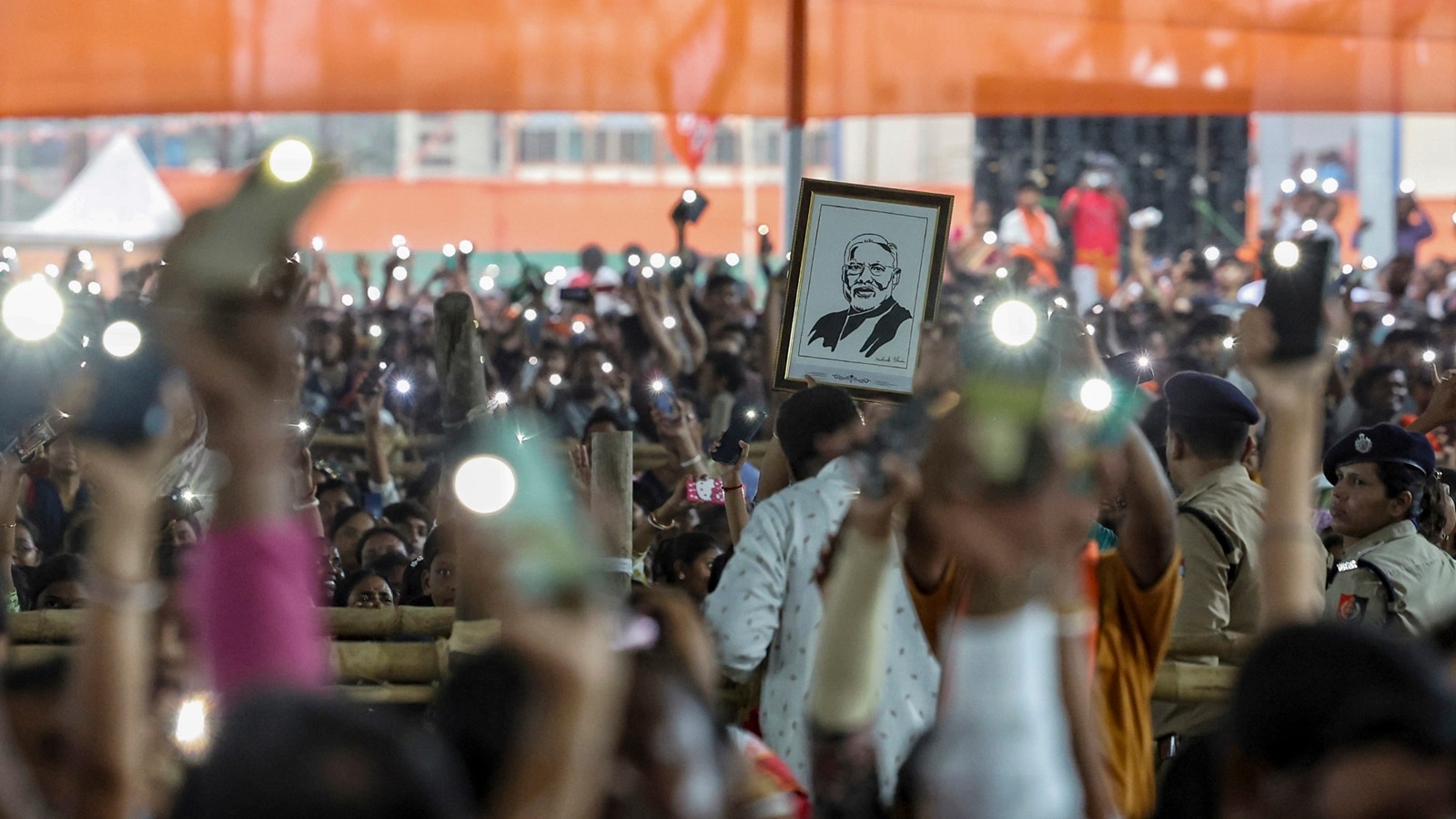
Modi's Women’s Convention in Varanasi
Modi's Varanasi rally frames women's reservation as a national mission, targeting the 2027 Uttar Pradesh elections with a strategic narrative.
India
BJP's Misunderstanding of Women's Quota Needs
The BJP's linking of the Women Reservation Bill to delimitation risks delaying women's empowerment in India, misreading the aspirations of female voters.
India
Women’s Reservation Bill 2026
The Constitution (131st Amendment) Bill, 2026 was defeated in Lok Sabha, revealing deeper political conflicts over women's reservation and delimitation.

Conflict & Security
Drone Warfare Killing Aid Workers at Unprec
Over 1,000 humanitarian workers killed in three years as cheap armed drones collapse legal protections. Gaza, Sudan, Ukraine, and DRC see deliberate targeting of aid convoys and hospitals with zero prosecutions.