Supreme Court Backs SIR, Expanding EC’s Roll Power
The court has shielded the Election Commission’s voter-roll drive, but only by pairing deference with tighter transparency and review.
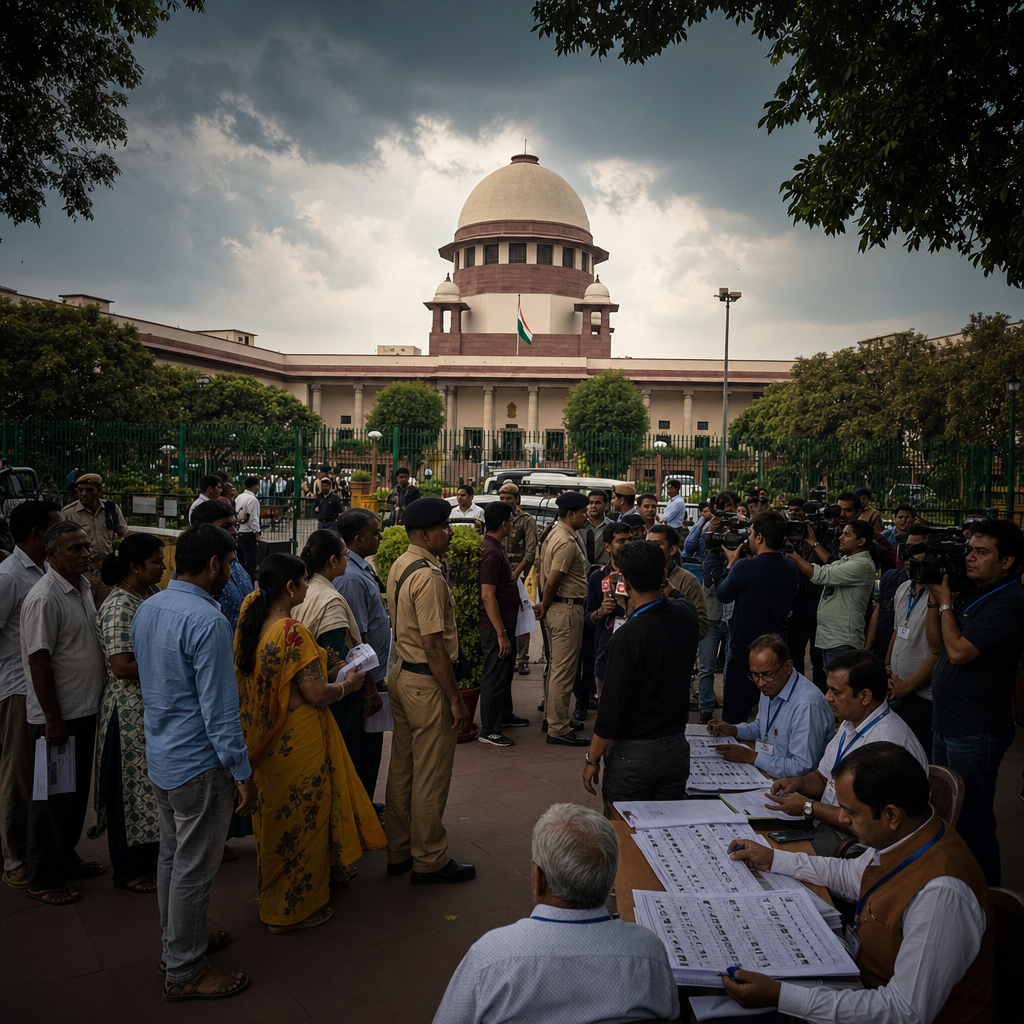
The Supreme Court on Wednesday upheld the Special Intensive Revision of electoral rolls as an exercise in furtherance of free and fair elections, rejecting the claim that the Election Commission of India was using it as a backdoor citizenship test,  The Hindu. The immediate result is simple: the Election Commission keeps the legal cover it needed to continue SIR, while the court preserves judicial review over how the exercise is carried out, not whether it exists at all, The Hindu.
Why the verdict matters
This was never just a dispute over paperwork. Petitioners, including the Association for Democratic Reforms, argued that SIR could disenfranchise genuine voters by forcing people to prove ancestry against the 2002/2003 rolls and by narrowing the documentary path to inclusion,  Telangana Today. The Election Commission’s answer was that voter registration is a “qualified right”: the Constitution requires citizenship, age and non-disqualification, and the poll body said it was only verifying those conditions, not arrogating to itself the final power to decide citizenship, The Hindu.
The court largely accepted that logic. It held that the Election Commission can examine citizenship for the limited purpose of deciding whether someone belongs on the roll, and if it has doubts it can refer the matter to the Centre under the Citizenship Act, The Hindu. That is the core power shift: the bench has stopped short of saying the EC can determine citizenship, but it has allowed the EC to use citizenship verification as a gatekeeping tool for electoral inclusion.
Who gains leverage now
The clear winner is the Election Commission. The court has not only upheld the Bihar exercise; it has also insulated the broader, staggered rollout that was already under way across 12 states and Union Territories, covering 51 crore voters, including West Bengal, Tamil Nadu and Assam, The Hindu. That matters because the legal challenge was aimed at the principle of mass revision itself, not just one state’s implementation.
The losers are the petitioners who wanted a halt to the process and the opposition parties that had framed SIR as a vehicle for arbitrary exclusion. In Bihar, the final roll stood at 7.42 crore voters after nearly 65 lakh names were removed from the draft list, and the court pushed the EC to publish searchable, booth-level deletion data and expand the list of acceptable documents by adding Aadhaar as an indicative proof, The Hindu. That tells you the bench sees the problem as procedural excess, not constitutional illegitimacy.
What to watch next
The next fight is over implementation. Watch whether the Election Commission keeps Aadhaar in the document mix, whether it publishes deletion data with enough detail to withstand scrutiny, and whether fresh petitions shift from the legality of SIR to specific exclusions in West Bengal, Tamil Nadu and Assam. The practical test is the next revision cycle: if the EC can move quickly without triggering mass litigation, this judgment will become the template for how India manages voter rolls before elections, The Hindu;  Rediff.