Sudan's Drone War: A Broken Embargo
Khaled Khiari warns of unchecked arms flows in Sudan's conflict.
Model Diplomat8 min readAfrica
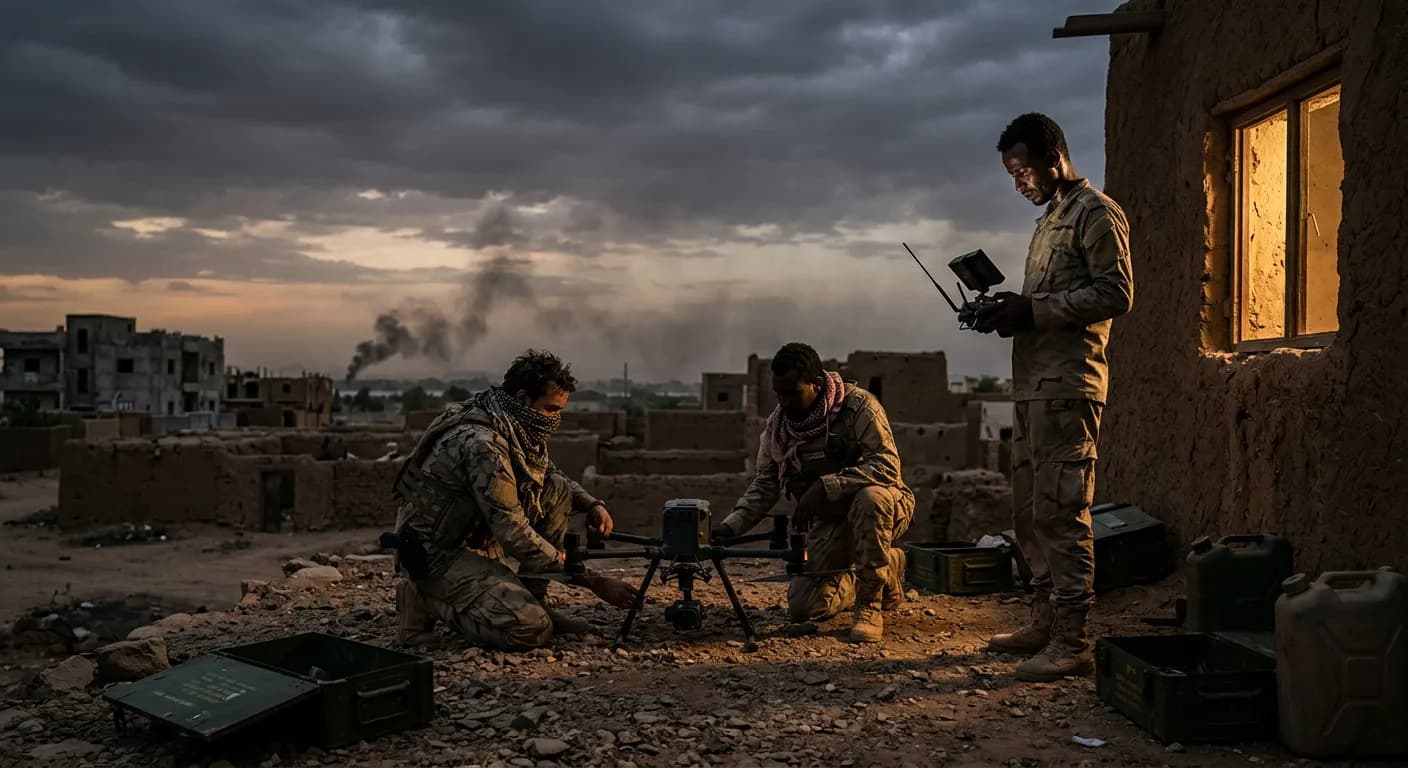
Khiari's Warning: Sudan's Drone War Exposes a Broken Embargo
ASG Khaled Khiari told the UN Security Council that Sudan's war is now driven by drone strikes and arms flows — a two-decade-old embargo cannot stop.
Sudan's war is no longer principally a ground war, and the UN's senior political envoy has said so aloud. Briefing the Security Council on 22 December 2025, Assistant Secretary-General Khaled Khiari framed the conflict as one "driven by indiscriminate drone strikes, unchecked arms flows" — a diagnosis that, seven months on, has calcified into the operative reality around El Obeid, where 500,000 civilians now face the same drone tempo — and the same siege logic — that preceded the fall of El Fasher. The thesis is uncomfortable but unavoidable: the 2005 Darfur-only arms embargo has been overtaken by a war fought with Chinese, Turkish, Iranian and Emirati technology moving through Chad, Egypt, Libya and the Red Sea — and the Council that renewed the embargo in September 2025 has neither expanded its scope nor sanctioned a single supplier state — making Khiari's warning, in effect, an indictment of the body he was briefing.
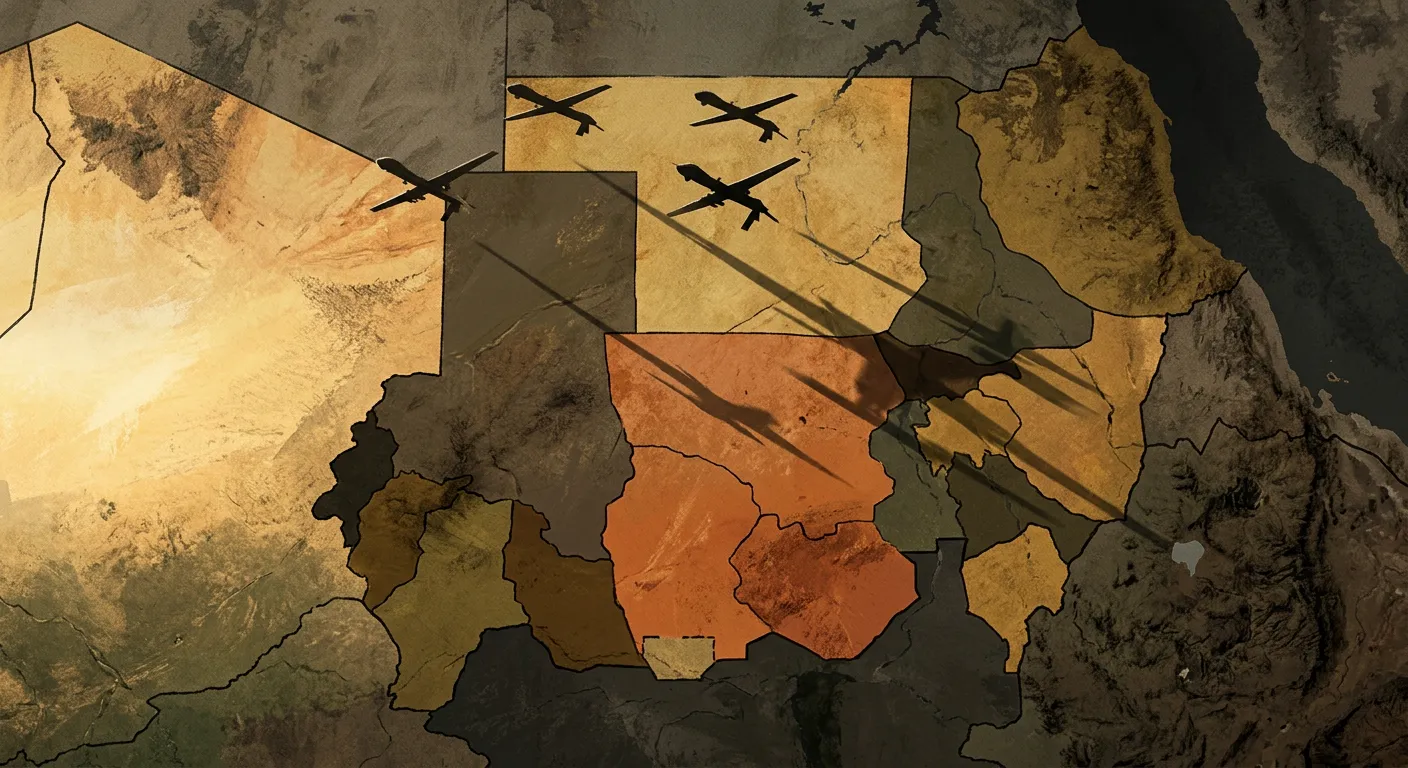
What Khiari actually said — and why the language matters
At the 10077th meeting of the Security Council, Khiari described a war whose front had shifted decisively into Kordofan: the Rapid Support Forces had taken Babanusa on 1 December and the Heglig oil field on 8 December, and Kadugli and Dilling were under siege. "Each passing day brings staggering levels of violence and destruction," he told the Council, warning that the "increasingly complex nature of the conflict and its expanding regional dimensions" — including the movement of South Sudanese forces across the border to protect Heglig — pointed to an internationalised war rather than a domestic one.
The Department of Political and Peacebuilding Affairs was more direct in its own summary, which recorded that Khiari "warned that Sudan's conflict has intensified, driven by indiscriminate drone strikes, unchecked arms flows" — the phrase that has since been picked up in almost every subsequent Council text on Sudan. That framing is deliberate. It shifts the analytical centre of gravity from the Sudanese generals — army chief Abdel Fattah al-Burhan and RSF commander Mohamed Hamdan "Hemedti" Dagalo — to the states enabling them. Days later, Al Jazeera reported that Secretary-General António Guterres had picked up the same language, calling on "all States with influence over the parties" to compel a halt to arms flows.
The numbers behind the warning
The empirical case that drones now define the war is overwhelming. In a public statement on 11 May 2026, the UN Human Rights Office reported that armed drone strikes accounted for at least 880 civilian deaths between January and April 2026 — "more than 80 percent of all conflict-related civilian deaths" documented in that window. High Commissioner Volker Türk called drones "by far and away the leading cause of civilian deaths." That single sentence rewrites the analytical premise of every previous Sudan intervention debate, which treated ground-force manoeuvre as the decisive variable.
By mid-June, Al Jazeera reported drone deaths in Sudan had passed 1,000 for the first five months of the year. ACLED, the conflict monitor,
documented 1,003 drone strikes from the war's outbreak in April 2023 to 23 January 2026 — 440 in Khartoum, 122 in North Kordofan, 118 in North Darfur — and recorded 198 further strikes in the first two months of 2026 alone. Attribution runs both ways. SAF drone attacks have killed more than 1,800 people since 2023; RSF strikes account for more than 780.
The tactic has also spread geographically. OCHA's Edem Wosornu told the same 22 December Council session that in South Kordofan alone, more than 100 civilians were killed in drone strikes between 4 and 16 December — including strikes on a kindergarten and hospital in Kalogi that killed 89 civilians, among them eight women and 43 children.
The suppliers Khiari did not name
Khiari's phrase "unchecked arms flows" is a diplomatic euphemism for a supply chain that has been mapped in granular detail by outside investigators. Amnesty International reported in May 2025 that Norinco GB50A guided aerial bombs, manufactured in 2024, had been used in Darfur — bombs dropped from Chinese Wing Loong II and FeiHong-95 drones "used only by the RSF in Sudan, and… provided by the UAE." A separate Amnesty investigation traced Chinese AH-4 155mm howitzers, of which the UAE is the sole importer, to RSF positions in Khartoum. Reuters, cited by Al Jazeera, documented at least 86 UAE cargo flights suspected of carrying weapons for the RSF landing at Chad's Amdjarass airstrip since April 2023.
The SAF's supply chain is no less international. Al Jazeera's forensic tracker records Iranian Mohajer-6 combat drones arriving in Port Sudan via cargo flights in late 2023 and 2024, Turkish Bayraktars routed through Egypt, and a 2024 pivot by Russia — previously aligned with the RSF through Wagner — to backing the army in exchange for a resurrected 2017 agreement on a Red Sea naval base. The BBC has
reported that Turkish Akinci drones, launched from an Egyptian airstrip near the border, have targeted RSF supply lines running out of Libya's Haftar-controlled east.
The result is a war in which every major strike carries a foreign fingerprint, and in which the Sudanese government's own UN ambassador has repeatedly named the UAE from the Council floor — a charge Abu Dhabi denies.
The embargo that does not embargo
The measure Khiari's warning implicitly indicts is the 1591 sanctions regime, imposed in 2005 and renewed by Security Council resolution 2791 (2025) on 12 September 2025. Its scope has not changed in two decades: the arms embargo covers Darfur only, leaving Kordofan, Khartoum and the Red Sea coast entirely outside its reach. Even within Darfur,
the UN's own Panel of Experts has documented violations in every recent reporting cycle, and no supplier state — not the UAE, Iran, Turkey, Russia or China — has been sanctioned. The Council renewed the regime unanimously, but only after
visible divisions over whether to reference Sudan's worsening situation or limit the text to "a purely technical roll-over." The technical roll-over faction prevailed.
Amnesty International has spent a decade calling for the embargo to be extended to the whole of Sudan; the June 2024 report New Weapons Fuelling the Sudan Conflict laid out the case in detail. In May 2026, Türk publicly endorsed the same recommendation, calling for "robust measures to prevent the transfer of arms, including increasingly advanced armed drones, to the fighting parties." He has been ignored.
The winners of this status quo are legible: the UAE preserves its RSF proxy while denying involvement and continues to receive Western arms transfers unimpeded; Russia recovers a Red Sea foothold; Turkey banks combat-proven Akinci sales; Egypt neutralises the RSF threat on its southern flank without formally entering the war. The losers are the civilians of Kordofan and the credibility of the 1591 regime itself.
The historical parallel Khiari is trying to prevent
The reason El Obeid is now the pivotal test is that El Fasher already happened. In February 2026, OHCHR reported that more than 6,000 people had been killed over three days when the RSF overran the Darfuri capital in late October 2025 — including 460 killed at the Saudi Maternity hospital and roughly 300 killed by shelling and drone attacks on the Abu Shouk displacement camp. The city had been under siege for 18 months. El Obeid has now been under siege-like conditions for the same 18 months, and the same tactics — attacks on fuel stations, hospitals and water infrastructure — are visible.
The BBC reported on 7 July 2026 that 27 drone strikes hit El Obeid in June alone, the highest monthly total of the war, with UN human rights office data showing 45 killed and 41 injured in 15 strikes between 6 and 28 June. On 3 July, Türk told an urgent debate of the Human Rights Council in Geneva that El Obeid represents a "red alert that needs to land on the desks of heads of state and government," warning that "another human rights catastrophe is unfolding" — his language a near-direct echo of the warnings that preceded El Fasher and were not acted upon.
Human Rights Watch followed the same day with a call for urgent action.
The Council itself has moved incrementally. On 26 June, it issued a press statement demanding the RSF halt its assault on El Obeid and citing the risk of mass atrocities. Under-Secretary-General Rosemary DiCarlo, briefing the Council that day, warned that El Obeid risks becoming "another El Fasher." That is now the diplomatic frame — but no operative measure has followed the framing.
The second-order effects
Khiari's warning about "expanding regional dimensions" is already materialising. Sudan recalled its ambassador from Addis Ababa in May 2026 after accusing Ethiopia and the UAE of enabling drone attacks on Khartoum International Airport launched, Sudanese military spokesmen said, from the Bahir Dar airport region. Chad placed its air force on high alert in late December 2025 after a drone strike killed two Chadian soldiers in the border town of Tine and warned it would "exercise our right to retaliate." South Sudanese forces have crossed into Sudan to protect the Heglig oil infrastructure. The war's drone infrastructure — the Emirati air bridge into Amdjarass, the Egyptian launchpads, the Ethiopian transit route Sudan alleges — has drawn at least four neighbouring states into direct exposure.
The knock-on effect is a slow-motion collapse of the Darfur-only embargo's political premise. If Kordofan, White Nile, Blue Nile and Khartoum are all now drone battlefields, and if strikes are being launched from Chad, Libya, Egypt and Ethiopia, the embargo covers neither the geography of the war nor the geography of its supply. That is the case Khiari was building on 22 December — and that the Council has, so far, declined to act on.
What to watch
- The next Security Council briefing on Sudan. DiCarlo, not Khiari, briefed on 26 June; the rhythm suggests another Council session in August or September 2026, timed to the annual 1591 renewal debate on or before 12 September.
- The 1591 renewal itself. The current regime, extended by resolution 2791 (2025), lapses on 12 September 2026, and the Panel of Experts' mandate on 12 October. Any expansion of the embargo beyond Darfur — or any designation of a supplier state — would need to be negotiated in that window. None is currently on the table.
- El Obeid. ACLED's Nohad Eltayeb assessed on 30 June that a full RSF takeover is "improbable" given SAF reinforcements, but drone strikes are already crippling fuel, water and power. The pattern that preceded El Fasher is now three months old.
The Bottom Line
Khiari's diagnosis — that Sudan's war is being driven by indiscriminate drone strikes and unchecked arms flows — is the Council's own most senior admission that the 1591 embargo has been technologically and geographically overrun. Until the Council either expands the embargo beyond Darfur or sanctions a supplier state, every subsequent briefing will document the same war in different cities. El Obeid is where the Council's credibility goes to die — or doesn't.
Discover more
US Politics
House Ethics Committee Pushes Sexual Miscond.
The House Ethics Committee has shifted responsibility for sexual harassment settlement records to the Office of Congressional Workplace Rights, complicating disclosure efforts.

US Politics
SNAP Food Assistance Faces Legal Challenges
In 2026, SNAP faces stricter eligibility rules and mounting legal challenges, threatening food assistance for the millions of Americans who rely on the program.
Global Politics
Xi Jinping Calls China-Russia Ties 'Precious'
Xi Jinping's description of China-Russia ties as 'precious' reflects a strategic imbalance, with Beijing dictating terms in the partnership.

Economics
Fed's Amex AML order puts correspondent banking on notice
Federal Reserve's Amex AML order requires board-level controls and a 90-day plan; OCC fined the bank $350 million over enterprise-wide deficiencies.