Sudan Blames Ethiopia for Drone Strikes
Sudan recalls ambassador amid drone conflict escalation.
Model Diplomat10 min readHorn of Africa
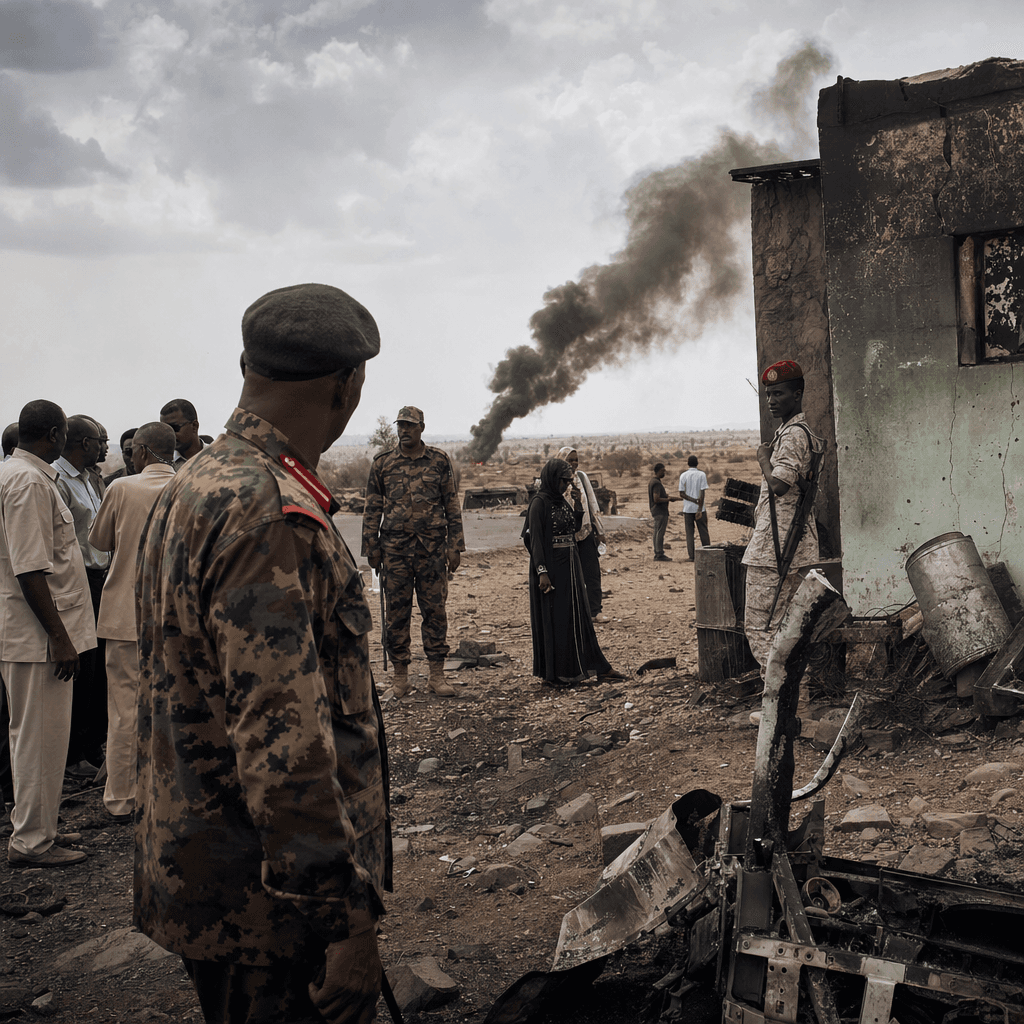
Sudan Blames Ethiopia for Drone Strikes on Khartoum Airport
Sudan recalled its ambassador from Addis Ababa on May 5, 2026, saying UAE-made drones launched from Ethiopia's Bahir Dar airport hit Khartoum. Here's what changes.
Sudan's accusation that Ethiopia let the United Arab Emirates launch drones at Khartoum International Airport from Bahir Dar on May 4, 2026, is the moment the war stopped being a proxy fight and started becoming an interstate one. Foreign Minister Mohieddin Salem recalled Sudan's ambassador the next day and told a news conference Khartoum was ready to "enter into an open confrontation" with Ethiopia "if it becomes necessary," according to Al Jazeera. The load-bearing claim is not that a drone hit the airport — it is that the Sudanese Armed Forces (SAF) have now publicly named a neighbouring state as a co-belligerent. That reframes the Horn of Africa's biggest war as a boundary problem between two capitals, not a domestic insurgency.
The airport had reopened to international flights a week earlier. Since the SAF retook Khartoum from the Rapid Support Forces (RSF) in March 2025, more than 1.8 million displaced residents have returned, per Al Jazeera. That fragile normality is what the May 4 strike destroyed — and it is the political achievement General Abdel Fattah al-Burhan cannot afford to be seen losing. A capital reopened at enormous political cost has now been shown, on international television, to be within the reach of drones launched hundreds of kilometres away.
What Sudan actually says it has
Brigadier General Asim Awad Abdelwahab, the SAF spokesperson, said on May 5 that Sudan had "conclusive evidence" from data recovered from a drone downed over el-Obeid, in North Kordofan, that four UAE-made drones had been launched from the Bahir Dar airport region since March 1, according to BBC News. Sudan's state-owned SUNA news agency published the same claim. The military says one of the drones downed in Kordofan matched Emirati serial data, and that a second drone launched from the same airport carried out the May 4 strike on Khartoum. Two of the four alleged Ethiopia-origin strikes — on March 1 and March 17 — hit SAF positions in Kordofan and Blue Nile state, the same
Al Jazeera briefing reports.
Salem, speaking in verbatim quotes carried by BBC News, described the strike as "direct aggression" and said the UAE and Ethiopia had chosen the "wrong path" and would "regret it." He nonetheless referred to Ethiopia as a "brotherly state" — diplomatic language that Sudan has not yet withdrawn, and that signals Khartoum is escalating short of severing relations. Sudan also has not asked the AU to expel Ethiopia from any body, nor has it lodged a formal complaint at the UN Security Council. The gap between the rhetoric ("open confrontation") and the procedural response (ambassador "recalled for consultations") is the space where Sudan is trying to preserve optionality.
Addis Ababa denies everything. Ethiopia's Ministry of Foreign Affairs called the accusations "baseless" and, in a rare public shift, accused Sudan of hosting "mercenaries" from the Tigray People's Liberation Front (TPLF), whose armed wing fought Ethiopia's federal government from 2020 to 2022. Ethiopia added, per BBC Amharic, that it had "refrained from publicising the grave violations of Ethiopia's territorial integrity and national security committed by some belligerents in the Sudanese civil war" out of respect for a "historic and enduring bond of friendship." A senior TPLF official, Amanuel Assefa, told AFP the group has "no connections with the Sudanese authorities" — quoted in the same
Al Jazeera report. The UAE, in a statement carried by the
BBC, called Sudan's claims "unfounded accusations and deliberate propaganda" and a "calculated pattern of deflection."
The corridor that changes the map
The non-obvious detail is geography. Since 2023, the documented UAE-to-RSF air bridge has run west: Abu Dhabi–Nairobi–Kampala–Amdjarass in eastern Chad, next to Darfur, per the BBC's earlier open-source investigation of UN Panel of Experts data. Reuters counted at least 86 UAE flights suspected of carrying weapons landing at Chad's Amdjarass airstrip, cited by
Al Jazeera's drone-warfare deep-dive. That western corridor supplied Darfur and Kordofan. It did not put central Sudan — Gezira, Blue Nile, or Khartoum itself — reliably within range of RSF long-endurance drones.
Bahir Dar changes that. The city sits roughly 480 kilometres east of Khartoum, well inside the operating radius of the Chinese-made Wing Loong II drones the UAE has flown for the RSF elsewhere, per the American Enterprise Institute, which lists the Wing Loong II range at 4,000 kilometres and a payload capacity of 400 kilograms. That is the analytical shift: if Sudan's forensic claim survives scrutiny, the RSF's air campaign now has an eastern axis — one that flanks the SAF's rear, threatens the Red Sea corridor at Port Sudan, and puts civilian infrastructure in the capital under precision drone threat for the first time since Khartoum was retaken. It also compresses SAF air-defence planning: instead of guarding the western approaches from Darfur, the army has to defend a 360-degree perimeter around the capital.
Reuters reported in February 2026 that Ethiopia had built a training camp for RSF fighters near the border and upgraded Asosa airport for drone operations, allegedly backed by the UAE; Ethiopia and the UAE both denied it, per BBC Focus on Africa. The May accusations do not stand alone — they extend a pattern that experts on the show described as the "first time Ethiopia has been directly linked to the war between the RSF and the Sudan Armed Forces."

Who benefits from the fight staying regional
The clearest beneficiary of a hardened Sudan–Ethiopia rupture is the RSF's chief patron. As long as the fight remains "Sudan versus Ethiopia," the UAE stays two removes from a war it is repeatedly named in — most recently in the International Crisis Group's April 2026 briefing "Divided Sudan, Elusive Peace", which warns of an "escalation cycle" among outside backers "locked in" over Sudan. The ICG briefing goes further, noting that "many of the countries supporting the Sudanese army have rallied behind Eritrea in its dispute with Ethiopia, which has the backing of the UAE" — a formulation that treats Sudan's civil war as a subset of a larger UAE-Egypt-Eritrea alignment problem. Alan Boswell, ICG's Horn of Africa director, told
Al Jazeera on May 5 that without foreign support, "both warring parties in Sudan would have run out of munitions very early in this war." Every bilateral row between Khartoum and Addis Ababa displaces attention from that supply chain.
The second beneficiary is Egypt. Cairo has backed the SAF since Burhan's 2021 consolidation, has flown Bayraktars in support of army operations, and views Ethiopia's Grand Ethiopian Renaissance Dam as an existential threat. The Centre for Strategic and International Studies has argued that Egypt's Sudan policy is effectively a GERD-management policy: an SAF victory that stays hostile to Addis Ababa preserves Egypt's downstream leverage on the Blue Nile. CSIS notes that Egypt began "actively courting Sudan once again" around the July 2020 first filling of the GERD; Burhan's reversal on the dam in January 2023 came three months before the war erupted. A Sudan–Ethiopia rupture is precisely the outcome that hardens Sudan's alignment behind Cairo — and, by extension, gives Egypt a Sudanese partner permanently opposed to the GERD's operating terms.
The clearest institutional loser is any prospect of an inter-Sudanese truce. On February 11, 2026, the "Quintet" — the African Union, IGAD, the Arab League, the EU and the UN — jointly called for "immediate halting of any further military escalation" in Sudan, per the UN Secretary-General's office. That mediation architecture assumes Sudan's neighbours are, at worst, passive. Sudan naming Ethiopia flips that assumption in public. The AU sits in Addis Ababa; its host is now an accused belligerent, and the mediation seat and the accused seat share a postcode. The Quintet statement specifically calls on "those with the greatest influence" to "halt the flow of weapons, fighters and other forms of support" — language that names no one but implicates the UAE, Egypt, Iran, Russia and now, by Khartoum's telling, Ethiopia.
The third loser is Sudanese civilians on the receiving end of a drone-dominated war. Emergency Lawyers, a Sudanese legal rights group, reported that a drone strike on May 2, 2026 killed five civilians on a bus in Omdurman, per Al Jazeera, and that nearly 700 civilians had been killed in drone strikes in the first three months of 2026 alone. That figure climbed above 1,000 by mid-June, according to the UN. A war that gets easier to fight from a distance is a war that gets harder to stop.
The border already had a fuse
This is not a bilateral relationship that had far to fall. The 740-kilometre Sudan-Ethiopia border has been contested since the 1902 Anglo-Ethiopian Treaty over the al-Fashaga triangle, per Chatham House, which reports the SAF has taken control of up to 95 per cent of the disputed lands since incursions began in November 2020. That incursion is the historical parallel worth naming: Khartoum moved into al-Fashaga precisely because Addis Ababa was distracted by the Tigray war. Sudan opportunistically exploited Ethiopian internal collapse in 2020; Ethiopia, in Khartoum's telling, is now returning the favour in 2026 while the SAF is stretched across Kordofan and Darfur. The
TRENDS Research Group argued five years ago that al-Fashaga, layered onto the GERD, "has the potential to set the region on fire." That prediction is now visibly on foot.
Layered onto al-Fashaga: the GERD dispute, Ethiopia's search for Red Sea access, and Ethiopia's post-Pretoria fragility in Tigray and Amhara. The 2021 International Crisis Group briefing warned an escalation of the border dispute could "trigger a regional war." Five years on, the trigger the ICG feared is drones, not tanks. The precedent matters because it explains why the diplomatic response of the two governments has been so structurally symmetrical: Ethiopia accuses Sudan of arming TPLF and Fano remnants; Sudan accuses Ethiopia of hosting the RSF training camp and the drone launch site. Both governments now allege the other is hosting armed groups aimed at internal opponents. That is the structural condition for a durable interstate proxy war, not a manageable diplomatic row. The BBC's field reporting from
Kordofan already describes "near-daily drone strikes" hitting markets, health facilities and aid convoys along a new front line that runs directly toward the Ethiopian border.
The primary document
The clearest primary source is not from Khartoum or Addis Ababa but from Geneva. UN High Commissioner for Human Rights Volker Türk told the UN Human Rights Council on June 15, 2026 that:
"In Sudan, the horrific conflict has expanded and escalated, marked by a sharp increase in the use of drone warfare."
Türk's office documented more than 1,000 civilian deaths from drone strikes in the first five months of 2026 alone, per Al Jazeera's coverage of his address. ACLED, the independent conflict monitor, counted 1,003 drone strikes between April 15, 2023 and January 23, 2026 — with 440 in Khartoum alone, per
Al Jazeera. SAF-attributed drone attacks have killed more than 1,800 people; RSF-attributed strikes have killed more than 780, per the same analysis.
The UN Secretary-General's office, in a May 7, 2025 statement on Sudan, had already warned that drone attacks on Port Sudan risked "large-scale civilian casualties and further destruction of critical infrastructure." The UK Foreign Office, in a
joint ministerial statement of February 19, 2026, warned that attacks on humanitarian personnel and infrastructure "may amount to war crimes," noting that up to 100,000 people had been displaced in Kordofan alone in recent months. On December 22, 2025, UK Chargé d'Affaires James Kariuki went further at the UN Security Council, condemning
drone strikes on the UNISFA peacekeeping base at Kadugli that killed six UN peacekeepers on 13 December. All of it sits on top of an existing UN arms embargo — Security Council Resolution 1591 (2005), extended most recently under Resolution 2736 (2024) — that both the UAE-to-RSF and Iran-to-SAF drone pipelines have been credibly accused of violating.
What to watch
- The forensics. Sudan says it has the crash-site data from el-Obeid, plus serial numbers linking a downed drone to UAE inventory and to Bahir Dar launch operations. If Khartoum shares that evidence with the UN Panel of Experts monitoring the arms embargo — or with a friendly Western capital willing to leak it — the accusation moves from political to legal. If it does not, the story stays a diplomatic gesture.
- The next UNSC drumbeat. The UK statement of December 22, 2025 already framed drone strikes as legal violations. The next scheduled Council briefing on Sudan is the vehicle where the Bahir Dar allegation will either be endorsed or buried. Watch whether the E3 (UK, France, Germany) or the US directly name Ethiopia — or continue the diplomatic convention of naming only the RSF and the SAF.
- Ambassador status. Sudan recalled its envoy "for consultations" — the classic reversible signal. A formal expulsion or a downgrade to chargé d'affaires would mark commitment to the interstate framing. If the envoy quietly returns within 60 days, Khartoum will have blinked.
- The RSF's eastern axis. If further drone strikes in central Sudan can be geolocated to Ethiopian airspace — using ACLED and PAX open-source tracking — the war's operational geometry has already changed, whatever Addis Ababa says. The
Kordofan front is the near-term test.
- The GERD calendar. Any Ethiopian move on final GERD operating protocols will now be read in Khartoum as leverage. The next round of trilateral talks, if held, will not be a technical negotiation but a hostage exchange.
The Bottom Line
Sudan's May 5, 2026 accusation that Ethiopia hosted the UAE-supplied drones that hit Khartoum airport is the moment a proxy war acquired a state defendant — and the moment the Horn of Africa's mediation architecture, headquartered in the accused capital, lost its neutral ground. The immediate winner is the RSF's foreign patron in Abu Dhabi, which recedes behind an Ethiopia-Sudan spat it did not have to fight. The immediate loser is any humanitarian truce mediated through the African Union, because Addis Ababa can no longer be treated as a disinterested convenor — and the war has become, on the evidence of 1,000 civilian drone deaths in five months, too lethal to leave to the region alone.
Discover more

Global Politics
US Seizes Iranian Ship, Tensions Surge
The US seizure of the Iranian ship Touska highlights a shift in control over the Strait of Hormuz, favoring Iran's strategic position.

International Relations
Pakistan's Key Role in US-Israel-Iran Meddle
Pakistan is seeking to mediate the US-Israel-Iran conflict, balancing high-stakes diplomacy against severe economic pressures and steep regional challenges.

Conflict & Security
Drone Warfare Killing Aid Workers at Unprec
Over 1,000 humanitarian workers killed in three years as cheap armed drones collapse legal protections. Gaza, Sudan, Ukraine, and DRC see deliberate targeting of aid convoys and hospitals with zero prosecutions.

Global
World Normalises Taliban as Afghan Women Eras
UN data shows Afghan women erased from public life as Russia recognises the Taliban, EU hosts officials in Brussels, and ICC warrants for gender persecution go unenforced.