Sudan Blames Ethiopia, UAE for Drone Attacks
Sudan escalates tensions with Ethiopia and UAE over drone attacks.
Model Diplomat9 min readAfrica

Sudan Blames Ethiopia, UAE for Drone Attacks on Khartoum
Sudan recalls its ambassador from Addis Ababa and threatens "open confrontation" after drones hit Khartoum airport on May 4, 2026 — dragging the Horn of Africa into a proxy war it has spent a decade trying to avoid.
Sudan's army on May 5, 2026 accused Ethiopia and the United Arab Emirates of jointly orchestrating four cross-border drone attacks since March 1, including a strike that shut Khartoum International Airport for 72 hours a week after its first international flight in three years. The accusation, delivered by military spokesperson Brig. Gen. Asim Awad Abdelwahab, is the first time Khartoum has named a neighbouring state as a co-belligerent — and it converts a civil war fought with imported drones into an interstate crisis over the airspace above the Blue Nile, the Grand Ethiopian Renaissance Dam, and one of Africa's most contested water basins. The thesis of this piece is simple: the real fuse is not the drone, it is the dam — and Abu Dhabi is the actor whose leverage grows either way.
What Sudan actually alleged
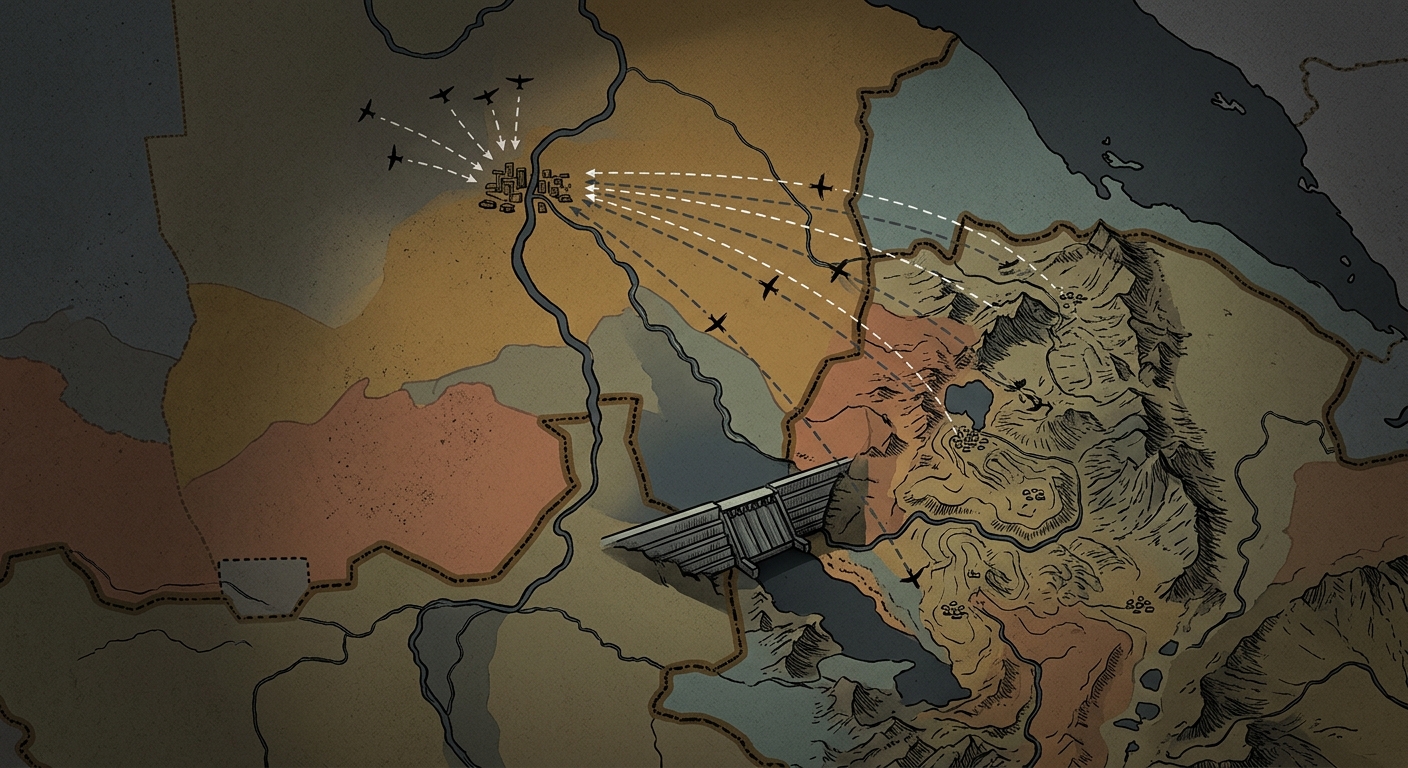
Standing before reporters in Port Sudan, Abdelwahab said the government had "conclusive evidence" — recovered from a drone downed in el-Obeid, capital of North Kordofan — that UAE-manufactured platforms had taken off from the Bahir Dar airport region in northwestern Ethiopia, striking Sudanese army positions on March 1 and March 17 before the May 4 barrage on the capital, Al Jazeera reported. Foreign Minister Mohieddin Salem announced the recall of Sudan's ambassador to Addis Ababa the same day and told a news conference Sudan was prepared to "enter into an open confrontation" with Ethiopia "if it becomes necessary." According to the
BBC, Sudan's state news agency SUNA quoted the army calling the strikes "direct aggression."
Ethiopia's Foreign Ministry rejected the accusations as "baseless" within hours, and countered that Khartoum had armed and financed remnants of the Tigray People's Liberation Front operating along Ethiopia's western frontier. The UAE dismissed Sudan's claims as "unfounded accusations and deliberate propaganda," in a statement carried by The National, calling the charge "a calculated pattern of deflection." Salem said Khartoum would submit fresh evidence to the UN Security Council,
allAfrica reported, citing the state SUNA agency.
The reason the accusation is not easily dismissed as wartime propaganda is that it lands on top of a documented paper trail. In February 2026, Reuters — cited by the BBC's Focus on Africa programme — used satellite imagery to reveal a secret training camp for RSF fighters in western Ethiopia, and identified upgrades at Ethiopia's Asosa airport consistent with drone operations. That reporting concluded the arrangement was backed by the UAE. Ethiopia and Abu Dhabi denied it. Sudan is now, in effect, claiming the operational payoff from that infrastructure has begun.
The load-bearing claim: UAE-built drones out of Ethiopia
Sudan's technical case rests on the debris from el-Obeid. Sudanese officials told AFP they had tracked a drone "identified as Emirati property" entering Sudanese airspace from Ethiopia and shot it down; they say another drone launched from the same region hit Khartoum on May 4. Independent researchers have separately established that the RSF fields Chinese-designed Wing Loong II and CH-95 platforms — systems whose operational deployment in Sudan is attributed to the UAE by the American Enterprise Institute's Critical Threats Project, with the Wing Loong II flying missions in support of the RSF since at least July 2024. Chatham House-adjacent analysts and the BBC have documented the same fleet, with the
BBC noting that the RSF is "widely reported to deploy Chinese long-range CH-95 drones that are supplied by the United Arab Emirates, which the UAE denies."
The provenance question — whose drone, launched from whose runway — matters because it is the difference between a proxy war and an act of state aggression under Article 2(4) of the UN Charter. It also matters because the ICJ has already closed one door. On May 5, 2025, the International Court of Justice threw out Sudan's case accusing the UAE of complicity in the genocide of the Masalit in Darfur, ruling it lacked jurisdiction because of Abu Dhabi's reservation to Article 9 of the Genocide Convention, Al Jazeera reported. UAE official Reem Ketait called the ruling "clear and decisive." Any new Sudanese case will have to be built on state responsibility for cross-border force — not genocide law — and will have to overcome Emirati diplomatic representations already lodged. In an April 21, 2024 letter to the Security Council president, the UAE's Permanent Representative told the Council that "all allegations of the involvement of the United Arab Emirates in any form of aggression or destabilization in Sudan… are spurious and unfounded and lack any credible evidence to support them," according to the
UN document. That is the position Abu Dhabi will restate; the burden of proof is on Khartoum.
Why now: the dam, not the drone
The May 4 strike was not a random escalation. Read the calendar. On September 9, 2025, Prime Minister Abiy Ahmed inaugurated the $5 billion Grand Ethiopian Renaissance Dam on the Blue Nile — 14 kilometres from the Sudanese border — over Egyptian and Sudanese protests, Al Jazeera reported. Sudan and Egypt issued a joint statement calling the move "unilateral" and a "continuous threat to stability." Six months later, drones started arriving in Sudan from Ethiopian airspace.
This is where the war's geometry changes. As the Observer Research Foundation put it in a recent analysis, Sudan's war "is fast transforming into the fault line of Northeast Africa, where water politics, border disputes, and great-power alignments are intertwining," with the RSF's supply lines "reportedly linked to the UAE" and Egypt "reinforcing its southwestern border" to protect its Nile leverage, ORF wrote. The Kordofan front — where 277 of the 1,003 drone strikes catalogued by ACLED between April 2023 and January 2026 have landed, per an
Al Jazeera analysis — is the corridor that connects RSF-held Darfur to army-held Khartoum. Blue Nile State, jutting between Ethiopia and South Sudan, is the corridor that connects the RSF to the GERD. A Sudan that loses control of Blue Nile is a Sudan that cannot threaten the dam. That serves Addis Ababa. It also serves Abu Dhabi, which the
Council on Foreign Relations notes has a "close relationship" with Ethiopia and has quietly aligned with Abiy against the Saudi-Egyptian bloc.
The historical parallel is uncomfortable. In December 1987, Ethiopia's UN mission wrote to the Secretary-General complaining that Sudan was scapegoating Addis Ababa for the SPLA's capture of Kurmuk in Blue Nile province, according to a Security Council letter archived by the UN. Blue Nile has been the seam where Ethiopian and Sudanese security services accuse each other for four decades. The 2026 escalation is not a rupture — it is a return to a pattern that only paused during Omar al-Bashir's rule, and one that now overlaps with drone warfare and the completed GERD.
The UAE calculus: cheap deniability, expensive silence
Abu Dhabi's position is more comfortable than it looks. It has already survived the ICJ, defused a US-led "Quad" mediation attempt that stalled in the autumn of 2025, and continues to deny any arms transfers. Foreign Affairs' Cameron Hudson writes that despite Secretary of State Marco Rubio's June 2025 Quad convening and a September 2025 statement, President Trump "spoke publicly" at a meeting with the Saudi crown prince, calling Sudan "horrible" — at which point "any move by the Emiratis to agree to a joint plan would have been seen as backing down. Instead of reinforcing the Quad plan, Trump jeopardized it."
The evidence base against the UAE has nonetheless thickened. Amnesty International verified footage of RSF fighters using Chinese GB50A guided bombs and 155mm AH-4 howitzers — the latter a system for which SIPRI data records the UAE as the only known buyer from China — during 2025 attacks in Khartoum and Darfur, per Al Jazeera. In April 2026, the Conflict Insights Group used mobile-phone tracking data to document a UAE-operated network of Colombian mercenaries who trained at a facility in Ghayathi in Abu Dhabi before deploying to RSF drone operations in Nyala and el-Fasher, the
BBC reported. The US Treasury has said Colombian fighters supported the RSF capture of el-Fasher last October but has stopped short of naming Abu Dhabi.
The UAE's revealed preference is legible. It denies each specific allegation, absorbs the reputational cost, and keeps supplying the side that is now militarily dominant in Darfur and the Kordofans. As the International Crisis Group's Alan Boswell told Al Jazeera, without foreign support "both warring parties in Sudan would have run out of munitions very early in this war." That is the leverage — and it is the leverage Abu Dhabi will not surrender to the Security Council, the ICJ, or a Trump-brokered Quad.
What the Sudanese army wants
General Abdel Fattah al-Burhan's calculation is domestic. He needs an external enemy to justify the failure to end the war after retaking Khartoum in March 2025. The SAF has not stopped the RSF advance in Kordofan; the RSF's siege of el-Obeid has held; nearly 19.5 million Sudanese face severe hunger, Al Jazeera reported in June, and displacement now stands near 13 million. Naming Ethiopia and the UAE does three things for Burhan: it explains battlefield losses, it forces Egypt to declare itself openly, and it manoeuvres the Security Council — where Sudan's UN Ambassador Al-Harith Idriss al-Harith Mohamed
told members in 2024 that "there is irrefutable evidence that this war we are experiencing is a result of the support of the UAE for militias" — into a fresh procedural moment.
What the numbers say the war has become
The UN High Commissioner for Human Rights, Volker Türk, told the Human Rights Council on June 15, 2026 that more than 1,000 civilians had been killed by drone strikes in Sudan in the first five months of 2026 alone — a "sharp increase" that ACLED has described as a war "transformed" into "a drone-dominated conflict," with "drone-on-drone combat" now visible. On July 1, 2026, the
Human Rights Council convened an urgent debate on el-Obeid at the request of Germany, Ireland, the Netherlands, Norway and the UK, warning that roughly 500,000 civilians were at risk of large-scale atrocities.
That is the war a Bahir Dar-to-Khartoum drone strike now feeds into. Cross-border operability is no longer a hypothesis — it is an operating assumption for the SAF's planners.
Diplomat View
The May 4 strike is a bell no one can un-ring. Our call: within the next 12 months, the Sudan war becomes an openly interstate conflict in the Horn — with Egypt and Ethiopia trading targeted operations along the Blue Nile axis, and the UAE calibrating its RSF supply just below the threshold that would force a US arms-transfer sanction. The forecast turns on three variables. First, whether Cairo answers the Bahir Dar allegation with kinetic action against RSF logistics inside Ethiopia — a New York Times investigation cited by the BBC already places Egyptian drones on an airstrip near the Sudanese border. Second, whether the Trump-Rubio Quad is revived after the July 2026 UN debate, or written off. Third, whether the ICJ ruling of May 2025 hardens into a doctrine that shields Emirati state responsibility. Revise this call if Abu Dhabi publicly suspends any category of transfers to the RSF, if Abiy Ahmed and Burhan meet in a third-country capital, or if the SAF loses Sennar or Damazin — any of which would collapse the Blue Nile axis and reshape the geometry. The base case is escalation. Sudan is now the arena in which the GERD, the Red Sea and the Gulf rivalry are being negotiated by drone.
What to watch
- UN Security Council submission. Foreign Minister Salem said Sudan will file fresh evidence against the UAE and Ethiopia; the next Council session on Sudan is the venue where that evidence will either be seen or leaked. Watch for a formal Article 51 letter invoking self-defence.
- Egypt's next move. Cairo has not commented publicly on Bahir Dar. A joint SAF-Egyptian statement, or a fresh Arab League communiqué, would confirm the anti-Ethiopia axis is consolidating.
- The el-Obeid siege. If the RSF takes el-Obeid, its drone reach extends to the Nile Valley — and Ethiopia's alleged rear base becomes strategically decisive rather than merely tactical.
The Bottom Line
Sudan's accusation is not really about a drone. It is Khartoum's attempt to relitigate the GERD, the ICJ ruling and the UAE's Red Sea strategy under the more forgiving heading of interstate aggression — and it will succeed in regionalising the war whether or not the evidence holds up. The winner, either way, is Abu Dhabi: if the charge sticks, the UAE has already been named and moved on; if it doesn't, Sudan's diplomatic ammunition is spent. Watch Blue Nile, not Khartoum.
Discover more

Global Politics
US Seizes Iranian Ship, Tensions Surge
The US seizure of the Iranian ship Touska highlights a shift in control over the Strait of Hormuz, favoring Iran's strategic position.

International Relations
Pakistan's Key Role in US-Israel-Iran Meddle
Pakistan is seeking to mediate the US-Israel-Iran conflict, balancing high-stakes diplomacy against severe economic pressures and steep regional challenges.

Conflict & Security
Drone Warfare Killing Aid Workers at Unprec
Over 1,000 humanitarian workers killed in three years as cheap armed drones collapse legal protections. Gaza, Sudan, Ukraine, and DRC see deliberate targeting of aid convoys and hospitals with zero prosecutions.

Global
World Normalises Taliban as Afghan Women Eras
UN data shows Afghan women erased from public life as Russia recognises the Taliban, EU hosts officials in Brussels, and ICC warrants for gender persecution go unenforced.