Strait of Hormuz War Escalates to Water War
Nine nights of bombing, desalination strikes, and a collapsed ceasefire
Model Diplomat13 min readMiddle East
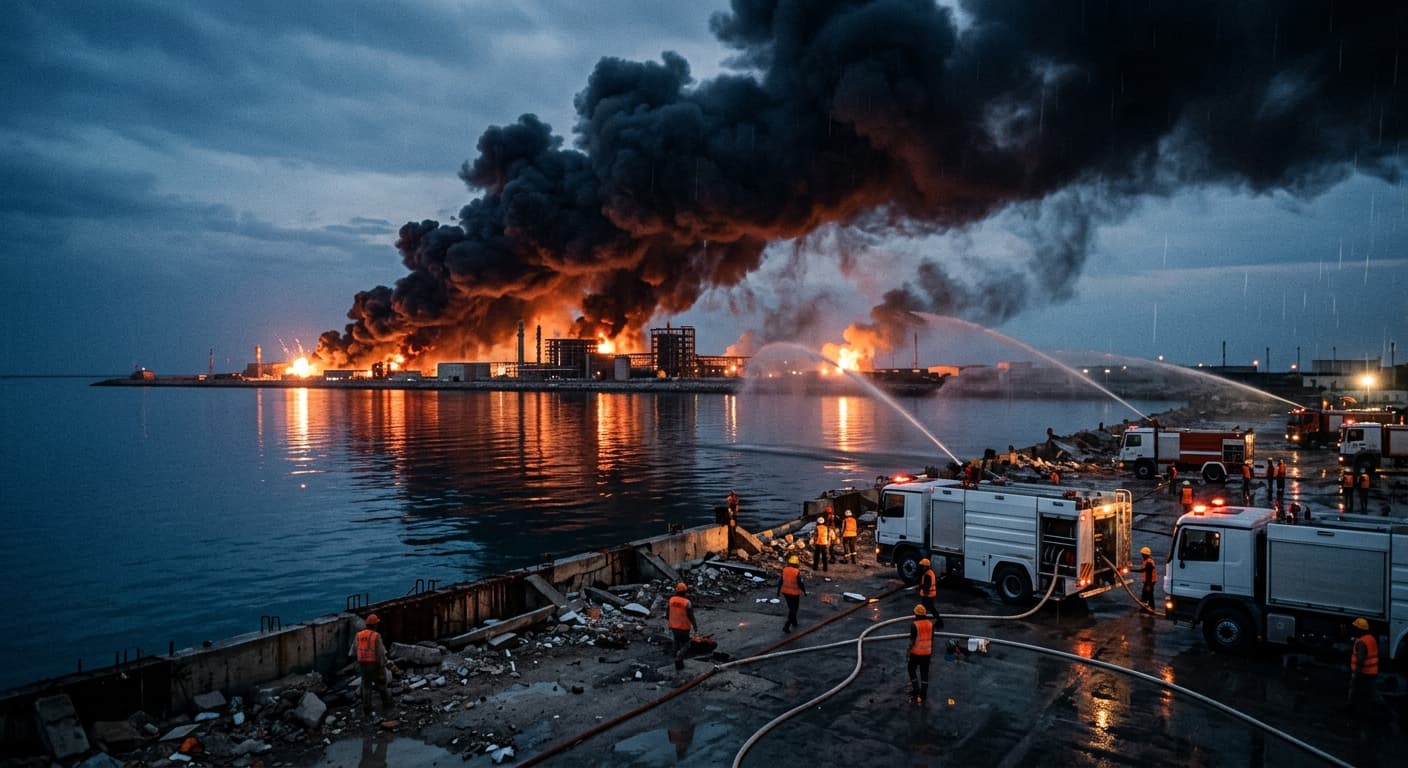
The Strait of Hormuz War Just Became a War on Water
Three US soldiers dead, nine nights of bombing, and Iran is now targeting the desalination plants that keep the Gulf alive — the conflict has crossed from a naval standoff into a battle over survival infrastructure. The Gulf monarchies are no longer mediators. They are the battlefield.
The United States bombed Iran for a ninth consecutive night on July 19–20, striking military command centres, air defence sites, and coastal surveillance installations as far north as Tabriz — the first time the northwestern city has come under attack since the escalation began, according to
Al Jazeera. Simultaneously, Iran hit a Kuwaiti power and water desalination plant for the second day running, setting it ablaze. The exchange marked a threshold no previous round of the five-month war had crossed: both sides are now systematically targeting the infrastructure that keeps the other's allies functional.
US Central Command announced that the strikes, completed at 02:00 GMT on July 20, targeted "Iranian military command centres, air defence and coastal surveillance sites, maritime capabilities, missile and drone launch sites, and communications networks" to "further diminish Iran's ability to attack commercial vessels and civilian mariners transiting the Strait of Hormuz." The operation followed the deaths of three US service members since Friday — two killed by Iranian ballistic missile and drone attacks on a base in Jordan, and a third killed Saturday in northern Iraq during a controlled detonation of unexploded ordnance from a downed Iranian drone, as NPR reported.
The US death toll has risen, with hundreds wounded since the war began on February 28. Iran's health ministry reports that 50 Iranians have been killed and over 500 wounded in US strikes in the past three weeks alone, according to Al Jazeera. Thousands more have died across Iran and Lebanon, where the war between Israel and Hezbollah was reignited, and several million have been internally displaced.
What elevates this moment beyond the daily rhythm of strike and counter-strike is the convergence of three escalatory vectors: the geographic expansion of US bombing to Iran's far northwest, the systematic targeting of civilian survival infrastructure on both sides, and the accelerating collapse of the Gulf states' position as anything other than a battleground.
The MoU That Died in Three Weeks
The current escalation should not be happening. On June 17, US President Donald Trump and Iranian President Masoud Pezeshkian signed a memorandum of understanding, brokered in Islamabad and announced at the G7 summit in Versailles, that was supposed to pause hostilities for a 60-day negotiating window, reopen the Strait of Hormuz, lift US sanctions, and channel $300 billion into Iranian reconstruction, the BBC reported. Oil prices dipped on the news. Tanker traffic began to recover.
The agreement collapsed within three weeks.
The trigger was deceptively small: on June 25, an Iranian drone slammed into a cargo ship transiting the Strait of Hormuz. There were no casualties and no major damage, The Associated Press via NPR noted. But the attack detonated the ambiguity at the heart of the entire diplomatic architecture.
Iran had seized on language in the MoU that appeared to assign Tehran a role in managing shipping through the strait. Iran's First Vice President Mohammad Reza Aref accused Washington of "striking before the ink on the MoU had even dried," arguing the deal gave Iran responsibility for traffic management. The US read the same text differently. It struck back within 24 hours.
By July 8, Trump declared the ceasefire "over" at the NATO summit in Ankara. The US reimposed its naval blockade on Iranian ports. Iran declared the strait closed "until further notice." The MoU's core clauses were dead on arrival — Clause 1, requiring "immediate and permanent termination of military operations on all fronts," and Clause 4, mandating US withdrawal from "proximity" to Iran and lifting of the blockade within 30 days, were never honoured by either side, according to an analysis by The Atlantic.
"The US has violated and suspended all its commitments within the framework of the Islamabad MoU," Iran's Deputy Foreign Minister Kazem Gharibabadi said on July 19, according to Al Jazeera. Tehran, he added, had "likewise suspended all our own commitments."
The White House Press Secretary, Karoline Leavitt, laid the blame squarely on Tehran: "The reason for the recent strikes is because Iran violated the MoU that we struck with them; specifically, in the MoU that they signed, they were not to fire on commercial vessels moving through the Strait of Hormuz," Al Jazeera reported.
Iran's new Supreme Leader, Mojtaba Khamenei — who succeeded his father Ali Khamenei after the latter was killed in the opening US-Israeli strikes on February 28 — fired back in a written statement read on state television. America's "repeated breaches" of the agreement had "laid bare a fundamental truth: the signature of the US president is utterly worthless and devoid of credibility," the BBC reported.
The MoU's failure was not merely diplomatic incompetence. It was structural. Two parties with irreconcilable red lines — Iran's claim of sovereignty over the strait, America's insistence on freedom of navigation enforced by naval blockade — signed a document designed to paper over the chasm. The only surprise is that the paper held for three weeks.
The Geography of Escalation: Why Tabriz Matters
The most significant operational signal in the ninth night of strikes was geographic: Iranian state broadcaster IRIB confirmed three explosions near Tabriz, capital of East Azerbaijan province, roughly 700 kilometres from the Strait of Hormuz. Al Jazeera's Tehran correspondent Tohid Asadi noted that, if confirmed, this marks "the first time the northwestern city has come under attack since the recent escalation began."
Simultaneously, US strikes hit Chabahar on the Gulf of Oman, the southwestern port cities of Mahshahr and Imam Khomeini in Khuzestan, and sites near Sirik, Jask, and Khvormuj along the southern coast. The breadth — from the far southeast to the far northwest — signals that the US is no longer confining its air campaign to the Hormuz littoral. It is hitting command-and-control nodes nationwide.
Michael Mulroy, former US deputy assistant secretary of defence for the Middle East, described the strategy to Al Jazeera as one "specifically designed to cut the regime off economically," adding that what began as an effort to degrade Iran's ability to close the strait is "now expanding to infrastructure targets." He warned the conflict "looks like it's going to escalate substantially," noting Iranian counterattacks "could cause significant issues for our Gulf allies."
The nuclear dimension sharpened further on July 19. Iran's Atomic Energy Organisation condemned a US attack on the Darkhovin nuclear power plant site in southwestern Iran, near the Iraqi border. The IAEA said it was investigating, noting the plant was "in the very early stages of construction," according to the BBC. The strike echoes the June 2025 US operation — involving 125 aircraft and 14 GBU-57 Massive Ordnance Penetrators — that destroyed enrichment facilities at Natanz and Fordow, as detailed in a
Congressional Research Service report. That same report noted that 440 kilograms of Iran's highly enriched uranium remains unaccounted for, with the IAEA unable to access the most proliferation-sensitive sites since June 2025.
A June 2026 Quad statement by France, Germany, the UK, and the US to the IAEA Board of Governors declared that Iran "remains the only state without nuclear weapons to have produced and accumulated uranium enriched up to 60%" and that the Agency "cannot draw a safeguards conclusion for 2025." In other words, the war's stated objective — to eliminate Iran's nuclear programme — has not been achieved. The programme has been driven underground, its material dispersed, its verification impossible.
The Water War: Kuwait as the Canary
If the US escalation is about dismantling Iran's military and economic infrastructure, Iran's retaliation has a different logic: make the war unbearable for America's Gulf partners.
For two consecutive days — July 18 and 19 — Iranian missiles and drones struck Kuwaiti power and water desalination plants. Kuwait's Ministry of Electricity, Water and Renewable Energy condemned what it called "heinous Iranian aggression." The country's firefighting force reported that several personnel were wounded while responding to blazes, according to Al Jazeera. On Sunday, Iran's army claimed strikes on a US ammunition depot at Camp al-Adiri and air defence radars at Ali Al Salem airbase.
The desalination strikes are not incidental. They target the existential infrastructure of the Arabian Peninsula. Kuwait, Bahrain, Qatar, and the UAE rely on desalination for the vast majority of their potable water. Iran itself has felt this weapon in reverse — the Bunji desalination plant in Jask was "completely destroyed" in US strikes, cutting water to 20 villages and roughly 10,000 people, according to Iranian officials cited by Al Jazeera.
The Gulf Cooperation Council accused Tehran of targeting civilian infrastructure, with Secretary-General Jasem Mohamed AlBudaiwi calling the attacks a "flagrant violation" of member states' sovereignty and a "grave breach of international law and the United Nations Charter." In April, the GCC chief had already urged the UN Security Council to "take all necessary measures" to end Iranian attacks and "protect maritime corridors," according to Al Jazeera.
The US insists its own strikes are confined to military targets; a White House spokesperson told the BBC that the US had "carried out strikes exclusively on military targets, including military logistics infrastructure." But the distinction between military and civilian infrastructure in this theatre is collapsing. Bridges, rail lines, power stations, and desalination plants can serve dual purposes — and both sides are interpreting that ambiguity in the most permissive way possible.
The Economic Weapon: Oil, Blockade, and the $91 Barrel
The Strait of Hormuz — normally carrying roughly one-fifth of global oil supply — is now a militarised chokepoint where both sides enforce rival rules.
US Central Command says it has redirected six commercial vessels and disabled another to ensure "full compliance" with its renewed blockade. The IRGC, for its part, announced on July 20 that four vessels attempted to transit via an "unsafe route" with US backing; two abandoned the attempt, and two were "involved in an accident" — the regime's signature euphemism for maritime coercion. The Business Times reported that just four vessels crossed the strait on Sunday July 19, down from a pre-war daily average of roughly 130. LNG traffic has stopped entirely — no LNG tanker has been observed in the strait since July 17, with approximately 1.9 million tonnes of LNG tanker capacity accumulating inside the Gulf.
Brent crude touched $91 per barrel intraday last week. It settled near $90.70 for September delivery, with WTI around $83.81, Firstpost reported. That represents a roughly 19% increase from pre-war levels.
International Energy Agency Executive Director Fatih Birol told the Council on Foreign Relations on July 17: "Oil security is still a critical issue. We should be worried, and I am worried if the situation does not improve in the next few weeks," Al Jazeera reported. Bart Melek, global head of commodity strategy at TD Securities, told the same outlet: "I suspect that a move to $100 is quite possible, should it become apparent that physical shortage risks are real and increasingly likely."
The energy analyst Hamidreza Shokouhi told Al Jazeera that the renewed blockade removes at least 1.5 million barrels per day of Iranian crude from global markets. Iran's parliament speaker and chief negotiator, Mohammad Bagher Ghalibaf, acknowledged that during the prior blockade "we did not export even one barrel." Domestically, the Iranian rial hit an all-time low of over 1.93 million to the dollar on July 19.
The US Department of Energy offers a competing narrative, insisting 8.5 million barrels of oil passed through the strait on July 13 "with military assistance" and describing the flow as "consistent with the recent average." US Energy Secretary Chris Wright pegged total Arabian Gulf flows — including pipeline bypasses — at roughly 14 million barrels a day, with about half transiting Hormuz and half via alternate routes, Benzinga reported. The gap between tanker-tracking data and official US figures reflects an information war being fought alongside the kinetic one. A market convinced the strait is closed behaves differently from one that believes the Pentagon has it under control.
The Missing Winner: Beijing's Quiet Accumulation
Absent from the battlefield but present in every economic calculation is China. While the US expends sorties and the Gulf absorbs desalination strikes, Beijing accrues advantage on at least three fronts.
First, discounted Iranian crude. During the previous blockade, Iran stored tens of millions of barrels on anchored supertankers. Some of that oil — sold at steep discounts — reaches Chinese refineries through ship-to-ship transfers and dark-fleet operations that US naval enforcement cannot fully interdict. The analyst Shokouhi told Al Jazeera that Iran's strategy is to ensure "no other regional country could export their oil via the strait."
Second, every day the Strait of Hormuz is disrupted, China's strategic petroleum reserve — the world's largest — gains relative value as insurance. Beijing's vulnerability to a Hormuz closure is lower than Europe's or Japan's, and its energy diversification — pipelines from Russia and Central Asia — provides a buffer that Western allies lack.
Third, the US is expending precision-guided munitions at a rate that strains its own stockpiles. The CRS report noted Congress "could conduct its own examination of the amounts of munitions and air and missile defence assets that US and partner forces may be expending." Every JDAM and Tomahawk fired at Iran is one not available for a contingency in the South China Sea. Beijing's defence planners are taking notes.
The Gulf's Breaking Point
The Gulf states — Kuwait, Bahrain, Qatar, the UAE, Oman, and Saudi Arabia — entered this conflict trying to prevent it. Al Jazeera's Zein Basravi reported from Dubai in April that "the GCC countries were from day one — months before this war even began — trying to keep it from happening. But it was like trying to stop a slow-moving car crash. And effectively, that crash has happened in their front yard."
Now they are absorbing the shrapnel. In April, 85% of the projectiles fired by Iran targeted Gulf countries, with the UAE the hardest hit. The GCC's demand to be included in any talks or deals with Iran "to enhance regional security and prevent further escalation" has gone unanswered. The June MoU was negotiated without them. Its collapse is being fought on their soil.
Jordan — which summoned Iran's chargé d'affaires in Amman to demand an end to "unjustified and blatant Iranian attacks" — has told Tehran its security is "a red line that cannot be crossed," the BBC reported. Israel's military warned that missiles fired toward Aqaba could spill into Israeli territory, and interceptor fragments were subsequently identified near Eilat. For the first time in weeks, Israeli air-raid sirens were prepared.
The conflict, in short, is metastasising. What began as a US-Israeli operation to disable Iran's nuclear programme on February 28 has become a war of regional punishment. The Congressional Research Service noted that "current operations mark the fifth US military engagement with Iran since the Iran-backed militant group Hamas attacked Israel in October 2023." Each iteration has been larger, broader, and harder to contain than the last.
Diplomat View
The ninth night of strikes changes the character of this war. What began as a targeted decapitation-and-disarmament mission has become a grinding campaign of state dismantlement — blockade, infrastructure destruction, and economic strangulation — met by an Iranian strategy of making the war unaffordable for America's partners. Neither side is winning. Both are losing slowly, and the real damage is accumulating in the Gulf states that never chose this fight.
The most consequential shift is the geographic expansion northward to Tabriz. It signals that the US is no longer calibrating its strikes to the Hormuz theatre. It is degrading Iran's military architecture nationwide, betting that systemic pain will force Tehran back to a negotiating table that no longer exists. The gamble is that Iran's capacity to retaliate against Gulf allies diminishes faster than those allies' tolerance for being bombed.
The counter-gamble, from Tehran, is visible in the repeated strikes on Kuwait's desalination plants. Iran has demonstrated it can make life unlivable for America's Gulf partners. The question is whether Kuwait City and Manama will pressure Washington to stop before Tehran does.
The historical parallel is not reassuring: the 1980s "Tanker War," in which Iran and Iraq attacked each other's oil exports and neutral shipping in the Gulf, drew in the US Navy, produced the USS Stark disaster, and ended only when both combatants were exhausted and the Cold War framework that sustained them collapsed. Today's conflict lacks even that bipolar architecture to contain it.
Three catalysts will determine the trajectory.
-
Oil at $100. If Brent crosses triple digits, the political calculus shifts. European and Asian economies will demand de-escalation regardless of the nuclear file. Watch the July 25 OPEC+ emergency consultations and any IEA emergency stock-release announcement.
-
The Darkhovin aftermath. If the IAEA confirms significant damage or radiological risk at the plant site, the legal and diplomatic environment changes overnight — likely triggering a UN Security Council emergency session. The Quad's June statement already laid the groundwork for further Board of Governors action.
-
Kuwait's breaking point. A third consecutive day of desalination strikes would probably trigger a formal GCC request for US restraint — the first open split in the coalition. Kuwait has already summoned Iran's chargé d'affaires. A formal expulsion would be the clearest signal yet that the Gulf is done serving as a battleground.
The Bottom Line
The US-Iran war has crossed the infrastructure threshold. Nine nights of bombing have expanded from the Strait of Hormuz to Tabriz, and Iran is hitting the desalination plants that keep the Gulf alive. The Gulf monarchies are no longer mediators or bystanders — they are the primary battlefield, and their tolerance for being one is finite. The next move belongs not to Washington or Tehran but to Kuwait City, Manama, and Riyadh, who must decide whether to absorb more punishment or demand that the United States stop a war that is now being fought on their soil. The MoU's collapse was not a failure of diplomacy — it was diplomacy designed to fail, built on irreconcilable claims to the same stretch of water. Until one side blinks on the question of who controls the Strait of Hormuz, the bombing will continue, and the water will keep burning.
Discover more
US Politics
SNAP Food Assistance Faces Legal Challenges
In 2026, SNAP faces stricter eligibility rules and mounting legal challenges, threatening food assistance for the millions of Americans who rely on the program.
US Politics
House Ethics Committee Pushes Sexual Miscond.
The House Ethics Committee has shifted responsibility for sexual harassment settlement records to the Office of Congressional Workplace Rights, complicating disclosure efforts.
Global Politics
Xi Jinping Calls China-Russia Ties 'Precious'
Xi Jinping's description of China-Russia ties as 'precious' reflects a strategic imbalance, with Beijing dictating terms in the partnership.

Conflict & Security
Drone Warfare Killing Aid Workers at Unprec
Over 1,000 humanitarian workers killed in three years as cheap armed drones collapse legal protections. Gaza, Sudan, Ukraine, and DRC see deliberate targeting of aid convoys and hospitals with zero prosecutions.