Strait of Hormuz Becomes the Prize as US-Iran
Ceasefire collapses over who controls the world's key oil chokepoint
Model Diplomat10 min readMiddle East
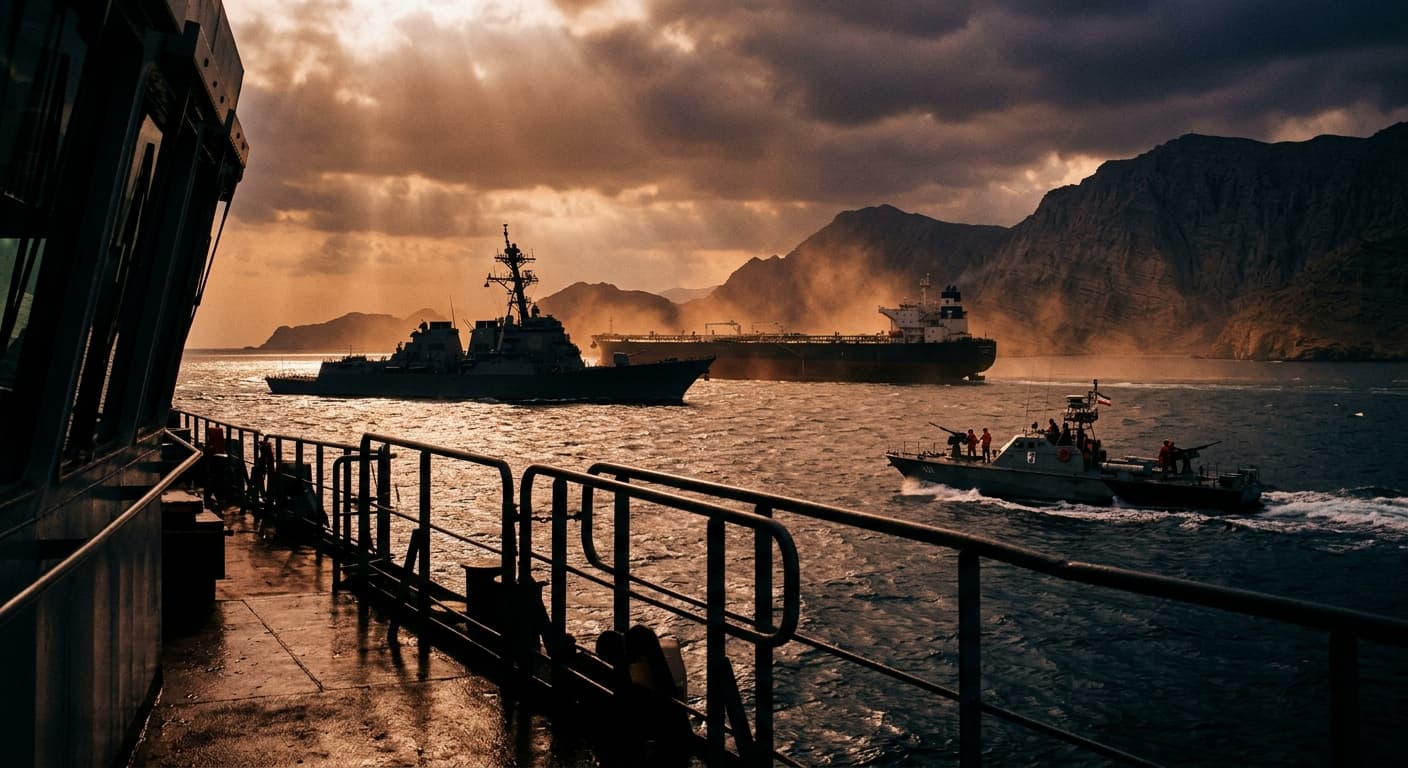
Strait of Hormuz Becomes the Prize as US-Iran Ceasefire Collapses
The June 17 memorandum of understanding to end the US-Iran war lasted 27 days before both sides began fighting again — not over Tehran's nuclear program, but over who gets to charge for passing through the world's most important oil chokepoint. By July 15, 2026, Brent crude had jumped 18% in nine days and five Gulf states were under missile fire.
On July 14, 2026, US Central Command struck six Iranian coastal sites — Abu Musa, Bandar Abbas, Bushehr, Chahbahar, Jask, and Konarak — targeting what it called Iran's "coastal defense systems, missile and drone sites and maritime capabilities," according to the Associated Press via KRMG. Within hours, Iran's Islamic Revolutionary Guard Corps fired cruise missiles at two United Arab Emirates tankers transiting Omani waters, killing one Indian mariner and wounding eight, and launched missiles and drones at US military facilities in Bahrain and Jordan. The June 17 ceasefire was dead. The real prize — control over who can tax the 20% of global oil and gas that once flowed through the strait — was up for grabs.
A ceasefire built to fail
The memorandum of understanding signed on June 17 was always fragile. It established a 60-day window for negotiations on a final accord addressing Iran's nuclear program and the strait, but its language on who controls traffic through Hormuz was deliberately vague, as analyst Tony Sycamore of IG Australia noted at the time, according to Al Jazeera. Washington insisted the strait was an international waterway with no tolls; Tehran asserted the right to manage traffic and possibly charge fees. That contradiction was never resolved.
The unraveling began on July 7, when Iran struck three commercial vessels — including a Qatari LNG tanker and a Saudi crude tanker — using a US-recommended southern route hugging the Omani coast, according to Al Jazeera. The US responded with strikes; Iran hit US bases across the Gulf. By July 10, President Donald Trump formally notified Congress that hostilities had resumed, invoking his authority under the War Powers Resolution to keep US forces in combat for another 60 days without lawmakers' approval, as
Al Jazeera reported. The Congressional Research Service confirms the administration has faced ongoing war-powers challenges, with resolutions pending in both chambers to direct the removal of US forces from hostilities against Iran absent a declaration of war, per a
CRS report.
Trump declared the ceasefire over on July 8, then said on July 11 the two sides had agreed to keep talking, then escalated again on July 13. On July 14, the US reinstated its naval blockade of Iranian ports at 4 p.m. ET, with Central Command noting that more than 20 US Navy warships and hundreds of military aircraft were operating across the Middle East, according to NPR. The blockade had previously run from April 13 to June 18.
The toll question: who taxes the chokepoint
The dispute is not about whether ships can pass. It is about who gets paid for letting them. Trump on July 13 declared the US the "guardian" of the strait and announced a 20% charge on all cargo shipped through the waterway to reimburse American security costs, according to BBC. He reversed the toll a day later, replacing it with promised Gulf-state investment deals in the US economy, as
NPR reported — but the conceptual break with centuries of US freedom-of-navigation policy was already on the record.
Iran's position mirrors Trump's logic. Tehran has insisted ships use its preferred northern route through Iranian territorial waters, where the IRGC can inspect and charge them. During the war's peak, some vessels reportedly paid as much as $2 million per transit for safe passage, according to Al Jazeera. Iran's parliament introduced a bill on July 14 — the "Strategic Action for the Security and Sustainable Progress of the Strait of Hormuz and the Persian Gulf" — to formalize that management role, per
Al Jazeera.
Both proposals collide with international law. Under the UN Convention on the Law of the Sea, all ships enjoy a right of "transit passage" through straits used for international navigation that must be "continuous, expeditious and unobstructed," with no tolls permitted except for specific services like pilotage. The International Maritime Organization's Council, concluding its 137th session on July 13, stressed that "the right of transit passage through straits used for international navigation should not be threatened, impeded, denied, hampered, impaired or suspended" and that passage "should remain free of any tolls and charges, in accordance with international law," according to UN News. The IMO Secretary-General, Arsenio Dominguez, told the Security Council in April that "there is no legal basis to introduce payments or tolls or discriminatory conditions on international straits," per a
UN press release.
The irony is sharp: the United States, which has fought for freedom of navigation since the Barbary Wars, now proposes a toll. Iran, which never ratified UNCLOS, claims a management role the treaty it rejected would not permit. An academic analysis in the Berkeley Journal of International Law notes both states "profoundly disagree about the applicable international law" and that the US, as a non-party to UNCLOS, enjoys only the right of nonsuspendable innocent passage — not the broader transit passage regime — while Iran is limited to a three-nautical-mile territorial sea under older customary law, per the SSRN paper.
Gulf states pay the bill
The actors absorbing the costs of this dispute are not in Washington or Tehran. They are the Gulf monarchies that host US bases, sit along the strait, and rely on it for nearly all of their oil and gas exports.
The UAE, which normalized ties with Israel in 2020 and deepened security cooperation with Washington, saw two of its tankers set ablaze on July 14. Its Defense Ministry called the strike a "brazen attack" that "constitutes a serious violation and a clear breach of international law," and warned it "reserved the right to retaliate," according to the BBC. That threat matters: Abu Dhabi had stayed largely on the sidelines of the war's earlier phases. Drawn-in escalation from a Gulf state that hosts US forces and traded with both sides would mark a significant widening.
Bahrain sounded air-raid sirens three times on July 14 as Iranian missiles targeted the US Fifth Fleet headquarters at al-Juffair. Jordan's military intercepted four ballistic missiles. Kuwait reported an Iranian attack on a naval vessel that wounded four personnel. Qatar, which has mediated between Washington and Tehran, condemned the tanker strikes and warned they "undermine political and diplomatic endeavors," per Al Jazeera. Oman, the other coastal state with a claim to manage the strait, called on all parties to respect international law.
The economic logic of a toll, if one were ever imposed, falls hardest on these same states. A Bruegel analysis finds that Gulf exporters would absorb 80–95% of a per-barrel transit toll, with the rest of the world bearing a negligible fraction — meaning the chokepoint tax is, in effect, a levy on Gulf oil revenues, according to Bruegel. The Brookings Institution warns that IRGC-collected tolls could become "a key source of revenue" for the very forces attacking Gulf shipping, and that other states might emulate the model at chokepoints from Malacca to Gibraltar, per
Brookings.
Traffic grinds to a halt
The data tells the story of a chokepoint being strangled. Before the war began on February 28, roughly 130–150 vessels transited the strait daily, moving about 20% of the world's oil and LNG. By July 9, just 22 ships crossed, according to Kpler data cited by NPR. By July 15, the US-recommended Omani route saw zero vessels transiting with AIS switched on, with Lloyd's List Intelligence reporting traffic "effectively grinding to a halt," per
Al Jazeera.
Brent crude, which had returned to pre-war levels near $72 after the June 17 deal, closed at $85.06 on July 15 — up 18% in nine days, per FT Markets. TD Securities' Bart Melek told Al Jazeera that "a move to $100 is quite possible" if physical shortage risks become real, according to
Al Jazeera. The US Department of Energy claimed 8.5 million barrels passed through the strait on July 13 with military assistance, calling the flow "consistent with the recent average," but ship-tracking data contradicts that sanguine framing.
The IMO confirmed at least two seafarers were killed in the July 14 tanker attacks — one Indian on the Al Bahiyah, with a second fatality on the same vessel confirmed later — and 14 injured on the Mombasa B, according to UN News. Some 6,000 seafarers remain stranded on hundreds of vessels in the Gulf, unable to exit safely, the agency said.
The legal vacuum both sides are exploiting
Neither the US nor Iran is a party to UNCLOS, the one treaty positioned to resolve the strait's legal status — a gap both are now exploiting. The US claims immutable freedom of navigation as customary law; Iran claims sovereign management rights over waters it never ceded to any convention, per the SSRN analysis.
The Security Council adopted Resolution 2817 in early 2026 condemning Iran's attacks on Gulf states and affirming navigational rights, as Secretary-General António Guterres reminded members in April, per a UN statement. But the Council has not authorized enforcement, and the US blockade — which Iran calls "an act of war" — operates in a legal grey zone. The UK and France have jointly pledged to work with Oman to keep its territorial waters safe and stand ready to deploy a "wider Multinational Military Mission" to support freedom of navigation, per a
UK government joint statement — a signal that European powers are positioning for a post-American security role if Trump's transactional approach falters.
Iran's Deputy Foreign Minister Kazem Gharibabadi declared the MoU "no longer valid" on July 14, saying Trump's blockade decision "has, in a way, dismantled" the truce, according to BBC. Iran's top negotiator, Mohammed Bagher Ghalibaf, went further, calling the fight "an essential and existential war with America," per
Al Jazeera. The IRGC warned that "the export of oil and gas from the region will be either for everyone or for no one," per
Al Jazeera — a threat to widen the conflict to other energy routes, including the Bab el-Mandeb Strait.
Key Takeaways
- The ceasefire collapsed over tolls, not nukes. The June 17 MoU's vague language on strait management was never resolved; both sides now want to charge for passage, which the IMO says violates international law.
- Gulf states are paying the bill. UAE tankers were struck, Bahrain and Kuwait came under fire, and a Bruegel analysis shows Gulf exporters would absorb 80–95% of any transit toll.
- Traffic is near zero. Vessel transits fell from ~140/day pre-war to 22 on July 9, with the US-recommended Omani route seeing zero tracked vessels by July 15.
- Brent rose 18% in nine days to $85.06 on July 15, with analysts warning $100 is possible if shortages materialize.
- The legal vacuum is the enabling condition. Neither the US nor Iran is party to UNCLOS; Security Council Resolution 2817 condemns attacks but authorizes no enforcement.
What to watch
- Next US-Iran negotiating round: Qatar-mediated indirect talks in Doha are the only diplomatic channel still technically open; their resumption or collapse will signal whether the July escalation is posturing or a return to full-scale war.
- UAE retaliation decision: Abu Dhabi's threat to retaliate for the July 14 tanker strikes would be the first direct Gulf-state military response to Iran in this conflict and would signal a widening of the war's participants.
- Trump's "next week" deadline: The president said on July 15 that strikes would intensify — targeting "power plants" and "bridges" — if Iran does not return to talks "next week." Whether he sets a firm date or lets the threat sit will shape Iran's calculus.
- August 17 MoU expiration: The 60-day window closes in mid-August; without an extension or a final accord, the legal basis for any ceasefire dissolves entirely.
Diplomat View
The strategic fact is that the Strait of Hormuz dispute has metastasized from a naval harassment problem into a sovereignty contest — and both Washington and Tehran have now signaled they want to monetize the chokepoint rather than simply keep it open. That convergence, perversely, is the barrier to peace: a deal in which Iran charges tolls is unacceptable to the US Congress and the IMO; a deal in which the US charges tolls is unacceptable to Iran and violates the freedom-of-navigation doctrine the US Navy has enforced since 1801. The ceasefire cannot hold because the underlying disagreement — who governs Hormuz — was deferred, not resolved.
The forecast: low-intensity strikes and counterstrikes continue through August, with periodic flare-ups whenever a vessel transits the "wrong" route. Brent likely settles in the $80–95 range, not spiking to $120 unless the IRGC makes good on its threat to widen the conflict to Bab el-Mandeb or the UAE carries through on its retaliation threat. The trajectory changes if: (a) Trump sets and enforces a hard deadline that forces Iran to choose between talks and infrastructure strikes, (b) a Gulf state — most likely the UAE — directly retaliates against Iran, drawing in GCC collective defense commitments, or (c) China, which has been quietly buying discounted Iranian crude, intercedes diplomatically to protect its energy supply. None of those is the base case. The base case is a war of attrition over a tollbooth neither side can legally operate.
The bottom line: the July escalation is not a ceasefire breakdown — it is the predictable consequence of a deal that papered over the only question that mattered. Until someone answers who governs Hormuz, every truce is a pause between toll disputes.
Discover more
US Politics
House Ethics Committee Pushes Sexual Miscond.
The House Ethics Committee has shifted responsibility for sexual harassment settlement records to the Office of Congressional Workplace Rights, complicating disclosure efforts.
India
Congress Accuses Modi of Stalling Women's Law
Congress accuses Modi of stalling women's reservation law by linking it to delimitation, revealing a deeper electoral strategy.
US Politics
Virginia's Redistricting Referendum
Virginia's redistricting referendum is drawing a flood of dark money, shaping future elections and the fight for congressional control amid party stakes.

Economics
Fed's Amex AML order puts correspondent banking on notice
Federal Reserve's Amex AML order requires board-level controls and a 90-day plan; OCC fined the bank $350 million over enterprise-wide deficiencies.