Southeast Asia's AI Chip Compliance Crisis
US export controls reshape regional tech landscape
Model Diplomat8 min readSoutheast Asia
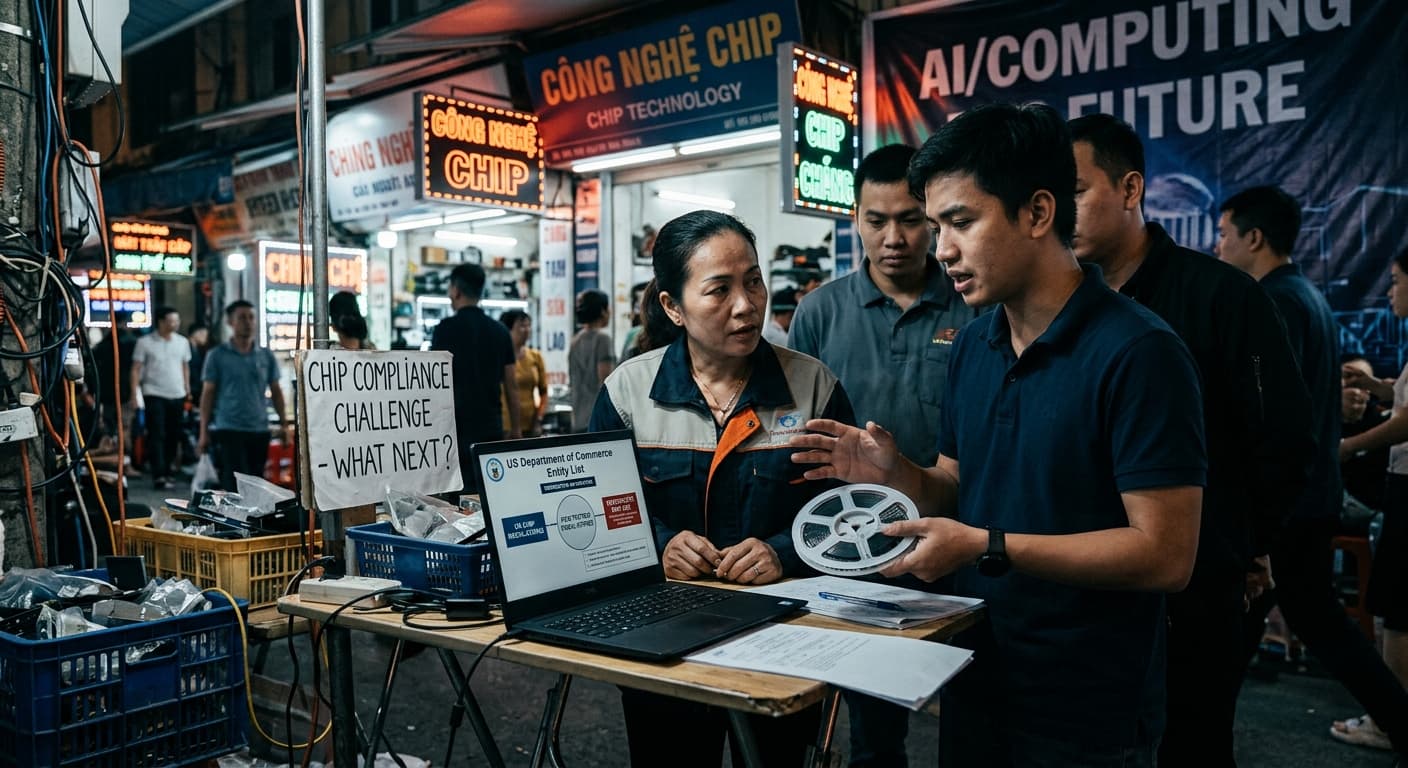
Southeast Asia's AI chip dilemma: comply or lose the boom
Washington's ultimate-ownership rule turns Malaysia, Thailand and Singapore into de-facto enforcers of US export controls — or the next targets. The compliance costs are only starting.
Any Nvidia customer whose ultimate parent sits in China now needs a US export licence — no matter which Southeast Asian flag flies over the data centre. That is the upshot of May 31, 2026 guidance from the US Bureau of Industry and Security (BIS), coming eight weeks after a $2.5 billion Super Micro diversion indictment, has quietly conscripted Malaysia, Thailand, Singapore, Indonesia and Vietnam into Washington's enforcement perimeter. The dilemma for the region is no longer whether to pick a side in the US–China AI chip war — it is whether their regulators can build ownership-tracing capacity fast enough to keep the data-centre boom, worth over $30 billion by 2030, from becoming a sanctions liability.
The rule that changed the map
The trigger was legal, not political. In the guidance published May 31 and reported by Al Jazeera, BIS reaffirmed that licensing requirements for advanced AI chips apply to "all businesses with headquarters or a parent company in China." The codified basis sits in
15 CFR §744.23, which extends US export-control jurisdiction to any entity "headquartered in, or whose ultimate parent company is headquartered in" a Country Group D:5 destination — a formulation that captures a PRC-headquartered cloud provider operating out of Johor or Batam just as tightly as one in Shenzhen.
That closes what Brookings scholar John Villasenor called the "cloud loophole": the mechanism through which Chinese firms leased offshore compute rather than importing controlled chips. In analysis published June 17, 2026, Villasenor documents that non-Chinese data centres in Singapore and Malaysia "currently obtain U.S. chips without a license and lease access to the chips to Chinese companies like ByteDance and Alibaba." A
Carnegie Endowment study identified at least eleven state-linked Chinese entities seeking access to restricted US chips through third-country cloud services, and reported Shanghai-based INF Tech remotely training AI models on roughly 2,300 Blackwell chips housed in an Indonesian facility.
For a Congressional overview of the regulatory arc — from actor-based Entity Listing through the shift to ultimate-parent controls — see the Congressional Research Service report R48642.

Why the enforcement burden lands offshore
Washington cannot audit a Johor server hall, so it threatens the counterparties that can. That is what makes the ultimate-ownership rule so consequential: it converts a compliance problem BIS cannot solve into one Southeast Asian regulators must. The Eco-Business opinion piece by Gerald Mako framed the region's exposure precisely — countries "seek data centre and AI investment to support economic growth" while facing "US secondary sanctions" if diversion is enabled through their jurisdictions, per Eco-Business.
The court dockets show why the burden is now unavoidable. On March 20, 2026, the DOJ unsealed an indictment against Super Micro co-founder Yih-Shyan "Wally" Liaw and two others over an alleged scheme that used a Southeast Asian pass-through firm, dummy servers and hair-dryer-lifted serial-number labels to route roughly $2.5 billion in AI hardware into China, according to Al Jazeera and the
BBC. Seven months earlier, the DOJ had charged ALX Solutions with 21 unlicensed shipments of Nvidia H100 GPUs staged through Singapore and Malaysia — a case that produced no named Southeast Asian government response. And in a case now testing regional resolve, Singapore Police seized a S$55 million ($42.5 million) mansion belonging to Aperia Group CEO Wei Zhaolun and filed the first-ever corporate prosecutions of tech firms under the country's chip-smuggling probe,
BBC reported.
The mechanics of the schemes reveal the enforcement problem's shape. A CSIS study mapped 11 discrete smuggling tactics across four stages — procurement, customs evasion, port exit, transshipment — and warned that combining them produces "compounding risk." Falsified end-user declarations, dummy shell firms, and repacked crates cannot be caught by tariff codes alone. They require ownership-chain tracing that most ASEAN customs authorities have never staffed for.
Three postures, one narrowing corridor
Malaysia has moved fastest, because it had the most to lose. Kuala Lumpur imposed a mandatory Strategic Trade Permit in July 2025 for the export, transshipment and transit of high-performance US-origin AI chips. A May 2026 ISEAS-Yusof Ishak analysis by Amalina Anuar documents that under the US–Malaysia Agreement on Reciprocal Trade (ART), Articles 5.1 and 5.2 now require Malaysia "to mirror US export controls, customs duties, quotas, and restrictions on goods deemed threatening to American security," per ISEAS Perspective 2026/37. Anuar calls this a shift from "sectoral neutrality" to structural US alignment — abandoning the deliberately country-neutral language of the July 2025 MITI directive. The rationale is defensive: Malaysia's semiconductor exports to the US stood at RM60.6 billion in 2024, and Kuala Lumpur bought a US commitment to factor its "cooperation" into any future Section 232 tariff determination.
Singapore is prosecuting its way out. The Aperia case matters not for the sums involved but because it is the first time corporate entities — Aperia Group subsidiaries and Luxuriate Your Life — have been charged in the local probe. The Lowy Institute noted that Singapore accounts for about 18% of Nvidia's billed revenue but under 2% of physical shipments, a gap that makes financial-flow reconciliation the real front line, according to the Lowy Interpreter. The vulnerability is what the Financial Times has called "Singapore-washing": Chinese firms reincorporating in the city-state to shed geopolitical baggage while remaining under ultimate PRC control.
Thailand is the exposed flank. The Bangkok firm publicly flagged by US authorities in May 2026 was tied to the country's sovereign AI push — a political embarrassment that Bangkok has yet to answer with the kind of statutory response Kuala Lumpur produced within weeks in 2025. A May 2026 RSIS commentary observed that in Thailand and Indonesia, "Chinese-origin platforms may depend on China-linked logistics, fintech, merchants, and data systems" — a supply-chain intimacy that makes ownership tracing especially hard, per RSIS.
Vietnam and Indonesia sit at the low end of the enforcement curve. Neither has a chip-specific transshipment regime, and Indonesia is where the INF Tech Blackwell case surfaced. Both are candidate targets for the next BIS enforcement action.
The non-obvious loser: sectoral neutrality itself
The received view is that this is a story about which chips reach China. It is really a story about the death of hedging as a viable Southeast Asian strategy. The dual-hosting posture Malaysia perfected (advanced-node work with US firms, mature-node work with Chinese ones) assumed the geopolitical fence would stay in the middle of the value chain. It has not. US controls are climbing upward into every layer of frontier AI compute and drifting downward toward the legacy chips where China's OSAT share is now 38%, per the ISEAS study.
The Carnegie analysis puts the diplomatic cost bluntly: "If Southeast Asian countries turn away from U.S. chips, they might also spurn U.S. technical standards and data governance norms — a choice that could ripple across the region's digital ecosystem." That is Washington's leverage — and its risk. Extraterritorial enforcement works only until the pain of compliance outweighs the pain of defection. The East Asia Forum argues ASEAN must hedge by "sourcing AI infrastructure from multiple ecosystems," per East Asia Forum, but the ultimate-ownership rule has quietly raised the price of that hedge to a level small economies may not be able to pay.
The MIT Center for International Studies notes that "Washington cannot substantially slow China's technological development without cooperation from US allies," per MIT CIS. Southeast Asian states are the newest, most reluctant members of that alliance — recruited by regulation, not treaty.
Who benefits, who pays
The winners are narrowing. Nvidia benefits so long as its Southeast Asian customers can prove clean ownership chains — the June 1 statement from an Nvidia spokesperson calling the BIS guidance a reaffirmation of "our existing approach" made that clear. Hyperscalers with mature compliance teams — AWS, Google, Microsoft — gain relative advantage against Chinese cloud rivals that must now be structurally partitioned or excluded. Malaysia's back-end packaging sector, per ISIS Malaysia, captures ATP work displaced from China — provided ART commitments hold.
The losers include ByteDance, Alibaba and any Chinese firm relying on offshore compute leases signed on five-to-seven-year terms before the May guidance. Also losing: the "fiercely neutral" branding Anwar Ibrahim's government marketed as recently as March 2025 — a posture the ART agreement has now formally retired, per Al Jazeera's Malaysia report. And Thailand's sovereign AI project, whose credibility now depends on whether Bangkok produces its own Strategic Trade Permit equivalent before Washington escalates.
What to watch next
- Thai response to the May Bangkok case. A concrete export-control statute or licensing regime is the missing piece; absent one before year-end, expect targeted US enforcement action against a named Thai entity.
- Aperia Group trial in Singapore. The first corporate conviction under the local regime would ratify a template ASEAN peers can copy; an acquittal would embolden diversion networks.
- ASEAN Digital Economy Framework Agreement negotiations. The Singapore-chaired Working Group on AI Governance is the natural venue for a common ownership-tracing standard. Progress here — or its absence — will signal whether ASEAN can act collectively or will be picked off individually.
- Next BIS enforcement letter. A public naming of a Vietnamese or Indonesian facility would confirm that the ultimate-ownership rule is being weaponised beyond the Malaysia–Singapore–Thailand triangle.
Diplomat View
The ultimate-ownership rule is the single most consequential move in Washington's chip-control campaign since the October 2022 controls — not because it changes what is illegal, but because it changes who has to police it. Southeast Asia has been drafted, and the region's institutional capacity to run corporate-ownership tracing is where the war is now being fought.
Base case: Malaysia and Singapore harden fast enough to stay inside the US perimeter; Thailand takes at least one visible enforcement hit before it moves; Indonesia and Vietnam become the next diversion frontier by mid-2027. The forecast revises if any of three things happen: Beijing formally retaliates against Kuala Lumpur for mirroring US controls (accelerating decoupling); a US court narrows extraterritorial reach in a challenge to the §744.23 framework (unlikely but decisive); or ASEAN's AI Governance Working Group publishes a common ownership-tracing standard before year-end (which would shift the story from bilateral coercion to multilateral compliance).
The bottom line: the US did not need to invade Southeast Asia's data-centre boom to control it. It only needed to make the region's regulators do the work — and the price of refusing is now higher than the price of complying. That is not diplomacy. It is enforcement by geometry, and it is working.
Discover more

US Politics
SNAP Food Assistance Faces Legal Challenges
In 2026, SNAP faces stricter eligibility rules and mounting legal challenges, threatening food assistance for the millions of Americans who rely on the program.

India
Delhi CM Rekha Gupta Blasts Opposition's Delm
Delhi CM Rekha Gupta's remarks on women's quota defeat reveal BJP's strategy for the 2029 Lok Sabha elections, focusing on delimitation.

International Relations
Economist Impact Sustainability Week 2026
Economist Impact Sustainability Week 2026 spotlights the energy transition, AI in clean technology, and supply chain resilience as themes for global leaders.

Economics
Fed's Amex AML order puts correspondent banking on notice
Federal Reserve's Amex AML order requires board-level controls and a 90-day plan; OCC fined the bank $350 million over enterprise-wide deficiencies.