South Korea's Mongolian Mineral Bet Runs Into
Seoul's rare earth deal with Ulaanbaatar faces a geographic trap
Model Diplomat8 min readEast Asia and Pacific
South Korea's Mongolian Mineral Bet Runs Straight Through Beijing's Chokepoint
Seoul's July 11 trade pact with Ulaanbaatar eliminates tariffs on rare earths and copper, but 90% of Mongolian exports must cross Chinese or Russian territory — and Beijing has already shown it will weaponize that geography.
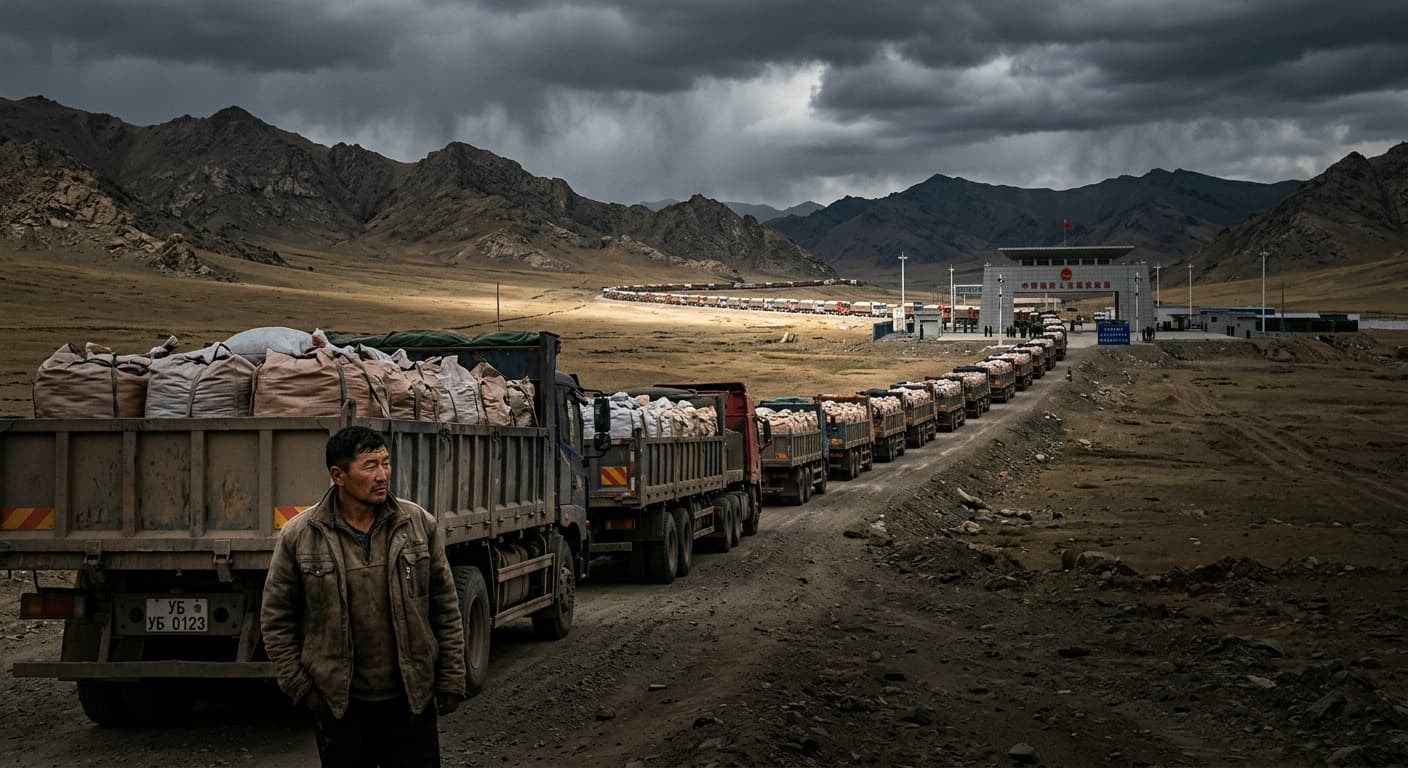
On June 27, a cargo hold of Mongolian tungsten concentrate touched down in South Korea — the first time the critical metal had reached the peninsula by air rather than rail. The shipment, confirmed by Song Byeong-gu, chairman of the Korean Association of Mongolian Studies, was a proof of concept: that Mongolia's mineral wealth can bypass the overland routes Beijing and Moscow control Korea JoongAng Daily. It was also a quiet admission that South Korea's entire Mongolian mineral strategy — formalized on July 11 with a Comprehensive Economic Partnership Agreement eliminating tariffs on copper, molybdenum, and rare earth elements — rests on a logistical lifeline that two adversarial powers can sever at will.
The pact is the most ambitious step yet in Seoul's campaign to diversify away from Chinese rare earth dominance, which has been brutally demonstrated. China now controls roughly 59% of global rare earth mining and approximately 90% of processing capacity CSIS. Over the past 18 months, Beijing has repeatedly restricted exports of heavy rare earths and permanent magnets — first in April 2025 in retaliation for U.S. tariffs, then in October 2025 with a foreign direct product rule that required Chinese government approval for any product containing even trace amounts of Chinese-origin rare earth materials
CSIS. In January 2026, China specifically targeted Japan with new dual-use export restrictions on rare earths linked to Prime Minister Takaichi's comments on a Taiwan contingency
CSIS. The message to any country building an ex-China supply chain is unambiguous: Beijing will use its rare earth monopoly as a geopolitical lever.
Mongolia, with the world's second-largest rare earth reserves at roughly 31 million tons — about 16% of the global total — is the most tantalizing alternative Korea JoongAng Daily. Its copper reserves are also ranked second globally at 55 million tons, and the Oyu Tolgoi mine alone holds an estimated 45 million tons of copper and 15 million tons of gold, currently ramping up toward 500,000 tonnes of copper per year by 2028-2036
Rio Tinto Q2 2026 Production Results. But the geology is not the problem. The map is.
The Logistics Trap
Mongolia is landlocked. Up to 90% of its mineral exports — and virtually all bulk commodities — move by rail through either China or Russia to reach global markets. Professor Jang Jae-hyuk of Hankuk University of Foreign Studies put it bluntly: "If China wanted to counter the United States, it could sharply raise customs costs or simply slow things down at the border. For now, there's no way around that logistics bottleneck" Korea JoongAng Daily. Russia owns half the strategic railroad that crosses Mongolia from north to south; the other half belongs to the Mongolian government
Foreign Affairs.
This is not a theoretical vulnerability. In the first half of 2023 alone, 2.4 million tons of goods moved between China and Russia through Mongolia — a 58% increase from the prior year — demonstrating how quickly the corridor can become a conduit for other powers' interests Foreign Affairs. Mongolia's trade dependency compounds the risk: China accounts for 91% of Mongolian exports and 41% of imports; Russia supplies over 90% of Mongolia's fuel
Congressional Research Service. If Beijing or Moscow perceive that minerals transiting through South Korea are ultimately bound for the United States or Japan — as Seoul's chairmanship of the Forum on Resource Geostrategic Engagement (FORGE) strongly suggests — experts warn they could delay shipments, demand onerous documentation, or impose retaliatory fees.
The air-freight solution demonstrated on June 27 is real but limited. "Critical minerals like tungsten, molybdenum, and rare earths can be processed locally into concentrates or intermediate materials through beneficiation or smelting, which makes transport far more efficient," Song Byeong-gu noted Korea JoongAng Daily. A joint research center opened in December 2025 between the two countries is specifically exploring on-site processing and air transport. But rare earth separation is chemically intensive and environmentally hazardous — the reason China's own processing has concentrated in Baotou, where the environmental costs are externalized. Building that capacity on the Mongolian steppe from scratch will take years and billions of dollars.
The Prize Beneath the Steppe
The scale of the opportunity explains why Seoul is pushing ahead despite the risks. Mongolia ranks 10th among the world's mineral-rich nations, with more than 80 minerals confirmed within its borders U.S. Geological Survey, via Korea JoongAng Daily. It has registered six rare earth deposits and 26 known occurrence sites. And critically, approximately 55% of Mongolia's territory — a landmass roughly 16 times the size of South Korea — remains unexplored by detailed geological survey.
The mining sector dominates Mongolia's economy, accounting for 27% of GDP, 70.9% of industrial output, and 87.2% of total exports in 2024 Korea JoongAng Daily. Oyu Tolgoi, operated by Rio Tinto, is already delivering: first-half 2026 copper production rose 31% year-on-year, and the ramp-up remains on track
Rio Tinto H1 2026 Production. But that production currently flows overwhelmingly to China, which holds 159 mining licences in Mongolia compared to South Korea's 11
European Parliament.
Seoul is not the only suitor. Japan has been Mongolia's largest bilateral aid donor and signed an Economic Partnership Agreement in 2016; its 2022-2031 Action Plan explicitly commits to "cooperation to ensure a long-term, stable supply of Mongolian copper, REEs, and other mineral resources to Japan" CSIS. Germany's Chancellor Scholz and France's President Macron both made overtures in 2022 and 2023 respectively
CSIS. But none of these countries has solved the fundamental geography problem either.
The China Factor: From Coercion to Architecture
South Korea's Mongolian push cannot be understood apart from the broader crisis in rare earth supply chains that Beijing has deliberately engineered. China's pattern is now well-documented: it first weaponized rare earths in 2010 with an export ban on Japan over the Senkaku/Diaoyu islands dispute CSIS. Between 2023 and 2025, it successively imposed export controls on gallium, germanium, antimony, graphite, and tungsten. Then, on April 4, 2025, it restricted seven heavy rare earth elements — samarium, gadolinium, terbium, dysprosium, lutetium, scandium, and yttrium — causing a 70% year-over-year collapse in permanent magnet exports by May 2025
IMF World Economic Outlook, April 2026.
After a short-lived 90-day truce, Beijing escalated again in October 2025, adding five more rare earths (erbium, europium, holmium, thulium, and ytterbium) and imposing a foreign direct product rule that denied export licenses to any firm affiliated with foreign militaries CSIS. The U.S. Department of Defense has since set a January 1, 2027 deadline to bar the use of rare earth materials and magnets from China, Russia, Iran, and North Korea in all defense procurement — a deadline that, by CSIS's assessment, may not be feasible unless significantly more capacity comes online in the next eight months
CSIS.
South Korea sits at the center of the allied response. It chaired the Minerals Security Partnership (MSP) from July 2024, and then the new Forum on Resource Geostrategic Engagement (FORGE), which succeeded MSP in February 2026 and is chaired by Seoul until June 2026 CSIS. Korea Zinc committed $7.4 billion to build a rare earth smelter in Tennessee
CSIS. A RAND Corporation study published in August 2025 specifically recommended that South Korea prioritize trilateral cooperation with Japan and the United States on Mongolian critical minerals, noting that "the trio will eventually need to work with partners outside the trio to enhance CMSC resilience — these partners could include India and Mongolia"
RAND.
But the same RAND study flagged barriers: "private-sector aversion to investment in regions with uncertain regulatory regimes" and "competition between South Korean and Japanese firms" RAND. And the Mongolian regulatory environment is indeed uncertain. In February 2026, Mongolia's Tax Authority issued a $443 million tax assessment on Rio Tinto's Oyu Tolgoi — an amount the company paid under protest, calling it "inconsistent with the Oyu Tolgoi Investment Agreement"
Rio Tinto Q2 2026 Production Results. Such actions remind foreign investors that resource nationalism remains a live risk in Ulaanbaatar.
The U.S. Dimension: A Triangular Tightrope
The geopolitical calculus gets sharper when you follow the minerals to their likely destination. South Korea currently chairs a 17-nation coalition — FORGE — that Washington launched to reduce global reliance on China for critical minerals Korea JoongAng Daily. If Mongolian rare earths are processed in South Korea and then fed into U.S. or Japanese defense supply chains, Beijing and Moscow will not need sophisticated intelligence to connect the dots.
The risk is not merely that China might block exports. It's that Mongolia itself could be coerced. China is Mongolia's dominant economic partner; a slowdown in coal purchases or border delays could inflict immediate pain on an economy where mining contributes over a quarter of GDP. Russia, meanwhile, owns the rail corridor and supplies nearly all Mongolian fuel. Between them, they hold multiple levers to make Ulaanbaatar think twice about deepening ties with Seoul, Tokyo, or Washington.
Mongolia's "Third Neighbor" policy — the decades-old strategy of balancing its two giant neighbors by cultivating ties with distant democracies — has never been tested at this level of economic consequence. The country attended the 2026 Critical Minerals Ministerial and is engaging with FORGE, signaling its desire to be more than a passive supplier CSIS. But the German Federal Institute for Geosciences and Natural Resources issued a sober assessment in 2023, concluding that Mongolia's rare earth deposits are all at an early stage of exploration and that "their commercialization would face significant challenges, including huge infrastructure investment"
European Parliament. Two years of diplomatic momentum have not yet changed that fundamental reality.
Diplomat View
Thesis: South Korea's Mongolia mineral strategy is not primarily a commercial play — it is a geopolitical insurance policy whose premium is paid in exposure to the very powers it seeks to hedge against. The June 27 tungsten air-freight test and the July 11 trade pact are genuine advances, but they address only the easiest segment of the problem: procurement. The harder challenges — processing capacity outside China, transport redundancy that does not depend on Chinese or Russian goodwill, and a regulatory environment in Ulaanbaatar stable enough to absorb billions in foreign investment — remain unsolved. The strategy will succeed or fail on whether Seoul can convert its convening power as FORGE chair and its $37 billion Supply Chain Stabilization Fund into bankable Mongolian processing infrastructure before the next Chinese export restriction hits. The January 1, 2027 DOD deadline for China-free magnets is the first hard test; a major Chinese restriction on light rare earths or permanent magnets before that date would transform the Mongolian option from a long-term hedge into an urgent necessity — and expose just how far the logistics pipeline still has to go.
What to watch:
- January 1, 2027: The U.S. Department of Defense ban on Chinese-origin rare earth magnets takes effect. If supply remains dependent on China, allied urgency around Mongolian alternatives will spike.
- FORGE chair transition (June 2026): South Korea hands the chairmanship to the next member state. Whether Seoul uses its final months to lock in Mongolian project commitments will signal the depth of its resolve.
- Mongolia's Entrée licence resolution: Rio Tinto is negotiating with the government over the Panel 1 licence transfer for Oyu Tolgoi. How that dispute resolves will indicate the investment climate for new critical mineral entrants.
The bottom line: South Korea's Mongolian bet is a wager that air freight and on-site processing can defeat geography before China's next rare earth restriction forces allied manufacturers to choose between shutdowns and concessions. The tungsten shipment proved the concept. Scaling it to rare earths will require years Beijing is unlikely to grant.
Discover more
US Politics
House Ethics Committee Pushes Sexual Miscond.
The House Ethics Committee has shifted responsibility for sexual harassment settlement records to the Office of Congressional Workplace Rights, complicating disclosure efforts.
Global Politics
Trump's Conflicting Messages on Iran War
Trump's mixed messages on Iran reflect a strategy of audience management, benefiting Tehran amid a complex geopolitical landscape.

US Politics
SNAP Food Assistance Faces Legal Challenges
In 2026, SNAP faces stricter eligibility rules and mounting legal challenges, threatening food assistance for the millions of Americans who rely on the program.

Conflict & Security
Drone Warfare Killing Aid Workers at Unprec
Over 1,000 humanitarian workers killed in three years as cheap armed drones collapse legal protections. Gaza, Sudan, Ukraine, and DRC see deliberate targeting of aid convoys and hospitals with zero prosecutions.