South Africa Court Restores Asylum Protecions
Constitutional Court reinstates non-refoulement for asylum seekers.
Model Diplomat7 min readAfrica
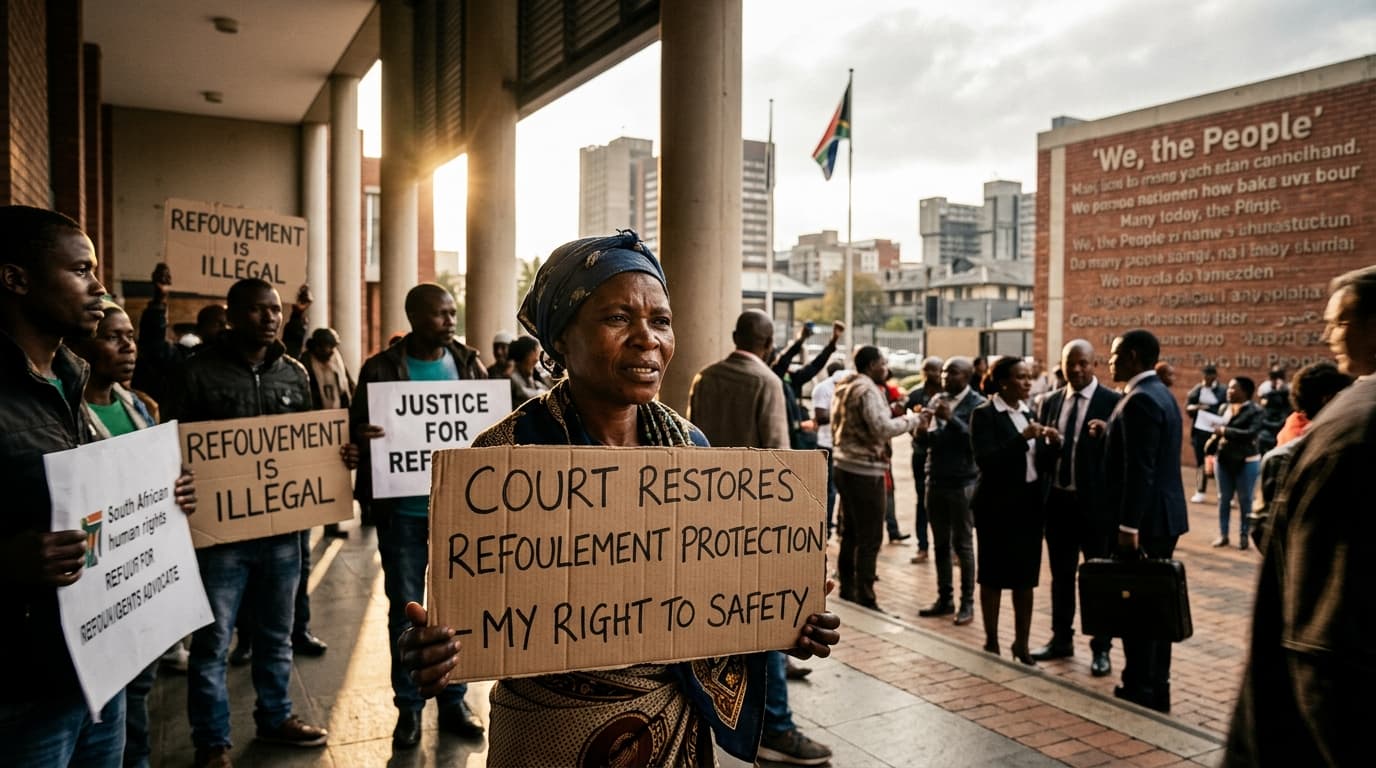
South Africa's top court restores non-refoulement, gutting 2020 asylum filters
South Africa's Constitutional Court on July 7, 2026 struck down transit-visa and "good cause" provisions of the Refugees Act, reinstating non-refoulement protections for asylum seekers.
South Africa's Constitutional Court unanimously ruled on July 7, 2026 that four sections of the amended Refugees Act violate the international principle of non-refoulement, restoring merits-based asylum access at the moment South Africa is expelling foreigners at the fastest pace in a decade. The judgment, written by Justice Steven Majiedt, does more than fix a domestic statute — it draws a constitutional line under a global trend of "procedural" asylum walls, and it lands directly on Home Affairs Minister Leon Schreiber's plan to tighten the refugee regime before November's local elections. The load-bearing move: the Court read Article 33 of the 1951 Refugee Convention into South African administrative law, and told the state its "safety valve" was an unconstitutional exercise of arbitrary power.
What the Court actually did
Sections 4(1)(f), 4(1)(h), 4(1)(i) and 21(1B) of the Refugees Act — inserted by the Refugees Amendment Act 11 of 2017 and in force since January 1, 2020 — were declared invalid with immediate effect. The provisions had allowed immigration officers to bar asylum applicants who lacked a valid transit visa, or who could not show "good cause," "valid reasons" or "compelling reasons" for procedural lapses. According to GroundUp, which published the judgment, Justice Majiedt held that "all asylum seekers are protected by the principle of non-refoulement and the protection applies as long as the claim to refugee status has not been finally rejected after a proper procedure on the merits."
The Court found the terms "good cause," "valid" and "compelling" were nowhere defined in the statute, "creating a real risk of arbitrary and inconsistent decision making." As NovaNews reported, Majiedt rejected the state's argument that the sections were a "safety valve" as "ill-conceived," calling the provisions "an arbitrary exercise of state power" that "subjects vulnerable asylum seekers to yet another bureaucratic step."
The case was brought by the Scalabrini Centre of Cape Town and confirms a Western Cape High Court ruling issued in early 2025. Amici admitted to the case included the UN High Commissioner for Refugees, Amnesty International, the Helen Suzman Foundation, the International Detention Coalition, and the Global Strategic Litigation Council for Refugee Rights — an unusually crowded bench of international observers for a domestic refugee case.
The primary law the Court enforced
The judgment is anchored on Article 33(1) of the 1951 Convention Relating to the Status of Refugees, which prohibits any contracting state from expelling or returning a refugee "in any manner whatsoever" to territories where life or freedom would be threatened. Only two exceptions apply: reasonable grounds to view the person as a danger to national security, or conviction of a particularly serious crime. Majiedt cited exactly those two limits, effectively translating the treaty text into a domestic constitutional standard.
That matters because South Africa, in its 2023 statement to the UN Sixth Committee on the Expulsion of Aliens, told the General Assembly that its Refugees Act "align[s] with the principles" of the International Law Commission's Draft Articles and extends protection to refugees and stateless persons (UN Sixth Committee statement). The Constitutional Court has now held the state to that representation, at a moment when the executive was moving in the opposite direction.
The angle: a treaty-body-style ruling from a domestic apex court
For international refugee lawyers, the ruling reads less like a South African administrative-law judgment and more like something the UN Human Rights Committee or the African Commission on Human and Peoples' Rights would issue. Scholarship on the 2017 Amendment Act had warned this was coming. In a 2020 Constitutional Court Review paper, legal scholar Tal Schreier argued that many of the Amendment's provisions "arguably breach SA's Constitution" and that courts would be forced to declare them unconstitutional under the strengthened interpretive role given to international refugee and human-rights law by the 2008 amendments to the Act. That is precisely what happened.
The Court also crossed a line most apex courts avoid: it publicly rebuked the government's lawyers. Majiedt found the state had "litigated extremely poorly," displaying "gross laxity and disturbing ineptitude," and took direct aim at "sweeping and unsupported assertions regarding Afghan and Bangladeshi nationals' involvement in human trafficking in South Africa." Such rhetoric, Majiedt warned, "carr[ies] the potential to shape broader societal narratives about refugees and may adversely affect the protection of their rights."
That paragraph is the ruling's second-order signal. It reframes an increasingly common government tactic — invoking security or trafficking risk to justify bypassing merits review — as a constitutional problem, not a policy choice.
The domestic political context the ruling walks into
The timing is not incidental. According to Al Jazeera, South African police arrested more than 900 people during the June 30 anti-migrant protests organised by the March and March movement, which had set an unofficial "deadline" for undocumented foreigners to leave. Ghana, Malawi, Nigeria and Mozambique have collectively repatriated an estimated 25,000 nationals in recent weeks; the
BBC reported that South Africa's ministerial task team on migration says 40,000 people have been arrested this year for contravening the Immigration Act.
President Cyril Ramaphosa has already announced a five-point plan that includes refusing asylum claims from those who transited through "safe" countries, relocating refugee reception centres to border posts, and extending digital IDs to non-citizens. Schreiber, of the Democratic Alliance, is the coalition minister driving the tightening. Two months ago, in a case brought by two Burundian applicants, the Constitutional Court gave him a win by barring unlimited repeat asylum applications; BBC News reported Schreiber welcomed that ruling as a "major victory" against "abuse" of the refugee system.
The July 7 judgment is the countervailing brake. It leaves Schreiber's political direction intact — the state can still reject claims on the merits, exclude serious criminals, and prosecute abuse — but forbids screening people out before merit is ever considered. On the ground, that reopens the door to a caseload the UN has estimated at roughly 250,000 refugees and asylum seekers, according to figures cited by BBC News.
Why this matters beyond South Africa
Non-refoulement is under quiet erosion worldwide. The UK's Rwanda plan, the EU-Tunisia and EU-Libya arrangements, the US "safe third country" framework and Australia's offshore processing all rest, in different ways, on the idea that procedural filters at the border can lawfully divert asylum seekers before a merits review. South Africa's Amendment Act was in the same family: not a formal derogation from Article 33, but an administrative bar dressed up as a queue-management tool.
Majiedt's ruling names that architecture and rejects it. The Court did not accept that "procedural missteps" — missing a transit visa, entering irregularly, delayed reporting — can extinguish the right to have a claim heard. It held that the constitutional right to non-refoulement attaches to the claim, not to the paperwork.
For the UN Refugee Agency, which intervened as amicus, that formulation is close to gold standard. UNHCR's own ExCom conclusions have long insisted that non-refoulement applies to asylum seekers as well as recognised refugees, precisely because the alternative allows states to define the protection out of existence by controlling who counts as a claimant. The
Committee on the Rights of the Child and UNICEF, in a joint statement issued on June 30, warned that migrant children in South Africa face "heightened risks of violence, exploitation, neglect, family separation, trafficking and psychological distress." Majiedt cited the same concern in domestic terms: children's claims tied to their parents' procedural lapses could not be extinguished without individual best-interests assessment.
Analysts had flagged the collision course. In its 2019 report on refugee-reception offices, Amnesty International documented approval rates falling from 15% in 2011 to 4% in 2015, and a backlog fluctuating between 130,000 and 400,000 pending claims — a system in which the 2020 amendments were designed to shrink the intake, not fix the pipeline.
Winners, losers, what to watch
The immediate winner is the Scalabrini Centre, which secured costs on two counsel and a nationwide precedent. The strategic winner is UNHCR, which now has an apex-court ruling in a G20 economy that reads the Refugee Convention as directly enforceable against domestic procedural filters — a citation other African, and possibly European, litigants will use.
The immediate loser is the Department of Home Affairs, both procedurally — its litigation was publicly excoriated — and politically. Schreiber must now redesign asylum processing without transit-visa gatekeeping at a moment when his coalition partners in the ANC are under pressure to be seen tightening the border.
What to watch:
- Legislative response: whether Parliament attempts to redraft sections 4 and 21 with defined criteria to survive constitutional review, or moves instead to the border-post reception-centre model announced by Ramaphosa. Any new bill would face the July 7 ruling as binding law.
- Local elections, November 2026: migration is the dominant campaign issue. Expect MK Party, ActionSA and the DA to invoke or attack the judgment on the stump. The next Thursday-protest cycle called by March and March leader Jacinta Ngobese-Zuma is the near-term flashpoint.
- Home Affairs' operational compliance: the ruling has immediate effect. The concrete test is whether deportations of transit-visa-less asylum seekers stop this week at Beitbridge, Lebombo and OR Tambo. Scalabrini and Lawyers for Human Rights have signalled they will monitor.
The Bottom Line
South Africa's Constitutional Court has done what few apex courts have been willing to do in the current global asylum climate: it has held that non-refoulement is not a policy preference but a constitutional rule, and that procedural filters designed to shrink asylum intake before merits review are an arbitrary use of state power. In a year of mass repatriations and anti-migrant protest, the July 7 judgment is the clearest domestic-court application of Article 33 of the 1951 Refugee Convention seen in the Global South this decade — and it will be cited well outside Pretoria.
Discover more
US Politics
SNAP Food Assistance Faces Legal Challenges
In 2026, SNAP faces stricter eligibility rules and mounting legal challenges, threatening food assistance for the millions of Americans who rely on the program.

Global Politics
US Seizes Iranian Ship, Tensions Surge
The US seizure of the Iranian ship Touska highlights a shift in control over the Strait of Hormuz, favoring Iran's strategic position.

International Relations
Economist Impact Sustainability Week 2026
Economist Impact Sustainability Week 2026 spotlights the energy transition, AI in clean technology, and supply chain resilience as themes for global leaders.

Economics
Fed's Amex AML order puts correspondent banking on notice
Federal Reserve's Amex AML order requires board-level controls and a 90-day plan; OCC fined the bank $350 million over enterprise-wide deficiencies.