Somalia's Election Crisis Threatens AUSSOM
Political deadlock risks UN funding for Somalia's stabilisation force.
Model Diplomat8 min readHorn of Africa
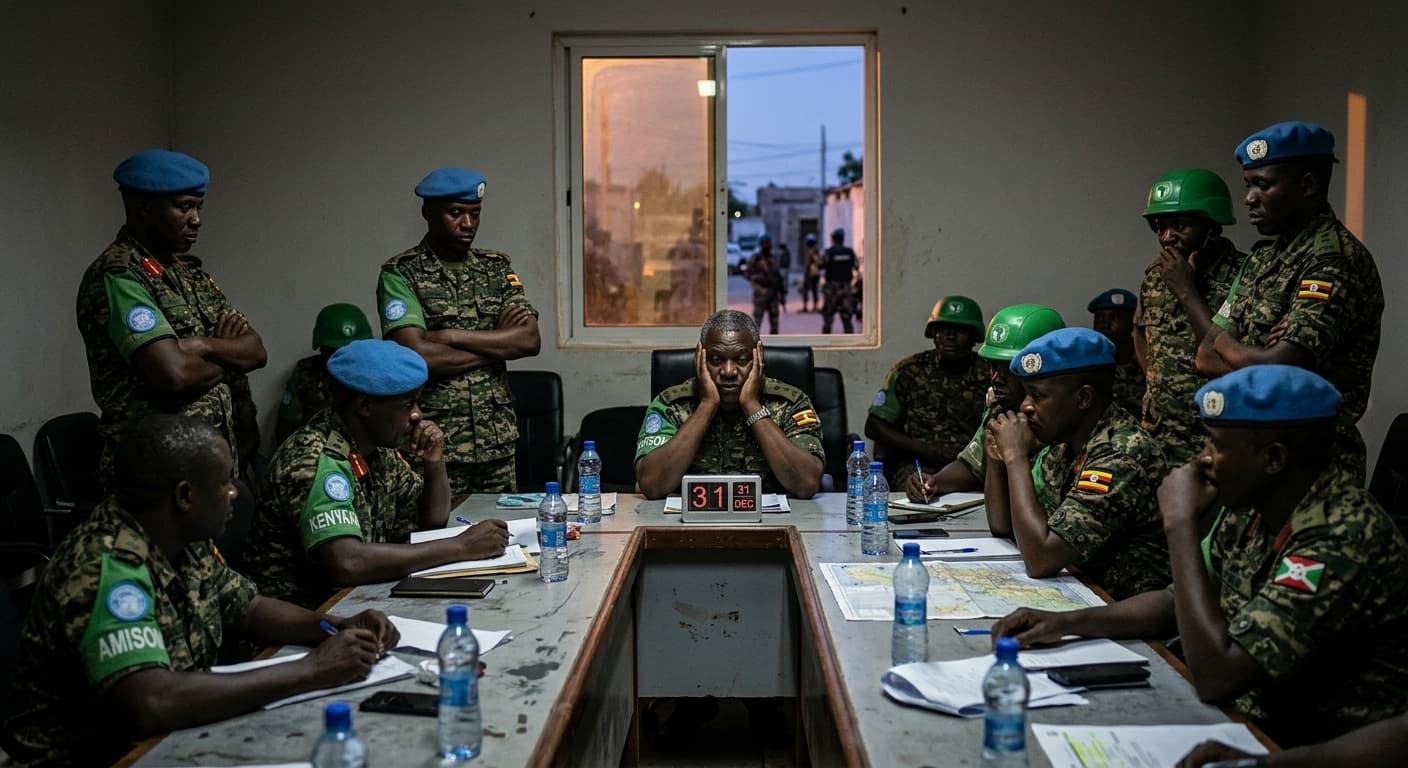
Somalia's Election Deadlock Now Threatens AUSSOM Funding Cliff
Turkey-brokered talks resumed in Mogadishu on July 8, 2026, but the real deadline is December 31 — when AUSSOM's mandate expires and Washington is poised to pull the plug on UN financing.
Somalia's electoral deadlock stopped being a domestic squabble on May 15, 2026 — the day President Hassan Sheikh Mohamud's four-year term expired and parliament, in his account, extended it by one. What is being negotiated this week in Mogadishu is no longer whether Somalis vote one-person-one-vote or by clan proxy. It is whether the African Union's 11,826-strong stabilisation force keeps its UN lifeline past December 31, 2026 — the day AUSSOM's mandate lapses and, on current signals from Washington, its assessed contributions with it. The federal government and the three opposition platforms — the Somali Future Council, Farmaajo's Nabad iyo Nolol, and the National Unity Forum — agreed on July 8 to keep talking. They did not agree on anything else. According to Dawan Africa, the parties issued "separate but nearly identical statements" from separate rooms, with Türkiye shuttling between them.
That is the shape of the crisis. Somalia's donors have spent 15 years and, on the European Union's own accounting, $2.8 billion just on the AU peacekeeping mission to hold the Al-Shabaab line while the state rebuilt itself. The state has now split three ways — Villa Somalia, the opposition coalition, and two federal states that walked out — at the exact moment donors are running out of patience and money.
The room, and who is not in it
The Turkey-facilitated round that opened on July 7 is the second attempt this year. The first, led by US chargé d'affaires Justin Davis and UK Ambassador Charles King, collapsed on May 15, the day Mohamud's original mandate ran out. Three weeks later, government forces and the security details of former Prime Minister Hassan Ali Khaire and former President Sharif Sheikh Ahmed fought running battles in Mogadishu's Abdiaziz district, in what
Al Jazeera reported as more than two days of clashes before clan-elder mediation ended the standoff.
Two of Somalia's six federal states — Puntland and Jubaland — are not in the room. Both have formally withdrawn from the federal system over the constitutional amendments Mohamud pushed through parliament, as Al Jazeera's Faisal Ali reported. More than 100 MPs and senators boycotted the final constitutional vote. The opposition coalition includes two serving federal-state presidents, two former prime ministers and a former president. In practice, Ankara is mediating between a government whose writ does not reach half the country and an opposition that has already threatened, in a communiqué from Kismayo in December 2025, to run parallel national elections of its own.
The core disagreement is technical only on paper. The government wants a one-person, one-vote system — the first direct national ballot since 1969. The opposition wants an "expanded indirect election" that keeps the 4.5 clan-power-sharing formula but broadens the delegate base. Behind the models sit two different theories of the Somali state. Villa Somalia is betting on a strong central executive delivering direct democracy. The opposition, and Puntland and Jubaland with it, insist the 2012 provisional constitution — and the federal bargain it encodes — is still the law.
Why December 31 is the real deadline
The electoral timetable no longer runs on Somali time. It runs on the UN Security Council calendar.
On December 23, 2025, the Council unanimously adopted Resolution 2809, extending the African Union Support and Stabilisation Mission in Somalia (AUSSOM) until December 31, 2026, with up to 11,826 uniformed personnel. The vote hid an unresolved fight. Resolution 2767 of December 2024, adopted with a US abstention, had established a "hybrid implementation" of the
Resolution 2719 framework — meaning up to 75% of AUSSOM's budget would come from UN assessed contributions, with the AU and international donors covering the rest. That was the financial architecture designed to make the mission sustainable after ATMIS.
Washington has spent 2025 dismantling it. According to a Reuters cable dated July 1, 2025 reviewed by the BBC's Somali service, the Trump administration told the AU it would not support the UN Support Office in Somalia (UNSOS) — the $500 million logistics backbone — beyond the end of 2025, and would oppose any renewal that includes UN-funded logistics or operations. AUSSOM's 2025 budget, at $190 million, is already a fraction of ATMIS's $100 million-per-year operating envelope plus its logistics tail. The Chinese delegate warned during the December 2025 vote that "the funding gap facing AUSSOM is unsustainable and the liquidity shortfall confronting UNSOS raise our concern," according to the
UN Meetings Coverage readout.
The US position, delivered by Jeffrey Bartos of the US Mission to the UN and quoted in the same UN readout, was blunter: "the transfer of security functions to Somalia has" stalled, and continued international support would depend on Somali leaders — federal government, member states and clans — coming together on governance and security. Read plainly, Washington has told Mogadishu that another year of political paralysis costs it the mission.
The Al-Shabaab arithmetic
Al-Shabaab has read the same calendar. The US Treasury estimates the group generates roughly $100 million a year from taxation, extortion and checkpoint tolls — more than half of AUSSOM's authorised annual budget. AFRICOM calls it the "largest, wealthiest, and most lethal" al-Qaeda affiliate in the world.
Between January and July 2025, fighting in Middle Shabelle displaced almost 60,000 people, Al Jazeera reported. The government has since clawed back several coastal districts — Gandershe, Dhanaane and Jilib-Marka — in an operation dubbed "Seefta Qarsoon" (Hidden Sword), reopening the Mogadishu–Marka road for the first time in over a decade, according to
BBC Somali. But security analyst Ahmed Kaboole told the BBC the government's ability to hold territory depends on not repeating the pattern of "take, then abandon." That in turn depends on AUSSOM contingents from Uganda, Kenya, Ethiopia, Djibouti and Egypt staying in position — and on their salaries being paid.
Under Trump, US airstrikes have partly filled the gap: they doubled year-on-year in 2025, per Al Jazeera's tracking. Kinetic action, however, does not garrison towns. AUSSOM does.
The regional realignment nobody is negotiating
The electoral crisis is not happening in a vacuum. It is happening in a Horn of Africa whose diplomatic geometry has changed faster than any Somali institution can absorb.
On December 26, 2025, Israel became the first UN member state to recognise Somaliland's independence, BBC News reported, a move Somali President Mohamud called a "naked invasion" and linked, in an
Al Jazeera interview from Istanbul on December 31, to alleged Israeli plans for a Gulf of Aden military base and Palestinian resettlement. Two weeks later, Mogadishu
cancelled all agreements with the United Arab Emirates, citing sovereignty violations — the UAE being the principal external backer of both Puntland and Jubaland.
That is the regional context in which Turkey now finds itself the last mediator standing. Ankara operates its largest overseas military base in Mogadishu, holds a 10-year defence pact with the federal government, and — under a controversial 2024 hydrocarbons deal — is entitled to up to 90% of proceeds from Somali offshore oil it develops, according to BBC Somali reporting. Turkey also mediated the December 2024 Ankara Declaration that patched over the Ethiopia-Somaliland port row. It is now the only external actor with enough standing on both sides of the Somali fight to sit them down.
Which means: whatever comes out of these talks will bear a Turkish signature. Whether US, UK and EU donors — the ones actually paying for AUSSOM and the humanitarian file — accept a Turkish-brokered settlement is a separate question.

What a breakdown looks like
Afyare Abdi Elmi, writing in Al Jazeera on June 2, 2026, warned that the country is now "caught between two competing claims to constitutional" legitimacy, with the government and at least three federal member states operating beyond their mandates. His prescription — direct US, UK and Gulf pressure, plus targeted sanctions on spoilers — is not the direction current Western capitals are moving.
The CSIS podcast Power, Politics, and Peace in Somalia captures the trajectory: the US "abstains from the last vote" on AUSSOM, may cut UN assessed contributions, and is signalling it will not underwrite a mission whose host government cannot deliver internal cohesion. Somalia's government, meanwhile, funds
more than two-thirds of its $950 million annual budget from external donors, according to the Mogadishu-based Heritage Institute. There is no fiscal room to self-finance security.
Diplomat View
The talks that resumed in Mogadishu on July 8 will not, on current form, produce a comprehensive electoral roadmap before December 31. The parties are too far apart on first principles, the two most important federal states are not in the room, and the opposition has a credible parallel-election threat it has not yet withdrawn. What is more likely — and what Ankara appears to be shepherding — is a face-saving technical extension: a Turkish-brokered communiqué that commits both sides to a hybrid electoral model (some direct local votes, an indirect federal vote) and buys 12 to 18 months of formal negotiation. That would be enough for the UK, as Security Council penholder, to sell Washington a further AUSSOM renewal in December.
The forecast changes if two things happen. First, if Puntland or Jubaland formalise a parallel electoral process before September, the international consensus collapses and the December vote fails. Second, if Al-Shabaab exploits the political vacuum to retake ground in Middle or Lower Shabelle — reversing the "Hidden Sword" gains — the case for cutting AUSSOM funding gets politically impossible even for a Trump White House. Watch Baidoa and the Kismayo-Mogadishu axis. That is where the next inflection will be measured.
What to watch next
- August–September 2026: Puntland and Jubaland's next move. A formal parallel-election declaration would kill the Turkey process.
- October 31, 2026: UNTMIS ceases all operations under
Resolution 2809 (2025), removing the UN political mission just as the electoral crisis peaks.
- December 2026: UN Security Council vote on AUSSOM renewal. On current US posture, without a Somali political agreement, the mission does not get another full-fat mandate.
The Bottom Line
Somalia's electoral deadlock is no longer a domestic crisis — it is the trigger that determines whether AUSSOM survives past December 31, 2026, whether Al-Shabaab reclaims the coast, and whether the Horn's rapidly realigning powers freeze Somali fragmentation in place. Turkey is now the only mediator with leverage on both sides, but Washington holds the purse strings and has signalled it will not pay for another year of paralysis. If the July talks do not produce a credible roadmap by autumn, the December mandate vote — not the election itself — becomes the moment Somalia's post-2007 international scaffolding starts to come down.
Discover more
US Politics
Congress Targets AI Chatbot Access for Terror
The House passed the Generative AI Terrorism Risk Assessment Act, focusing on AI's role in terrorism and potential surveillance implications.
India
Rajnath Singh's Durga Squad for 2026 Polls
Rajnath Singh's Durga Squad promised women's safety in Bengal but has since disappeared from the agenda, revealing BJP's true priorities.
India
Congress Accuses Modi of Stalling Women's Law
Congress accuses Modi of stalling women's reservation law by linking it to delimitation, revealing a deeper electoral strategy.

Economics
Fed's Amex AML order puts correspondent banking on notice
Federal Reserve's Amex AML order requires board-level controls and a 90-day plan; OCC fined the bank $350 million over enterprise-wide deficiencies.