SK Hynix, CXMT IPOs Fueled by Chip Shortage
Two blockbuster capital raises, one shared driver: memory scarcity
Model Diplomat9 min readeast_asia
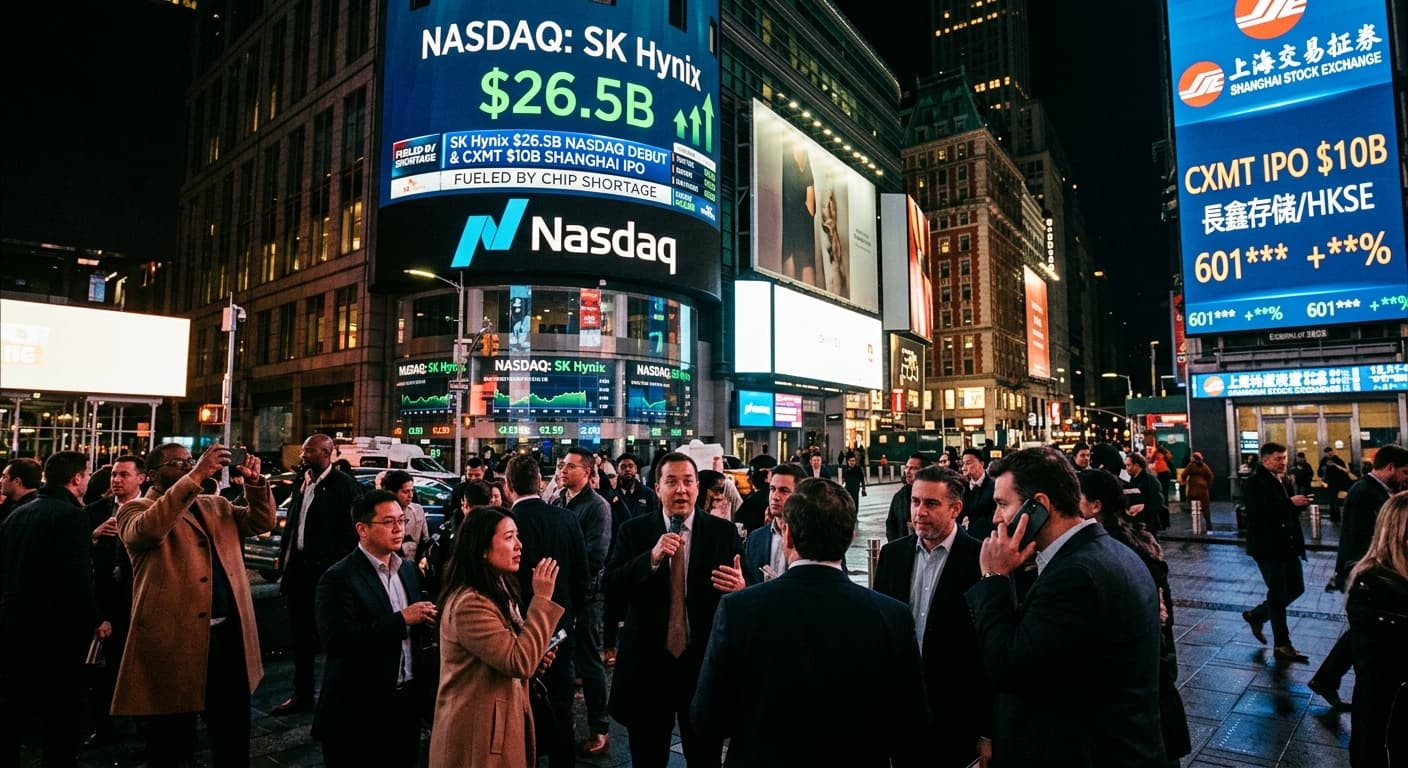
SK Hynix Just Raised $26.5 Billion. China's CXMT Wants $10 Billion. Chey Tae-won's Chipflation Warning Explains Why Both Can Win.
SK Hynix's record-smashing Nasdaq debut and CXMT's looming Shanghai IPO are not competing stories — they are two halves of the same trade, and the SK chairman knew this was coming.
On July 10, 2026, SK Hynix sold 177.9 million American depositary shares at $149 each, raising $26.5 billion in the largest foreign-company listing in US history. Demand ran more than seven times the shares on offer, and the stock surged as much as 17% on its first trading day, reported the BBC. The deal eclipsed Alibaba's $25 billion record from 2014 and priced at a 2.9% premium to the Seoul-traded shares — a near-unprecedented inversion of the discount that secondary listings normally require.
Two weeks earlier, on June 29, South Korean President Lee Jae Myung stood beside the chairmen of Samsung and SK Group to unveil an $880 billion national chip-and-AI investment plan, declaring that semiconductors were the "triple axis for a great leap forward," according to the BBC.
Across the Yellow Sea, China's ChangXin Memory Technologies — CXMT — is preparing its own blockbuster: an initial public offering targeting $8.5 billion to $10 billion on Shanghai's STAR Market, according to the Financial Times and
Nikkei Asia. If completed, it would be the largest chip IPO in Chinese history.
The thesis: These two capital raises — separated by 600 kilometers of sea and an escalating US-China tech war — are both being fueled by the same force: a memory-chip shortage so severe that it has created pricing power for every producer with a fab, including the challenger no one expected to matter this fast. SK Group Chairman Chey Tae-won's warning about "chipflation" is not a warning to consumers. It is a warning to his own industry that today's windfall is tomorrow's vulnerability — and CXMT's IPO is the proof.
The $26.5 Billion Bellwether
SK Hynix's Nasdaq debut was not supposed to happen at a premium. But the company is, by several metrics, the single largest beneficiary of the AI infrastructure buildout. It is the dominant supplier of high-bandwidth memory (HBM) to Nvidia, and its net income hit 40.34 trillion won ($26.6 billion) in the first quarter of 2026 alone, Al Jazeera reported. Its market capitalization crossed $1 trillion in May, joining Samsung and Micron in a club previously reserved for Nvidia, Apple, and Microsoft, according to the
BBC.
The arithmetic behind these numbers is brutal in its simplicity. Demand is so far ahead of supply that SK Hynix has sold out its entire 2026 production slate and is no longer accepting new orders for major memory products, according to the Center for Strategic and International Studies. On June 17, the company shipped samples of its next-generation 12-layer HBM4E to major customers — 48GB capacity per stack, 16Gbps per-pin data rate, 17% improvement in heat resistance over the previous generation — via
PR Newswire.
The market backdrop is extraordinary. Omdia raised its 2026 semiconductor revenue forecast to 62.7% growth, with DRAM nearly doubling in value and NAND potentially quadrupling compared to 2025, the research firm announced on April 24. Omdia senior analyst Myson Robles-Bruce cautioned that "meaningful supply relief is unlikely until well into 2027." AI-memory demand is growing 50–60% year-on-year against supply expansion of just 15–20%.
This is not merely a data-center story. On July 16, Apple CEO Tim Cook told the Wall Street Journal that price increases were "unavoidable," calling the situation "unsustainable." Counterpoint Research data showed that a 32GB DDR5 DRAM module for PCs jumped from $94 in Q3 2025 to $282 in Q1 2026 — a 122% increase in six months, the BBC reported. Counterpoint's VP of research Neil Shah expects constrained supply to last "as long as two years." Micron CEO Sanjay Mehrotra told investors his company "currently does not have line of sight as to when memory supply will be able to catch up with increasing demand."
CXMT's $10 Billion Counter-Move
The SK Hynix ADR and the CXMT IPO are capital-raising twins born of the same shortage. The difference is that one is a victory lap and the other is a breakout attempt.
CXMT is China's leading homegrown DRAM producer, headquartered in Hefei, Anhui province. Its technology still lags the incumbents — industry estimates place CXMT roughly two to three years behind Samsung and SK Hynix in process maturity and advanced HBM capability, according to analyses from Semianalysis and
The Economy. But that gap, in a market this supply-constrained, is a difference of degree rather than kind. When the incumbents are sold out, a two-year technology lag does not stop a buyer from writing a purchase order.
CXMT is accelerating into HBM3 production, recruiting global engineering talent, and expanding its Hefei campus. Tom's Hardware reported industry research suggesting CXMT is close to matching Micron's memory capacity in 2026 — a milestone that, if realized, would make China the world's second-largest DRAM producer by volume. Apple has been lobbying Washington for clearance to buy from CXMT amid the global shortage,
The Economy reported in June.
These four companies — SK Hynix, Samsung, Micron, and CXMT — now form the axis around which global memory geopolitics turns.
- SK Hynix leads in HBM, has sold out 2026 production, just raised $26.5 billion, and is building the $14.5 billion Yongin cluster with the first clean room targeted for February 2027.
- Samsung Electronics carries the broadest memory portfolio, valued at roughly $1.34 trillion, and is converting its Pyeongtaek P5 line to HBM capacity as part of South Korea's $880 billion national plan.
- Micron Technology is spending heavily on multi-region expansion — Idaho, Virginia, Singapore, Taiwan — and saw quarterly revenue quadruple year-on-year but still cannot meet demand.
- CXMT is the challenger: pre-IPO, two to three years behind in technology, but gaining capacity share at a rate that has drawn a formal US congressional push for a ban.
CSIS projects that data centers will consume roughly 70% of worldwide memory output in 2026, crowding out consumer devices, automobiles, and industrial equipment. The imbalance is structural, not cyclical.
Chey Tae-won's Warning, and the Irony It Contains
SK Group Chairman Chey Tae-won has been the most prominent industry voice warning about the dangers of sustained high memory prices. In a July 2024 interview with the Korea Herald, he laid out a logic that has since played out nearly verbatim:
"If prices stay elevated too long, the market itself shrinks. Customers find alternatives. New entrants get attracted. And governments start treating memory as an economic-security commodity — which invites retaliation."
His argument was not that chipmakers should moderate prices out of altruism. It was that sustained chipflation is strategically self-defeating for the incumbents. High prices incentivize exactly the kind of state-backed challenger that CXMT represents. They turn memory from a commoditized industrial input into a strategic bottleneck that governments — particularly the US and China — will seek to control. And they compress the very market that chipmakers depend on, as downstream customers cut orders or seek substitutes.
Every element of Chey's forecast has materialized. CXMT is raising $8.5–10 billion on the thesis that the incumbents cannot supply enough DRAM at any price. Apple's Tim Cook publicly declared the situation unsustainable. Micron's CEO said he had no line of sight to supply-demand balance. And on July 16 — six days after SK Hynix's Nasdaq triumph — US House China committee chair John Moolenaar, a Republican, formally urged the Trump administration to ban US companies from buying memory chips from CXMT and YMTC, the Financial Times reported.
The letter frames reliance on Chinese memory as a critical vulnerability in AI infrastructure supply chains. It arrives at the precise moment CXMT needs global institutional capital to fund its expansion.
The Political Squeeze: Washington Wants a Wall, Silicon Valley Wants Supply
The US policy response is fracturing along predictable lines. On one side, House China committee Republicans want a hard ban on Chinese memory purchases — treating CXMT and YMTC the way Washington treated Huawei, effectively walling them off from the US market. On the other, Apple and the broader consumer-electronics, automotive, and medical-device industries are lobbying for access. A coalition of US trade associations representing those sectors urged the Trump administration in June to address memory shortages directly, CSIS reported.
The commercial logic of buying from CXMT is self-evident in a shortage. The political cost of banning it rises with every quarterly earnings call that cites component costs. When Sony raised console prices and Apple flagged device price increases — the BBC reported Cook telling the Wall Street Journal that consumers could no longer be shielded — the supply chain had already spoken.
For CXMT, this creates a narrow strategic window. As long as the shortage persists and Washington cannot fill the gap with domestic capacity, the IPO is not just a capital raise. It is a legitimacy play: a bet that global markets will recognize CXMT as a necessary fourth supplier before Washington decides otherwise.
The US has structural reasons to resist. New memory fabrication facilities cost $15–20 billion and take years to reach volume production. SK Hynix, Samsung, and Micron control more than 90% of global DRAM production, according to CSIS. Even with Micron's aggressive US buildout — including facilities in Idaho and Virginia — meaningful supply relief is not expected until late 2027 at the earliest.
That timeline is the entire game. If CXMT can price its IPO, scale production, and establish customer relationships in the next 18 months, it will be entrenched by the time the incumbents' new capacity arrives. If Washington preempts that with an outright ban before the IPO prices, Beijing loses its most potent memory champion just as it was becoming commercially viable.
What to Watch
July–September 2026: SK Hynix begins repatriating its $26.5 billion, with traders bracing for won volatility. The Financial Times reported that the repatriation could take over a month and move currency markets.
August–October 2026: CXMT's IPO pricing window. If US-China tensions escalate further — particularly around Moolenaar's proposed ban — expect either accelerated timing or a delay. The final number will signal Beijing's assessment of whether the window is open or closing.
Late 2027: SK Hynix's Yongin clean room, Samsung's Pyeongtaek HBM conversion, and Micron's multi-site expansion begin delivering volume. That is the moment supply starts catching up — and the moment CXMT's price-premium disappears if its technology has not advanced in parallel.
Diplomat View
SK Hynix's $26.5 billion Nasdaq debut and CXMT's $10 billion Shanghai IPO are not competing narratives — they are two sides of a single, unstable equilibrium. The same shortage that makes SK Hynix the most coveted stock on Wall Street is what makes CXMT financeable at all. Chey Tae-won's warning about "chipflation" — that sustained high prices invite challengers, shrink the market, and trigger geopolitical retaliation — has become the industry's governing dynamic, and July 2026 is the month it crystallized.
The forecast: CXMT's IPO will price in the second half of 2026 and will be oversubscribed, because the global memory shortage creates a commercial logic that temporarily overpowers the political logic of decoupling. The moment that changes is when new capacity from Yongin, M15X, and Micron's US buildout begins delivering volume in late 2027. At that point, CXMT faces the classic DRAM-industry trap — commoditization from the incumbents' scale — and its valuation will depend entirely on whether it has closed the technology gap in the intervening 18 months. If it has not, Chey's forecast will look prescient in the worst possible way for Beijing. If it has, the memory trio becomes a quartet — and the geopolitics of AI infrastructure become far more complicated than Washington currently assumes.
The wildcard is Washington. An outright ban on CXMT purchases before the IPO prices would reorder the chessboard overnight. But a ban that arrives after CXMT has raised capital and locked in customers would be far harder to enforce — and far more costly to the US industries that depend on memory supply. That sequencing question, more than any single earnings number, is what will determine whether the memory industry's structure in 2028 resembles the oligopoly of 2024 or something genuinely new.
Conditions that would change this forecast: An outright US ban on CXMT purchases before the IPO prices; a sharp pullback in hyperscaler AI capex that eases memory demand earlier than projected; or a breakthrough Chinese advance in domestic lithography that obviates the equipment bottleneck.
The Bottom Line
SK Hynix vacuumed up $26.5 billion from American investors at the precise moment China's CXMT is pitching its own $10 billion raise on the other side of a tech war. Both deals are being underwritten by the same shortage — and that shortage is Chey Tae-won's "chipflation" made real. The money will flow to both. The question that matters for the next 18 months is whether the geopolitics of memory chips will allow the challenger to keep what it builds.
Discover more

India
700 Activists Accuse PM Modi of MCC Breach
Over 700 activists allege PM Modi breached election code with a televised address attacking opposition parties just before state elections.

India
UN Expert Albanese: India Violates Law
UN Rapporteur Francesca Albanese accuses India of breaching international law, spotlighting human rights concerns in Kashmir and prompting diplomatic pushback.

India
Women’s Reservation Bill 2026
The Constitution (131st Amendment) Bill, 2026 was defeated in Lok Sabha, revealing deeper political conflicts over women's reservation and delimitation.

Economics
Fed's Amex AML order puts correspondent banking on notice
Federal Reserve's Amex AML order requires board-level controls and a 90-day plan; OCC fined the bank $350 million over enterprise-wide deficiencies.