Singapore-Japan Digital Zone Sidelines US
March 2026 pact merges Asia's top digital governance projects, leaving US out.
Model Diplomat7 min readAsia
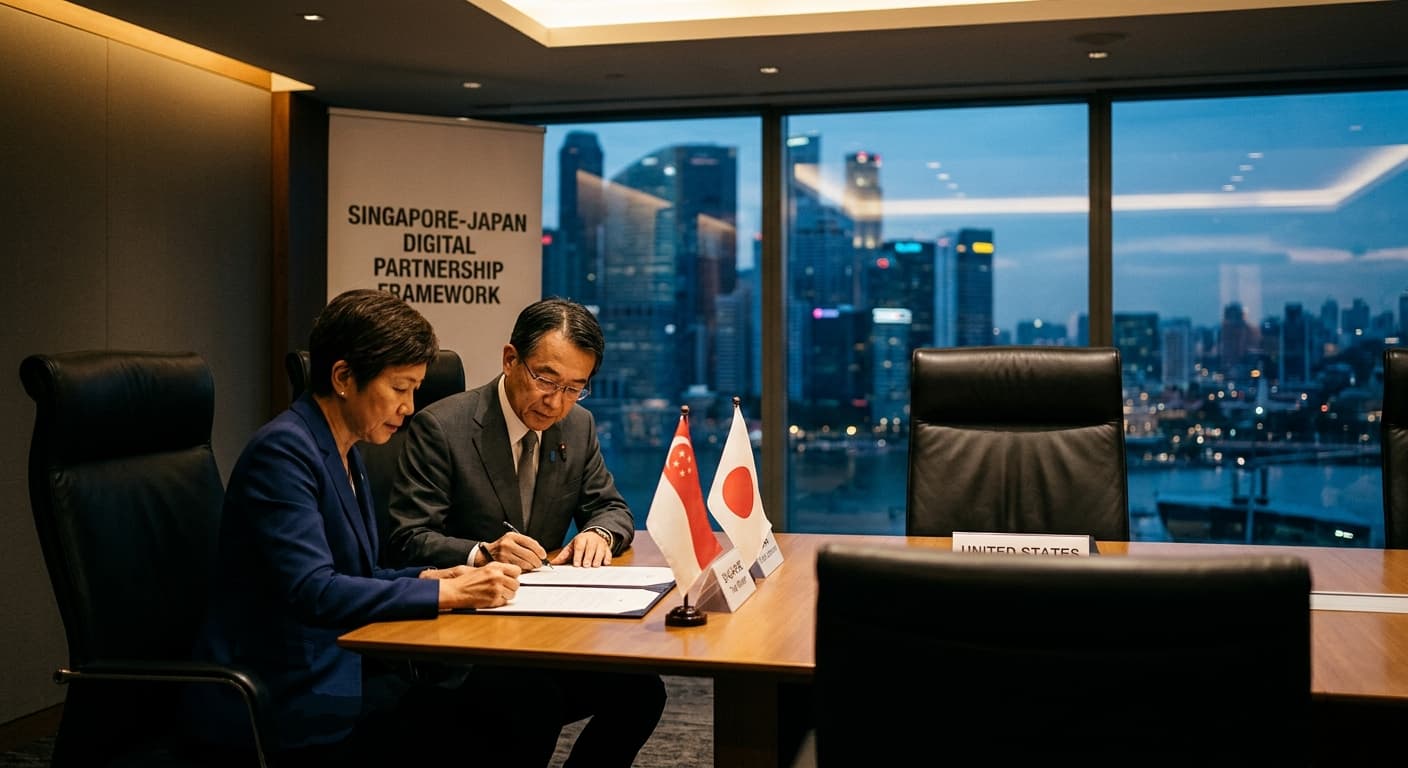
Singapore and Japan Just Built a Digital Free-Trade Zone. The U.S. Isn’t in It.
Singapore and Japan’s March 2026 Strategic Partnership merges two of Asia’s most ambitious digital-governance projects into a single operating system for data, AI, and advanced chips — while Washington watches from the sidelines.
On March 18, 2026, Prime Minister Lawrence Wong and his Japanese counterpart upgraded six decades of diplomatic ties to a Strategic Partnership that covers more ground than most free-trade agreements — and will cut compliance costs for every cloud company, AI developer, and semiconductor firm moving data between the two economies. The deal, formally announced during Wong’s visit to Tokyo, commits both governments to eliminate unjustified barriers to cross-border data flows, align AI safety and governance rules, and coordinate investment in quantum computing and advanced chips — a package that effectively bilateralizes standards that have so far existed only in fragmented, plurilateral agreements. IBTimes
The partnership is not a one-off. It is the missing link that welds Singapore’s modular digital-economy agreements — built with Australia, the EU, and the DEPA grouping — onto Japan’s "Data Free Flow with Trust" (DFFT) architecture, which Tokyo has been pushing through the G7, G20, and the WTO. Together, the two countries now form a single rule-of-origin for data governance in the Indo-Pacific. The winners are the hyperscale cloud providers and AI labs that will operate across a harmonized regulatory zone from Changi to Chiyoda. The loser, for now, is the United States — whose decade-long retreat from binding digital trade commitments has created a vacuum its closest Asian allies are filling without it.
What the deal actually does
The partnership’s operational core is a set of commitments on digital trade and cross-border data governance. Both governments will “cooperate to promote digital trade, resolve data-related issues, and establish rules that enhance business and consumer confidence,” according to the joint statement released by Singapore’s Prime Minister’s Office. PMO Singapore
For enterprises, that means a more predictable environment for cloud services, data analytics, and cross-border AI deployment — one in which data-localization requirements will be imposed only for legitimate public-policy purposes, such as personal-data protection, mirroring the framework already embedded in Singapore’s Digital Economy Agreements. CNA
The partnership also layers on AI governance: both sides committed to “increase cooperation on AI safety, governance and building of AI models that are culturally and linguistically reflective,” including through the ASEAN-Japan Co-Creation Initiative for AI. IBTimes By May 2026, the first Singapore-Japan Digital Cooperation Dialogue had already formalized joint work on online safety, quantum-safe cryptography, and interoperable ICT policies between Japan’s Ministry of Internal Affairs and Communications (MIC) and Singapore’s Ministry of Digital Development and Information.
MIC Japan
Meanwhile, a Memorandum of Cooperation between Singapore’s Personal Data Protection Commission and Japan’s Personal Information Protection Commission is expected before the end of 2026, creating formal regulatory coordination on cross-border data protection — and giving companies a single on-ramp for compliance in both markets. IBTimes
On hardware, the partnership builds on a January 2026 Memorandum of Understanding on quantum science between Japan’s Cabinet Office and Singapore’s Ministry of Digital Development and Information, and pledges deepened collaboration on semiconductors — a sector where Japan’s $11.2 billion in new chipmaking subsidies and Singapore’s role as a global semiconductor hub create complementary investment incentives. Electronics Weekly
The architecture that was waiting to happen
The real significance of the Singapore-Japan deal lies in how it finishes a puzzle both countries have been assembling independently.
Singapore has spent the past five years building the world’s densest network of Digital Economy Agreements (DEAs) — with Australia, the UK, the EU, and the DEPA countries (Chile, New Zealand, and now South Korea). These are modular, often non-binding agreements designed to “address new issues quickly without getting bogged down in cumbersome trade negotiations,” as CSIS analysts have noted. CSIS Singapore’s DEAs have pushed the frontier on digital identities, e-invoicing, e-payments, and AI governance — norms that academic researchers have labeled “norm entrepreneurship in digital trade.”
Cambridge
Japan, for its part, has been the intellectual and diplomatic engine behind DFFT — the concept, first introduced by former Prime Minister Shinzo Abe at the G20 in 2019, that cross-border data flows should be free but accompanied by trust-building regulatory cooperation. Japan has operationalized DFFT through the G7 roadmap, the U.S.-Japan Digital Trade Agreement, the Japan-UK Comprehensive Economic Partnership, and, crucially, as co-convener of the WTO Joint Statement Initiative on E-Commerce alongside Singapore and Australia. CSIS
The March 2026 Strategic Partnership connects these two tracks. By committing to a bilateral mechanism that directly aligns data governance, AI standards, and investment rules, Singapore and Japan have created a functional “digital governance nucleus” — one that leverages existing CPTPP disciplines (free data flows, ban on forced server localization) and DEPA-style norms (data portability, trusted digital services) while adding a layer of operational cooperation that those agreements lack. The EU, too, has reinforced this architecture: on February 1, 2026, the EU-Singapore Digital Trade Agreement entered into force — the EU’s first-ever stand-alone bilateral digital trade pact, which prohibits data localization and guarantees paperless trade. European Commission And on May 5, 2026, the EU and Japan held the fourth Digital Partnership Council in Brussels, announcing new deliverables on data, AI, quantum, and semiconductor cooperation.
Shaping Europe
The result is a densely interwoven web of digital rulemaking, with Singapore-Japan at the center, that spans the Indo-Pacific and reaches across to Europe.
The American vacuum
The United States is conspicuously absent.
Washington has not signed a comprehensive digital trade agreement since the U.S.-Japan Digital Trade Agreement in 2019. The Biden administration withdrew U.S. support for core data-flow provisions in the WTO E-Commerce JSI in 2023, a move the U.S. Chamber of Commerce warned would “harm both U.S. workers and national competitiveness by unduly burdening technology companies.” CSIS The Trump 2.0 administration has focused on reciprocal tariffs on goods, leaving digital trade governance to atrophy.
The consequence: when 67 WTO members — representing roughly 70% of global trade — adopted interim arrangements for the E-Commerce Agreement on March 28, 2026, the United States was not among them. Singapore, Japan, and Australia co-convened the negotiations; the agreement will enter into force once 45 members ratify it. CSIS
Singapore and Japan are now filling the rules gap. Their partnership “can present a robust, governance-forward model that emphasizes data protection, AI safety, and cross-border data flows without requiring a larger US-led framework,” as exa’s research synthesis noted, citing multiple CSIS and ISEAS analyses. This creates competitive pressure: regional tech supply chains seeking stable data regimes now have a credible alternative to U.S.-centric standards — and one that is more predictable than China’s state-led data-sovereignty model.
Winners and losers
The clearest beneficiaries are the cloud and AI hyperscalers. Google Cloud, Amazon Web Services, and Microsoft Azure operate data centers in both Singapore and Japan. A harmonized data-governance zone between Asia’s two most advanced digital economies removes a significant compliance cost — particularly the patchwork of localization rules that, as OECD researchers have documented, doubled globally between 2017 and 2021 and now encompass more than 100 restrictive measures across 40 countries. OECD The WTO and OECD calculate that failing to implement the E-Commerce Agreement could cost the global economy $159 billion annually in foregone trade.
IBTimes
Japanese firms reliant on imported digital services also stand to gain. A 2025 CSIS survey found that 47% of Japanese exporters said their production costs would rise more than 10% if foreign digital services became unavailable; 17% said costs would rise more than 40%. CSIS The Singapore-Japan partnership directly reduces the risk of such cost shocks by locking in cross-border data access.
The losers are harder to name but equally consequential. India and South Africa, which blocked the WTO E-Commerce Agreement from being formally integrated into the multilateral rulebook on the grounds that plurilateral agreements violate consensus principles, now face an Asia-Pacific bloc that is moving ahead without them. CFR China’s digital governance model — built around data sovereignty, state access, and domestic technology mandates — is increasingly isolated from the rules being embedded in this overlapping network of DEAs, the CPTPP, and the EU’s digital trade architecture.
And the United States faces a subtler but starker cost: its technology companies remain the world’s most competitive, but the regulatory floor under which they operate is being written in Tokyo and Singapore, not in Washington. As CSIS noted in its post-mortem of WTO MC14, “coalitions of the willing moving ahead on trade liberalization, leaving behind those who decline to participate,” is now the central organizing principle of digital trade governance. CSIS
Diplomat View
The Singapore-Japan Strategic Partnership is not a treaty, and it will not show up in trade statistics next quarter. But it is the most significant institutional step yet toward a bifurcated digital-trade order — one in which an Asia-Europe consensus on open data flows, AI governance, and semiconductor cooperation advances through bilateral and plurilateral agreements, while the United States prioritizes tariff battles and export controls.
The forecast: by mid-2027, the WTO E-Commerce Agreement could clear the 45-ratification threshold and the EU-Japan-Singapore digital governance triangle will be operational. Japan’s AI Bridging Cloud Infrastructure 3.0 project (¥36 billion) and Singapore’s additional S$1 billion in AI R&D funding will anchor investment in sovereign compute — reducing reliance on U.S.-centric cloud infrastructure. The PDPC-PIPC Memorandum of Cooperation, expected by end 2026, will provide the operational rails for corporate compliance across both jurisdictions.
The conditions for revision are clear. If Washington re-engages — either through a revived Indo-Pacific Economic Framework digital chapter or a bilateral digital trade agreement with Japan — the axis could widen. If China successfully pressures ASEAN members to dilute the ASEAN Digital Economy Framework Agreement (DEFA) negotiations, the fragmentation could harden. But for now, the momentum is with the small, wealthy, rules-making states that have mastered the art of moving fast where the giants are stuck.
The Bottom Line
Singapore and Japan have stitched together their digital-governance architectures into a single operating system for cross-border data, AI, and advanced chips. The partnership is not primarily about bilateral trade — it is about setting the default rules for the Indo-Pacific digital economy before Washington or Beijing writes their own. If the architecture holds through 2027, the world’s most valuable data flows will run through a regulatory corridor designed in Tokyo and Singapore — and the United States will have to negotiate access to a system its allies built without it.
Discover more

US Politics
SNAP Food Assistance Faces Legal Challenges
In 2026, SNAP faces stricter eligibility rules and mounting legal challenges, threatening food assistance for the millions of Americans who rely on the program.
India
Congress Accuses Modi of Stalling Women's Law
Congress accuses Modi of stalling women's reservation law by linking it to delimitation, revealing a deeper electoral strategy.

India
Delhi CM Rekha Gupta Blasts Opposition's Delm
Delhi CM Rekha Gupta's remarks on women's quota defeat reveal BJP's strategy for the 2029 Lok Sabha elections, focusing on delimitation.

Economics
Fed's Amex AML order puts correspondent banking on notice
Federal Reserve's Amex AML order requires board-level controls and a 90-day plan; OCC fined the bank $350 million over enterprise-wide deficiencies.