Sherritt Exits Cuba: OFAC Sanctions Impact
How US sanctions ended a 32-year mining venture in Cuba
Model Diplomat8 min readNorth America
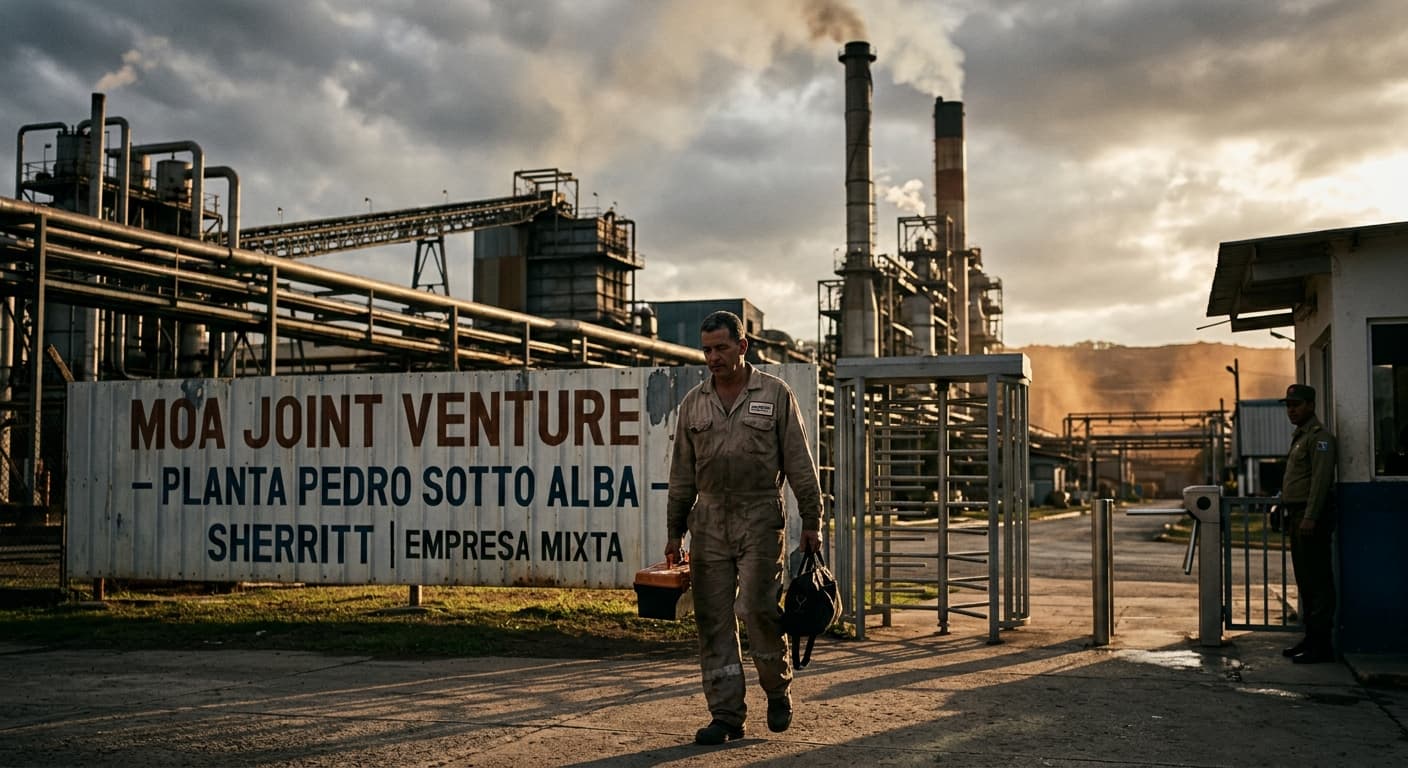
Sherritt Exits Cuba: How One OFAC Designation Ended a 32-Year Mining Bet
Trump's May 7, 2026 sanctions on GAESA and a Moa Nickel executive forced Toronto's Sherritt to suspend its Cuban joint venture — pushing cobalt prices up and Havana closer to fiscal collapse.
A single name added to a US Treasury blacklist on May 7, 2026 — Ania Guillermina Lastres Morera, executive president of GAESA and of Moa Nickel SA — ended a 32-year Canadian-Cuban industrial marriage inside 24 hours. Sherritt International's decision to suspend direct participation in its Moa joint venture is not a compliance footnote: it is the moment Washington's secondary-sanctions architecture demonstrated, in a single OFAC entry, that it can now unwind a foreign investor's flagship asset without the investor's home government having any effective say. The winners are US-aligned cobalt refiners and Chinese producers in the Democratic Republic of Congo. The losers are Cuba's balance of payments, Sherritt's Fort Saskatchewan refinery, and Canada's already-battered claim that its blocking statute means anything.
The designation that pulled the plug
The primary document is short. On May 7, 2026, the Office of Foreign Assets Control added Lastres Morera to the Specially Designated Nationals list under the Cuba executive order, and updated the GAESA entry, according to Treasury's own recent-actions bulletin. Because she sits atop both GAESA — the military conglomerate that owns Cuba's half of Moa Nickel — and MNSA itself, any US person or dollar-clearing bank transacting with the venture now faces primary sanctions exposure.
The legal chassis is Executive Order 14380 of January 29, 2026, which declared Cuba an "unusual and extraordinary threat" under the International Emergency Economic Powers Act, and its May 7, 2026 follow-on order. That White House order authorizes blocking sanctions on any foreign person determined "to operate in… the metals and mining… sector of the Cuban economy" and — this is the new part — authorises Treasury to cut off correspondent-account access for foreign banks that facilitate "any significant transaction" for a blocked person.
That is the mechanism. Sherritt is a Canadian company with no direct US operations of consequence, but its Fort Saskatchewan cobalt refinery, its financing, and its US customer base all move through the dollar system. Once Lastres Morera and, effectively, MNSA became sanctioned counterparties, every Sherritt bank became a candidate for correspondent-account exclusion. The Financial Times reported the termination the same day, noting the joint venture had run 32 years and warning of upward pressure on cobalt prices.
Sherritt's board — including several independent directors who resigned in the following weeks, per corporate filings — did the only thing solvent boards do: they exited before the correspondent-banking exclusion arrived, not after.
Why Moa was structurally fragile before Rubio signed
Sherritt's operation was already the highest-cost cobalt producer in the world. A November 2025 Nature Communications study benchmarking 79 mining and refining facilities placed Cuba's Moa complex at a weighted levelised cost of $32,819 per tonne of cobalt — 125% above the Democratic Republic of Congo's $14,588 and 41% above the Papua New Guinea benchmark. On nickel, Moa's $15,037 per tonne was the highest of any regional cluster in the sample.
Those numbers matter because the cobalt market has been oversupplied since 2023. The Financial Times reported that Chinese producer CMOC nearly doubled DRC output in 2024, and Darton Commodities projects the glut will run until 2028. CSIS notes benchmark refined cobalt sat around
$22.30 per pound in late November 2025 — well below what Moa needs to earn its cost of capital.
Put crudely: Sherritt was operating a marginal high-cost asset in a saturated market inside a sanctioned jurisdiction. OFAC did not kill a healthy business. It killed a business whose only defensible margin was political — the willingness of a Canadian miner to hold its nerve while everyone else pulled out. That nerve had a price. On May 7, it exceeded it.
The second-order winner is not who you think
The conventional read is that Chinese producers benefit. They do — CMOC and Indonesia's Chinese-financed HPAL projects absorb any tonnage that Moa vacates, deepening a structural dominance already estimated at 60% of global refined cobalt supply by 2025, per Darton Commodities.
The less obvious winner is the US Department of Defense. Since 2022, Washington has poured Defense Production Act Title III money into Idaho's Jervois cobalt mine and Ontario's Electra Battery Materials refinery — the latter receiving a $20 million DPA grant in 2024 and a further C$17.5 million from Ottawa in 2025, according to CSIS. Every non-Chinese tonne removed from world supply makes the CSIS-recommended $24/lb price floor look cheaper and more politically defensible. Sherritt's exit does not just punish Havana; it clears the field for a US-Canadian "friendshored" cobalt corridor that excludes both China and Cuba.
That is the geopolitical logic beneath the moral rhetoric. Secretary of State Marco Rubio's statement that sanctions will continue "until the regime takes all necessary political and economic reforms," reported by Al Jazeera, reads as regime-change language. The critical-minerals subtext reads as industrial policy.
Havana's fiscal math just broke
For Cuba, Moa was not marginal. Nickel and cobalt were among the island's top three foreign-exchange earners, alongside remittances and medical services. The Council on Foreign Relations' backgrounder notes that Cuba is enduring its "worst economic and energy crisis in decades", and the May 7 designations landed the same week UN special rapporteurs called Washington's fuel blockade "energy starvation." A third nationwide blackout in six months hit on
July 7, 2026, and Energy Minister Vicente de la O Levy conceded the government has
"absolutely no fuel, oil, and absolutely no diesel."
Moa's cash flow was one of the last hard-currency streams still flowing into the state. GAESA — which OFAC's designation now formally cuts off from dollar clearing — is the conduit through which the Cuban military monetises hotels, ports, remittances and, until May 7, mining. The Council on Foreign Relations' Cuba analyst Ricardo Herrero predicted in an April 2026 note that Sherritt "won't immediately pull out" but that a chilling effect would set in. Herrero's timeline was off by weeks; the direction was right.
The Helms-Burton overhang
The Sherritt story does not end with an OFAC entry. On June 23, 2026, the US Supreme Court ruled 6-3 in ExxonMobil v. Corporación CIMEX that Cuban state-owned firms cannot invoke sovereign immunity against Title III Helms-Burton lawsuits, Al Jazeera reported. Justice Brett Kavanaugh's majority opinion held that the 1996 statute "eliminates the sovereign immunity of Cuban agencies and instrumentalities" — a clean, textualist reading that opens a new litigation front.
Moa is exactly the kind of asset Title III was written for. The mine sits on land nationalised from the Freeport Sulphur Company in 1960; Sherritt has been on the US State Department's Cuba Restricted List since the first Trump term. A wave of Freeport-heir plaintiffs was frozen out by earlier sovereign-immunity defences from CIMEX-style Cuban entities. That barrier is now gone. Sherritt's exit is, among other things, a legal hedge: a company that has "suspended direct participation" is a harder Title III target than one still booking Cuban revenue.
The 1996 Helms-Burton Act's Title III was suspended by every president from Clinton through Obama precisely because Canada and the EU threatened WTO retaliation. Trump lifted the suspension in his first term. His second-term Supreme Court just made it enforceable.
Ottawa is missing in action
Canada has a Foreign Extraterritorial Measures Act — its 1996 blocking statute — designed for exactly this scenario. It has not been invoked. Prime Minister Mark Carney's government, consumed by a parallel trade fight over Trump's 25% auto tariffs, has said nothing substantive about Sherritt. The BBC's coverage of Carney's tariff response makes clear where Ottawa's political capital is being spent — and Cuba is not on the list.
That silence is the story within the story. In 1996 the Chrétien government fought Helms-Burton at the WTO. In 2019 the Trudeau government publicly backed Sherritt. In 2026, with a Trump administration threatening to sanction any bank that services a Cuba-linked JV, Canada's calculation is that defending a single high-cost mining venture is not worth the correspondent-banking risk to Canadian banks. That is a strategic concession dressed as inaction.
The European precedent is worse. Brookings' survey of IEEPA makes the point that dollar-clearing dependence overwhelms blocking statutes in practice. The EU learned this with Iran secondary sanctions after 2018; Canada is learning it with Cuba in 2026.
Diplomat View
The May 7 designation of Moa Nickel's executive president is not really about Cuba. It is a proof-of-concept for a US sanctions doctrine that can dismantle a friendly-country foreign investment inside 24 hours, by targeting a single natural person rather than the corporate entity — thereby sidestepping the diplomatic cost of blacklisting a Canadian company directly. Expect the same template to be applied against European hotel operators (Meliá in Cuba), Spanish tobacco interests, and — the real target — third-country firms operating in Venezuela and Iran.
The forecast: Sherritt writes down its Cuban assets to zero at Q2 2026 earnings and its Fort Saskatchewan refinery converts to third-country feedstock or closes within 18 months, absent a DPA-style Canadian intervention. Cobalt prices grind higher on the margin but the DRC glut caps the upside; the real price signal is in refined nickel sulphate delivered to North American cathode plants, which will trade at a widening premium to LME.
This forecast changes if: (a) Canada invokes FEMA and Sherritt sues Ottawa for indemnity, forcing a diplomatic escalation; (b) a Cuban political transition triggers Helms-Burton's sanctions-lifting clause; or (c) OFAC issues a specific licence letting Sherritt continue Fort Saskatchewan refining of pre-existing Cuban feed inventory. None looks likely before year-end.
What to watch:
- August 12, 2026 — Sherritt's Q2 earnings release, first opportunity to size the writedown and refinery decision.
- September 2026 — OFAC's expected update to the Cuba Restricted List and any general licence guidance on legacy JV wind-downs.
- Fall 2026 US Supreme Court term — additional Helms-Burton Title III petitions now working through the Eleventh Circuit post-ExxonMobil.
The Bottom Line
The Sherritt exit is the first time a G7 investor's flagship joint venture has been unwound by a single OFAC designation of a foreign executive rather than by direct sanction of the company itself — a template Washington will now reuse against European and Asian firms in Cuba, Venezuela and Iran. Canada's silence signals that dollar-clearing dependence has, in practice, hollowed out its blocking statute. The winners are US-aligned critical-minerals policy and Chinese cobalt; the loser is any illusion that Havana can substitute foreign investment for Venezuelan oil.
Discover more
US Politics
House Ethics Committee Pushes Sexual Miscond.
The House Ethics Committee has shifted responsibility for sexual harassment settlement records to the Office of Congressional Workplace Rights, complicating disclosure efforts.

International Relations
Pakistan's Key Role in US-Israel-Iran Meddle
Pakistan is seeking to mediate the US-Israel-Iran conflict, balancing high-stakes diplomacy against severe economic pressures and steep regional challenges.

US Politics
SNAP Food Assistance Faces Legal Challenges
In 2026, SNAP faces stricter eligibility rules and mounting legal challenges, threatening food assistance for the millions of Americans who rely on the program.

Economics
Fed's Amex AML order puts correspondent banking on notice
Federal Reserve's Amex AML order requires board-level controls and a 90-day plan; OCC fined the bank $350 million over enterprise-wide deficiencies.