Seoul's Mongolian Mineral Bet Is a Gamble
South Korea bets air freight can bypass China's transit chokepoint
Model Diplomat11 min readEast Asia and Pacific
Seoul's Mongolian Mineral Bet Is Really a Gamble That China Won't Shut the Airspace
South Korea's new trade deal with Mongolia eliminates tariffs on critical minerals — but the real bet is that processed concentrates flown out over Chinese territory can bypass the landlock that has trapped every "third neighbor" strategy before it.
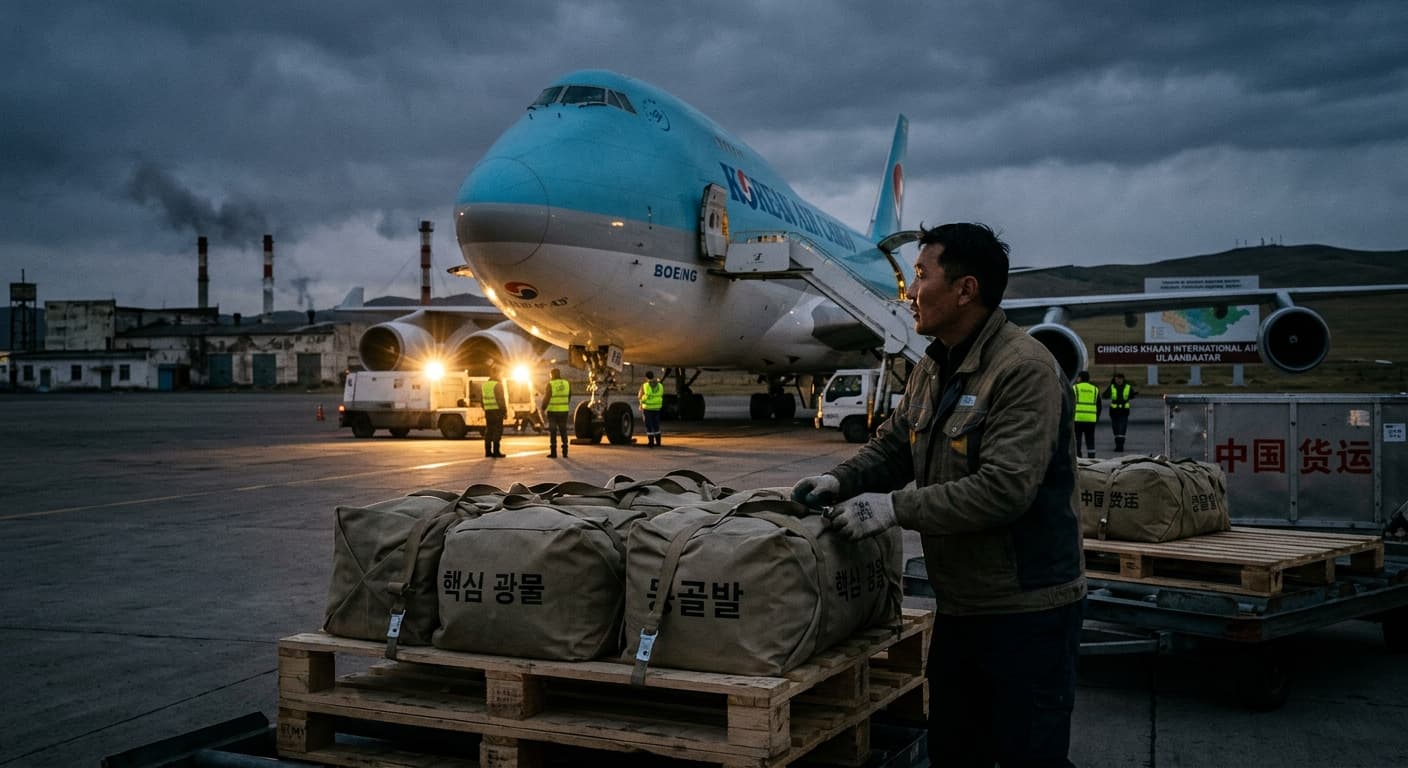
On June 27, 2026, a cargo plane lifted off from Ulaanbaatar carrying tons of Mongolian tungsten concentrate bound for South Korea, as reported by the Korea JoongAng Daily. The flight lasted a few hours, crossed Chinese airspace without incident, and landed without fanfare. It was the most significant test flight of Seoul's economic security strategy in a decade, not because of what was in the hold, but because of what it proved could be flown over.
Nine days later, on July 11, South Korean President Lee Jae-myung and Mongolian President Ukhnaa Khurelsukh stood side by side at the Naadam Festival in Ulaanbaatar and announced a Comprehensive Economic Partnership Agreement eliminating tariffs of 2 to 5 percent on Mongolian copper, molybdenum, and rare earth elements, according to the Korea JoongAng Daily. The deal formalizes a joint research center that has been operating since December 2025, tasked with finding ways to process and export minerals from a country that shares not a single kilometer of border with an allied nation.
The agreement is not a trade pact. It is a geopolitical wager that the "air bridge" — flying beneficiated concentrates over Chinese and Russian territory — can bypass the defining vulnerability of Mongolia's third-neighbor policy: geography. The June 27 flight proved the concept. Scaling it to challenge China's dominance of global critical mineral supply chains is an entirely different proposition.
The Resource Prize
Mongolia possesses the world's second-largest rare earth reserves after China, estimated at 31 million tons — roughly 16 percent of the global total — distributed across six registered deposits and 26 known occurrence sites, according to the U.S. Geological Survey. Its copper reserves of 55 million tons also rank second globally, anchored by the Oyu Tolgoi mega-mine in the Gobi Desert, which alone holds an estimated 45 million tons of copper and 15 million tons of gold. Coal reserves stand at 175 billion tons, fourth worldwide.
And those figures capture only the explored portion. Some 55 percent of Mongolian territory remains unsurveyed, meaning current reserve estimates rest on geological mapping of less than half the country. The mining sector already dominates the economy, accounting for 27 percent of GDP, 70.9 percent of industrial output, and 87.2 percent of total exports as of 2024. Mongolia's economy grew 6.9 percent in 2025, driven largely by a nearly 60 percent surge in Oyu Tolgoi copper production, according to the World Bank.
For South Korea — a country whose net import reliance for critical minerals exceeds 99.7 percent, per the Korea Institute of Geoscience and Mineral Resources, and which imports roughly half its rare earths from China — Mongolia is the most attractive alternative supplier on the map that is not already claimed by a rival power.
The attraction is mutual. Mongolia's "third neighbor" policy, articulated over three decades, seeks to balance the gravitational pull of its two immediate neighbors — China takes more than 90 percent of Mongolian exports, while Russia supplies 95 percent of its fuel, according to Foreign Affairs — by cultivating economic and diplomatic ties with developed democracies. Seoul has become the most committed suitor. But the structural obstacle has never been willingness. It has been physics.
The Transit Trap
As a landlocked nation, Mongolia has exactly two routes to the sea: rail lines through China to the port of Tianjin, or rail lines north through Russia. Up to 90 percent of Mongolian exports, including minerals, must traverse one of these corridors.
"If China wanted to counter the United States, it could sharply raise customs costs or simply slow things down at the border," said Jang Jae-hyuk, a professor of Mongolian Studies at Hankuk University of Foreign Studies, speaking to the Korea JoongAng Daily. "For now, there's no way around that logistics bottleneck."
Jang's assessment understates the vulnerability. China has repeatedly demonstrated willingness to weaponize transit chokepoints against South Korea — most notoriously during the 2016–2017 THAAD missile defense dispute, when Beijing inflicted over $15 billion in lost revenue on South Korean companies, according to CSIS. Beijing has also cyclically cut off exports of urea — a chemical compound essential to South Korean transport and agriculture — in 2021, 2023, 2024, and again in 2025–2026. It imposed sanctions on five U.S. subsidiaries of Hanwha Shipping in August 2025 following a U.S.-South Korea shipbuilding deal.
The pattern is unambiguous: when Seoul moves closer to Washington on strategic matters, Beijing calibrates economic pressure. A South Korean drive to route Mongolian rare earths — the very minerals China dominates at roughly 59 percent of global mining and 90 percent of refining — through its own processing plants and potentially onward to U.S. defense supply chains would represent the most direct challenge yet to China's mineral leverage. The question is not whether Beijing would respond, but when and how.
The Air-Bridge Workaround
Seoul's answer is to process minerals inside Mongolia and fly them out.
The joint research center established in December 2025 is specifically designed to explore local beneficiation and smelting — transforming raw ore into concentrates or intermediate materials light enough for air freight. "Critical minerals like tungsten, molybdenum and rare earths can be processed locally into concentrates or intermediate materials, which makes transport far more efficient," Song Byeong-gu, chairman of the Korean Association of Mongolian Studies, told the Korea JoongAng Daily. He then cited the June 27 tungsten flight as proof: "That shows there's real room to diversify how some critical minerals are transported."
The air-bridge logic is commercially coherent for high-value, low-volume minerals. Tungsten concentrate at current prices trades at roughly $350 per metric tonne unit; rare earth oxides can command multiples of that. A cargo plane of beneficiated dysprosium or terbium, heavy rare earths essential to permanent magnets for EV motors, wind turbines, and missile guidance systems, is worth flying. A cargo plane of copper concentrate is not.
This is the first hard limit on Seoul's strategy. Mongolia's largest and most economically significant mineral export is copper — and Oyu Tolgoi's underground expansion, which drove a nearly 60 percent production increase in 2025, according to the World Bank, is producing copper concentrate measured in millions of tons. That copper will continue to travel by rail to Chinese smelters — not because Seoul and Ulaanbaatar prefer it, but because the economics of bulk commodity transport are indifferent to geopolitical preference.
The air bridge solves tungsten and select rare earths. It does not solve the broader dependency. And even for those minerals it can serve, the solution is conditional on something Seoul cannot control: continued Chinese tolerance of overflight rights for cargo it has every strategic reason to block.
The FORGE Chairman's Dilemma
This is where the bilateral trade deal collides with Seoul's larger institutional role. South Korea has chaired the Minerals Security Partnership since July 2024 — the first non-U.S. chair in the forum's history — and its successor, the Forum on Resource Geostrategic Engagement (FORGE), was launched at the February 2026 Critical Minerals Ministerial in Washington with Seoul in the chair through at least June 2026, according to CSIS.
FORGE's explicit mandate is to coordinate allied policy on critical minerals supply chains — from mining through processing to end-use — across 17 member nations including the United States, Japan, Australia, Canada, the European Union, and Gulf states. South Korea has committed $37 billion through its Supply Chain Stabilization Fund for overseas critical minerals investment, as documented by CSIS. Korea Zinc is building a $7.4 billion rare-earth processing facility in Tennessee, the largest single allied investment in non-Chinese rare earth capacity.
The contradiction is structural. South Korea chairs the allied effort to build a mineral supply chain that excludes China, while pursuing a bilateral strategy in Mongolia that depends on Chinese forbearance to function. Beijing reads FORGE's project pipeline as clearly as Washington does. The more minerals that flow from Mongolia to South Korean processors, and the more of those processed materials that reach U.S. defense contractors, the higher the probability that Beijing treats Mongolian overflights as a de facto sanctions violation and imposes the very transit restrictions Jang warns of.
Victor Cha, Ellen Kim, and Andy Lim at CSIS have argued that South Korea and Japan should pursue "a deterrent strategy of collective resilience," leveraging China's own import dependencies to impose reciprocal costs when Beijing uses economic coercion, as reported by CSIS. But that framework applies to direct bilateral coercion — a urea cutoff, a tourist ban. It does not address the subtler transit problem: China need not formally ban anything. It can "inspect" cargoes, "review" customs documentation, "delay" clearance. No single incident rises to the level of coercion that triggers allied retaliation. The cumulative effect, however, renders the air bridge commercially uninvestable.
The Investment Climate Wildcard
There is a second structural obstacle, distinct from geography: Mongolia's investment climate.
The country's 2012 Strategic Entities Foreign Investment Law — passed explicitly to block a Chinese state-owned enterprise from acquiring the SouthGobi coal mine — required parliamentary approval for any foreign investment in strategic sectors exceeding $70 million, as detailed by CSIS. More recently, as
Foreign Affairs documented, a Mongolian court canceled permits for a Czech-backed prospecting company, triggering threats of international litigation — and reviving memories of the 2009 decision to revoke a Canadian firm's uranium license, a move widely interpreted as placating Moscow.
Mongolia's constitution and Land Law further restrict foreign ownership: foreign nationals and majority foreign-owned companies cannot freely transfer, collateralize, or sell land-use rights, complicating the financing of large-scale processing facilities, according to CSIS. A South Korean or joint U.S.-Korean venture seeking to build a rare earth separation plant on Mongolian soil would face legal hurdles that add risk premiums no commercial lender will ignore.
The RAND Corporation, in its 2025 trilateral study on U.S.-Japan-ROK critical minerals cooperation, flagged "private-sector aversion to investment in regions with uncertain regulatory regimes" as a primary barrier, according to RAND. Mongolia is, by that metric, among the more challenging destinations for the tens of billions South Korea has earmarked for overseas minerals investment.
The Japan Precedent
Seoul is not operating in a vacuum. Japan has been here before — and its experience is instructive.
Tokyo launched its rare earth diversification strategy after China's 2010 export ban, triggered by the Senkaku/Diaoyu fishing boat dispute. By 2025, Japan had reduced its rare earth dependence on China from 93 percent (2009) to 66 percent — a significant but incomplete shift, as CSIS reported. Japan became Mongolia's first Economic Partnership Agreement counterpart in 2016, and the two countries upgraded ties to a "Special Strategic Partnership for Peace and Security" in 2022, with an explicit commitment to "ensure a long-term, stable supply of Mongolian copper, REEs, and other mineral resources to Japan."
Yet Japan's Mongolian mineral imports remain modest. The institutional architecture is in place; the transit constraint has kept volumes low. The lesson for Seoul is that diplomatic agreements and strategic partnerships — no matter how well-structured — cannot overcome the physical reality that everything leaving Mongolia must pass through territory controlled by Beijing or Moscow.
South Korea has one advantage Japan lacked at the outset: the air-bridge concept, proven by the June 27 test flight. But the advantage narrows the moment China calculates that tolerating those flights costs more — strategically — than blocking them.
What This Means for the U.S.
The United States is not a bystander. The Trump administration's January 2026 executive order on critical minerals explicitly prioritized allied processing partnerships. The February 2026 Critical Minerals Ministerial drew 55 delegations and launched FORGE. Project Vault, a domestic stockpile backed by the largest loan in Export-Import Bank history, signals Washington's seriousness.
But the U.S. represents only 1.7 percent of global rare earth consumption, 3.6 percent of cobalt, and 5.1 percent of nickel, as CSIS documented — meaning unilateral American action cannot sustain a viable alternative supply chain. Aggregating allied demand through FORGE is the only path to commercially viable processing outside China.
South Korea's Mongolian gambit is, in this sense, a pilot project for the entire allied architecture. If Seoul can demonstrate — even at modest scale — that processing minerals in Mongolia and flying them to allied manufacturing hubs works commercially and geopolitically, it establishes a template for FORGE's broader engagement with Mongolia and potentially other landlocked resource states. If it fails — whether because China squeezes transit, investment falters, or costs prove prohibitive — it will confirm that geography is a harder problem than diplomacy.
The IMF projects Mongolia's growth at 5.5 percent in 2025 and around 5 percent over the medium term, driven by copper. The World Bank flags trade uncertainty and geopolitical tensions as the primary downside risks. Neither institution models what happens if China treats Mongolian mineral shipments to allied processors as a strategic threat. That scenario is not in the baseline — which is precisely why it is the one that matters.
The Bottom Line
South Korea's Mongolian mineral strategy is a bet that air-freighted concentrates can solve a problem rail-dependent bulk exports cannot. The June 27 test flight proved it works at the scale of tons. Whether it works at the scale that moves markets — and whether Beijing tolerates it — is a test that has not yet been run.
The bet's weakness is not technical, commercial, or diplomatic. It is that the strategy's success is its own greatest threat: the more South Korea succeeds at diverting Mongolian rare earths into allied supply chains, the more likely China is to treat those flights as a challenge to its mineral dominance and squeeze the airspace accordingly. Seoul is betting it can stay beneath Beijing's threshold of strategic irritation. That threshold is unknowable in advance — and discoverable only by crossing it.
Diplomat View
The Mongolia-South Korea deal is not about minerals. It is about whether geography can be defeated by processing technology and air logistics — and the answer shapes every allied mineral diversification strategy now under construction.
Three conditions will determine whether this bet pays out or collapses. First, China's tolerance threshold: if Beijing calculates that Mongolian rare earths flowing to Korea and onward to U.S. defense contractors undermines its strategic leverage, overflight permissions — currently routine — become a chokepoint. Second, Mongolia's regulatory stability: a single high-profile contract cancellation or permit revocation aimed at a Korean investor would freeze the pipeline of capital Seoul has earmarked. Third, the commercial viability of airborne beneficiated minerals at scale: the June 27 tungsten flight cost something. Whether that cost is competitive against Chinese-processed alternatives — or requires permanent allied subsidy — remains unanswered.
The forecast is that Seoul secures a modest, niche mineral corridor — tungsten, select heavy rare earths — sufficient to demonstrate the concept but insufficient to alter South Korea's fundamental dependency on Chinese-processed minerals. The air bridge survives only as long as it stays small. If that forecast proves wrong, it will be because China chose strategic restraint in Mongolia rather than escalation — a choice that would itself signal Beijing's own calculation about the durability of its broader mineral dominance.
Upcoming catalysts:
- December 2026: Joint research center's first annual findings on processing viability and air-freight economics are expected, providing the first data-driven assessment of whether the air bridge scales commercially.
- January 1, 2027: Deadline for U.S. defense contractors to comply with the DoD sourcing rule barring rare earth materials and magnets from China, Russia, Iran, and North Korea — sharpening the strategic value of any allied alternative supply, including Mongolian-sourced minerals.
- Ongoing: FORGE chairmanship transition — South Korea's term ends in June 2026; whether Seoul retains leadership or passes the chair will test allied confidence in the Korean-led diversification model that Mongolia exemplifies.
Discover more
US Politics
House Ethics Committee Pushes Sexual Miscond.
The House Ethics Committee has shifted responsibility for sexual harassment settlement records to the Office of Congressional Workplace Rights, complicating disclosure efforts.

US Politics
SNAP Food Assistance Faces Legal Challenges
In 2026, SNAP faces stricter eligibility rules and mounting legal challenges, threatening food assistance for the millions of Americans who rely on the program.
India
700 Activists Accuse PM Modi of MCC Breach
Over 700 activists allege PM Modi breached election code with a televised address attacking opposition parties just before state elections.

Conflict & Security
Drone Warfare Killing Aid Workers at Unprec
Over 1,000 humanitarian workers killed in three years as cheap armed drones collapse legal protections. Gaza, Sudan, Ukraine, and DRC see deliberate targeting of aid convoys and hospitals with zero prosecutions.