Saudi Arabia's Red Sea Pipeline Expansion
Riyadh aims to secure oil transport against Hormuz threats
Model Diplomat8 min readMiddle East
Saudi Arabia's Red Sea Pipeline Play: Buying Insurance Against Hormuz
Aramco is studying a 1–2 million bpd expansion of the East-West Petroline to Yanbu. The move locks in permanent Hormuz-bypass capacity — and shifts leverage across the Gulf.
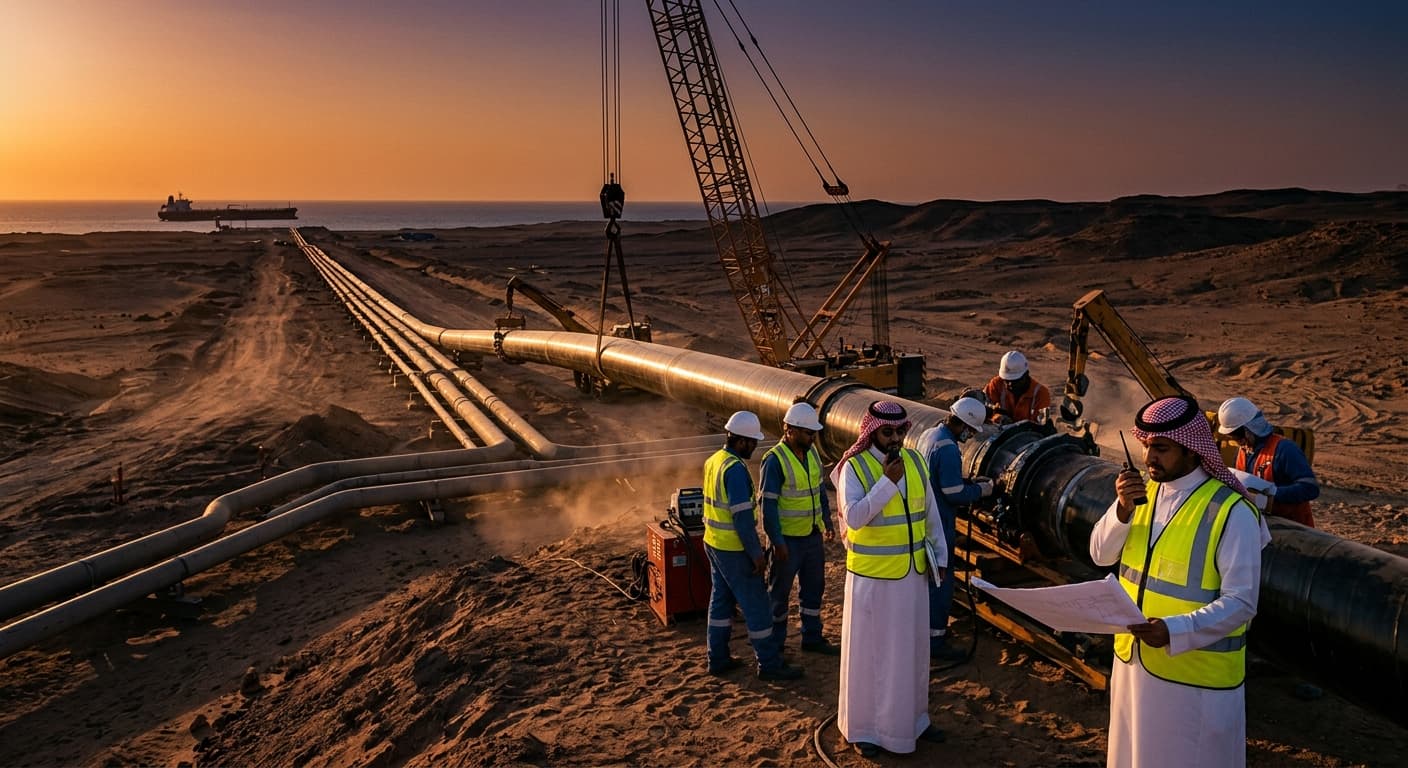
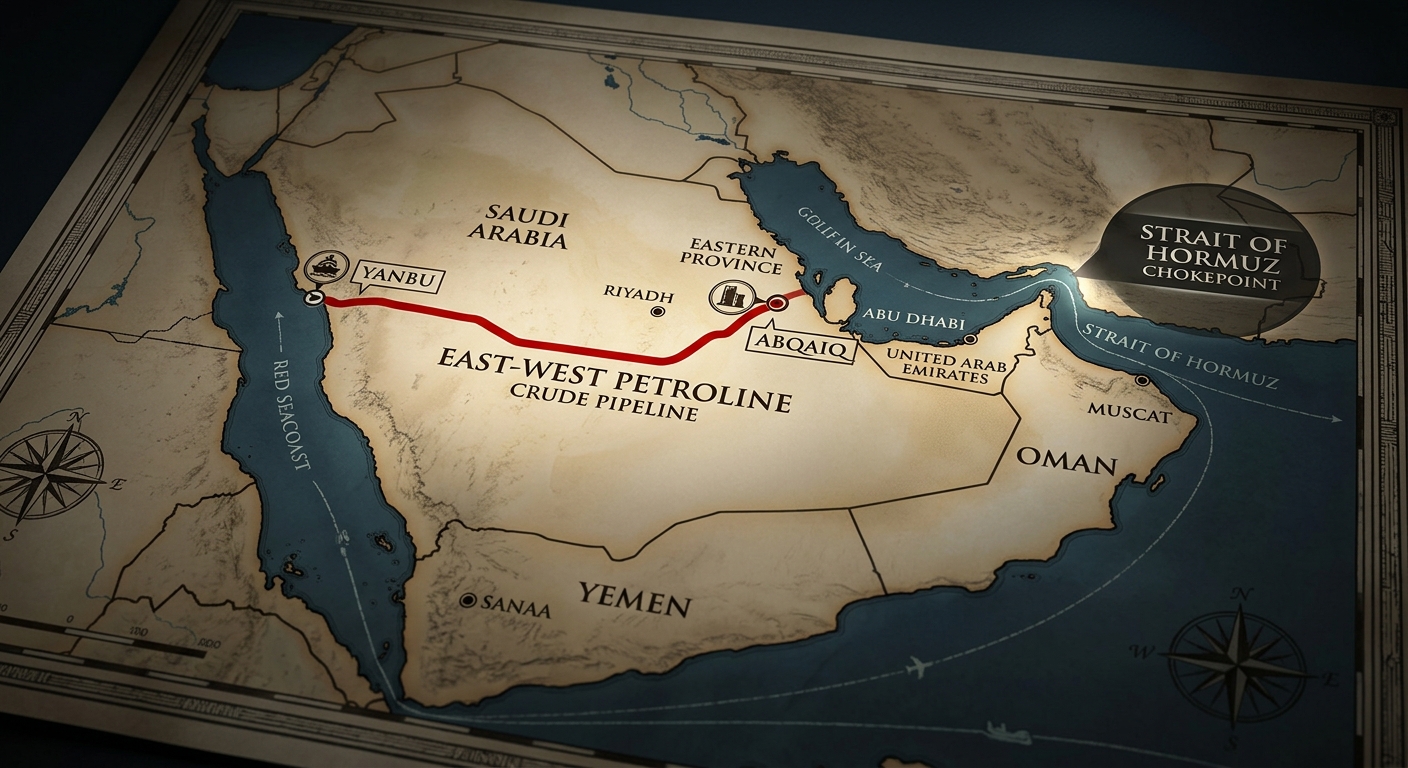
Saudi Arabia is weighing a 1–2 million barrel-per-day expansion of its East-West "Petroline" to the Red Sea port of Yanbu, and holding preliminary talks with Gulf neighbours about access — a plan that would convert what was a wartime workaround into permanent structural insurance against the Strait of Hormuz. That matters because the 2026 US–Israel war on Iran proved a single Iranian decision can strip 20 million barrels a day from the seaborne oil market, and Riyadh is the only Gulf producer with a plausible path to fully bypass the strait. The pipeline expansion is not an engineering story. It is a bid to make Saudi crude the only Gulf barrel that Iran cannot hold hostage — and to charge the neighbours for the privilege.
The trigger: how a 5-month war rewired Gulf logistics
Before February 28, 2026, the Petroline moved an average of 770,000 barrels per day, according to Kpler tanker data cited by Al Jazeera. By late March, Aramco had cranked flow to 2.9 million bpd; by April, after repairing a pumping station struck during the war, the Saudi Ministry of Energy said the 1,200-km line was back at its full 7 million bpd nominal capacity, according to
Al Jazeera. The shift was decisive: Riyadh loaded up to 77% of its total crude exports through Yanbu during the crisis, according to the
Gulf Research Center, a share that would have been unthinkable a year earlier.
The rest of the Gulf did not have that option. Iraq's seaborne crude exports collapsed by more than 97% in May 2026, falling from 3.32 million bpd a year earlier to just 96,000 bpd, according to OilPrice.com, stripping roughly $5 billion in monthly revenue from a state budget 90% dependent on oil. Kuwait, Qatar and Bahrain — with no pipeline outside Hormuz at all — simply watched cargoes stall.
Even after the June 17 US–Iran memorandum of understanding, the strait has not returned to normal. Iran has mined the central shipping lane, and demining "will take months and months and months," according to Bruce Jones at Brookings. Tehran has also kept its Persian Gulf Strait Authority — a body created to collect tolls on transit — in place, a "major departure from the status quo ante" that challenges customary international maritime law. On July 7, 2026, ships were again attacked in the strait, according to
Al Jazeera — the day the Petroline expansion story broke.
The thesis: Saudi Arabia is buying strategic optionality, not just steel
The proposed expansion is best read against a single number. During calendar 2024, roughly 20 million bpd of crude and products flowed through Hormuz — about 27% of global maritime oil trade and 20% of world petroleum-liquids consumption — according to the US Congressional Research Service, in Report R45281. Existing bypass pipelines — Petroline, ADNOC's Habshan-Fujairah line, and the Iraq-Türkiye pipeline — could handle only about 9 million bpd combined, according to
Al Jazeera's tally. Add 2 million bpd to Petroline and Saudi Arabia alone accounts for nearly half of all Hormuz-alternative capacity in the region.
That is the geopolitical prize. Aramco CEO Amin Nasser has called the East-West line a "critical lifeline"; Al Jazeera reported his framing in May 2026 as the UAE announced its own accelerated Fujairah expansion. Riyadh's calculation is that the war exposed a permanent risk premium in Gulf crude, and the producer who can most credibly promise delivery outside the strait captures the pricing benefit — and the strategic goodwill.
Who wins, who pays
The primary winner is Saudi Aramco itself. The company controls roughly 12% of global oil production with a capacity above 12 million bpd, and its market capitalisation of over $1.7 trillion depends on being viewed as the world's residual-supplier-of-last-resort, according to figures reported by Al Jazeera. A permanent 9-million-bpd Red Sea route — Petroline plus a reactivated IPSA — would give the kingdom outlet for essentially all of its 2025 export volume of around 6.5 million bpd without a single tanker crossing Hormuz, according to
Gulf Research Center analysis. No other Gulf producer is anywhere close.
The second winner is Iraq — but only if Riyadh lets it in. In March 2026, Baghdad publicly asked to reopen the Iraqi Pipeline through Saudi Arabia (IPSA), a 1.65-million-bpd, 1,380-km line built during the 1980s Iran-Iraq tanker war and confiscated by Riyadh in 2001 as debt compensation, according to the Gulf Research Center commentary. Iraq's southern Basra fields have no domestic route north; the only realistic Hormuz-bypass for Iraqi crude runs through Saudi steel. That gives Mohammed bin Salman a lever over an OPEC rival that he has never previously had.
The losers are equally specific. Iran loses its most valuable asymmetric weapon: the ability to threaten 20 million bpd with a handful of mines and speedboats. As Brookings noted in June 2026, Iran's toll scheme through the IRGC — reportedly $1 per barrel, or roughly $2 million per very large crude carrier — depends on Hormuz remaining the only exit. Every barrel that permanently shifts to Yanbu erodes that revenue stream.
Kuwait and Qatar also lose relative standing. Neither has any pipeline route outside Hormuz, and the proposed 2,400-km "New Coastal Pipeline" to Oman's Salalah — sponsored jointly by KPC, Aramco, QatarEnergy and ADNOC — would cost $15–25 billion and take 7–10 years, according to a Gulf Research Center analysis. In the meantime, Doha and Kuwait City will negotiate on Riyadh's terms.
The historical parallel: Petroline was born of the same fear
This is the second time Saudi Arabia has built infrastructure specifically to escape Iranian pressure in Hormuz. The original Petroline was completed in 1982 during the Iran-Iraq tanker war, precisely to secure "outlets other than on the Gulf," according to the Gulf Research Center. IPSA followed in 1987 for the same reason. The lesson of the 1980s — that Iranian threats to the strait produce lasting infrastructure, not just short-term price spikes — is exactly what is playing out in 2026. As the Israeli think tank
INSS put it, the pipeline gives Saudi Arabia "strategic flexibility that most of their neighbors lack" and helped ensure that Riyadh, along with Oman, was "less affected by Iran during the war."
But there is a caveat that Riyadh understands. As the Gulf International Forum noted on July 2, 2026, the Red Sea itself is not risk-free: Houthi attacks on shipping through Bab al-Mandeb have exposed "the limits of that approach" — trading one maritime chokepoint for another. Expect the pipeline expansion to be paired with continued Saudi diplomatic pressure to constrain the Houthis, and with quiet interest in the longer-term "Four Seas" corridor through Jordan and Syria to Banias on the Mediterranean, a route the Forum estimates could carry 1.5 to 2 million bpd of Saudi and Gulf crude to European markets.
The market context: a glut, not a shortage
The paradox of the July 7 announcement is timing. Oil prices have fallen sharply since the June ceasefire — Brent dropped from a wartime peak of roughly $120 to $83.55 immediately after the framework deal, according to the BBC. Gulf producers are now discounting stored crude in a race for market share, according to
Mezha, and the UAE — which quit OPEC to escape production caps — pushed output to a near-record 3.8 million bpd in June, according to reporting aggregated by
iftttwall. Building expensive infrastructure into a glut is counterintuitive — unless the point is not next quarter's barrels, but the next Hormuz closure.
That is the give-away. Riyadh is investing on a decade-long horizon, not this year's margin. As Thammasat Business School's Ruth Banomyong told Al Jazeera on July 7, the enduring lesson of the war is "not to replace the Strait of Hormuz, but to reduce overdependence on any single transport corridor." Saudi Arabia is the Gulf state with the geography, capital and existing pipeline network to act on that lesson at scale.
The Asian angle: leverage over buyers, not just producers
The second-order effect is often missed. Roughly 80% of oil transiting Hormuz is destined for Asia, per figures the Congressional Research Service attributes to the IEA. China, India, Japan and South Korea are the ultimate buyers. Right now, Asian refiners can play Gulf producers against each other because all Gulf crude comes through the same maritime bottleneck. A Saudi barrel loaded at Yanbu, however, arrives with a lower risk premium and — critically — a shorter route to European Mediterranean markets via the Suez Canal.
That is the quiet transformation. If Aramco can credibly offer Rotterdam and Trieste at competitive freight rates while its Gulf neighbours cannot, Riyadh gains genuine pricing optionality between Asian and European buyers. As the Gulf International Forum framed it, "the difference between a supplier with nowhere else to go and one with a genuine alternative is the difference between a dependency and a partnership."
What to watch next
- Aramco capex disclosure: Aramco's next quarterly results are the earliest formal window for confirmed spending on Petroline expansion. A line item consistent with a $3–5 billion multi-year project would confirm the plan has moved beyond "preliminary consultations."
- Iraqi cabinet decision on IPSA: Baghdad's technical team was engaged with Riyadh as of March 2026 on reactivating IPSA. A signed access agreement — or its collapse — will define whether the expansion is a Saudi-only asset or a Gulf-wide utility.
- Hormuz MOU expiry: The US–Iran 60-day arrangement expires in mid-August 2026. If Iran reasserts tolling authority or the Persian Gulf Strait Authority begins charging service fees, expect Aramco to accelerate final investment decisions on Yanbu capacity.
- Houthi posture: The Yanbu-Bab al-Mandeb corridor is only as valuable as it is safe. Any new Houthi strike on Red Sea shipping or on Petroline pumping stations — as occurred in 2019 — reshapes the entire calculation.
Diplomat View
Saudi Arabia's Petroline expansion is the most important structural response to the 2026 Hormuz crisis, and it is misread as a defensive move. It is offensive. By 2028, if the expansion and any IPSA reactivation proceed, Riyadh will control roughly half of all Hormuz-bypass capacity in the Gulf — and become the indispensable transit host for Iraqi crude that has no other path to market. That is not energy security. It is the assembly of a regional monopoly on strategic optionality, and it hands Mohammed bin Salman a lever over OPEC pricing discipline and Asian buyers alike that no previous Saudi leader has held.
The forecast fails if two things happen: Yemen's Houthis make the Red Sea corridor as risky as Hormuz, or Iran and Washington negotiate a durable freedom-of-navigation regime that removes the wartime premium on bypass routes. Neither looks likely on current trajectories. Watch Aramco's next capex line, and Baghdad's answer on IPSA. Those are the tells.
Discover more

US Politics
SNAP Food Assistance Faces Legal Challenges
In 2026, SNAP faces stricter eligibility rules and mounting legal challenges, threatening food assistance for the millions of Americans who rely on the program.
Global Politics
Trump's Conflicting Messages on Iran War
Trump's mixed messages on Iran reflect a strategy of audience management, benefiting Tehran amid a complex geopolitical landscape.

US Politics
House Ethics Committee Pushes Sexual Miscond.
The House Ethics Committee has shifted responsibility for sexual harassment settlement records to the Office of Congressional Workplace Rights, complicating disclosure efforts.

Economics
Fed's Amex AML order puts correspondent banking on notice
Federal Reserve's Amex AML order requires board-level controls and a 90-day plan; OCC fined the bank $350 million over enterprise-wide deficiencies.