Saskatchewan Backs Northern Shield Pipeline
Canada's energy strategy shifts with new pipeline endorsement.
Model Diplomat7 min readNorth America
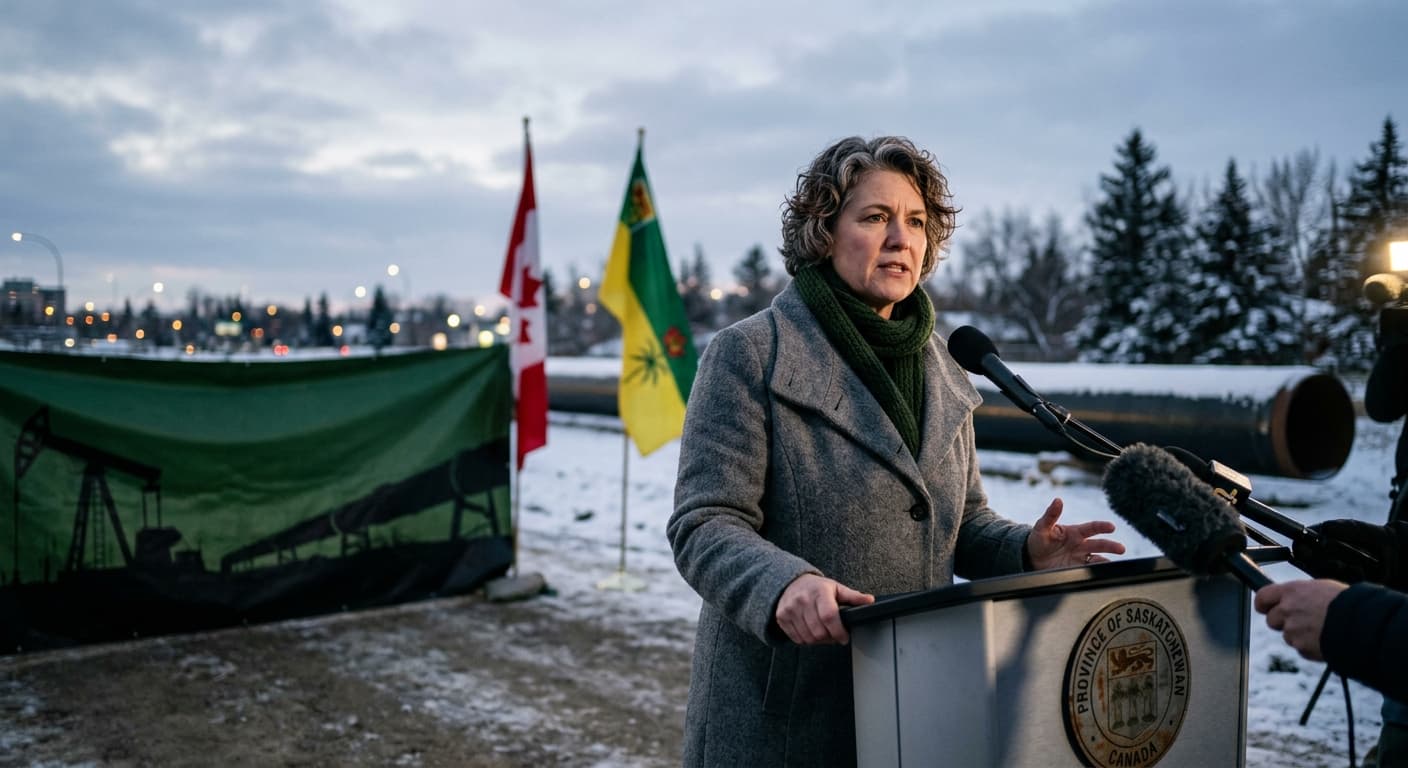
Saskatchewan Backs Northern Shield Pipeline as Canada Rewires Its Energy Map
Saskatchewan endorsed the 3,300-km, 500,000-bpd Northern Shield Energy Corridor on July 8, 2026 — a domestic answer to Line 5 risk, US tariffs and the Venezuela reset.
Saskatchewan's low-key endorsement on July 8, 2026, of the Northern Shield Energy Corridor — a proposed 3,300-kilometre, 500,000-barrel-a-day pipeline from Hardisty, Alberta to Sarnia, Ontario — is the second half of a bigger geopolitical bet: Canada is quietly building the parallel plumbing to survive a permanent decoupling from the United States as a captive energy customer. The Northern Shield line, unveiled by Alberta Premier Danielle Smith and Ontario Premier Doug Ford on July 6 in Calgary, would move Alberta crude east through Canadian territory to Ontario and Quebec refineries — the same barrels that today ride Enbridge's Line 5 across Michigan, a route Lansing has been trying to shut for six years. Combined with the west-coast pipeline Prime Minister Mark Carney signed with British Columbia five days earlier, Ottawa and its energy-producing provinces are attempting something no Canadian government has managed since the National Energy Program: an east-west spine designed to route around Washington.
The announcement, and what is actually in it
On July 6, Smith and Ford framed the Northern Shield project in Calgary as, per The Canadian Wire, "a bold assertion of Canadian economic independence." Ontario is funding a feasibility study; Alberta will provide the crude; no proponent, no route, no cost estimate and no financing structure has been named. According to
Global News, Saskatchewan's endorsement came a day later, in a two-paragraph government statement calling the project "positive news both for our province and our nation." Premier Scott Moe did not appear at the Calgary event. Alberta press secretary Sam Blackett acknowledged the plan "did not yet have Saskatchewan's approval," and that costs and commercial models remain to be worked out.
Political analyst Ken Coates told Global News he was "surprised that Saskatchewan wasn't represented alongside Smith and Ford," given that Regina had signed the underlying trilateral energy-and-transport MOU. That absence matters: any Hardisty-to-Sarnia route runs directly across Saskatchewan and Manitoba, and neither Manitoba Premier Wab Kinew nor federal officials were present either. The Wawa News editorial the following day, syndicated in Wawa-news.com, quoted Northwatch calling the corridor "the wrong direction for Canada in the middle of a climate crisis." What was announced is closer to a political signal than a project — but the signal is the point.
Why now: the Line 5 problem and the Venezuela problem
The corridor's strategic logic sits in two dossiers that most Canadians never read. The first is the Enbridge Line 5 file. According to a Congressional Research Service brief, Line 5 is a 645-mile, 540,000-bpd conduit from Superior, Wisconsin to Sarnia that supplies the majority of Ontario and Quebec's crude and most of Michigan's propane. Michigan has been trying to revoke Enbridge's 1953 Straits of Mackinac easement since 2019; on April 23, 2025, the
Sixth Circuit let the state's shutdown case go forward in state court. Ottawa has invoked the 1977 Transit Pipelines Treaty. But the treaty machinery is slow, and the Trump administration has offered no signals it will step in on Canada's behalf.
If Line 5 goes, Enbridge's own filings warn that refineries in Ontario, Quebec, Michigan, Ohio and Pennsylvania would lose roughly 45% of their crude, with no viable substitute — rail can replace less than 10% of light-crude volumes. Northern Shield is, functionally, an all-Canadian Line 5 replacement in waiting. The dimensions are close to identical: 500,000 bpd vs. 540,000 bpd, Hardisty vs. Superior origin, Sarnia terminus in both cases. Once you see it that way, the project stops looking speculative and starts looking like insurance.
The second dossier is Venezuela. Larry Hughes wrote in Policy Options in January 2026 that the US capture of Nicolás Maduro and the reopening of Venezuelan heavy-crude exports to Gulf refineries threaten Canadian heavy-oil demand in as many as 23 US states. In 2024, Canada exported roughly 3 million barrels a day of heavy crude to US refineries built for that grade; Trump has publicly said Venezuelan volumes could displace Canadian supply within 18 months. As the
BBC reported, 97% of Canada's oil exports — worth about US$100 billion in 2023 — head south. That concentration is the vulnerability the Carney government is now attempting to unwind.
The bigger architecture: two pipelines, one strategy
Northern Shield is not a standalone. On July 2, 2026, Carney and British Columbia Premier David Eby signed the Canada–British Columbia Cooperative Prosperity Agreement to enable a new 1-million-bpd oil pipeline from Bruderheim, Alberta, along the Trans Mountain corridor to the Pacific. Al Jazeera reported that Carney called this "the gateway to the world's fastest-growing markets" and set a target of doubling Canada's non-US exports within a decade. Alberta will submit its proposal for that line by July 1, 2026; the federal Major Projects Office (MPO) under the One Canadian Economy Act will designate it as a project of national interest by October 1, 2026; construction is targeted to begin September 1, 2027.
The Asia Pacific Foundation of Canada notes that since TMX opened in May 2024, Canadian crude exports to Indo-Pacific markets have gone "from virtually zero to an average of C$571 million per month," with China, Singapore, South Korea, Hong Kong and India as buyers. That is the west leg. Northern Shield is the east leg — securing the domestic refining base in Ontario and Quebec, insulating Ottawa from Michigan politics, and pre-empting the Venezuela substitution risk.
The commercial case is thinner than the political one. The C.D. Howe Institute calculated on July 3, 2026 that Canadian pipeline capacity, including Enbridge Mainline and TMX optimisations, will reach roughly 5.9 million bpd by the late 2020s — against oilsands production forecasts of 5.2 to 5.9 million bpd by 2030. Adding a million-barrel west-coast line plus a 500,000-bpd Northern Shield line meaningfully overshoots forecast supply. Heather Exner-Pirot argued in
The Hub that the west coast line has "become primarily a politically driven project." Northern Shield, without a private proponent, is even more so.
Saskatchewan's leverage — and its silence
Saskatchewan sits between Alberta and Ontario on any conceivable Northern Shield route, alongside Manitoba. It is also the third leg of the trilateral energy-and-transport MOU. Yet Premier Moe skipped Calgary. Two reasons are visible.
First, Saskatchewan is quietly rewriting its own energy hand. Policy Options reported that a $1.7-billion Bell AI data centre near Regina, backstopped by a $2.6-billion SaskPower coal refurbishment program, has drawn megaproject proponents "lining up" since the province released its energy security strategy in October 2025. Moe's government is holding leverage over scarce dispatchable power — the resource other jurisdictions have exhausted.
Second, Regina extracts more by staying ambiguous. Coates warned in Global News that stacking "four or five new pipeline projects" on top of active potash and copper mines would strain Saskatchewan's workforce, which economist Moshe Lander said is already the country's binding constraint. A quiet endorsement lets Moe claim national-interest credit without committing scarce labour, or accepting the environmental liability of a corridor cutting across the province's north.
The federal Constitution gives him room. As Jack Mintz argued in The Hub on July 7, 2026, Ottawa's decision to allow British Columbia to levy a royalty on the west-coast pipeline sets a precedent Saskatchewan could invoke. If BC can charge for oil transiting its territory, so can Saskatchewan and Manitoba. Ford and Smith may have announced Northern Shield first; the tolls will be negotiated with the provinces they crossed off the podium.
The Indigenous, environmental and northern Ontario constraints
The Alberta–Ottawa MOU makes Indigenous co-ownership a condition of any new oil pipeline. That standard now applies to Northern Shield by extension. Northwatch and northern Ontario environmental groups have already framed the corridor as Wawa-News reported, as "all risk and no rewards" for the region, noting the proposed route parallels caribou range and boreal-shield wetlands. Duty-to-consult litigation is the single most predictable delay in Canadian pipeline history, and the Ontario proposal has none of the multi-year consultation record that TMX or the west-coast MOU has begun to assemble.
What to watch
- October 1, 2026: federal deadline to designate the west-coast pipeline a project of national interest under the MPO. Whether Northern Shield gets referred alongside it is the single clearest signal of Ottawa's real posture.
- August 1, 2026: Trump's deadline for new tariffs on Canadian goods, which Carney told reporters he will not accept "at whatever cost," per the
BBC. Any escalation raises the political payoff of visible east-west infrastructure announcements.
- Ontario's feasibility study: expected in Q4 2026. Without a cost estimate, a route or a private proponent, Northern Shield remains a memorandum, not a project.
- Line 5 Michigan Supreme Court decision: pending on the tribal appeal filed April 2, 2025. A ruling forcing shutdown would collapse Northern Shield's political timeline from years into months.
Diplomat View
The Northern Shield Energy Corridor, as announced, is a press event, not a pipeline. It has no proponent, no route, no cost, no financing, no Indigenous partners, and no federal referral. What it does have is timing — arriving four days after Carney's west-coast deal and three weeks before Trump's August 1 tariff wall. Read that way, Northern Shield is best understood as the eastern half of a hedge: if Michigan closes Line 5, if Venezuela displaces Canadian barrels in US Gulf refineries, or if Trump's tariffs turn punitive, Ottawa wants a domestic answer already sketched on paper. Saskatchewan's terse endorsement — issued a day late, from Regina, without Premier Moe's face on it — signals a province that will collect political credit and future tolls but not underwrite the workforce or the risk. The forecast to revise: if by October 1, 2026, Northern Shield has not been referred to the MPO alongside the west-coast line, treat it as symbolic. If it is referred, and if Enbridge or TC Energy signs on as proponent, the project moves from theatre to policy — and Canada's energy map will look meaningfully different by 2035.
Discover more
Global Politics
Xi Jinping Calls China-Russia Ties 'Precious'
Xi Jinping's description of China-Russia ties as 'precious' reflects a strategic imbalance, with Beijing dictating terms in the partnership.

India
Yamini Aiyar on Modi's Federalism Shift
Yamini Aiyar critiques Modi's shift from equity-based to performance-based federalism, highlighting implications for India's political landscape.

India
Women’s Reservation in India
India's 33% women's reservation law is enacted but won't take effect until after 2029 due to political setbacks and census delays.

Economics
Fed's Amex AML order puts correspondent banking on notice
Federal Reserve's Amex AML order requires board-level controls and a 90-day plan; OCC fined the bank $350 million over enterprise-wide deficiencies.