Sara Duterte Impeachment Trial Opens
Senate trial begins amid political tensions in the Philippines
Model Diplomat9 min readSoutheast Asia
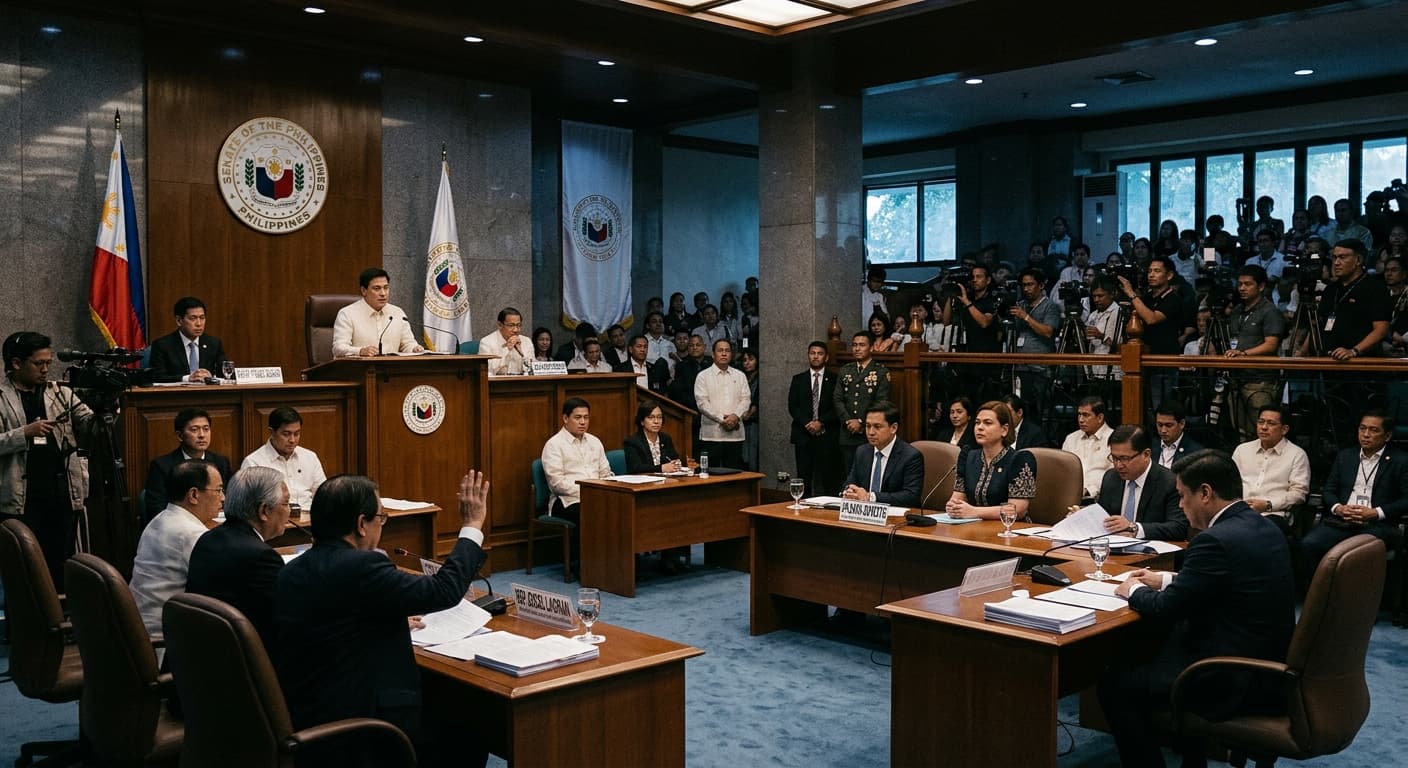
Sara Duterte impeachment trial opens: what the Escudero vote reveals
The Philippine Senate opened VP Sara Duterte's impeachment trial on July 6, 2026, electing Francis Escudero 12-8 to preside — a procedural coup that will shape a ₱612 million corruption verdict and the 2028 presidency.
The Philippine Senate on July 6, 2026 opened the impeachment trial of Vice-President Sara Duterte-Carpio by first replacing the man the constitution seemed to hand the gavel to — a 12-8 vote installing Senator Francis "Chiz" Escudero as presiding officer over Senate President Sherwin Gatchalian. That vote, before any evidence was heard, is the story: the Philippines is running the region's rarest live experiment — simultaneous domestic impeachment of a sitting vice-president and International Criminal Court prosecution of her father — and the arithmetic of who counts the votes now decides whether Southeast Asia's oldest post-authoritarian democracy can convict a Duterte on the merits, or whether the case dies of procedure the way its 2025 predecessor did.
The stakes are singular. A conviction requires 16 of 24 senator-judges and would permanently bar Duterte from public office — killing her declared 2028 presidential bid outright, according to Al Jazeera. An acquittal, or a Supreme Court intervention that kills the trial on procedure, would likely deliver her the presidency her father lost to The Hague.
The Escudero vote was not procedural — it was the trial
Under Article XI of the 1987 Constitution, the Senate sits as an impeachment court and the Chief Justice presides only when the sitting president is on trial. For any other official — vice-president, chief justice, ombudsman — the text is silent on who wields the gavel. Minority Leader Alan Peter Cayetano, a Duterte loyalist, argued to GMA News that constitutional practice designates the Senate president by default and that changing the arrangement "could expose the proceedings to legal challenges." Senator Kiko Pangilinan, a majority-bloc lawyer, countered that the text imposes no such requirement — an interpretation the chamber ratified when it voted 12-8 to seat Escudero.
That is a 60 percent majority for a Marcos-aligned presiding officer inside a chamber that Duterte allies had, only weeks earlier, controlled. Senator Panfilo Lacson moved Escudero's nomination and Escudero — a lawyer and former Senate president who oversaw the aborted 2025 proceedings — immediately used his first ruling to lock in the harder conviction math: two-thirds of the full 24-member Senate, not two-thirds of those present, according to BusinessWorld. Both rulings tilt the field toward the prosecution before a single witness is sworn.
Escudero framed the choice narrowly in his opening remarks: "As presiding officer, I shall do my part to uphold the fairness and integrity of this process, and shall see it through to its proper conclusion." The BBC noted Duterte herself did not attend, sending counsel — a defense posture that mirrors her father's approach at the ICC in The Hague.
Rappler confirmed the vice-president skipped the opening as her legal team had signaled she would, framing her absence as the exercise of a constitutional right to be represented by counsel.
The charges: ₱612 million, threats, and a plunder arrest that changed the arithmetic
Lead House prosecutor Rep. Gerville Luistro of Batangas opened by telling the court the evidence would show that more than ₱612 million in confidential and intelligence funds entrusted to the Office of the Vice-President and the Department of Education were disbursed and liquidated under questionable circumstances. The four articles allege culpable violation of the constitution, betrayal of public trust, corruption, and grave threats — the last stemming from a November 2024 broadcast in which Duterte said she had contracted a killer to eliminate President Ferdinand Marcos Jr., his wife, and House Speaker Martin Romualdez if she herself were killed. Duterte has called the video venting, not a plot; the NPR wire summary of the House probe records the same ₱612.5 million ($10.3 million) figure at the heart of the corruption count.
The Senate arithmetic shifted hours before the gavel fell. Al Jazeera reported that the Sandiganbayan, the country's anti-graft court, ordered the arrest of Senator Rodante Marcoleta — a Duterte ally — on a plunder charge tied to 75 million pesos ($1.2 million) in undisclosed private donations during his 2025 Senate campaign, and issued a hold-departure order the same day. Marcoleta was to sit as a senator-judge. His absence, if it holds, does not lower the 16-vote conviction threshold — Escudero explicitly ruled it does not — but it removes one of the anticipated acquittal votes from the roll.
Alejandro Reyes, adjunct professor at the University of Hong Kong's Department of Politics and Public Administration, told Al Jazeera that "the Senate arithmetic is crucial. Conviction requires 16 of 24 senators, so even a Marcos-leaning Senate leadership does not guarantee a guilty verdict." Reyes read Marcoleta's arrest as "adds to the sense of escalation" and framed the trial as sitting "inside a wider battle over corruption, Senate control and the 2028 succession."
The 2025 ruling that still shadows the courtroom
Lead defense counsel Sheila Sison built her opening around a single document: the Supreme Court's July 25, 2025 ruling that voided the first impeachment. The BBC reported that the court found the February 2025 House vote violated the constitutional bar on more than one impeachment proceeding per official per year — a technicality, but a fatal one. The court explicitly noted it was "not absolving Duterte of the charges she faces," while suspending any impeachment path until February 2026, when the one-year clock ran out. Sison told the impeachment court that earlier House conduct was "tainted with grave abuse of discretion" and that the 2026 complaint inherits the same defect.
That argument matters because the 15-member Supreme Court is dominated by justices appointed under Rodrigo Duterte — a bench that already once treated a procedural bar as sufficient to spare his daughter, BBC noted. Escudero's ruling that the impeachment court will follow the constitutional two-thirds threshold "unless the Supreme Court rules otherwise" reads less as deference than as an invitation: any senator-judge unhappy with the trajectory can seek a writ, and the same court that killed round one is now positioned as an escape valve for round two.
The revived complaint sailed through the House in May 2026 on a 257-26 vote with nine abstentions, a margin Al Jazeera called "far surpassing the one-third threshold" and a barometer of Marcos's continued grip on the lower chamber. Between the two impeachments, the Senate itself briefly slipped from Marcos control: Cayetano was installed as Senate president on May 11, 2025 with the deciding vote cast by Senator Ronald "Bato" dela Rosa, who — as
Al Jazeera reported — surfaced from hiding to vote, was pursued by police under an ICC warrant, and later absconded from the Senate amid gunfire. That the Marcos camp has since re-taken presiding-officer control is precisely why the July 6 vote reads as decisive.
The ICC parallel is the reason this trial exists
The impeachment cannot be separated from The Hague. On April 23, 2026, ICC Pre-Trial Chamber I unanimously confirmed three counts of crimes against humanity against former president Rodrigo Duterte for murder and attempted murder tied to the "war on drugs" from November 2011 to March 2019. The court's press release states plainly:
"There are substantial grounds to believe that Mr Duterte is responsible for the crimes against humanity of murder and attempted murder, pursuant to article 7(1)(a) of the Rome Statute … committed as part of a widespread and systematic attack against a civilian population."
The Duterte trial at The Hague is scheduled to begin on November 30, 2026, according to the BBC, which described the 81-year-old former president as "the first Asian former head of state to be indicted by the ICC." Rodrigo Duterte was surrendered to ICC custody on March 11, 2025 — an extradition the Marcos government executed within hours of his arrival at Manila airport from Hong Kong, per an
ICC Office of the Prosecutor statement. The Rome Statute's temporal jurisdiction over crimes committed while the Philippines was a state party held even though Duterte withdrew the country from the treaty in 2019.
The parallel prosecution is doing analytic work no domestic case could. Political scientist Cleo Calimbahin, writing for the Australian Institute of International Affairs, argued that Marcos's decision to surrender the elder Duterte "less than two months before a critical mid-term election" was itself a political bet — one made when Sara Duterte's satisfaction ratings had collapsed and her 2028 chances "dimmed." That bet has since aged badly: the May 2025 Senate elections weakened Marcos's numbers enough that a Duterte-aligned Senate briefly voted 18-5, per Calimbahin, to return the first impeachment to the House. The ICC prosecution nonetheless removes the family patriarch from the Philippine political stage during the exact window in which Sara Duterte would normally consolidate her 2028 base.
What this means for international-law standards
Two things are being tested at once, and analysts should keep them separate.
The first is the durability of the Rome Statute's temporal jurisdiction. The ICC's April 2026 confirmation-of-charges decision is now the strongest post-withdrawal precedent on record and holds regardless of what the Philippine Senate does with the vice-president. The court has already scheduled trial for November 30, 2026 and, per the BBC, indicted Duterte's former police chief Ronald dela Rosa on a parallel warrant — meaning the treaty's reach now extends beyond a single head of state to the operational chain of a domestic security campaign.
The second is whether a Philippine domestic accountability mechanism can complete a run without being nullified. Since democratic restoration in 1986, only one impeachment has ended in conviction — Chief Justice Renato Corona in 2012, on a 20-3 vote, per Al Jazeera. President Joseph Estrada's 2000 trial collapsed into the EDSA II uprising before a verdict; his removal,
as an academic reconstruction by Raul Fabella argued, ultimately rested on extra-constitutional street politics rather than a Senate vote. Duterte's first impeachment was killed by the Supreme Court on a technicality. A conviction here would be the second completed impeachment verdict in the country's post-1986 history. An acquittal or a second procedural kill would harden the empirical finding — one the Corona verdict briefly disturbed — that Philippine impeachment functions as political theatre with a nullification safety valve.
The concrete winners and losers are already visible. Marcos's House allies, led by Speaker Romualdez, have delivered a 257-vote impeachment and a Marcos-aligned presiding officer inside 60 days. The 15-member Supreme Court dominated by Rodrigo Duterte's appointees is the last institutional lever available to the defense. The Sandiganbayan's timing on Marcoleta — hours before opening statements — reads as institutional coordination whether or not it was.
What to watch next
- The Marcoleta writ. Whether the arrested senator's team can secure emergency Supreme Court relief that returns him to the Senate floor as a judge. If the SC intervenes, expect the defense to file a parallel challenge to Escudero's presiding-officer status.
- The Supreme Court docket. Duterte counsel Sheila Sison has already flagged the 2025 grave-abuse-of-discretion ruling. A petition for certiorari to halt the trial is the most likely next filing.
- November 30, 2026. The scheduled start of Rodrigo Duterte's ICC trial at The Hague. Overlap between the two proceedings — the impeachment is expected to run several months, per Rappler — will compress the Duterte camp's political bandwidth precisely when Sara needs to defend and campaign simultaneously.
The Bottom Line
The Sara Duterte impeachment is not a corruption case that happens to be political — it is a succession fight fought inside a courtroom, with the ICC prosecution of her father as the parallel track that removes her most valuable asset from the field. The 12-8 vote installing Escudero, and his ruling locking conviction at 16 of 24 regardless of absences, were the decisive rulings of the trial; everything from here is evidence handling in a game whose scoring rules have already been set. If the Supreme Court intervenes a second time, Philippine impeachment will be established as a mechanism the executive can trigger but the judiciary can nullify — and Sara Duterte will enter 2028 as the frontrunner her father cannot campaign for.
Discover more
India
Women's Reservation Bill 2026: A Political Sh
India's Lok Sabha rejected the Women's Reservation Bill, exposing a political maneuver to redraw electoral maps favoring the north over the south.
India
Women’s Reservation Bill Fails in Lok Sabha
The Constitution (131st Amendment) Bill failed in Lok Sabha, signaling a setback for women's representation and a win for southern states' federalism.

India
Women’s Reservation Bill
Parliament weighs the Women's Reservation Bill to reserve 33% of seats for women in the Lok Sabha and state assemblies, a landmark gender-equality test.

Economics
Fed's Amex AML order puts correspondent banking on notice
Federal Reserve's Amex AML order requires board-level controls and a 90-day plan; OCC fined the bank $350 million over enterprise-wide deficiencies.