Santa Marta's parallel track: fossil-fuel end
57 countries build a fossil-fuel transition framework outside the COP consensus trap
Model Diplomat8 min readSouth America
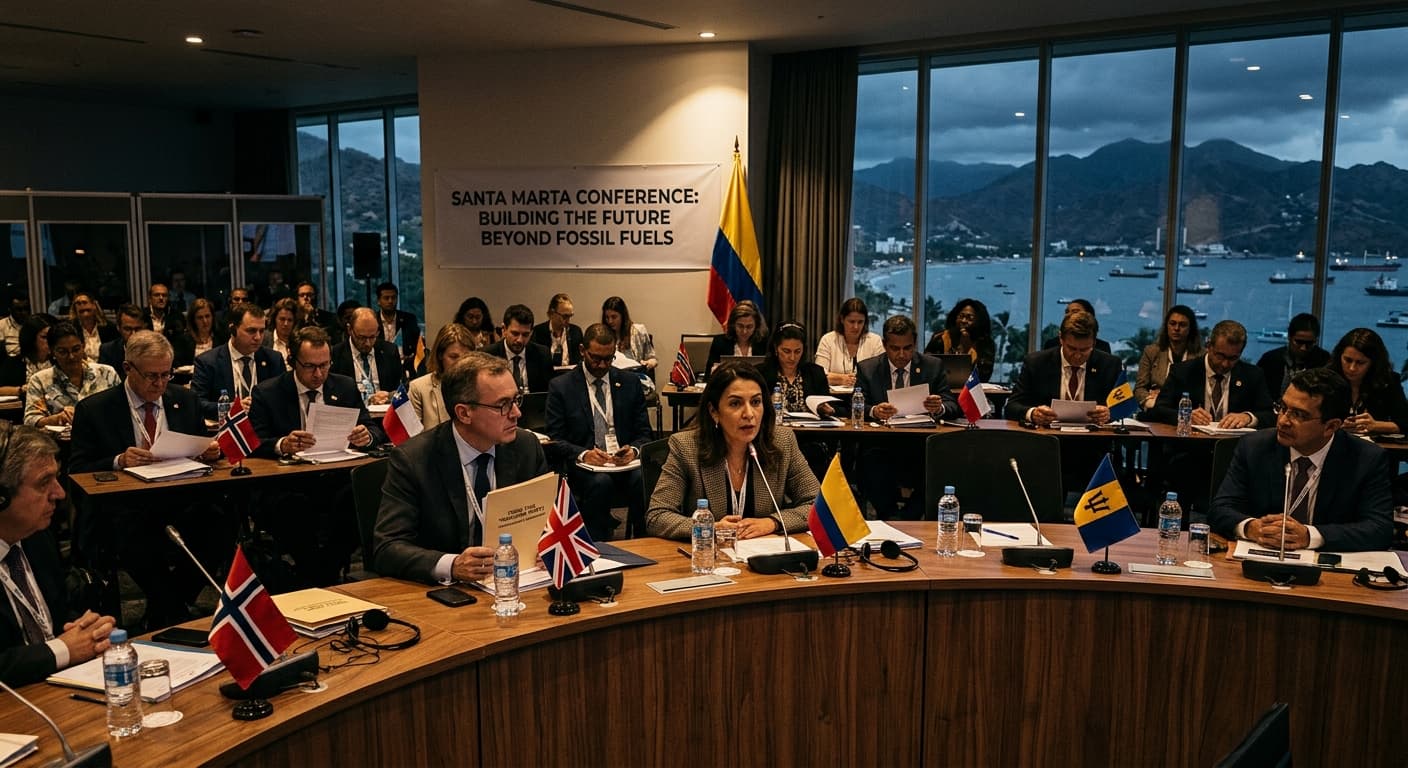
Santa Marta's parallel track: the fossil-fuel endgame the COP couldn't deliver
A new coalition of 57 countries, deliberately excluding the UN's biggest veto-wielders, is building a fossil-fuel transition framework outside the COP consensus trap — and it may reach a binding treaty before the UNFCCC catches up.
Fifty-seven countries representing roughly one-third of global GDP gathered in Santa Marta, Colombia, from April 24 to 29, 2026, for the first international conference explicitly devoted to transitioning away from fossil fuels — and the decisive feature was not who came, but who was excluded. The United States, China, India, Russia and every Middle East petrostate were not invited, a design choice that let participants move past three decades of COP deadlock and into practical planning. The Santa Marta process, as it is now called, is the first credible attempt to build a parallel climate-diplomacy track that can operate at a speed the consensus-bound UN Framework Convention on Climate Change structurally cannot match — and it may force a binding fossil-fuel treaty into existence before the COP process catches up.
The veto problem, solved by exclusion
The root cause of three decades of climate-negotiation failure is structural: any single state can block consensus. At COP30 in Belém, Brazil, in November 2025, roughly 80 countries pushed for a roadmap to phase out fossil fuels; oil-producing nations held their veto line and the final text contained no reference to fossil fuels at all, according to BBC News. Brazil's COP30 presidency responded by promising a voluntary roadmap outside the formal UNFCCC process — a tacit admission that the consensus model had reached its limit on the single most important issue in the climate agenda.
Colombia and the Netherlands then designed a conference that would not reproduce that deadlock. The co-hosts based invitation criteria on countries' support for the fossil-fuel roadmap at COP30, deliberately excluding the actors most likely to water down discussion, according to analysis by Sciences Po. The result was a room of 57 countries including major fossil-fuel producers — Canada, Norway, Brazil, Nigeria, Mexico, Australia — alongside climate-vulnerable small island states and a bloc of EU members. The European Parliament's briefing on the conference described it as a "safe harbour" for state and non-governmental actors to advance the transition at a speed the UNFCCC cannot, according to the
European Parliament.
The logic is borrowed from arms control, not environmental diplomacy. The nuclear Non-Proliferation Treaty was negotiated by a core coalition and only later joined by holdouts including France and China in the 1990s. The Fossil Fuel Treaty Initiative, the civil-society campaign driving the Santa Marta process, is explicitly modelled on that architecture: non-proliferation (ending new exploration), global phase-out, and a just transition, according to Amnesty International. A threshold of around 50 states would be needed to make such a treaty credible, as legal scholar Alexander von Bernstorff noted — and Santa Marta assembled 57, as
Corporate Knights reported.
What Santa Marta produced
The conference did not negotiate a treaty. It produced three things designed to build toward one.
First, three workstreams were launched to run through the second conference in Tuvalu in early 2027: developing national and regional transition roadmaps, aligning trade policy to support decarbonization, and transforming financial architecture to unlock transition investment, according to Corporate Knights. France presented a national roadmap at the conference; Colombia and Brazil are reportedly drafting their own, according to
Sciences Po.
Second, a new Global Energy Transition Panel was launched on April 25, 2026, intended to advise policymakers on transition pathways and framed as complementary to the Intergovernmental Panel on Climate Change, though some participants flagged concerns about its mandate and composition, according to Amnesty International.
Third, 18 nations — mostly small island states and host Colombia — used the conference to call for negotiation of a new binding international instrument to manage the phase-out of coal, oil and gas, according to Sciences Po. The conference exposed a clear divide between countries seeking binding international rules and those preferring flexible, nationally determined pathways — the same fault line that has paralysed the COP, but now contained within a coalition that can plausibly resolve it.
The final Santa Marta conference report was released on June 23, 2026, at the Global Energy Transition and Electrification Summit in London, part of London Climate Action Week, according to Corporate Knights. The same day, UN Secretary-General António Guterres delivered a special address framing continued fossil-fuel dependence as a security risk and convening leaders in September ahead of COP31, according to the
United Nations.
The legal backstop: the ICJ advisory opinion
The Santa Marta process gained an unexpected accelerant on July 23, 2025, when the International Court of Justice issued a unanimous advisory opinion establishing that states have a legal obligation to protect the climate system under both treaty and customary international law. The ICJ specifically named fossil-fuel production, consumption, the granting of exploration licences and the provision of fossil-fuel subsidies as conduct that could breach international law, according to the International Court of Justice. The opinion confirmed that state responsibility applies to wrongful conduct, opening a pathway for reparation claims, as
Cambridge University's International & Comparative Law Quarterly analysis noted.
The opinion is advisory, not binding. But it gives the Santa Marta coalition something the COP process has never had: a credible legal threat. Countries that continue to license new fossil-fuel extraction or subsidise production now face potential litigation in both international and domestic courts citing the ICJ ruling, as BBC News reported. The European Parliament briefing on Santa Marta explicitly identified the ICJ opinion as a basis for translating climate obligations into national legislation through the TAFF process, according to the
European Parliament.
Who benefits, who loses
The winners are the climate-vulnerable states and the fossil-fuel producers willing to plan their own exit. Colombia gains diplomatic prestige as the bridge between Global North and Global South. The Netherlands, birthplace of Shell, gains moral authority as a former petrostate-turned-convenor. France gains a platform for its national roadmap. The small island states — Tuvalu, Vanuatu, Fiji, the Marshall Islands — gain a track where their existential interest is the organising principle, not a negotiating position to be traded away. The World Resources Institute, which co-chaired the central bank workstream and launched a new Santa Marta Transition and Financial Stability Group, gains institutional standing as the bridge between finance and diplomacy, according to WRI.
The losers are the excluded petrostates and the major emitters. Saudi Arabia, which has systematically fought any further reference to "transitioning away" in COP texts, lost its veto in this room, as the SWP Berlin analysis documented. China, which stayed quiet at COP30 while others blocked, is now outside a process that may set terms for the clean-energy trade architecture it dominates, as SWP Berlin noted. The United States under Trump's second term, which sent no delegation to COP30 and withdrew from the Paris Agreement, is simply absent — the Santa Marta process was designed partly to be shielded from U.S. disruption, according to the
European Parliament briefing. India, which led the Like-Minded Developing Countries bloc in resisting fossil-fuel phase-out language at COP30, finds itself excluded from a process reframing the transition it opposed, as
ORF observed.
The second-order risk falls on the excluded producers of clean-energy hardware. If the Santa Marta process builds trade-policy alignment around decarbonization, the terms of that alignment will be set without China's input — even though China manufactures the majority of the world's solar panels and batteries. The coalition could become a demand-side cartel that sets standards and procurement rules the supply side must meet.
The COP31 test
COP31 opens in Antalya, Türkiye, on November 9, 2026, with Türkiye as president and Australia leading negotiations under a power-sharing arrangement, according to the United Nations in Türkiye. Brazil's fossil-fuel transition roadmap, expected to draw on the Santa Marta report, is set to be presented there, according to
Corporate Knights.
The central question is whether the Santa Marta process feeds into COP31 or runs alongside it. The conveners insist it is complementary, not a replacement. But the structural tension is clear: a parallel track that can move faster and speak more freely will inevitably draw ambition away from the consensus-bound COP, raising the cost of compromise inside the UNFCCC. If Brazil's roadmap is weak, the Santa Marta coalition will have a stronger case for pursuing a binding treaty outside the UN system entirely. If the roadmap is strong, the coalition's leverage is that it can deliver the coalition of the willing to endorse it.
The Tzeporah Berman, founder and chair of the Fossil Fuel Treaty Initiative, put the timeline plainly: more concrete processes and formalising of agreements will come out of the Tuvalu conference in 2027, according to Corporate Knights.
What to watch
- September 2026: Guterres convenes leaders ahead of COP31 — the first test of whether the Santa Marta coalition can present a unified position.
- November 9–20, 2026: COP31 in Antalya. Brazil's fossil-fuel transition roadmap is presented. Watch whether Santa Marta participants coordinate endorsement and whether excluded states attempt to re-enter the conversation.
- Early 2027: Second TAFF conference in Tuvalu, co-hosted with Ireland. The decision point on whether the process moves toward formal negotiations on a binding fossil-fuel treaty.
Diplomat View
The Santa Marta process is the most significant structural shift in climate diplomacy since the Paris Agreement, and it is being driven by a coalition that has accepted the COP's consensus model cannot deliver on fossil fuels. The leverage now sits with the 57-country coalition and its scientific panel, legal backstop from the ICJ, and a second conference in Tuvalu that can plausibly pivot from roadmaps to treaty negotiations. The forecast: if Brazil's COP31 roadmap is thin, the Santa Marta track accelerates toward a binding instrument outside the UNFCCC by 2028. If the roadmap is robust, the coalition becomes the endorsement mechanism that gives it political force. Either way, the excluded petrostates and major emitters are now in a reactive position — they can join on terms set by others, or they can watch a coalition representing a third of global GDP set the trade, finance and legal architecture of the transition without them. Revision conditions: if the Tuvalu conference fails to attract new signatories beyond the Santa Marta core, or if a major participant like Canada or Norway withdraws, the process stalls. Absent that, the two-speed climate diplomacy Wesley Morgan of UNSW described is now the operating reality — and the faster track is the one that matters.
Discover more

US Politics
SNAP Food Assistance Faces Legal Challenges
In 2026, SNAP faces stricter eligibility rules and mounting legal challenges, threatening food assistance for the millions of Americans who rely on the program.
US Politics
House Ethics Committee Pushes Sexual Miscond.
The House Ethics Committee has shifted responsibility for sexual harassment settlement records to the Office of Congressional Workplace Rights, complicating disclosure efforts.
India
UN Expert Albanese: India Violates Law
UN Rapporteur Francesca Albanese accuses India of breaching international law, spotlighting human rights concerns in Kashmir and prompting diplomatic pushback.

Economics
Fed's Amex AML order puts correspondent banking on notice
Federal Reserve's Amex AML order requires board-level controls and a 90-day plan; OCC fined the bank $350 million over enterprise-wide deficiencies.