Samsung's ₩89 Trillion Quarter Turns Memory
Samsung's record profit highlights memory's geopolitical stakes.
Model Diplomat8 min readAsia
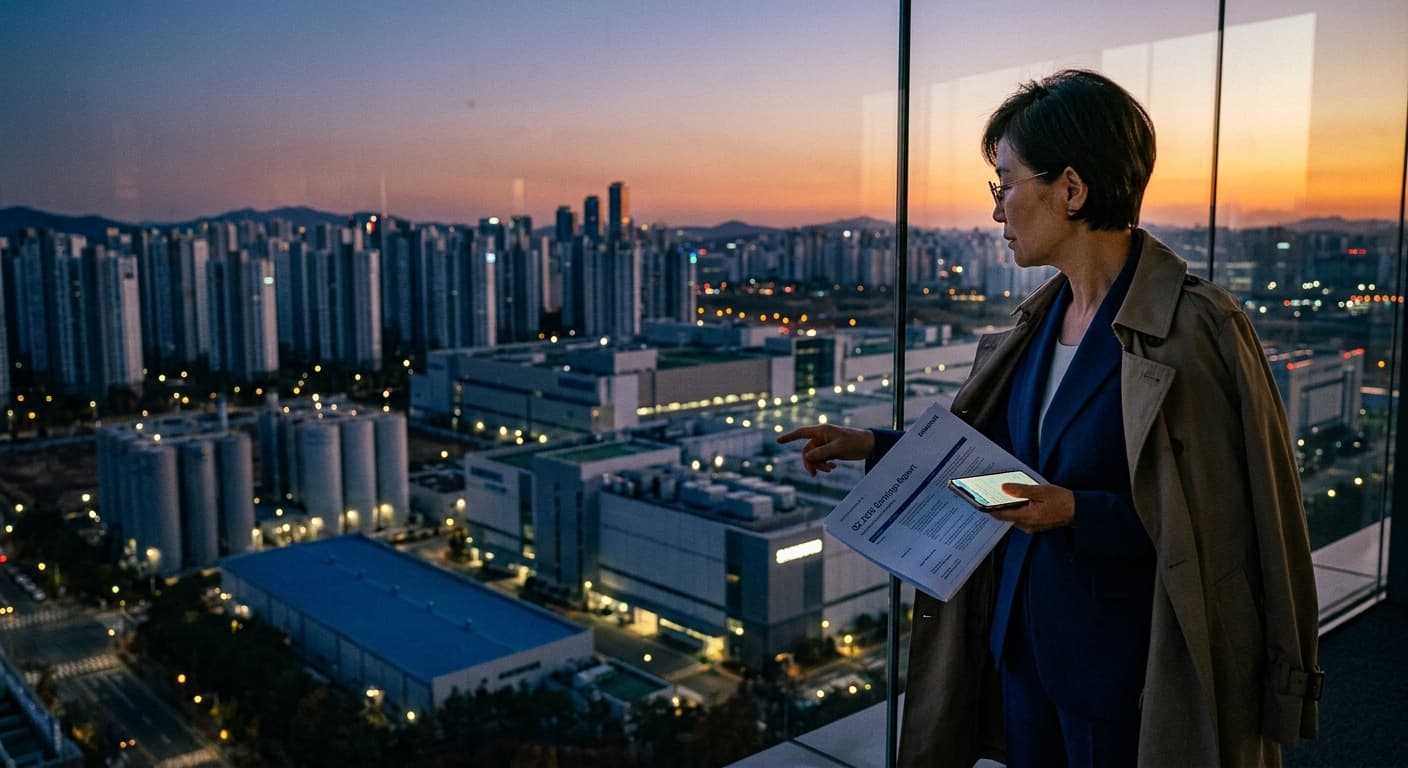
Samsung's ₩89 Trillion Quarter Turns Memory Into Geopolitics
Samsung's Q2 2026 profit jumped 19-fold on AI memory demand — and made high-bandwidth memory the next front in US export controls, antitrust, and industrial policy.
Samsung Electronics on July 7, 2026 forecast a second-quarter operating profit of ₩89.4 trillion ($58.4 billion) — a 1,810% jump from the ₩4.7 trillion it posted a year earlier, when the same quarter's 55% slide first flagged how brutal the memory cycle had turned. The rebound, driven almost entirely by high-bandwidth memory (HBM) sold into AI data centers, is now the clearest single data point that memory chips have crossed a threshold: they are no longer a commodity input to the AI stack, they are its binding constraint — and Washington, Seoul and Beijing are already rewriting export, antitrust and industrial policy around that fact.
The counterintuitive tell is the tape. Samsung shares dropped nearly 7% in Seoul on the same day the profit forecast came out, according to the BBC, as some investors had priced in an even larger beat. That reaction — a record quarter treated as a disappointment — captures what has changed. The memory oligopoly is not just cyclically strong; it is priced as a scarce strategic asset. And when an asset gets priced that way, governments intervene.
The number nobody's really pricing
Frame the swing plainly. Samsung's Q2 2025 operating profit was ₩4.7 trillion; Q2 2026 preliminary profit is ₩89.4 trillion. Revenue nearly doubled year-on-year to ₩171 trillion, per the BBC. It is the third consecutive record quarter. In a normal cycle, that would be the story.
It is not the story. The Financial Times describes the result as "relentless AI demand" translating directly into memory pricing power. Counterpoint Research analyst Marc Einstein, quoted by the BBC, called it "one of the best quarterly performances ever" and put it near the tech-sector record set by Nvidia earlier in 2026. IDC's Bryan Ma expects "supplies to be tight through next year given the unabated demand from AI data centres."
The scale of the underlying demand is what turns this from a corporate earnings note into a policy story. A Center for Strategic and International Studies analysis published in June 2026 estimates that Meta, Microsoft, Amazon and Alphabet will lift annual AI-capable data-center spending from $217 billion in 2024 to roughly $650 billion by 2026, and reports that OpenAI's Stargate project alone secured 2025 agreements for up to 900,000 DRAM wafers per month — equivalent to about 40% of global DRAM output. SK Hynix, per the same CSIS note, has sold out its entire 2026 HBM slate and stopped taking orders for major memory products.
That is what a chokepoint looks like. Three firms — Samsung, SK Hynix and Micron — control more than 90% of global DRAM output, per CSIS. Data-center customers are projected to consume roughly 70% of world memory output in 2026. A new fab costs $15–20 billion and takes years. Shortages are forecast to persist through 2027 "and potentially beyond."
Where the export-control map now runs
The regulatory scaffolding was built before this quarter, but this quarter proves why it matters. On December 5, 2024, the US Bureau of Industry and Security (BIS) published an interim final rule that, in its own Federal Register text, "impos[es] new controls on certain high bandwidth memory (HBM) commodities that provide necessary memory capacity and bandwidth needed for advanced artificial intelligence (AI) models and supercomputing applications" — the first time HBM was named as a country-wide control category.
Critically, the rule reaches Samsung and SK Hynix output through the Foreign-Produced Direct Product Rule. A Congressional Research Service report on US export controls confirms BIS "added China wide-controls for advanced packaging SME, high-bandwidth memory (HBM), and dynamic random-access memory (DRAM)," extended by the expanded FDPR to foreign-made chips produced with US tools. In practice, that means every wafer Samsung ships from Pyeongtaek or Xi'an sits inside the US regulatory perimeter.
BIS tightened the perimeter further on September 2, 2025, revoking Validated End-User authorizations for Samsung China Semiconductor and SK hynix Semiconductor (China), effective December 31, 2025, according to the Federal Register notice. Samsung and SK Hynix now need licenses to move US-origin equipment into their own Chinese fabs. A
CSIS analysis of the underlying regime notes the "memory bandwidth density" threshold — 3.3 GB/s per square millimeter — effectively prohibits export to China of anything more advanced than HBM2, which means HBM2e, HBM3, HBM3e and HBM4 are locked out.
That threshold is the reason Samsung's Q2 2026 profit is so lopsided toward AI memory: the highest-margin product cannot legally be sold into the second-largest market. What looks like a corporate windfall is a policy-created rent, extracted from Western hyperscalers who have nowhere else to buy.
Nvidia, Samsung and the qualification that unlocks the trade
The one variable that could reprice this whole complex in the next two quarters is Nvidia's HBM3E qualification of Samsung. A Financial Times report earlier this cycle noted Micron's HBM3E passed Nvidia's qualification tests while Samsung's had not, and a separate
FT piece cites Nvidia management saying it expects "to ultimately qualify a third supplier in Samsung, despite the company's challenges over the past year." Samsung already makes memory for Nvidia's China-market H20 chip, per the
BBC, but the flagship Blackwell and next-generation Rubin sockets are the prize.
If Samsung passes on Nvidia's flagship HBM3E — or HBM4 — the current quarter's ₩89.4 trillion is not a peak. It is a base. SK Hynix, whose share price has more than tripled in 2026 per the BBC, currently absorbs most of the top-tier Nvidia allocation. A third qualified supplier reprices Nvidia's cost curve down and Samsung's memory margin up simultaneously. The Financial Times reported in an earlier cycle that Samsung had issued a rare public apology for "falling behind on AI"; the July 7, 2026 numbers suggest that apology chapter is closing.
The industrial-policy answer: Seoul's $1 trillion bet
Governments read the same tape. On June 29, 2026, South Korean President Lee Jae-myung, standing alongside the leaders of Samsung and SK Hynix, announced roughly $1 trillion in chip and AI investment, according to Al Jazeera — a plan the
BBC reports will anchor a semiconductor manufacturing hub in the southwest of the country. Nvidia CEO Jensen Huang has separately committed more than 260,000 of the company's most advanced AI chips to South Korean firms and the government, per the
BBC, building what Seoul calls "sovereign AI" infrastructure it will control.
That plan does two things at once. It compensates Samsung and SK Hynix for the Chinese market they are steadily losing under US controls, and it locks South Korean fab capacity onto Korean soil, where allied export enforcement is easier. It also acknowledges what Samsung's earnings make undeniable: the country now runs an economy in which chip cycles set the KOSPI. Samsung and SK Hynix combined have lifted South Korea's benchmark index by more than 80% year-to-date, per the BBC.
The wage math has followed the profit math. A Reuters-fed Al Jazeera report notes Samsung's May 2026 pay deal gives workers 10.5% of operating profit. On the July 7 forecast, that formula alone commits roughly ₩9.4 trillion in single-quarter labor payments — a signal that the boom is being institutionalized inside the company's cost base, not treated as transient.
The bill lands on consumers, and the antitrust question follows
The second-order effect is already priced into consumer electronics. On June 26, 2026, Apple CEO Tim Cook told the Wall Street Journal that price increases were "unavoidable" and the memory situation "unsustainable," per the BBC. The same report notes RAM prices have more than doubled since October 2025, that global average smartphone prices are expected to rise about 20% in 2026 to an all-time high per Omdia, and that Microsoft's Xbox raised console prices by up to $150 in a single announcement — its second hike in less than a year — citing the "components crisis," according to a
follow-up BBC report.
NPR reported in late 2025 that TrendForce's Avril Wu measured DRAM demand exceeding supply by 10%, with buyers already paying 50% more quarter-on-quarter and up to two-to-three times more for expedited orders. Wu expected another 40% price rise in the following quarter.
That price path is what turns memory pricing into an antitrust question. Historic precedent is not comforting for the industry: in 2006, 34 US state attorneys-general — as covered at the time by the Financial Times — filed price-fixing suits against Samsung, Micron, Infineon and Hynix over a 1998–2002 DRAM conspiracy that produced more than $730 million in federal fines. The current environment — three producers, sold-out capacity, coordinated production shifts toward HBM, and quarterly price hikes — is precisely the fact pattern regulators are trained to look at. A
CSIS retrospective has already flagged that Chinese authorities opened an anti-monopoly probe of Nvidia one week after the December 2024 US export controls, a template Beijing can readily extend to Samsung and SK Hynix if they refuse to backfill Chinese demand — as the US has asked them not to do.
Diplomat View: expect the next serious regulatory shoe to drop in Brussels or Washington, not Beijing. The European Commission's DG COMP has an unfinished chapter on cartelized memory pricing, and US congressional scrutiny of AI-input pricing is escalating fast enough that a bipartisan hearing on hyperscaler cost pass-through is a matter of when, not if.
Diplomat View
The trade a policymaker should make on today's Samsung print is not the earnings trade — it is the regulatory arbitrage. Memory chips have quietly become the most concentrated, most price-inelastic, most export-controlled input in the global AI stack, and the political economy of that fact is only now catching up to the earnings. The forecast: within twelve months, at least one major jurisdiction — most likely the European Commission, possibly a US state AG coalition — opens a formal antitrust inquiry into HBM/DRAM pricing coordination, and the Trump administration adds explicit price or allocation conditions to any further BIS authorizations touching Samsung or SK Hynix. What would falsify that call: a sharp break in HBM spot pricing before Q4 2026 (indicating supply is catching up faster than CSIS projects), a formal Nvidia qualification of a Chinese HBM alternative (undercutting the political case for control), or a Samsung-led voluntary allocation deal with hyperscalers that pre-empts regulatory action.
What to watch next
- Late July 2026: Samsung's full Q2 detailed earnings release — the divisional breakout will show how much of ₩89.4 trillion is HBM versus commodity DRAM/NAND, and whether the Nvidia HBM3E qualification has landed.
- December 31, 2025 (already effective): Samsung China Semiconductor and SK hynix Semiconductor (China) exit the US Validated End-User program per the BIS
final rule — watch for license-application backlog and any Seoul push for a bilateral carveout.
- Nvidia FY27 Q1 earnings (roughly late August 2026): Any explicit mention of a third qualified HBM supplier resets the memory oligopoly's competitive geometry.
The Bottom Line
Samsung's ₩89.4 trillion quarter is not a corporate story — it is the balance sheet of a policy regime. Washington built an export-control perimeter around HBM before the market understood what HBM was worth; Seoul is now spending $1 trillion to keep that perimeter defensible; Beijing is preparing the antitrust and cybersecurity tools it used against Micron for a second use. The next quarter of AI infrastructure economics will be decided less by Jensen Huang or hyperscaler capex and more by which regulator moves first on the three-company chokepoint that Samsung's earnings just made impossible to ignore.
Discover more
US Politics
SNAP Food Assistance Faces Legal Challenges
In 2026, SNAP faces stricter eligibility rules and mounting legal challenges, threatening food assistance for the millions of Americans who rely on the program.
India
Rajnath Singh's Durga Squad for 2026 Polls
Rajnath Singh's Durga Squad promised women's safety in Bengal but has since disappeared from the agenda, revealing BJP's true priorities.

India
UN Expert Albanese: India Violates Law
UN Rapporteur Francesca Albanese accuses India of breaching international law, spotlighting human rights concerns in Kashmir and prompting diplomatic pushback.

Conflict & Security
Drone Warfare Killing Aid Workers at Unprec
Over 1,000 humanitarian workers killed in three years as cheap armed drones collapse legal protections. Gaza, Sudan, Ukraine, and DRC see deliberate targeting of aid convoys and hospitals with zero prosecutions.