Samsung, SK Hynix Create China-Free Chip Tool
Korean firms reshape supply chains amid U.S. export controls
Model Diplomat8 min readAsia
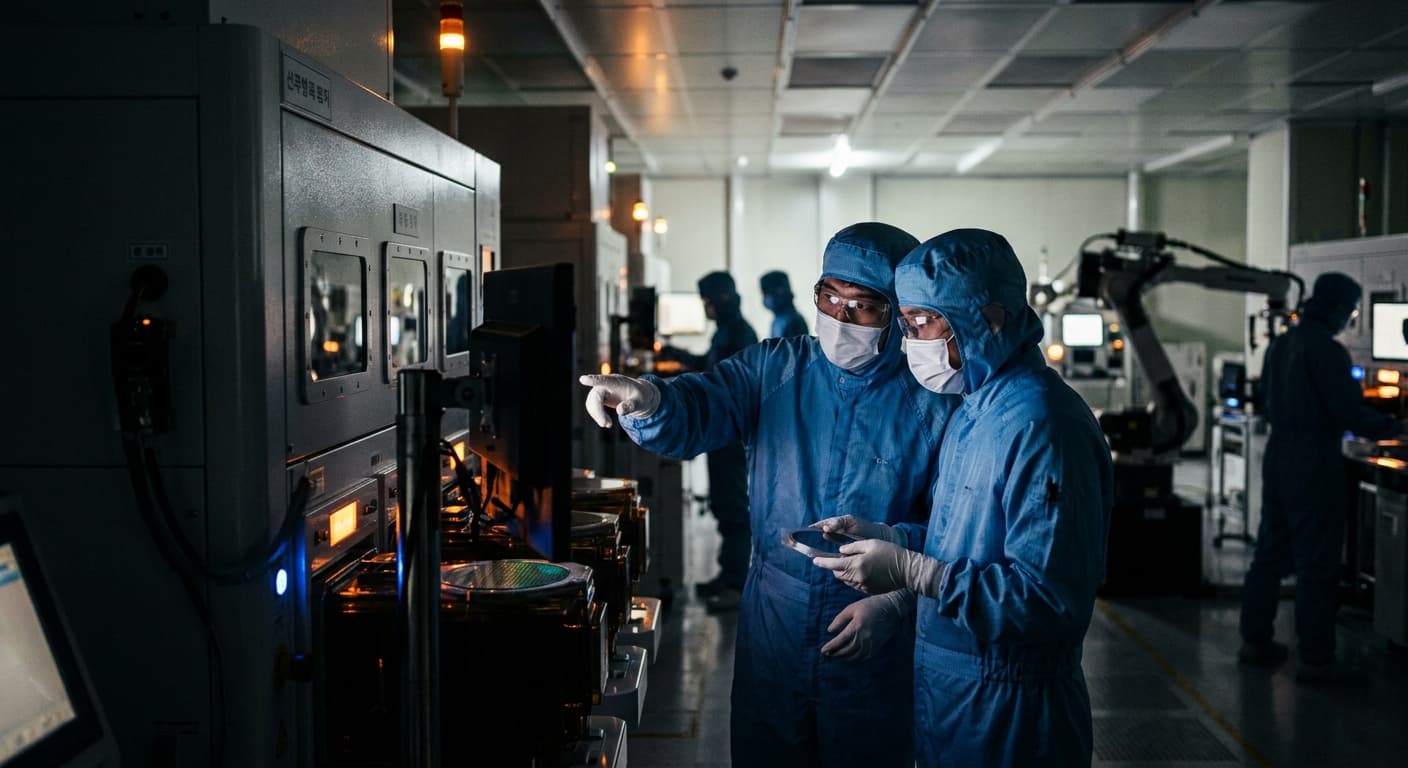
Samsung, SK Hynix Build a China-Free Chip Tool Buffer
Samsung and SK Hynix are quietly stripping Chinese suppliers from their fabs to pre-empt the next round of U.S. export controls — reshaping the memory supply chain.
Samsung Electronics and SK Hynix are engineering a "China-free" buffer inside their tool and component supply chains, a defensive redesign meant to survive the next tightening of U.S. export controls on the roughly 28% of world memory production that sits inside their Chinese fabs. The move — reported on July 7, 2026 by DigiTimes and corroborated across Korean trade press — is not a hedge. It is the operational tell that Seoul's two chip champions no longer believe Washington's licensing regime is durable, and that the political economy of memory is being redrawn around one assumption: the U.S. Bureau of Industry and Security (BIS) will keep escalating, and Chinese vendors will be the next tripwire.
That reframes what looks like a supply-chain story into a semiconductor-policy story. The angle the wires miss: the Korean firms are not merely diversifying — they are pricing U.S. controls as a permanent structural cost, and building a parallel non-Chinese bill of materials that lets them accept the loss of their China fabs without cascading damage to their global operations. That is a decision made by finance committees, not diplomats. And it tells you where the memory industry ends up in 2028.
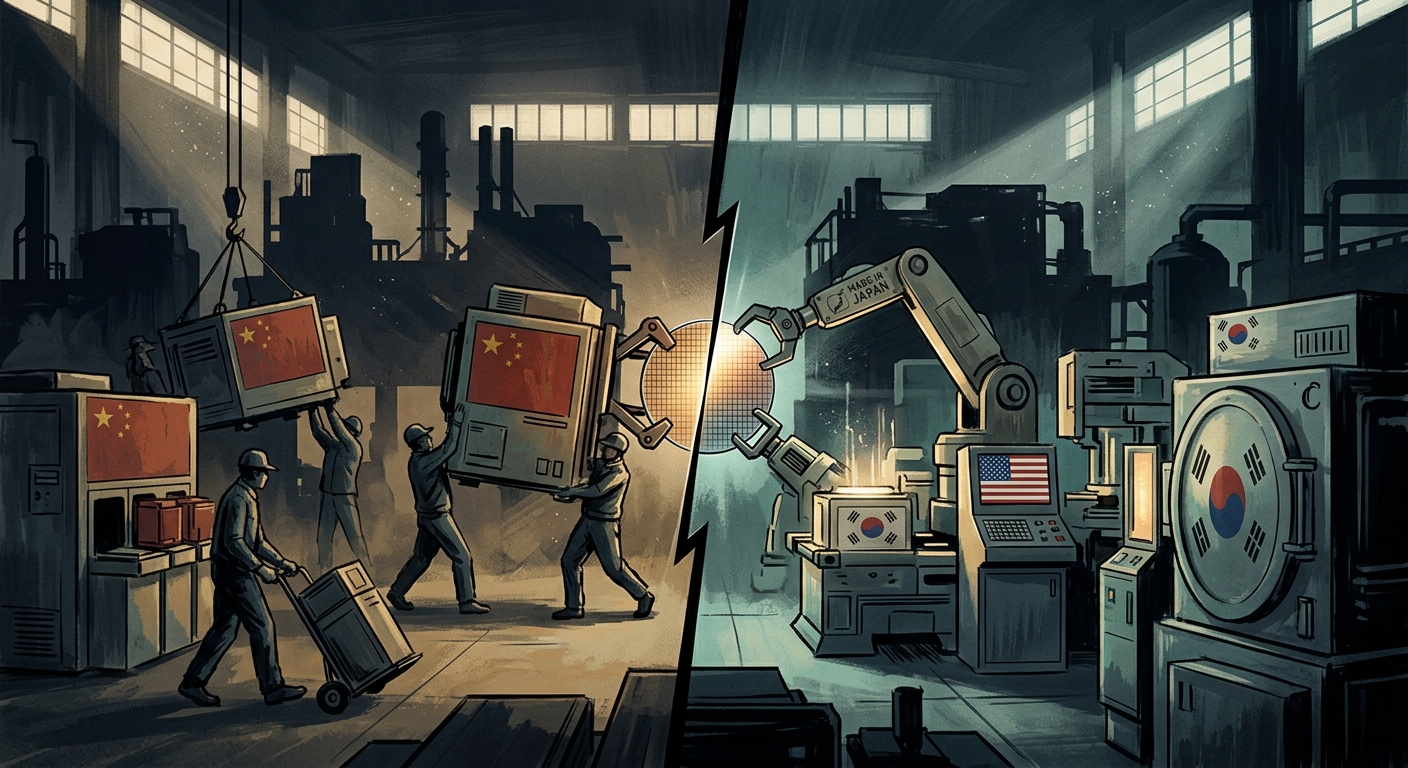
The ratchet that got us here
The specific trigger is documented. On September 2, 2025, BIS published a Federal Register notice — 90 FR 42321 — revoking the Validated End-User authorizations that had let Samsung's Xi'an fab and SK Hynix's Wuxi and Dalian sites import U.S.-origin chipmaking equipment without individual licenses. The Congressional Research Service confirms the effective date as December 31, 2025 in its primer on U.S. semiconductor export controls. Days later, BIS applied the same treatment to TSMC's Nanjing fab,
BBC News reported.
That was the demolition of a five-year policy compromise. Under the VEU framework — codified at 15 CFR Part 748, Supplement 7 — pre-approved facilities could receive controlled equipment on a class-license basis. Its revocation converts every tool shipment into a case-by-case licensing decision under BIS's end-use rules at
15 CFR 744.23, the regulation that governs advanced-node and semiconductor manufacturing equipment controls.
Washington did throw a lifeline. Reuters reported, via Big News Network, that BIS issued 2026 annual licenses in June covering the two Korean firms' shipments into their China plants. The licenses are, in the words of the officials briefing Reuters, "temporary." That is the operative word for the whole architecture.
Why "China-free" is not diversification — it is triage
The stakes are concentrated. According to a 2024 German Marshall Fund analysis, SK Hynix produces about 40% of its DRAM at Wuxi, which alone represents roughly 13% of global DRAM capacity; Samsung's Xi'an complex accounts for approximately 15% of world NAND. The 2023
PIIE Policy Brief 23-10 put the aggregate figure at about 40% of both firms' memory output originating in China.
That is the exposure the "China-free" buffer is meant to insulate. What Samsung and SK Hynix are doing, per Korean industry press summarized in this week's MOJO Trick report, is auditing the parts and subsystems inside their fab lines — everything from vacuum pumps to ancillary wet-process modules — and requalifying non-Chinese alternatives from Korean, Japanese, U.S. and European suppliers. The purpose is not to serve the China fabs. It is to make sure the rest of the two companies' global footprint — the Pyeongtaek and Icheon mega-fabs at home, the Texas complex Samsung is building with CHIPS Act support, and the packaging cluster near Seoul — cannot be dragged into a compliance blast radius if BIS adds a Chinese tool vendor to the Entity List.
The list of likely tripwires is not obscure. CSIS's November 2024 analysis of allied SME export controls names Naura, AMEC, and Shanghai Micro Electronics Equipment as the Chinese firms whose share of their domestic tool market has surged from roughly 10-15% before controls to 25-35% today. A follow-up CSIS piece from March 2026 finds that
Chinese equipment share reached 40% in etch and deposition, driven partly by Made in China 2025 procurement mandates that force domestic buyers toward local kit. That growth is precisely what would attract the next FDPR expansion.
The primary document Washington keeps waving
If you want to understand the corporate calculus, read the current text of the U.S. end-use rule. Section 744.23(a)(4) prohibits the export, reexport or in-country transfer of any Commerce Control List item that will be used in the "development or production" of covered SME by "an entity headquartered in, or whose ultimate parent is headquartered in" China. As the Cornell Legal Information Institute's e-CFR text makes clear, the rule reaches indirect exports — meaning a Korean fab that installs a Naura-made deposition chamber, then ships U.S.-controlled parts to service it, is potentially inside the perimeter.
That is why "China-free" is being written into requisition orders, not press releases. The GAO documented the reason in GAO-25-107386: its interviews with the industry found that companies with thousands of suppliers "struggled to make sure its suppliers understood what they were permitted to export, leading to supply chain disruptions." Removing Chinese vendors from the bill of materials is the only way to make the compliance perimeter self-executing.
Who wins
The immediate beneficiaries are not Korean. They are the three U.S. tool giants — Applied Materials, Lam Research and KLA — plus Japan's Tokyo Electron and, at the top of the stack, ASML. Every dollar of Korean fab capex that had been quietly leaking to Chinese SME suppliers at legacy nodes now flows back into the allied vendor base. CSIS notes that U.S. equipment makers' non-U.S. manufacturing footprints in Singapore and Malaysia — set up in part to route around export controls — position them to service the Korean shift without new capacity constraints.
The second winner is Micron. The Idaho DRAM maker is the direct competitor to Samsung and SK Hynix, and it has minimal China production exposure. As long as the Korean firms' Wuxi and Xi'an operations are technology-frozen — barred from upgrading to EUV-based 1a-generation DRAM by controls that remain in place per the Korea Institute for International Economic Policy's assessment — Micron faces a competitive tailwind it did not have to earn. The 2023 CSIS analysis of
Beijing's Micron ban warned against overreacting because the underlying trajectory already favored the U.S. player. It still does.
The third, and less obvious, winner is Seoul itself. On June 29, 2026, President Lee Jae Myung announced that Samsung and SK Hynix will commit 800 trillion won — about $518 billion, according to Al Jazeera — to build two new fabs each in South Jeolla, plus a $52 billion packaging cluster near Seoul.
The BBC framed the plan as a $1 trillion AI-and-chip investment when combined with data-center pledges from SK Group, GS and Naver. The "China-free" tool audit is the industrial-policy twin of that spend: it re-anchors the Korean memory supply chain around domestic capacity while giving Seoul the leverage to demand that Korean tool startups — Wonik IPS, Semes, Eugene Technology — be qualified into the Tier-1 fab lines they were previously locked out of.
Who loses
Chinese equipment makers are the direct casualty. Naura's revenue base has been built on the assumption that both domestic Chinese fabs and foreign-owned fabs on Chinese soil represent addressable demand. Removing the Korean and Taiwanese fabs from that market — even at legacy nodes — pushes Naura and AMEC back onto a purely domestic customer base at exactly the moment Beijing is asking them to scale.
The subtler loser is the U.S. export-control framework itself. The Council on Foreign Relations warned in January 2026 that the Trump administration's new AI chip rule — permitting Nvidia H200 and AMD MI325X shipments to China under conditions — is "strategically incoherent and unenforceable." That incoherence — tightening on tools while loosening on chips — is what Samsung and SK Hynix are pricing. They cannot trust that today's licenses survive tomorrow's negotiation. Al Jazeera's June 1, 2026 report that BIS
reaffirmed license requirements for Chinese-headquartered firms outside China was itself an admission that the loophole architecture is being patched in real time.
And there is a second-order loser worth naming: the multilateral coalition Washington built in 2022-23. The CSIS localization data show that controls, whatever their strategic merit, have accelerated Chinese domestic tool-vendor share from 15% to 35% in four years. Korean firms are now paying the compliance cost of a policy whose primary long-run effect has been to subsidize the very Chinese SME industry it was designed to strangle. That is not a Korean grievance the U.S. can easily dismiss.
Diplomat View
The evidence points to a specific forecast. Samsung and SK Hynix will not be operating meaningful advanced-node capacity in China by the end of 2028. The 2026 annual licenses will be renewed once — probably twice — but the direction of travel, from the VEU revocation through the FDPR expansion through the 744.23 end-use net, is unambiguous. Seoul's $518 billion domestic buildout is the exit ramp, not a supplement. The "China-free" tool audit is the load test. Expect Samsung to be first to formally announce a phased wind-down of Xi'an NAND capacity — most likely conditioned on the completion of the Taylor, Texas fab and the first South Jeolla site in 2027-28.
What would revise this call: a U.S.-China grand bargain on chips before the 2028 U.S. election that restores a durable VEU-style regime for Korean fabs; a Chinese decision to seize or fence in the Xi'an and Wuxi facilities in retaliation for the Korean shift; or a demonstration that domestic Chinese SME can service the Korean fabs at 20-nanometer-and-below memory nodes without tripping U.S. controls — currently technically implausible. Absent one of those, the "China-free" buffer is not a hedge. It is the first draft of the exit.
What to watch next
- Fourth-quarter 2026 BIS Entity List cycle. Naura, AMEC, or SMEE additions would immediately activate the buffer Samsung and SK Hynix are now building. Watch Federal Register notices in October and December.
- Samsung Q3 2026 earnings call, late October. First scheduled opportunity for management to disclose the capex allocation split between China maintenance and South Jeolla / Taylor buildout. A cut to China maintenance capex below 10% of segment total would confirm exit staging.
- SK Hynix U.S. share sale, targeted for late 2026.
Blocks & Files reported an intended raise of up to $36 billion. Prospectus disclosures on China-fab risk factors will be the clearest primary-source read on how the company privately assesses the license regime's durability.
The Bottom Line
Samsung and SK Hynix's "China-free" tool buffer is not diversification — it is the memory industry pricing in the permanent unreliability of U.S. export-control diplomacy, and quietly writing down the future of their Chinese fabs. The winners are Applied Materials, Lam, ASML, Micron and Seoul's industrial-policy planners; the loser is the multilateral coalition Washington needs if controls are to bite. When historians look for the moment the memory supply chain decoupled, they will point here, not to any BIS press release.
Discover more

US Politics
House Ethics Committee Pushes Sexual Miscond.
The House Ethics Committee has shifted responsibility for sexual harassment settlement records to the Office of Congressional Workplace Rights, complicating disclosure efforts.
US Politics
SNAP Food Assistance Faces Legal Challenges
In 2026, SNAP faces stricter eligibility rules and mounting legal challenges, threatening food assistance for the millions of Americans who rely on the program.

India
UN Expert Albanese: India Violates Law
UN Rapporteur Francesca Albanese accuses India of breaching international law, spotlighting human rights concerns in Kashmir and prompting diplomatic pushback.

Economics
Fed's Amex AML order puts correspondent banking on notice
Federal Reserve's Amex AML order requires board-level controls and a 90-day plan; OCC fined the bank $350 million over enterprise-wide deficiencies.