Sahel Insurgency: Juntas and Russia's Role
Exploring the Sahel's ongoing security crisis and insurgent victories.
Model Diplomat7 min readAfrica
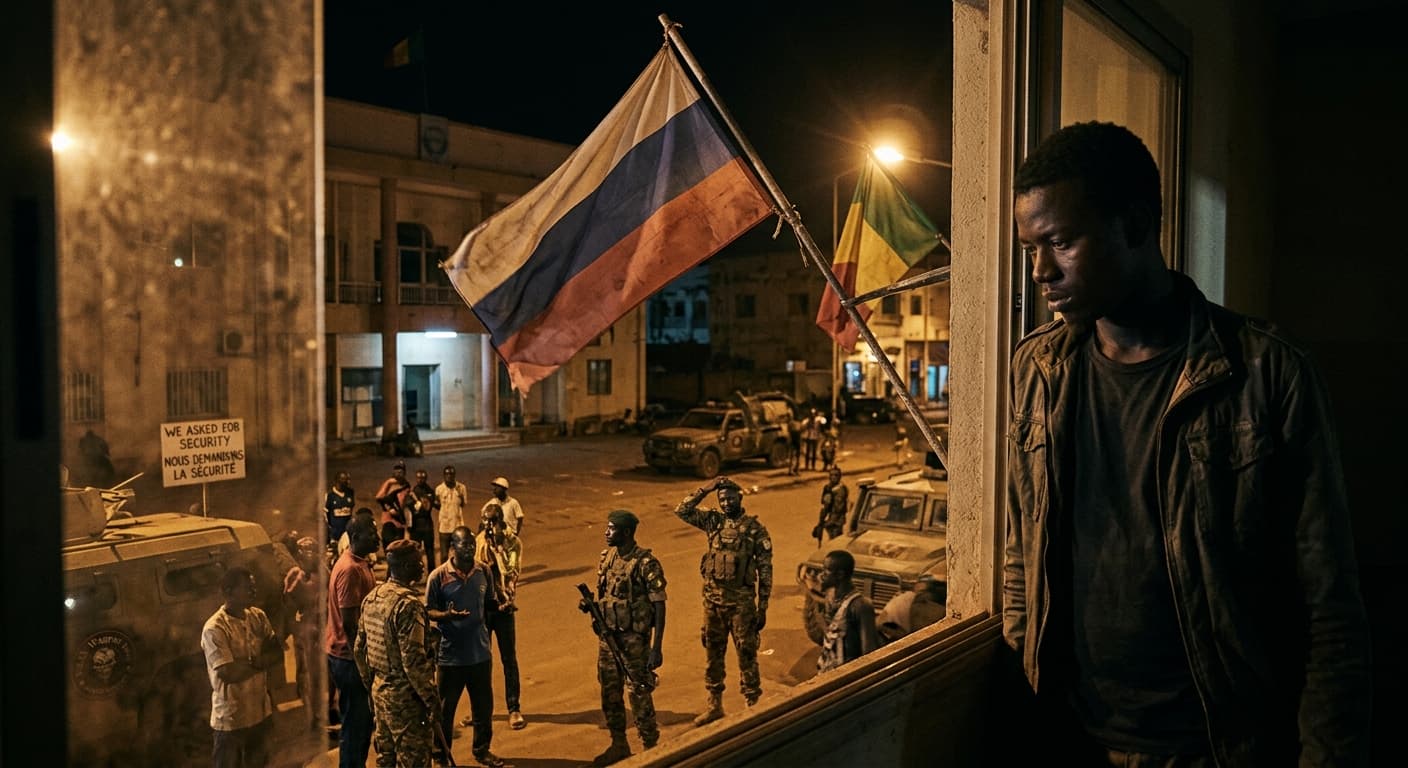
Why the Sahel Still Bleeds: Juntas, JNIM and the Russia Trap
A governance vacuum left by three coups, a failed pivot to Russian mercenaries, and a jihadist coalition mastering drone warfare explain why Sahel insurgents keep winning.
The Sahel now produces 51% of the world's terrorism deaths on 19% of its attacks — and the reason is not that JNIM has grown stronger, but that the states fighting it have hollowed themselves out. In the twelve months to July 8, 2026, the al-Qaeda affiliate Jama'at Nusrat al-Islam wal-Muslimin (JNIM) killed a defence minister, forced Russian mercenaries out of Kidal, blockaded Bamako's fuel supply, hit Niamey's airport twice, and last Saturday struck five Malian towns simultaneously. Each blow lands on juntas that seized power promising to defeat these very fighters — and then dismantled the diplomatic, human-rights and intelligence architecture that had been keeping them contained. The insurgency is not winning because it is invincible. It is winning because Mali, Burkina Faso and Niger chose sovereignty over capability, and Moscow has failed to fill the gap.
The July 4 offensive, and what it revealed
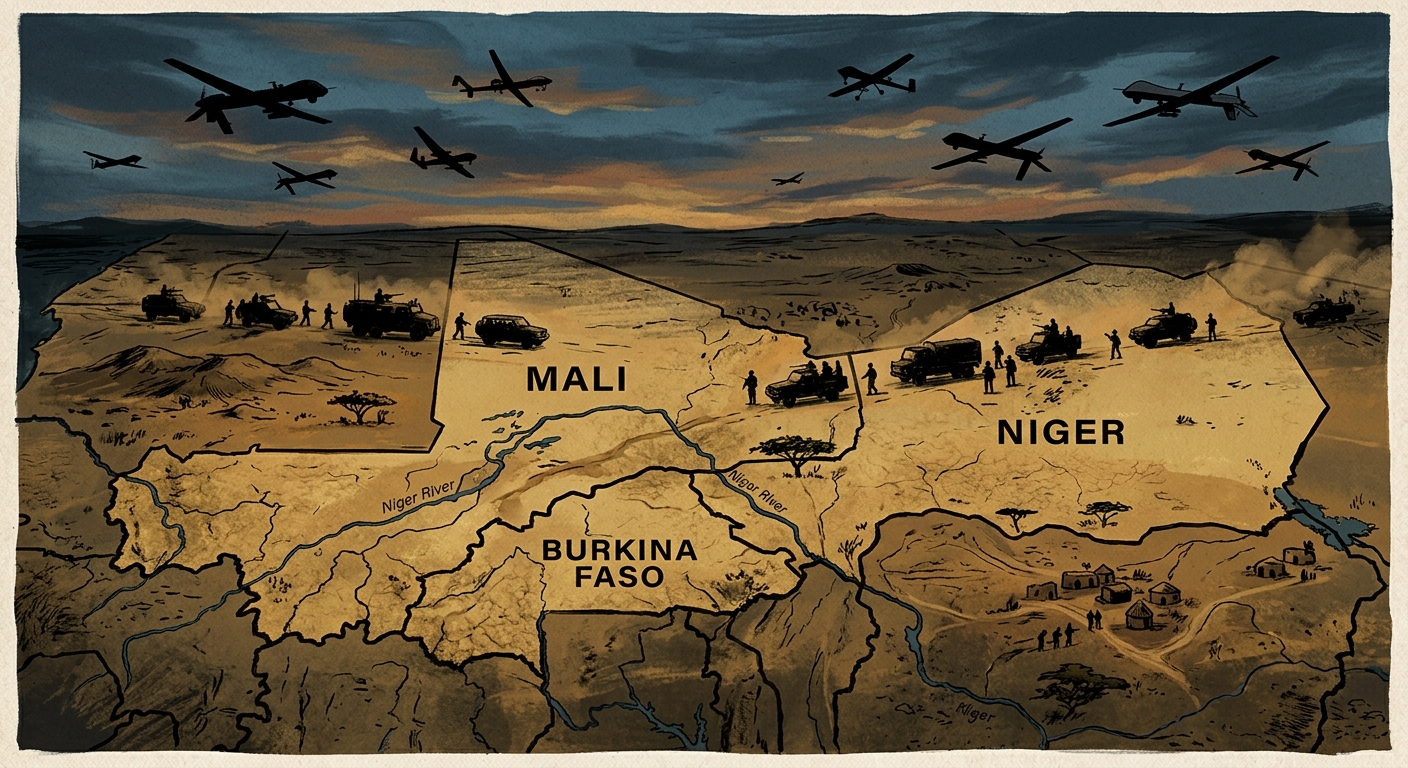
At around 5 a.m. on Saturday, July 4, 2026, coordinated attacks hit Aguelhok, Anefis and Gao in northern Mali, Sevare in the centre, and a major prison at Kenieroba, 74 km from Bamako, according to Al Jazeera. It was the second synchronized wave in ten weeks. The first, on April 25–26, killed Defence Minister Sadio Camara in a suicide truck-bombing on his residence in Kati and drove Russian Africa Corps mercenaries out of the strategic northern base of Kidal,
the BBC reported. Ulf Laessing of the Konrad Adenauer Foundation told the BBC the April operation was "the largest co-ordinated jihadist attack on Mali for years."
What the April and July waves demonstrated is not merely tactical audacity. It is the ideological pragmatism the Malian state's enemies have taught themselves. JNIM, which seeks a Sharia emirate, is now fighting alongside the Tuareg-led, secular-leaning Azawad Liberation Front (FLA). The Stimson Center's Kaitlyn Hashem describes the alliance as "a pragmatic alignment of interests: JNIM benefits from the local legitimacy and ethnic grounding of the Tuareg cause, while the FLA gains access to JNIM's superior military capabilities," in her Sahel analysis. She notes JNIM even issued a public statement urging Russian forces to stand aside in exchange for a non-aggression understanding — a page from Hayat Tahrir al-Sham's Syria playbook.
The governance choice that lit the fuse
Every serious dataset points at the same variable: the three coups. Mali (2020, 2021), Burkina Faso (2022) and Niger (2023) each seized power on the promise of restoring security. According to the Council on Foreign Relations, extremist violence has instead surged since. On January 29, 2025, the three formally exited the Economic Community of West African States (ECOWAS) to form the Alliance of Sahel States, a step
Al Jazeera documented as ending a half-century of West African integration norms.
The consequences are measurable. The CDD-West Africa Security Tracker recorded 12,964 fatalities across West Africa in the first half of 2025 alone — 96% of them concentrated in Nigeria, Burkina Faso, Mali and Niger. In Burkina Faso, JNIM claimed
more than 280 attacks in that period, double the same window in 2024, according to BBC Monitoring. The junta of Capt. Ibrahim Traoré now controls two of its country's 13 regions with any confidence, according to the Global Initiative Against Transnational Organized Crime.
The junta model has failed on its own terms for a specific reason: it destroyed the intelligence and legitimacy infrastructure that counter-insurgency requires. UN Secretary-General António Guterres told the Security Council on November 18, 2025 that armed groups have driven 4 million people from their homes, closed 14,800 schools and 900 health facilities, and that the region "accounts for over half of global terrorism-related casualties." Where the state pulls back, JNIM offers courts, dispute resolution and — perversely — protection.
The worst compounding factor is what soldiers do to civilians. GI-TOC data cited by the BBC found the Malian army and its Russian allies caused 1,486 civilian casualties between January 2024 and March 2025 — more than the jihadists they were fighting. ACLED senior analyst Heni Nsaibia told Al Jazeera that in Mali "the army was more likely to attack civilians." Every reprisal against Fulani villages is a recruitment poster for JNIM. This is the mechanism — not ideology alone — by which insurgencies self-perpetuate.
Russia's Sahel bet is unravelling
The external-influence half of the equation runs through Moscow. When France withdrew Operation Barkhane in August 2022, some 4,000 French soldiers were replaced by roughly 1,500 to 2,500 Russian mercenaries — first Wagner, now the Kremlin-controlled Africa Corps — according to CFR's Ebenezer Obadare. The trade, as the University of Copenhagen's Sorcha MacLeod told
BBC Verify, was "security services in exchange for payments and access to valuable natural resources" — chiefly gold from Mali's Loulo–Gounkoto complex and its projected place as Africa's second-largest lithium producer.
That bet has now been tested and found wanting. On April 28, 2026, Africa Corps confirmed it had abandoned Kidal alongside Malian troops; rebels then filmed themselves roaming the base, according to the BBC. Russian air strikes near Kati saved the presidential palace but could not prevent Camara's assassination. "Russia will struggle to attract new clients for the Africa Corps because they just didn't do their job — it's reputational damage," Laessing told
Al Jazeera. By July 7, Moscow was resupplying Bamako by naval shipment — a public admission that its Sahel deployment cannot sustain itself.
The technology gap is closing in the wrong direction. Analysis by Morocco's Policy Center for the New South, based on nearly 3,000 ACLED-tracked JNIM events, documents that the group has added a new drone capability every two to three months since 2024 — from captured government UAVs to suicide FPVs to glide munitions and jamming-resistant systems. Drones now feature in roughly 40% of JNIM operations. On January 29, 2026, IS-Sahel Province used drones in direct combat for the first time when it struck Diori Hamani airport in Niamey, according to the
South African Institute of International Affairs. On June 18, 2026, JNIM hit the same airport, killing
35 people including 11 soldiers.
The African Union's absent middle
Between failed Western counter-terrorism and failing Russian mercenary support lies a third actor that has largely gone missing: the African Union. The AU's own MISAHEL mission has had no High Representative since August 2023, the Institute for Security Studies notes. When Algeria and Mali fell into a diplomatic crisis this spring — with Niger and Burkina Faso recalling ambassadors from Algiers in solidarity — no continental body was positioned to mediate.
The AES's answer is a 6,000-strong Unified Force, launched in Niamey in December 2025, funded through a 0.5% import levy the three states agreed on March 28, 2025, according to ISS Africa. It is the third attempt at a joint Sahel force after the Multinational Joint Task Force (2017) and the G5 Sahel (2017–2023), both of which collapsed. What makes the AES version different is its explicit rejection of Western oversight; what makes it likely to fail is the same thing. Cross-border coordination with Nigeria, Côte d'Ivoire, Ghana and Benin — the coastal states now absorbing the spillover — is politically forbidden by the AES's own posture.
Meanwhile, humanitarian systems are collapsing. The UN Office for the Coordination of Humanitarian Affairs said on June 3, 2026 that 24.3 million people across the Sahel need urgent aid, that Mali's humanitarian response plan is "only 16 per cent fulfilled," and that regional funding has "collapsed to its lowest level in a decade." Aid retreat, in this context, is a security event: it removes the last state-adjacent actors capable of reaching contested territory.
Forward look
Three catalysts to watch:
- Bamako's fuel siege. JNIM's blockade of the Sikasso–Kayes–Bamako corridor has choked the capital since September 2025. If a full breakdown of supply occurs before the November rainy-season demobilisation, the junta faces its first genuine urban crisis.
- AES Unified Force first combat deployment, expected in the Liptako-Gourma tri-border area in late 2026. A defeat here would end the junta model's military credibility.
- AU Peace and Security Council session on the Algeria–AES rift. The AU's new commission chair Mahmoud Ali Youssouf has an opening ISS Africa has publicly urged him to seize. Silence past September would confirm the AU's Sahel irrelevance.
Diplomat View
The mainstream narrative — that jihadists are winning because the Sahel is poor, dry and young — is descriptively true and analytically useless. The forecast here is sharper: the AES juntas' security model will not survive 2027 in its current form, and the trigger will be either a JNIM territorial administration inside a regional capital or a Russian withdrawal negotiated to save face after another Kidal-style collapse. What would change the forecast: a credible African Union–brokered reopening to ECOWAS coastal states for intelligence-sharing, a functioning AES Unified Force cross-border operation, or a Russian troop injection above 5,000 with air assets. Absent one of those, the trajectory points toward a partitioned Mali — a functional Bamako rump under Russian air cover, a JNIM-influenced central belt, and an FLA-administered Azawad. Coastal West Africa should plan on that basis, not on the AES's rhetoric of imminent victory.
The Bottom Line
The Sahel's deadly insurgency persists not because JNIM is uniquely lethal, but because three juntas dismantled the diplomatic, judicial and intelligence scaffolding that had contained it — and because their Russian replacement force cannot fight the war it was paid to fight. Until the Alliance of Sahel States chooses cooperation over sovereignty theatre, or the African Union reclaims the mediating role it vacated in 2023, the region's civilians will keep paying the price of a governance experiment that promised security and delivered siege.
Discover more
Human Rights
Balochistan Crackdown and UN Findings
Pakistan's Balochistan faces a UN report citing 18,000 disappearances, revealing a failing containment strategy amid rising insurgency.
Global
Nigeria Senate Moves to End Boko Haram Rehab
Nigeria's Senate calls for the end of Operation Safe Corridor, jeopardizing the rehabilitation of over 124,000 Boko Haram defectors amid rising Sahel insurgency.
Conflict & Security
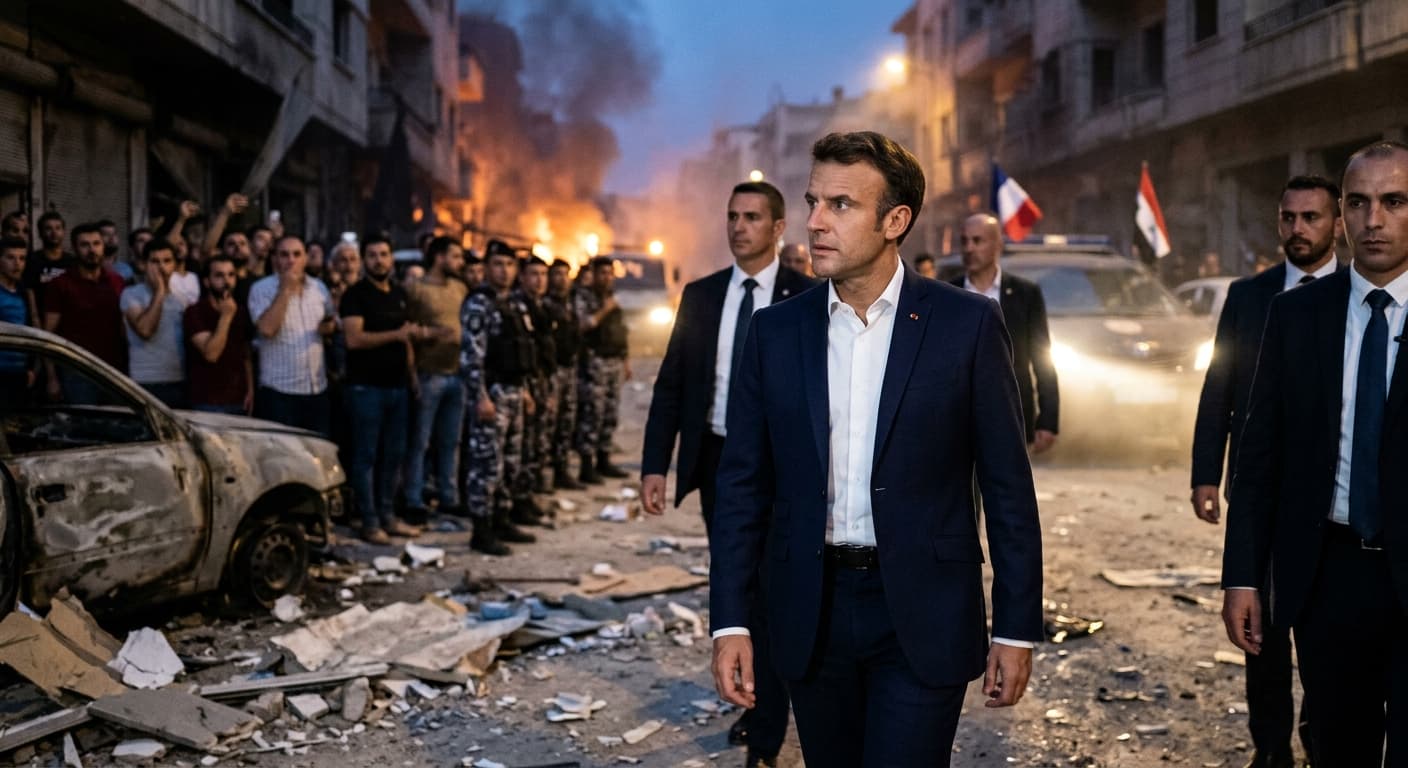
Macron's France-Syria Reset Amid Blasts
Despite twin bombings in Damascus, Macron's visit underscores France's commitment to Syria's reconstruction and energy routes.
Global
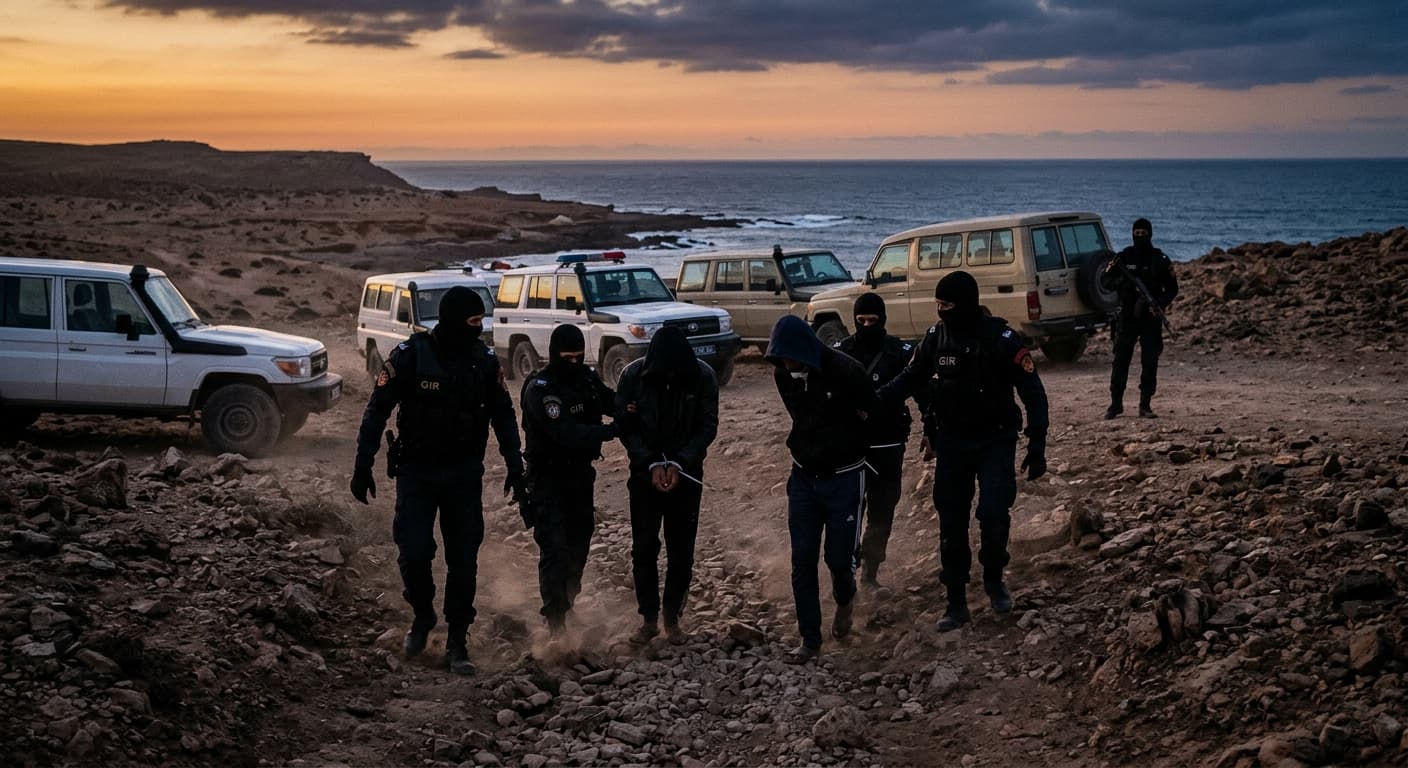
Morocco's ISSP Bust Signals Sahel Insurgency
Morocco arrests 10 ISSP recruits, indicating the Sahel insurgency has expanded to the Atlantic, reshaping counterterrorism strategies.